
 Physics
Textbook
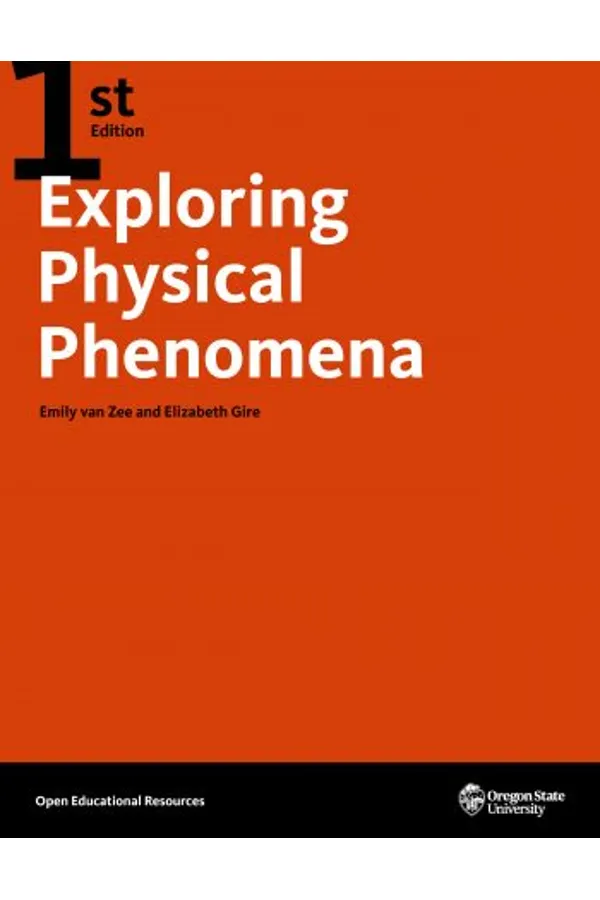
Exploring Physical Phenomena : What happens when light from the Sun shines on the Earth?
Not rated yetRate this bookExploring Physical Phenomena by Emily van Zee and Elizabeth Gire asks what happens when sunlight reaches Earth. This guide follows its five inquiry-based units, connecting light, thermal processes, weather, climate, and the Sun–Earth–Moon system with evidence, explanation, and science teaching.
Free reading is available at the official source. Opens in a new tab.
 Free
About this book
Exploring Physical Phenomena by Emily van Zee and Elizabeth Gire asks what happens when sunlight reaches Earth. This guide follows its five inquiry-based units, connecting light, thermal processes, weather, climate, and the Sun–Earth–Moon system with evidence, explanation, and science teaching.
How to study this book
Begin with a prediction and record what would count as evidence before considering an explanation. Keep observations separate from interpretations and revise models when results conflict with expectations. Use the source’s handouts, discussion, mathematical work, and teaching reflections together. Practical activities require appropriate instruction and precautions.
Chapter-wise explanations and study tasks
Unit 1: Light — Initial Ideas and Evidence
The first investigations draw out prior ideas and use observable patterns to develop central claims about light. Pinhole phenomena make the relationship among source, opening, and image especially important. A prediction is useful when it can be compared with an actual observation.
Study task: Sketch a predicted pinhole image and explain what observation would challenge your initial model.
Unit 1: Light — Mathematical Models
The unit develops mathematical representations and uses them to estimate a quantity. Relate the variables to the physical arrangement before substituting values. A useful model must explain why changing a distance or size affects the observed pattern.
Study task: Draw and label a source–pinhole–screen geometry and derive a proportional relationship before checking it against source data.
Unit 1: Light — Extended Ideas and Teaching
Further evidence and historical perspectives broaden the model beyond the first activity. Teaching connections ask how learners develop and justify ideas. Distinguish a persuasive explanation from an assertion that a recognized scientific name makes it true.
Study task: Design a discussion prompt that asks learners to connect a specific observation with a light model.
Unit 2: Thermal Phenomena — Sensation and Measurement
Objects that feel different may have similar measured temperatures. This distinction opens questions about transfer and material properties. Use measurement to examine prior expectations rather than rejecting an unexpected result simply because it conflicts with touch.
Study task: Compare a prediction based on touch with a fictional temperature dataset and explain what the difference suggests.
Unit 2: Thermal Phenomena — Representations
The unit builds central ideas and mathematical relationships for thermal processes. Quantities such as temperature change and energy transfer play different roles. Interpret the model’s assumptions and variables before treating an equation as a universal rule.
Study task: Explain the variables and assumptions in a source thermal relationship and check the dimensions of a worked estimate.
Unit 2: Thermal Phenomena — Explanation and Transfer
Applying ideas to a new situation tests understanding beyond a familiar demonstration. The friend-or-family exploration and teaching reflection require listening to another person’s reasoning. Revise the explanation in response to evidence and questions.
Study task: Plan a safe, instructor-approved conceptual demonstration and prepare questions that reveal another learner’s starting explanation.
Unit 3: Local Weather — Developing Central Ideas
Light and thermal processes contribute to changes in air, water, and surface conditions. The investigations connect prior units with evidence about local weather. Avoid jumping from a temperature difference to a complete atmospheric explanation.
Study task: Create a concept map connecting surface heating with a local-weather question and identify the observations needed at each step.
Unit 3: Local Weather — Beach Explanations
The beach context links different responses of land and water with patterns in the surrounding air. Use a sequence of mechanisms rather than a memorized label. Distinguish a schematic model from the complexity of actual weather conditions.
Study task: Draw a labelled explanatory sequence for a source-described beach phenomenon and state one simplifying assumption.
Unit 3: Local Weather — Quantification and Teaching
Mathematical estimates provide a way to test whether an explanation is plausible in scale. The teaching connections also ask how students use evidence and representations. A reasonable numerical result still needs a clear interpretation.
Study task: Complete a source-based estimate with units and explain how its scale supports or challenges the proposed mechanism.
Unit 4: Global Climate — Greenhouse Explanation
The climate unit integrates light and thermal ideas to explain the greenhouse effect. Track the relevant energy transfers and distinguish different kinds of radiation. A model should show how the components interact rather than treating the atmosphere as a simple solid lid.
Study task: Create an energy-transfer diagram from the source and explain two mechanisms that a lid analogy conceals.
Unit 4: Global Climate — Evidence and Impacts
The unit examines evidence of climate change and uses central ideas to consider consequences. Separate observations, inferred mechanisms, model projections, and value-based decisions. Different claims may be supported by different kinds of evidence.
Study task: Classify four source statements as observation, explanation, projection, or response proposal and identify the supporting evidence for each.
Unit 4: Global Climate — Change and Action
Representations of changing quantities connect rates and accumulated effects. Action resources introduce questions about scale, responsibility, and evidence. Treat dated external links and policy references separately from the physical reasoning.
Study task: Interpret a source graph of change, then evaluate one proposed response using mechanism, scale, evidence, and limitations.
Unit 5: Astronomy — Observing Patterns
Observations of the Sun and Moon provide a starting point for models of their apparent movement. Record time, location, and viewing conditions consistently. Prior expectations, such as assuming the Moon appears only at night, should be tested against evidence.
Study task: Design an observation log for apparent sky patterns using safe viewing methods and explain how it would challenge one starting assumption.
Unit 5: Astronomy — Day, Night, and Moon Phases
The unit compares explanatory models and develops a geometry for lunar phases. Distinguish a model that reproduces an observation from evidence that uniquely selects it. Moon phase and lunar eclipse involve different spatial relationships.
Study task: Use diagrams to explain phase changes and contrast them with an eclipse, identifying the role of the observer.
Unit 5: Astronomy — Seasons and Quantities
Seasonal constellations, Earth’s seasons, tilt, and scale estimates connect observations across longer periods. A mechanism should account for several related patterns rather than one familiar fact. Use the mathematical work to test an explanation’s consistency.
Study task: Draw a seasonal model and explain how it addresses daylight duration and illumination without using changing Earth–Sun distance as the sole cause.
Handouts, Schedule, and Teaching Resources
Handouts and sample schedules support the inquiry process rather than add a sixth content unit. Equipment and remote-learning suggestions require adaptation to the actual setting. Use them to plan evidence gathering, discussion, and reflection.
Study task: Create a short learning sequence containing prediction, evidence, discussion, model revision, and reflection, listing required resources and access limits.
Applied assignment
Develop an evidence-based teaching sequence on one sunlight-related phenomenon. Include initial learner ideas, a prediction, observations or supplied data, a diagrammatic model, a mathematical estimate, and a revision prompt. Explain the model’s limitations and how learners will justify their conclusions.
Suggested reading plan
Study Unit 1 before using its light ideas in later units, then Unit 2 for thermal reasoning. Integrate them in Unit 3’s local weather and Unit 4’s climate explanations. Use Unit 5 for longer observational sequences, with the handouts and suggested schedule as adaptable planning supports.
Questions for reflection
- Which observation supports each part of the explanation?
- What would distinguish two models that predict the same initial result?
- How can a teacher respond productively to an unexpected observation?
Edition and source notes
Based on the linked Oregon State University source, listed as 2020 in the library. It contains five substantial units plus handouts and teaching resources. These original study prompts are organized within those units; they do not replace equipment instructions or supervision. Never view the Sun directly or through an optical device without appropriate certified solar-viewing arrangements.
About access & copyright
This page provides book information and study material. Full-text access is provided by the original publisher or authorised source; a listing does not grant permission to republish the book.
Read our Library Access & Copyright policyExplore the contents
Check the chapters covered in this edition.
Visit the official source
See reading, preview or purchase options.
Save for later
Keep this textbook in your saved collection.
Reader ratings & reviews
Share your thoughts
Your review helps other students choose the right resources.
KEEP LEARNING
Your next great read
Physics Engineering
Introduction to Electricity, Magnetism, and Circuits
View Introduction to Electricity, Magnetism, and Circuits — book Calculus
-Based Physics II
View Calculus-Based Physics II — book Calculus
-Based Physics I
View Calculus-Based Physics I — bookUniversity Physics, Volume 3 (OpenStax)
University Physics, Volume 3 (OpenStax)
View University Physics, Volume 3 (OpenStax) — bookUniversity Physics, Volume 2 (OpenStax)
University Physics, Volume 2 (OpenStax)
View University Physics, Volume 2 (OpenStax) — bookUniversity Physics, Volume 1 (OpenStax)
University Physics, Volume 1 (OpenStax)
View University Physics, Volume 1 (OpenStax) — book Classical mechanics
Principles of Mechanics
View Principles of Mechanics — book accelerators
Detectors in Particle Physics
View Detectors in Particle Physics — book Natural Sciences



