
Beginning in Algebraic Geometry
Affordable water tariffsTextbook
The Economics of Water
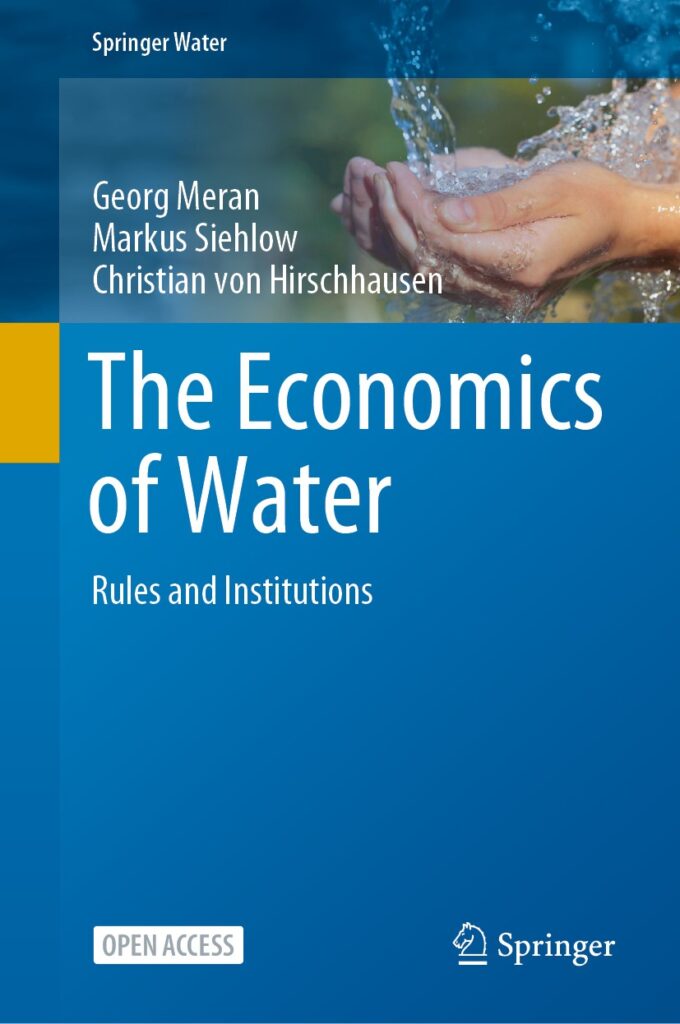
Not rated yetRate this bookThe Economics of Water connects hydrological constraints with the rules and institutions governing water use. Georg Meran, Markus Siehlow and Christian von Hirschhausen develop integrated management, tariffs, markets and transboundary allocation through economic models and case studies. This six-chapter guide explains the reasoning, assumptions and policy questions of the 2021 textbook.
Free reading is available at the official source. Opens in a new tab.
 Free
About this book
The Economics of Water connects hydrological constraints with the rules and institutions governing water use. Georg Meran, Markus Siehlow and Christian von Hirschhausen develop integrated management, tariffs, markets and transboundary allocation through economic models and case studies. This six-chapter guide explains the reasoning, assumptions and policy questions of the 2021 textbook.
How to use this book
The book is suited to advanced undergraduate or graduate study in economics, engineering and water management. Review basic optimization and economic reasoning as needed. For every model, write the objective, decision variables, constraints and institutional assumptions before interpreting its solution. Preserve the distinction between a physical allocation, a monetary benefit and a policy judgement.
Chapter-wise explanations and study tasks
Chapter 1: Introduction
The opening chapter frames water scarcity as a combined physical, economic and institutional problem. Hydrology determines flows and storage, while rules determine who can use water and under what conditions. The authors link these perspectives rather than assuming that an allocation formula alone resolves management. Their approach also makes distribution and ethical priorities visible. Read the introduction to identify the book's scope, methods and explicit limits. Separate a descriptive account of an existing system from a normative claim about how water ought to be shared, and identify the evidence required for each.
Study task: Choose a water-allocation dispute and list a hydrological constraint, an economic question and an institutional question. Explain why none can be answered completely in isolation.
Chapter 2: Water Availability: A Hydrological View
This chapter introduces the water cycle and the distinction between large global stocks and the smaller flows available for particular uses. Precipitation, interception and evapotranspiration affect how water moves through a landscape; human activities can alter those relationships. The authors develop a dynamic hydro-economic model to show why current use must be considered alongside changes in storage and future availability. Do not interpret a global average as the amount reliably available at a specific place and time. A usable water balance requires a defined geographical boundary and period, with inflows, outflows and storage accounted for consistently.
Study task: Construct a simple annual water balance for an illustrative catchment. Label inflows, uses, losses and the change in storage, then explain what seasonal variation the annual total conceals.
Chapter 3: Integrated Water Resource Management: Principles and Applications
The largest chapter develops integrated management through models that connect water use, hydrology and social objectives. The economic value of water depends on the decision context and the welfare criterion being applied. Efficiency, basic needs and distribution are therefore not interchangeable objectives. The chapter extends its framework to recycling, groundwater, water quality, eco-hydrology, river allocation and transfers between watersheds. Follow each model by identifying decision variables, constraints and the outcome being optimized. A solution is conditional on those choices. Compare alternative welfare assumptions before treating a calculated allocation as the uniquely correct policy.
Study task: Allocate an illustrative limited supply between two uses under two different stated priorities. Explain how a minimum basic-needs constraint could change the efficient solution.
Chapter 4: Water Tariffs
Water tariffs must reconcile resource-use incentives, financial viability, ecological aims and social concerns. The chapter compares structures such as single-part, two-part and increasing-block tariffs and considers rationing as another management instrument. Fixed and volumetric components influence users differently, so examine both the total bill and the marginal price attached to additional consumption. A tariff designed to recover costs can have uneven effects across households with different needs or circumstances. Increasing blocks should be evaluated against explicit objectives rather than assumed equitable by their shape alone. Connect a proposed tariff with supply conditions and the institutional capacity needed to implement it.
Study task: Using clearly invented rates, compare bills under a flat volumetric tariff and a two-part tariff for low and high consumption. Discuss cost recovery and affordability separately.
Chapter 5: Water Markets
Markets for water require defined entitlements, workable institutions and a physical system that permits the intended transfers. The authors develop a river-basin model, compare pricing arrangements and discuss the Murray–Darling experience. Water location and hydrological links matter: moving an allocation on paper may affect other users or require infrastructure. Distinguish the enduring entitlement from the quantity allocated under current conditions. Examine who can participate and how third-party consequences are handled. The central question is not simply whether trading occurs, but whether the market's design fits the basin and the objectives it is supposed to serve.
Study task: Trace a hypothetical transfer between two basin users. Identify an entitlement question, a delivery constraint and a possible effect on a third party.
Chapter 6: Transboundary Water Resource Management
Shared river basins introduce strategic interaction because decisions in one jurisdiction affect users in another. The chapter considers agreements, principles, cooperative and noncooperative models, benefit sharing and allocation rules under shortage. It extends a two-riparian framework to larger groups and uses the Nile and Euphrates as case studies. Sharing water volumes and sharing benefits are different approaches: cooperation may create opportunities that a fixed-volume negotiation misses. Compare an agreement with the incentives and information needed to sustain it. Treat the case discussions as the book's historical analysis rather than as a statement of current treaty developments.
Study task: Build a two-country example in which cooperation increases total benefits. Explain how those benefits might be shared so that both parties prefer cooperation to their stated alternative.
Applied study assignment
Prepare an illustrative basin-policy comparison with a defined supply, users and stated objectives. Compare a management rule, a tariff option and a cooperation arrangement. Use invented quantities only when clearly labeled as assumptions. Explain distributional effects and identify information you would require before making a real policy recommendation. Discuss how drought or changed demand would test the arrangement.
Suggested study plan
- Read Chapters 1–2 and describe a basin through a consistent water balance and management boundary.
- Work slowly through Chapter 3, comparing how different objectives change the interpretation of an allocation.
- Read Chapters 4–5 together and distinguish service tariffs from trading arrangements and entitlements.
- Use Chapter 6 to assess cooperation, benefit sharing and shortage rules, then revisit the assumptions of your original basin example.
Questions for deeper understanding
- When can a physically feasible allocation be economically inefficient or socially unacceptable?
- Which tariff objectives are aligned and which may conflict?
- Why do water-market transactions require hydrological and institutional safeguards?
- What is gained by negotiating benefits rather than only fixed water volumes?
Edition and source coverage
Source edition: Georg Meran, Markus Siehlow and Christian von Hirschhausen, Springer, 2021, DOI 10.1007/978-3-030-48485-9. This original study companion follows the verified chapter sequence and the chapter descriptions, abstracts and learning material on the official publisher's book page and linked open-access chapters. The explanations synthesize the main concepts and add original study tasks; they do not reproduce exercise solutions or claim to cover every derivation, dataset or case example. Consult the full chapters for detailed methods, evidence, figures and references.
About access & copyright
This page provides book information and study material. Full-text access is provided by the original publisher or authorised source; a listing does not grant permission to republish the book.
Read our Library Access & Copyright policyExplore the contents
Check the chapters covered in this edition.
Visit the official source
See reading, preview or purchase options.
Save for later
Keep this textbook in your saved collection.
Reader ratings & reviews
Share your thoughts
Your review helps other students choose the right resources.



