
Environmental Toxicology
ChemistryTextbook
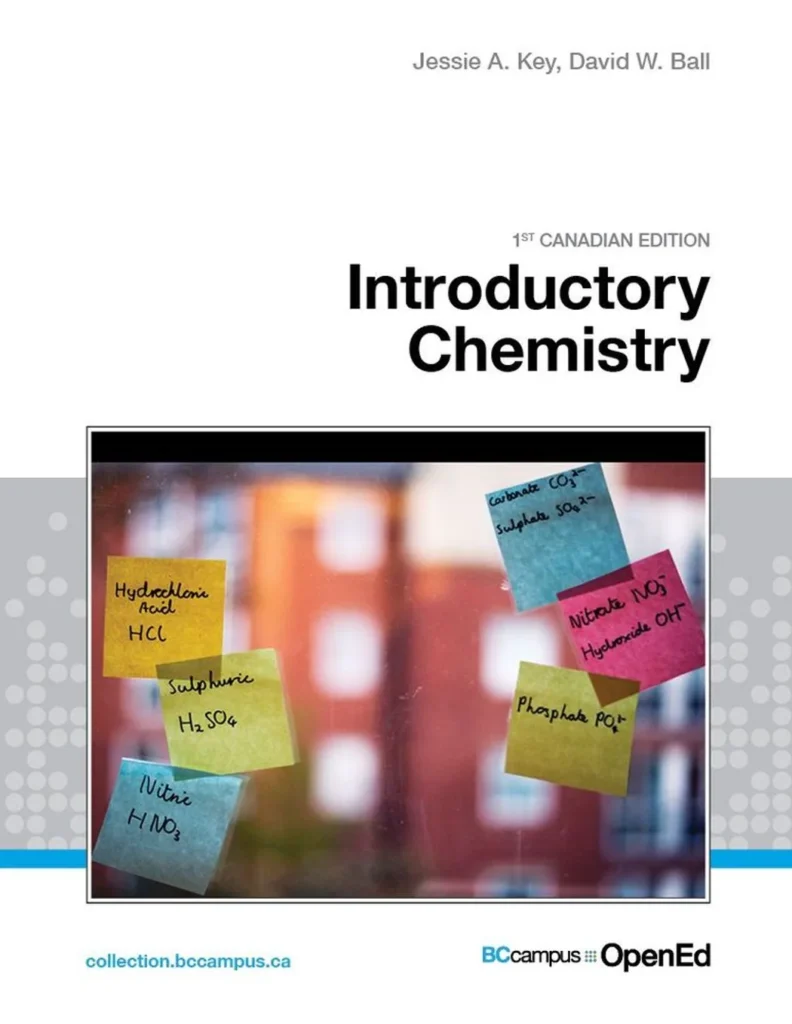
Introductory Chemistry, 1st Canadian Edition [Clone]
Not rated yetRate this bookIntroductory Chemistry, 1st Canadian Edition [Clone] follows an eighteen-chapter course in chemical reasoning, from matter and measurement to reactions, bonding, solutions, equilibrium, organic chemistry, kinetics, and thermodynamics. The linked adaptation credits David W. Ball and Jessie A. Key. This guide follows its actual contents, including the added kinetics and chemical-thermodynamics chapters, and emphasizes particle models, quantitative accounting, and the conditions under which chemical rules apply.
Free reading is available at the official source. Opens in a new tab.
 Free
About this book
Introductory Chemistry, 1st Canadian Edition [Clone] follows an eighteen-chapter course in chemical reasoning, from matter and measurement to reactions, bonding, solutions, equilibrium, organic chemistry, kinetics, and thermodynamics. The linked adaptation credits David W. Ball and Jessie A. Key. This guide follows its actual contents, including the added kinetics and chemical-thermodynamics chapters, and emphasizes particle models, quantitative accounting, and the conditions under which chemical rules apply.
Chapter-wise summaries and study tasks
I. Chapter 1. What is Chemistry
The opening chapter defines chemistry through matter, properties, and transformations, then connects those definitions with scientific investigation. Physical descriptions concern measurable characteristics without necessarily changing identity; chemical descriptions concern composition and possible transformations. Elements, compounds, and mixtures organize samples by what they contain and how their components relate. Scientific explanations depend on observations and testable reasoning rather than a name alone.
A useful starting habit is to separate the evidence available from the conclusion drawn. A uniform-looking material might be a pure substance or a homogeneous mixture, and a visible change may require additional investigation before its cause is established. Chemistry links macroscopic observations with a model of particles and interactions.
Study task. Classify several hypothetical materials using stated evidence rather than appearance alone. Design an observation that could distinguish a mixture from a compound and explain what uncertainty would remain.
II. Chapter 2. Measurements
Chemical measurement requires both numerical values and units. Scientific notation supports comparisons across very large or small scales, while significant figures express the precision justified by an observation. Unit conversions use equivalent quantities to change the representation without changing the physical amount. Temperature scales require attention to offsets as well as interval size, so they cannot all be converted through one simple multiplicative factor. Density links mass and volume under specified conditions.
Calculations should preserve suitable intermediate precision and report a final result with defensible units and digits. A dimensional check and an order-of-magnitude estimate provide independent safeguards against misplaced factors or a conversion performed in the wrong direction.
Study task. Convert a mass–volume measurement into density with justified significant figures. Compare a temperature conversion with a length conversion and explain why their mathematical forms differ.
III. Chapter 3. Atoms, Molecules, and Ions
Atoms, molecules, and ions connect chemical identity with composition and charge. Atomic theory and isotopic masses explain why periodic-table mass values need not be whole numbers. Ions form through changes in electron count rather than a change in elemental identity. Ionic formulas reflect charge-balanced ratios, while molecular formulas describe discrete combinations whose names follow different conventions. The source also introduces acid nomenclature within this chapter.
Read a chemical symbol with separate attention to proton number, isotope information, and charge. A subscript inside a formula changes composition, whereas a coefficient counts complete entities. These distinctions support later reaction balancing and mole calculations, where treating every number attached to a symbol as the same kind of quantity produces errors.
Study task. Translate a mixed set of ion, ionic-compound, molecular, and acid names into formulas. Explain one charge-balance step and calculate the mass of a formula unit using the appropriate atomic masses.
IV. Chapter 4. Chemical Reactions and Equations
Chemical equations describe changes in composition while conserving atoms and charge. Coefficients balance the equation without altering formula subscripts. Combination, decomposition, combustion, displacement, neutralization, and oxidation–reduction classifications emphasize different reaction features rather than one interchangeable naming system. Ionic equations help identify the species actually changing in an aqueous reaction and separate spectators from participants.
Symbols should be linked with phases and chemical context. A balanced equation provides necessary accounting but does not alone establish reaction speed, completeness, or whether the proposed conditions are suitable. Classification is useful when it supports prediction and interpretation, not when a memorized pattern replaces evidence about the actual reactants and products.
Study task. Balance examples from three reaction classes and write an appropriate net ionic equation. Verify atom and charge conservation separately, explaining why changing a subscript would represent a different chemical statement.
V. Chapter 5. Stoichiometry and the Mole
The mole bridges particle counts and laboratory-scale amounts. Molar mass converts mass to amount of substance, while a balanced reaction supplies mole ratios connecting reactants and products. Limiting-reagent analysis compares available amounts against required stoichiometric proportions. Theoretical yield is the calculated maximum under those assumptions, whereas actual yield is measured and may be lower for several reasons. Percent yield compares these two quantities.
A reliable solution labels the chemical entity at every stage: grams of one substance cannot be transferred directly to grams of another through coefficient ratios alone. Excess reactant and limiting reactant are roles determined by the supplied quantities, not permanent properties of the chemicals involved.
Study task. Solve a two-reactant problem by calculating the possible product from each reagent. Identify the limiting reagent, theoretical yield, and remaining excess, then use a hypothetical measured yield to compute percent yield.
VI. Chapter 6. Gases
Gas behavior connects pressure, volume, temperature, and amount through models with stated assumptions. The empirical gas laws describe restricted comparisons, while the ideal-gas equation combines the relationships using absolute temperature. Partial pressures describe contributions within a mixture. Kinetic molecular theory links macroscopic behavior with particle motion and collisions, and effusion or diffusion comparisons connect motion with molecular mass. Real gases deviate when finite particle volume and intermolecular attractions become important.
The model’s usefulness does not mean every gas is ideal at every condition. Before substituting numbers, identify what is held constant, choose compatible units for the gas constant, and distinguish Celsius readings from the kelvin temperature required in the equation.
Study task. Compare a constant-amount expansion with a gas-mixture problem. State the applicable assumptions and units, then explain qualitatively why an ideal-gas prediction can become less reliable near condensation.
VII. Chapter 7. Energy and Chemistry
Energy accounting distinguishes a system from its surroundings and identifies transfers as heat or work. Enthalpy changes describe reactions under the relevant conditions, with signs tied to whether energy is absorbed or released by the chosen system. Reaction coefficients and physical states belong to the thermochemical statement. Hess’s law combines enthalpy changes because the net change depends on initial and final states rather than the particular route. Formation reactions provide a consistent reference framework.
Thermochemical stoichiometry connects an enthalpy value with the amount reacting. Reversing or multiplying an equation requires the corresponding change to its enthalpy statement. A large negative enthalpy does not by itself establish how rapidly a reaction proceeds.
Study task. Combine two or more thermochemical equations to obtain a target reaction and calculate its enthalpy change. Explain the sign and scale changes when a reaction is reversed or its coefficients are multiplied.
VIII. Chapter 8. Electronic Structure
Electronic structure explains how light and matter reveal quantized energy behavior. Photon energy connects with frequency, while atomic states are described using quantum numbers and allowed electron arrangements. Electron configurations organize occupancy and help connect atomic structure with the periodic table. Shell structure, shielding, and nuclear attraction contribute to trends in size, ionization, and related properties.
Orbitals are not classical paths around a nucleus. Their models express allowed states and spatial probabilities, which differ from a familiar planetary picture. Periodic trends become more useful when their mechanisms are explained and exceptions are considered rather than treated as arrows that automatically settle every comparison.
Study task. Write configurations and appropriate quantum-number information for selected atoms. Compare a pair of periodic properties using attraction and shell structure, then relate an electronic transition to absorbed or emitted light.
IX. Chapter 9. Chemical Bonds
Bonding models account for stable arrangements and their properties at different levels of detail. Lewis diagrams track valence electrons, ionic descriptions emphasize charged species, and covalent models emphasize shared electron density. Octet exceptions require careful accounting rather than forcing every structure into one pattern. Molecular geometry and bond polarity combine to determine overall polarity; polar bonds can cancel in a symmetric arrangement. Valence-bond, hybridization, and molecular-orbital approaches provide further ways to interpret bonding.
Each model answers particular questions and has limits. A plausible Lewis drawing is not a complete depiction of electron density, and hybrid orbitals should not be mistaken for an independent observation of an atom’s isolated state.
Study task. Draw Lewis structures with electron counts and charges, predict geometry and polarity, and compare a symmetric with an asymmetric example. State one question for which a molecular-orbital model adds information beyond an ordinary Lewis diagram.
X. Chapter 10. Solids and Liquids
Liquids and solids are shaped by particle organization and interactions. Intermolecular forces influence properties such as viscosity, surface tension, and boiling behavior, but they must be distinguished from bonds within a molecule. Melting, boiling, subliming, and related transitions change phase without necessarily changing chemical identity. Solid structures vary, so a molecular solid, ionic solid, and network solid need different explanations of their properties.
During a phase change under suitable conditions, added energy can change the arrangement of particles without the same temperature rise seen within a single phase. Comparing substances requires attention to structure, interaction strength, and the conditions of observation, not only molecular mass.
Study task. Explain a difference in boiling behavior using molecular structure and intermolecular interactions. Sketch a heating curve and identify where energy changes temperature and where it supports a phase transition.
XI. Chapter 11. Solutions
Solutions combine a solute and solvent at the molecular or ionic level. Concentration units describe different ratios, so the denominator must be identified before calculating or comparing values. Concentrations can function as conversion factors, and dilution relates a conserved solute amount to a changed total solution volume when no reaction or loss occurs. Colligative properties depend on dissolved-particle concentration under the model, making ionic dissociation relevant to interpretation.
A concentrated solution is not automatically a strong electrolyte or a strong acid; those descriptions concern different properties. Solution calculations need consistent units and a clear distinction between the amount of solvent and the volume or mass of the complete solution.
Study task. Prepare a dilution calculation on paper and verify conserved solute amount. Compare the expected colligative effect of a molecular solute and an ionic solute while stating assumptions about particle formation and solution behavior.
XII. Chapter 12. Acids and Bases
Acid–base models describe different aspects of proton-related chemistry. Arrhenius definitions focus on aqueous species, while Brønsted–Lowry reasoning identifies proton donors, acceptors, and conjugate pairs. Strength concerns the extent of reaction, whereas concentration concerns amount per quantity of solution. Water autoionization supports the pH framework, and logarithmic scales require careful interpretation. Buffers resist some pH changes through coupled acid–base components, while titrations connect measured volumes and reaction stoichiometry.
A buffer has limited capacity and is not a mechanism for keeping pH fixed under any addition. Likewise, a titration equivalence point is defined by stoichiometry, not a universal requirement that every mixture reach the same pH.
Study task. Identify conjugate pairs and distinguish a dilute strong acid from a concentrated weak acid. Solve an appropriate titration calculation and explain the separate roles of stoichiometry, equilibrium, and the indicator or measured endpoint.
XIII. Chapter 13. Chemical Equilibrium
Chemical equilibrium is dynamic: opposing processes continue while macroscopic composition can remain steady. The equilibrium expression relates activities or their introductory approximations according to a balanced reaction and stated conditions. The reaction quotient describes the current mixture and can be compared with the equilibrium constant to predict a net direction. Le Chatelier’s principle provides qualitative reasoning about disturbances, but quantitative relationships must still respect the actual reaction and temperature.
Equilibrium does not require equal reactant and product concentrations. A catalyst can speed approach to equilibrium without changing its position. Special equilibria extend the same reasoning to particular chemical settings rather than introduce a separate meaning of equilibrium.
Study task. Write an equilibrium expression, calculate a reaction quotient from hypothetical data, and predict the direction of net change. Compare a concentration disturbance with adding a catalyst and explain why their effects differ.
XIV. Chapter 14. Oxidation and Reduction
Oxidation–reduction chemistry tracks changes in electron accounting through oxidation states and balanced half-reactions. Conservation of atoms and charge both matter, and the balancing method depends on the stated medium. Voltaic cells use a spontaneous redox process to generate electrical output, whereas electrolysis uses external electrical energy to drive a process. Oxidation occurs at the anode and reduction at the cathode in both categories, even though electrode signs and operating arrangements differ.
Cell diagrams and electron-flow arrows should be tied to the actual reactions. Ionic movement maintains charge balance through the electrolyte or connecting pathway; electrons do not travel through every part of the cell by the same route.
Study task. Balance a redox equation using half-reactions under the specified conditions. Draw a simple cell with electron and ion pathways, then compare which energy transfer distinguishes a voltaic cell from an electrolytic one.
XV. Chapter 15. Nuclear Chemistry
Nuclear chemistry concerns changes in nuclei rather than rearrangements of ordinary chemical bonds. Radioactive emissions differ in particle or radiation character, charge, and penetration, and nuclear equations conserve appropriate nucleon and charge counts. Half-life describes the probabilistic decline of a large population of unstable nuclei, not a schedule for predicting the decay of one specific atom. Activity measures a rate of decay and is distinct from measures of absorbed energy or biological effect. Applications use isotopic properties for tracing, dating, or other purposes, while nuclear energy involves changes in binding relationships.
Compare quantities carefully: remaining nuclei, activity, energy release, and exposure are related but not interchangeable measurements.
Study task. Balance representative nuclear equations and calculate the remaining fraction after several half-lives. Explain why that fraction is a population expectation and distinguish activity from the amount of material or an exposure-effect measure.
XVI. Chapter 16. Organic Chemistry
Organic chemistry organizes carbon compounds through connectivity, substituents, and functional groups. Hydrocarbon frameworks may be straight, branched, saturated, or unsaturated, with naming conventions preserving relevant structural information. Halides, alcohols, and other oxygen- or nitrogen-containing groups alter the range of interactions and reactions a molecule can support. Polymers connect repeated units into larger materials whose properties depend on structure and arrangement. A molecular formula alone does not establish connectivity, and compounds with the same composition can have different identities.
Learning functional groups provides a framework for comparison rather than a complete prediction of every reaction. Practice moving between names and drawings to expose hidden assumptions about bonds, position, and the chosen parent structure.
Study task. Draw and name several constitutional isomers, marking their functional groups. Compare a small monomer representation with a polymer repeating unit and explain which structural features are retained or changed during the depicted formation process.
XVII. Chapter 17. Kinetics
Kinetics asks how fast reactions occur and which mechanisms can explain the observed behavior. Rates relate concentration changes to time with stoichiometric normalization where required. Rate laws are determined from evidence and cannot generally be read directly from a balanced overall equation. Integrated laws connect concentration with time under specific reaction-order assumptions. Activation energy and the Arrhenius relationship connect temperature with rate constants, while mechanisms must account for the observed law and overall reaction. Catalysts provide an alternative pathway and can change rate without changing the net thermodynamic balance.
Distinguish a proposed sequence of elementary steps from the experimentally observed overall reaction. A mechanism must satisfy both chemical accounting and kinetic evidence.
Study task. Use hypothetical initial-rate data to infer reaction orders and the rate constant’s units. Test a proposed mechanism against the overall equation and rate behavior, then explain how catalysis differs from increasing product favorability.
XVIII. Chapter 18. Chemical Thermodynamics
Chemical thermodynamics evaluates the direction and limits of change through energy, entropy, and free energy. Entropy concerns the distribution of energy and accessible states rather than a purely visual idea of messiness. The second law applies to an appropriately defined total system and surroundings. Gibbs free energy combines enthalpy and entropy contributions under the relevant conditions, making temperature important to spontaneity. Nonstandard compositions require attention to the reaction quotient rather than using a standard-state value without adjustment.
Spontaneous does not mean immediate or fast: kinetic barriers can keep a thermodynamically favorable process slow. This final chapter connects with equilibrium while preserving the distinction between the preferred direction, the equilibrium condition, and the speed of reaching it.
Study task. Compare hypothetical reactions with different signs of enthalpy and entropy change. Explain when temperature can change the predicted direction, then distinguish a standard free-energy statement from one for an actual nonstandard mixture.
How to study this book
- Read each chapter with separate notes for observations, particle models, symbolic representations, and numerical relationships.
- Write assumptions and units before calculating. Check atoms, charge, counted entities, and the scale of the answer.
- Use mixed problems to distinguish reaction accounting, equilibrium position, thermodynamic direction, and reaction rate.
- Redraw structures and diagrams independently, checking electron counts, molecular geometry, and the meaning of every arrow.
- The linked clone includes some formatting and equation-rendering artifacts. Compare unclear passages with its web sections or a reliable course reference rather than guessing at damaged notation.
Questions for reflection
- Which question is being answered: composition, amount, direction, rate, or structure?
- What condition must hold for the chosen equation or simplified model to apply?
- How can a particle-level explanation provide an independent check on the numerical result?
Source edition and coverage
This guide covers all eighteen chapters in the linked Canadian-edition clone, including its kinetics and chemical-thermodynamics extensions. It follows the chapter arrangement of this adaptation rather than assuming that all versions of Introductory Chemistry have identical coverage. These are original study explanations and learning tasks. Read the complete book at the official source.
About access & copyright
This page provides book information and study material. Full-text access is provided by the original publisher or authorised source; a listing does not grant permission to republish the book.
Read our Library Access & Copyright policyExplore the contents
Check the chapters covered in this edition.
Visit the official source
See reading, preview or purchase options.
Save for later
Keep this textbook in your saved collection.
Reader ratings & reviews
Share your thoughts
Your review helps other students choose the right resources.
KEEP LEARNING
Your next great read
Chemistry
 Chemistry
CHEM 1114 - Introduction to Chemistry
View CHEM 1114 - Introduction to Chemistry — book Chemistry
The Basics of General, Organic, and Biological Chemistry
View The Basics of General, Organic, and Biological Chemistry — book Chemistry
 of Cooking
View Chemistry of Cooking — book Biology
Biochemistry: Free For All
View Biochemistry: Free For All — book Chemistry
Introductory Chemistry
View Introductory Chemistry — book Chemistry
Fundamentals and Principles of Chemistry
View Fundamentals and Principles of Chemistry — book Chemistry
Chemical Bonding and Organic Chemistry
View Chemical Bonding and Organic Chemistry — book Chemistry
Laboratory Manual: General Chemistry I Honors
View Laboratory Manual: General Chemistry I Honors — book Chemistry



