
Environmental Toxicology
ChemistryTextbook
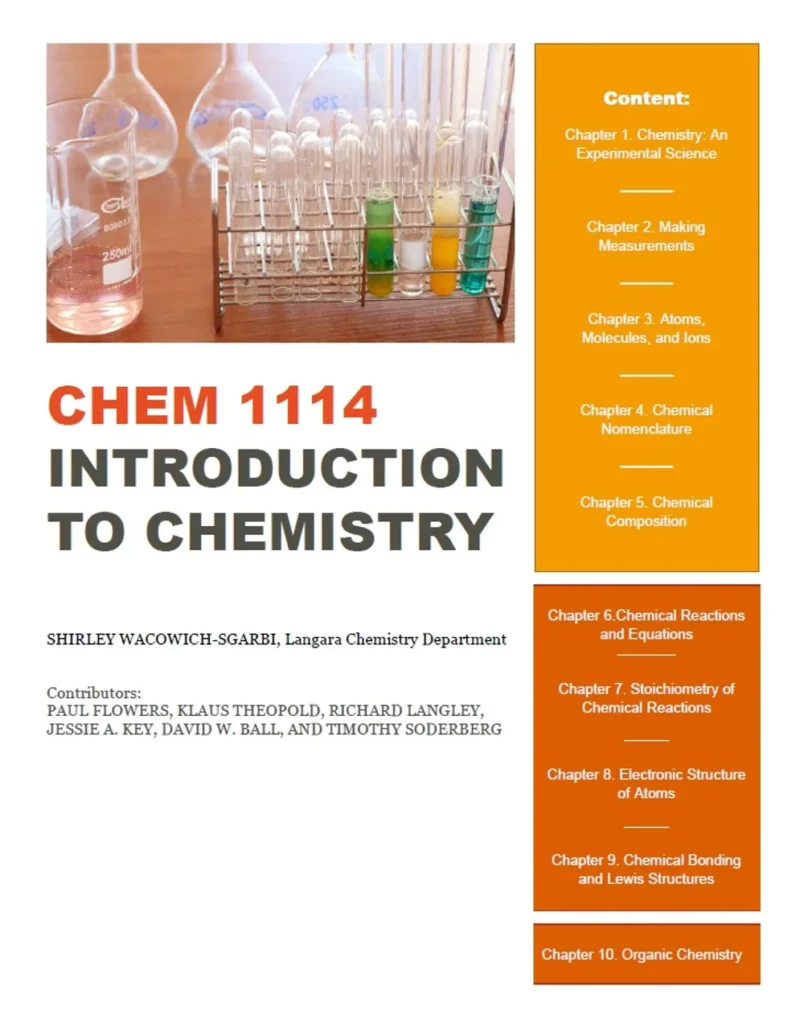
CHEM 1114 - Introduction to Chemistry
Not rated yetRate this bookCHEM 1114 - Introduction to Chemistry is a Langara College adaptation organized into ten chapters. Shirley Wacowich-Sgarbi and the Langara Chemistry Department combine experimental reasoning, measurement, atomic structure, nomenclature, composition, reactions, stoichiometry, electronic structure, bonding, and introductory organic chemistry. This guide follows that selected course sequence and connects calculations with particle-level explanations, units, and defensible chemical representations.
Free reading is available at the official source. Opens in a new tab.
 Free
About this book
CHEM 1114 - Introduction to Chemistry is a Langara College adaptation organized into ten chapters. Shirley Wacowich-Sgarbi and the Langara Chemistry Department combine experimental reasoning, measurement, atomic structure, nomenclature, composition, reactions, stoichiometry, electronic structure, bonding, and introductory organic chemistry. This guide follows that selected course sequence and connects calculations with particle-level explanations, units, and defensible chemical representations.
Chapter-wise summaries and study tasks
Chapter 1. Chemistry: An Experimental Science
Chemistry connects observable properties with the composition and transformations of matter. The chapter distinguishes elements, compounds, and mixtures, as well as physical changes from processes that produce different substances. A substance’s phase does not by itself determine its chemical identity, while homogeneous appearance does not establish that a sample is a pure compound. Laboratory separation techniques exploit physical differences among mixture components rather than necessarily changing their chemical structures.
Experimental reasoning requires distinguishing what was observed from the molecular explanation proposed for it. A color change or gas formation can motivate a chemical hypothesis, but the context and supporting evidence matter. Classification becomes useful when it helps predict an appropriate separation or test, not merely when a label is memorized.
Study task. Classify several samples by phase, purity, and composition using explicit evidence. Propose a physical separation sequence for a hypothetical mixture and explain which property each stage exploits.
Chapter 2. Making Measurements
Measurements combine a numerical value, a unit, and an appropriate account of uncertainty. Scientific notation organizes scale, while significant figures communicate the precision justified by the measurement process. Accuracy concerns agreement with a reference; precision concerns consistency among repeated results. Arithmetic rules for reported digits differ between sums and products, and premature rounding can distort a multistep answer. Dimensional analysis arranges conversion factors so units guide the calculation.
Density connects mass and volume and can function as a conversion relationship when conditions and material identity are specified. A conversion is not complete merely because the numbers look reasonable: the final units and order of magnitude should also fit the physical question.
Study task. Convert a measured quantity through two unit changes, carrying guard digits until the final report. Compare repeated measurements with a reference value and explain separately what they show about accuracy and precision.
Chapter 3. Atoms, Molecules, and Ions
Atomic theory developed through models tested against observations rather than through one complete discovery. Electrons, nuclei, protons, and neutrons explain charge and mass distributions, while atomic number identifies an element and mass number distinguishes isotopic composition. Chemical formulas communicate which atoms are present and in what proportions; subscripts and coefficients have different meanings. The periodic table organizes elements by atomic number and recurring patterns, providing a framework for later explanations of chemical behavior.
Different isotopes share an elemental identity without necessarily having identical masses or nuclear properties. Likewise, changing the charge of an atom does not change its proton number. These distinctions are essential when interpreting symbols, formulas, and the evidence behind average atomic masses.
Study task. Decode isotope and ion symbols into proton, neutron, and electron counts. Compare a formula subscript with a reaction coefficient, then explain how a historical observation required revision of an earlier atomic model.
Chapter 4. Chemical Nomenclature
Chemical nomenclature translates composition into a name and back into a formula. Element names and symbols provide the base vocabulary, while ionic and molecular compounds use different naming systems. Ionic formulas reflect charge balance and formula-unit ratios; simple molecular names can use prefixes to specify atom counts. Metals with more than one common ionic charge require additional information, and polyatomic ions must be recognized as coordinated groups. The physical appearance of a compound is not a reliable substitute for this structural information.
Practice should run in both directions. A learner who can name a displayed formula may still need work constructing a neutral ionic formula from a name or distinguishing a molecular prefix from an ionic charge designation.
Study task. Create a mixed set of ionic and molecular names and formulas. Explain charge balance for each ionic formula and identify one case where a metal’s charge must be specified to make the name unambiguous.
Chapter 5. Chemical Composition
Chemical composition connects the mass of a sample with the number and proportions of its particles. Atomic, molecular, and formula masses apply to different representations, while the mole provides a counting unit for macroscopic quantities. Molar mass converts between mass and amount of substance. Percent composition describes mass contributions and can be used to infer an empirical formula through mole ratios. A molecular formula requires additional information because several molecules can share the same simplest ratio.
The critical reasoning step is to identify what is being counted: atoms, molecules, ions, or formula units. Ratios in a formula refer to particle or mole relationships, not automatically to equal mass contributions. Keeping those levels separate prevents many errors in composition calculations.
Study task. Determine an empirical formula from a hypothetical composition and use a supplied molar mass to find a molecular formula. Explain why the composition alone cannot distinguish all molecular multiples.
Chapter 6. Chemical Reactions and Equations
Chemical equations represent transformations while conserving atoms and, where relevant, charge. Balancing changes coefficients rather than the identities expressed by formula subscripts. Precipitation reactions depend on the formation of an insoluble product under the stated conditions. Acid–base reactions and oxidation–reduction processes describe different kinds of chemical change, though a complex reaction may require more than one perspective. Complete and net ionic representations distinguish reacting species from spectators in aqueous systems.
A balanced equation is a necessary accounting statement, not proof that a proposed reaction will occur readily under all conditions. Recognizing phases and the chemical context helps connect symbolic equations with laboratory observations.
Study task. Balance three equations from different reaction classes and justify each classification. Write a net ionic equation for an appropriate aqueous example, checking both atoms and total charge.
Chapter 7. Stoichiometry of Chemical Reactions
Stoichiometry uses a balanced equation to relate amounts consumed and produced. Masses are converted to moles before applying coefficient ratios and converted back only when the requested quantity requires it. A limiting reagent determines the maximum product possible from the supplied amounts, while theoretical and actual yields answer different questions. Molarity links solute amount with solution volume, and other concentration units describe different ratios. Quantitative analysis uses these relationships to infer an unknown from measured reactions or composition.
Every calculation should identify the chemical entity, units, and reaction assumption. A numerical result can be internally consistent yet answer the wrong question if solution volume, solvent mass, and total solution mass are treated as interchangeable quantities.
Study task. Solve a reaction problem with two reactants and a supplied actual yield. Identify the limiting reagent, theoretical product, percent yield, and remaining excess reactant, then explain how a measured solution concentration enters the same reasoning.
Chapter 8. Electronic Structure of Atoms
Electronic structure explains patterns that a simple nuclear model cannot. Electromagnetic energy and atomic spectra show that energy exchange is constrained in ways requiring a quantum description. Orbitals represent allowed electronic states rather than tiny planetary tracks. Quantum rules organize electron configurations and connect them with the periodic table. Effective nuclear attraction and shell structure help explain trends in atomic size, ionization energy, and related properties, although trends should be reasoned through rather than applied without exceptions.
Distinguish a model’s representation from a photograph of an electron’s path. The evidence supports predictions about energies and probabilities, not a classical orbit drawn merely for convenience.
Study task. Write electron configurations for selected atoms and ions, explaining the relevant electron count. Use shell structure and nuclear attraction to compare two periodic properties, then connect a spectral transition with an energy difference.
Chapter 9. Chemical Bonding and Lewis Structures
Bonding models explain how atoms form stable arrangements through electrostatic interactions and electron sharing. Ionic and covalent descriptions emphasize different patterns, while Lewis structures account for valence electrons in a useful simplified representation. A correct diagram must respect total electron count and charge, with formal charge helping compare candidate structures. Resonance indicates that one ordinary Lewis drawing can be insufficient; it does not describe a molecule rapidly switching among separate pictured structures.
The chapter’s sequence includes overlapping introductions to ionic and covalent bonding, which should be used to reinforce a common accounting method. Lewis models have limits and should not be treated as complete physical pictures of electron density or as proof of every molecular property.
Study task. Draw a neutral molecule and a polyatomic ion, recording the electron budget and formal charges. Compare resonance contributors and explain what the shared resonance description conveys beyond one isolated structure.
Chapter 10. Organic Chemistry
The organic chapter develops structural reading and naming rather than surveying every branch of organic chemistry. Condensed and line-angle representations compress information according to conventions about carbon and hydrogen. Functional groups organize recognizable chemical families, including hydrocarbons, halides, alcohols, ethers, amines, carbonyl compounds, carboxylic acids, esters, and amides. Naming requires an appropriate parent framework, numbering, substituents, and group-specific conventions. Similar formulas can represent different connectivities, so names and drawings must preserve structural information.
Work back and forth among a name, a full structural drawing, and a condensed or line representation. This reveals hidden counting mistakes and prepares readers to recognize why moving a functional group can change a compound’s identity.
Study task. Translate several organic names into line-angle structures and back. Identify the functional groups, justify parent-chain numbering, and draw two constitutional isomers to show why molecular formula alone is insufficient.
How to study this book
- Use three linked representations whenever possible: observable behavior, a particle-level explanation, and the symbolic equation or formula.
- Write quantities with units at every stage and state the counted entity when using moles.
- Practice nomenclature and structural interpretation in both directions before attempting unfamiliar reaction calculations.
- Check conservation of atoms and charge, electron counts in Lewis structures, and the scale of every numerical answer.
- Use the source’s end-of-chapter problems for mixed practice and complete laboratory activities only within the course’s safety and instructional arrangements.
Questions for reflection
- Which information is supplied by a formula, and which requires a measurement or structural model?
- Does a balanced equation establish only accounting, or also the conditions under which a process occurs?
- What independent check would reveal an error in your calculation or diagram?
Source edition and coverage
This guide covers all ten chapters of the linked Langara CHEM 1114 adaptation. Its coverage ends with organic nomenclature; it does not assume the additional gas-law, equilibrium, or thermodynamics chapters found in broader introductory chemistry texts. These are original study explanations and learning tasks. Read the complete book at the official source.
About access & copyright
This page provides book information and study material. Full-text access is provided by the original publisher or authorised source; a listing does not grant permission to republish the book.
Read our Library Access & Copyright policyExplore the contents
Check the chapters covered in this edition.
Visit the official source
See reading, preview or purchase options.
Save for later
Keep this textbook in your saved collection.
Reader ratings & reviews
Share your thoughts
Your review helps other students choose the right resources.
KEEP LEARNING
Your next great read
Chemistry
 Chemistry
Introductory Chemistry, 1st Canadian Edition [Clone]
View Introductory Chemistry, 1st Canadian Edition [Clone] — book Chemistry
The Basics of General, Organic, and Biological Chemistry
View The Basics of General, Organic, and Biological Chemistry — book Chemistry
 of Cooking
View Chemistry of Cooking — book Biology
Biochemistry: Free For All
View Biochemistry: Free For All — book Chemistry
Introductory Chemistry
View Introductory Chemistry — book Chemistry
Fundamentals and Principles of Chemistry
View Fundamentals and Principles of Chemistry — book Chemistry
Chemical Bonding and Organic Chemistry
View Chemical Bonding and Organic Chemistry — book Chemistry
Laboratory Manual: General Chemistry I Honors
View Laboratory Manual: General Chemistry I Honors — book Chemistry



