
 Natural Sciences
ChemistryTextbook
The Basics of General, Organic, and Biological Chemistry
Not rated yetRate this bookThe Basics of General, Organic, and Biological Chemistry connects measurement and atomic structure with reactions, organic functional groups, and the chemistry of living systems. The catalog credits David W. Ball, John W. Hill, and Rhonda J. Scott. The linked archival PDF is titled Introduction to Chemistry: General, Organic, and Biological, version 1.0, and preserves a twenty-chapter sequence. This guide identifies that title difference and follows the linked file rather than assuming a different edition. It is intended for introductory chemistry, particularly learners who need a foundation for health and biological sciences. Calculations should always include units, chemical equations should conserve atoms and charge, and biological applications should be understood through the chemical relationships developed earlier.
Read on the publisher’s website. Opens in a new tab.
 Free
About this book
The Basics of General, Organic, and Biological Chemistry connects measurement and atomic structure with reactions, organic functional groups, and the chemistry of living systems. The catalog credits David W. Ball, John W. Hill, and Rhonda J. Scott. The linked archival PDF is titled Introduction to Chemistry: General, Organic, and Biological, version 1.0, and preserves a twenty-chapter sequence. This guide identifies that title difference and follows the linked file rather than assuming a different edition. It is intended for introductory chemistry, particularly learners who need a foundation for health and biological sciences. Calculations should always include units, chemical equations should conserve atoms and charge, and biological applications should be understood through the chemical relationships developed earlier.
Book summary
About this book
The Basics of General, Organic, and Biological Chemistry connects measurement and atomic structure with reactions, organic functional groups, and the chemistry of living systems. The catalog credits David W. Ball, John W. Hill, and Rhonda J. Scott. The linked archival PDF is titled Introduction to Chemistry: General, Organic, and Biological, version 1.0, and preserves a twenty-chapter sequence. This guide identifies that title difference and follows the linked file rather than assuming a different edition. It is intended for introductory chemistry, particularly learners who need a foundation for health and biological sciences. Calculations should always include units, chemical equations should conserve atoms and charge, and biological applications should be understood through the chemical relationships developed earlier.
Chapter-by-chapter study guide
Chapter 1: Chemistry, Matter, and Measurement
Chemistry examines matter, its composition, properties, and changes. Physical and chemical properties describe different kinds of observations, while substances and mixtures require different classification. Measurement connects numerical values with units and uncertainty. Significant figures communicate precision, and dimensional analysis uses unit relationships to organize conversions. Density links mass and volume but depends on the substance and conditions. A calculation that produces an apparently reasonable number can still be wrong if units or precision are mishandled. These habits support every later quantitative chapter.
Study application: Classify a set of observations as physical or chemical, then solve a multistep density conversion using explicit units. Explain which measurement limits the precision of the final result.
Chapter 2: Elements, Atoms, and the Periodic Table
Atomic structure connects protons, neutrons, and electrons with element identity, isotopes, and charge. Atomic number differs from mass number, while a periodic-table atomic mass reflects isotopic composition rather than one particular atom's nucleon count. Electron arrangements help explain recurring chemical behavior and the organization of the periodic table. Symbols and conventions make it possible to describe particles precisely. The chapter establishes the link between an element's identity and the electron behavior involved in bonding, avoiding the idea that all particles in an atom contribute to chemical reactions in the same way.
Study application: For several isotope and ion symbols, determine protons, neutrons, and electrons. Explain why isotopes of one element can share chemical tendencies while having different masses.
Chapter 3: Ionic Bonding and Simple Ionic Compounds
Ionic compounds combine charged particles in ratios that produce an electrically neutral formula unit. Electron loss and gain help explain common monatomic ions, while polyatomic ions retain a recognizable group and charge. Formula writing and naming require distinguishing charge from the number of atoms. Variable-charge metals need information that fixed-charge ions may not. Properties arise from electrostatic relationships in an extended structure rather than isolated molecular pairs. Recognizing ionic composition supports later work on aqueous solutions and reaction equations.
Study application: Write formulas from ion charges and names, then reverse the process. For a compound containing a polyatomic ion, explain what parentheses and subscripts count and check overall neutrality.
Chapter 4: Covalent Bonding and Simple Molecular Compounds
Covalent bonding involves shared electrons and molecular structures. Lewis representations track valence electrons, while multiple bonds, lone pairs, shape, and polarity explain important properties. A polar bond does not automatically make the whole molecule polar because geometry affects how bond contributions combine. Molecular naming follows conventions different from ionic naming. Intermolecular attractions must also be distinguished from the bonds holding atoms together within a molecule. These distinctions prepare learners to understand phases, solubility, and organic structures.
Study application: Draw Lewis structures for a small set of molecules, count electrons, predict basic shapes, and compare bond polarity with overall molecular polarity. Explain why symmetry can matter.
Chapter 5: Introduction to Chemical Reactions
A chemical equation represents a rearrangement of atoms, not their creation or destruction. Balancing changes coefficients while preserving chemical formulas. Reaction classifications help recognize patterns such as combination, decomposition, combustion, precipitation, and acid–base change. Aqueous reactions introduce soluble species and net ionic descriptions, where spectator ions are separated from the actual chemical change. States and conditions supply information that a bare formula cannot. Classifying a reaction should support understanding rather than replace checking what species are present.
Study application: Balance an equation, identify its reaction type, and write a net ionic equation for an appropriate aqueous example. Explain why changing a formula subscript would describe a different substance.
Chapter 6: Quantities in Chemical Reactions
The mole connects particle counts with measurable amounts. Molar mass converts mass to amount, and balanced coefficients supply ratios between reacting species. Stoichiometry requires moving through those relationships in the correct order rather than comparing masses directly. Limiting-reactant reasoning identifies which input constrains product, while theoretical and actual yields answer different questions. Percent yield does not establish purity or identify the cause of a loss. A complete solution states the balanced reaction, relevant amounts, and the assumptions about reaction completion.
Study application: Given two reactant masses, identify the limiting reactant, calculate theoretical product, and determine the amount of excess reactant remaining. Check that the calculation uses mole ratios rather than mass ratios.
Chapter 7: Energy and Chemical Processes
Energy changes accompany heating, phase changes, and chemical reactions. Heat and temperature are related but not identical, and the direction of transfer depends on the defined system and surroundings. Calorimetry relates temperature change to heat capacity under specified assumptions. Exothermic and endothermic processes have opposite energy-transfer directions, while energy conservation connects the parts of a problem. Reaction-energy diagrams and thermochemical relationships help interpret chemical change. Units and sign conventions should be stated before substitution into a formula.
Study application: Analyze a simple calorimetry example with a clearly defined system. Explain the sign of each heat term and identify one assumption that would fail if substantial heat escaped to the room.
Chapter 8: Solids, Liquids, and Gases
The behavior of phases reflects particle motion and intermolecular forces. Gas laws connect pressure, volume, temperature, and amount under appropriate conditions, with absolute temperature required in proportional relationships. Ideal-gas reasoning is a model that becomes less accurate under some real conditions. Phase changes involve energy transfer without the same interpretation as an ordinary temperature change. Pressure units and the distinction between gas particles and the empty space between them matter. The chapter connects microscopic descriptions with observable properties.
Study application: Solve a gas-state change using consistent pressure and temperature units. Then interpret a heating curve, distinguishing energy used for temperature change from energy associated with a phase transition.
Chapter 9: Solutions
Solutions combine solute and solvent at the molecular or ionic level, with solubility affected by interactions and conditions. Concentration can be expressed in several ways, each with a defined numerator and denominator. Dilution changes concentration by adding solvent while conserving the amount of solute under the stated conditions. Colligative and related solution properties depend on particle concentrations and require care when compounds dissociate. Osmosis connects solutions across a selectively permeable barrier. A clear setup distinguishes solution volume from solvent volume.
Study application: Prepare a dilution calculation from a stock solution and verify solute conservation. Compare equal formula-unit concentrations of a molecular solute and an ionic solute, stating the idealized dissociation assumption.
Chapter 10: Acids and Bases
Acid–base models describe proton transfer and related chemical behavior. Strength concerns the extent of ionization or reaction, while concentration concerns how much material is present; the two are not synonyms. pH expresses a logarithmic relationship, making a one-unit change chemically significant. Neutralization, titration, and buffers connect acid–base chemistry with quantitative and biological applications. A buffer resists certain changes within a limited capacity rather than keeping pH fixed under every addition. Calculations must match the assumptions about the species and their behavior.
Study application: Compare a strong dilute acid with a more concentrated weak acid without equating strength and concentration. Calculate a simple pH change and explain why a buffer eventually loses effectiveness.
Chapter 11: Nuclear Chemistry
Nuclear processes alter atomic nuclei and differ from ordinary electron-based chemical reactions. Radioactive emissions have distinct particle and charge characteristics, so nuclear equations conserve appropriate quantities. Half-life describes a repeated proportional decrease rather than a fixed amount lost per interval. Applications include tracing, energy, and medical uses, while exposure and risk require context. The chapter's examples teach principles rather than individualized safety or treatment decisions. Distinguishing chemical identity, nuclear change, and activity prevents common conceptual errors.
Study application: Balance a nuclear equation and calculate the remaining fraction after several half-lives. Explain why the same half-life does not mean the same number of atoms decay in every equal interval.
Chapter 12: Organic Chemistry — Alkanes and Halogenated Hydrocarbons
Organic structures use carbon's bonding patterns to create chains, branches, and rings. Alkanes provide the foundation for naming and structural representation, while constitutional isomers share a formula but differ in connectivity. Condensed and line-angle formulas communicate information differently but represent the same atoms and bonds when interpreted correctly. Halogen substitution changes composition and properties. Naming requires a consistent parent structure, numbering, and substituent description. The chapter establishes the structural language needed for later functional groups.
Study application: Draw several constitutional isomers for a small molecular formula and name them systematically. Convert one structure among expanded, condensed, and line-angle forms while checking carbon valence.
Chapter 13: Unsaturated and Aromatic Hydrocarbons
Alkenes and alkynes introduce multiple bonds with consequences for geometry, naming, and reactivity. Geometric isomerism depends on structural restrictions and substituent arrangements, not merely drawing a bond in another direction. Addition reactions change bonding patterns across unsaturation. Aromatic compounds have a distinctive bonding framework and should not be treated as ordinary alternating isolated double bonds in every reaction. Recognizing the structural class helps predict which reactions and properties are plausible.
Study application: Identify an alkane, alkene, alkyne, and aromatic structure. For an alkene, determine whether geometric isomerism is possible and show how an addition reaction changes the bonding pattern.
Chapter 14: Organic Compounds of Oxygen
Alcohols, phenols, ethers, aldehydes, and ketones introduce oxygen-containing functional groups with different bonding and properties. Hydrogen bonding, polarity, and molecular size help explain boiling-point and solubility trends. Oxidation and reduction relationships connect several groups, but outcomes depend on the starting structure and conditions. The same element's presence does not make two compounds chemically equivalent: the functional group's arrangement matters. This chapter builds the recognition skills needed to interpret larger biological molecules.
Study application: Classify a set of oxygen-containing structures by functional group and compare two likely intermolecular interactions. Trace one appropriate oxidation relationship while accounting for the starting carbon's bonds.
Chapter 15: Organic Acids and Bases and Some of Their Derivatives
Carboxylic acids, esters, amines, amides, and related compounds connect functional groups with acidity, basicity, and characteristic reactions. Structure affects proton-transfer behavior and interactions with water. Ester formation and hydrolysis illustrate how groups can be transformed, while amines and amides differ despite both containing nitrogen. Naming and recognizing these groups supports later understanding of lipids, amino acids, and proteins. A functional-group label is a starting point for reasoning about properties, not an explanation that can ignore the rest of the molecule.
Study application: Identify acid, ester, amine, and amide groups in simple structures. Compare an amine with an amide and explain why the bonding environment changes the behavior of nitrogen.
Chapter 16: Carbohydrates
Carbohydrates include simple sugars and larger structures connected through characteristic linkages. Functional groups, stereochemistry, ring formation, and glycosidic bonds influence properties and biological roles. Monosaccharides, disaccharides, and polysaccharides differ in size and organization. A shared elemental formula does not guarantee the same structure or digestibility. Recognizing the connection points between sugar units helps explain hydrolysis and the differences among storage and structural materials. The chapter uses earlier organic chemistry to interpret biological molecules rather than introducing an unrelated vocabulary list.
Study application: Compare two carbohydrate structures by monomer, linkage, and likely role. Mark the bond broken in a hydrolysis example and explain why linkage orientation can matter biologically.
Chapter 17: Lipids
Lipids are grouped by properties and biological roles rather than one uniform repeating structure. Fatty acids, fats, oils, phospholipids, and steroids illustrate different arrangements. Chain length and unsaturation affect intermolecular packing and physical behavior. Ester chemistry connects storage lipids with hydrolysis, while amphipathic molecules help explain membrane organization. A molecular description should be separated from broad dietary or medical conclusions that require additional evidence. The chapter's main task is relating structure to solubility, energy storage, and membrane functions.
Study application: Compare saturated and unsaturated fatty-acid structures, then identify hydrophilic and hydrophobic regions in a phospholipid. Explain how those regions support a membrane-like arrangement in water.
Chapter 18: Amino Acids, Proteins, and Enzymes
Amino acids contain groups whose charge depends on conditions, and peptide bonds link residues into proteins. Primary sequence supports higher levels of structure through several interactions. Denaturation changes structure and function without necessarily breaking every peptide bond. Enzymes catalyze reactions and have specificity, environmental dependencies, and inhibition patterns. Catalysis changes reaction rate rather than the overall equilibrium position. Connecting chemical groups with folding and binding helps explain why a small structural change can affect function.
Study application: Build a short peptide from amino-acid structures, identify the peptide bonds, and compare a sequence change with denaturation. Explain why an enzyme can accelerate a reaction without changing its equilibrium constant.
Chapter 19: Nucleic Acids
Nucleotides combine a sugar, phosphate, and nitrogenous base, and their linkage creates directional nucleic-acid chains. DNA and RNA differ in components and roles, while complementary pairing supports information storage and transfer. Replication, transcription, and translation are distinct processes with different products. The genetic code connects nucleotide information with amino-acid sequence, but a sequence must be read in the appropriate direction and frame. This chapter integrates molecular structure with biological information rather than reducing the process to base names alone.
Study application: Label a nucleotide and distinguish it from a nucleoside. Trace information from a short DNA example to RNA and a peptide using an explicitly stated strand and reading direction.
Chapter 20: Energy Metabolism
Metabolism connects pathways through energy transfer, electron carriers, and regulated reactions. Catabolic processes break down materials, while anabolic processes build molecules and require resources. Carbohydrate, lipid, and protein metabolism intersect rather than forming entirely isolated systems. ATP and reduced carriers link reactions, while cellular conditions influence pathway use. Learning a list of intermediates without understanding the inputs, outputs, and purpose makes the overall logic hard to retain. The chapter brings earlier reaction and biological-molecule concepts into one integrated system.
Study application: Create a pathway map showing how major nutrient classes connect with central energy metabolism. Label where energy carriers are produced or consumed and distinguish carbon flow from electron transfer.
Study instructions
- Work through the general-chemistry chapters before the organic and biological sections. Later structures rely on bonding, acid–base reasoning, and reaction quantities.
- Use dimensional analysis in every numerical problem, carrying units through intermediate steps and checking significant figures at the end.
- Balance atoms and charge before performing stoichiometric calculations. State the model or simplifying assumption used.
- Draw functional groups and practice moving among structural representations rather than memorizing names without a structure.
- Build comparison tables for easily confused ideas: strength versus concentration, heat versus temperature, inter- versus intramolecular forces, and catalyst effects versus equilibrium.
- For biological chapters, identify structures, linkages, reactions, and functions, then connect them with the earlier organic chemistry.
- Attempt source exercises independently and diagnose errors as conceptual, structural, algebraic, unit-related, or arithmetic. Treat health-related examples as educational chemistry rather than personal clinical guidance.
Questions for reflection
- Why must formulas remain fixed while an equation is balanced?
- How can molecular geometry change overall polarity?
- Why is acid strength different from concentration?
- How do functional groups explain biological-molecule behavior?
- How does an enzyme affect rate without changing equilibrium?
Sources and edition coverage
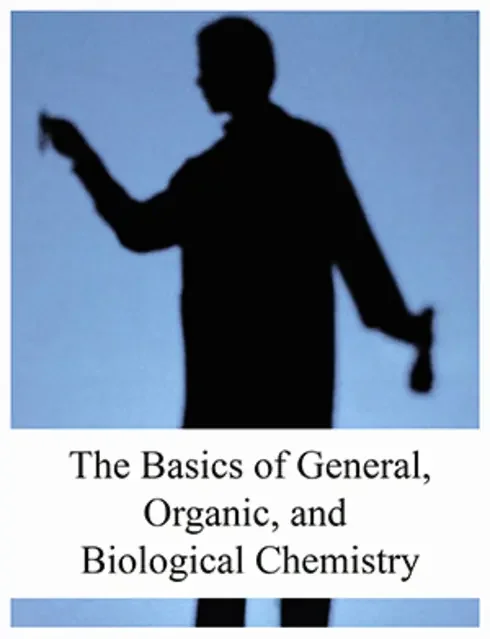
Coverage follows all twenty chapters of the linked complete archival PDF, titled Introduction to Chemistry: General, Organic, and Biological, version 1.0, preserved in December 2012. The Open Textbook Library lists the book under The Basics of General, Organic, and Biological Chemistry, credits Ball, Hill, and Scott, and gives 2011. The archive's removed-attribution statement is acknowledged rather than confused with a different edition. The original catalog cover is used. This is an original study guide. Read the linked textbook for its full explanations, evidence, worked examples, exercises, and references. The study applications above are new practice suggestions, not quoted textbook exercises.
About access & copyright
This page provides book information and study material. Full-text access is provided by the original publisher or authorised source; a listing does not grant permission to republish the book.
Read our Library Access & Copyright policyExplore the contents
Check the chapters covered in this edition.
Visit the official source
See reading, preview or purchase options.
Save for later
Keep this textbook in your saved collection.
Reader ratings & reviews
Share your thoughts
Your review helps other students choose the right resources.
KEEP LEARNING
Your next great read
Natural Sciences Natural Sciences
The Adventure of Physics - Vol. VI: The Strand Model - A Speculation on Unification
View The Adventure of Physics - Vol. VI: The Strand Model - A Speculation on Unification — book Natural Sciences
Mind, Body, World: Foundations of Cognitive Science
View Mind, Body, World: Foundations of Cognitive Science — book Biology
Anatomy and Physiology of Animals
View Anatomy and Physiology of Animals — book Biology
General Biology
View General Biology — book Chemistry
 of Cooking
View Chemistry of Cooking — book Biology
Cells: Molecules and Mechanisms
View Cells: Molecules and Mechanisms — book Biology
Biochemistry: Free For All
View Biochemistry: Free For All — book Chemistry
Introductory Chemistry
View Introductory Chemistry — book Engineering & Technology



