
The Adventure of Physics – Vol. I: Fall, Flow, and Heat
ChemistryTextbook
Chemistry of Cooking
Not rated yetRate this bookSorangel Rodriguez-Velazquez’s Chemistry of Cooking connects introductory chemistry with ingredients and culinary processes. The 2016 compilation adapts material from chemistry and baking texts into eleven principal thematic divisions. This guide follows those divisions and incorporates their subordinate topics, from measurement and bonding to thickening, flour, fat, sugar, leavening, dairy, eggs, chocolate, and seasoning. The goal is to explain why a change in composition or processing produces a different result. The book is educational chemistry; its historical culinary examples are not a substitute for current food-handling requirements.
Free reading is available at the official source. Opens in a new tab.
 Free
About this book
Sorangel Rodriguez-Velazquez’s Chemistry of Cooking connects introductory chemistry with ingredients and culinary processes. The 2016 compilation adapts material from chemistry and baking texts into eleven principal thematic divisions. This guide follows those divisions and incorporates their subordinate topics, from measurement and bonding to thickening, flour, fat, sugar, leavening, dairy, eggs, chocolate, and seasoning. The goal is to explain why a change in composition or processing produces a different result. The book is educational chemistry; its historical culinary examples are not a substitute for current food-handling requirements.
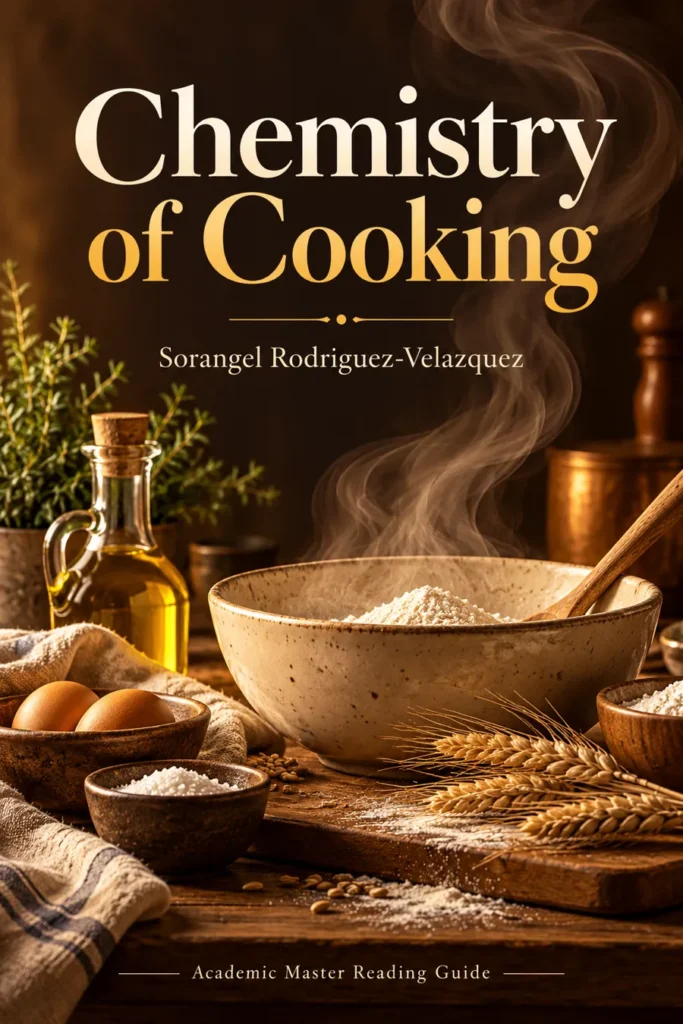
Cover: original Academic Master reading-guide design. The linked source remains the edition described above.
Book summary
About this book
Sorangel Rodriguez-Velazquez’s Chemistry of Cooking connects introductory chemistry with ingredients and culinary processes. The 2016 compilation adapts material from chemistry and baking texts into eleven principal thematic divisions. This guide follows those divisions and incorporates their subordinate topics, from measurement and bonding to thickening, flour, fat, sugar, leavening, dairy, eggs, chocolate, and seasoning. The goal is to explain why a change in composition or processing produces a different result. The book is educational chemistry; its historical culinary examples are not a substitute for current food-handling requirements.
Chapter-by-chapter summaries
1. Essential ideas
Matter classification, physical and chemical change, measurement, uncertainty, energy, and calorimetry establish the scientific vocabulary. A visible change does not by itself reveal whether composition changed. Separate precision from accuracy and retain units through calculations. In a heating example, distinguish temperature from transferred energy and identify what the calorimetric model includes. Recording uncertain measurements honestly is more informative than reporting unjustified decimal places. These foundations allow later recipe observations to become testable explanations rather than descriptions such as cooked enough or mixed well.
2. Atoms, molecules, and ions
Atomic structure, the periodic table, formulas, and molecular and ionic compounds connect ingredients with particle-level descriptions. A chemical formula represents composition, not necessarily an independently existing molecule in every material. Compare the roles of ions in a dissolved salt with molecules in another ingredient. Use charge and atom counts to check a representation. The chapter gives a vocabulary for explaining why substances dissolve, interact, or behave differently without reducing all culinary effects to a vague appeal to chemicals.
3. Thickening and concentrating flavours
Viscosity, coagulation, gelatinization, crystallization, sauces, nontraditional thickeners, and low-temperature techniques illustrate distinct mechanisms. Protein coagulation differs from starch granule changes, so increasing heat can have different effects in two mixtures. Sugar crystallization depends on composition and process history as well as sweetness. Compare thickeners using their functional conditions rather than assuming equal masses are interchangeable. For an observed texture, identify which structure is changing and what competing mechanism could produce a similar appearance. Distinguish culinary process description from validated safety conditions.
4. Flour
Milling, wheat types, streams, treatments, additives, whole grains, rye, and alternative flours affect composition and performance. Flour is not a uniform powder whose only relevant property is mass. Protein, starch, bran, and processing help explain water uptake and dough behaviour. Compare a substitution by the structure the product needs rather than only the ingredient’s name. Separate a historical or regulatory term from a functional description. The chapter connects production and ingredient classification with what happens during mixing, resting, and baking.
5. Fats and oils
Composition, physical state, sources, and bakery functions connect molecular structure with tenderness, aeration, layering, flavour, and mouthfeel. Fat can interrupt networks or help incorporate air depending on how it is used. A liquid oil and a plastic fat may supply similar energy while behaving differently in a mixing process. Compare substitution through melting behaviour, water content, and structural role. Identify whether a recipe depends on fat as a dispersed ingredient or as an organized phase. Nutritional equivalence does not establish technological interchangeability.
6. Sugar
Sugar chemistry, refining, syrups, alternative sources, and substitutes show that sweetness is only one function. Solubility, water interactions, crystallization, browning, and texture depend on the particular ingredient and conditions. Honey, glucose, malt, and other syrups introduce differences beyond their perceived sweetness. Compare a replacement through solids, moisture, and the desired structural effect. The source contains visible editorial placeholders in some headings, so consult complete explanations rather than treating every label as a finalized regulatory statement. Avoid assuming a reduced-sugar formula behaves like the original automatically.
7. Leavening agents
Catalysis, yeast, acid-base chemistry, pH, baking powder, bicarbonates, and water chemistry connect gas generation with product structure. Producing gas and retaining it are different requirements. Biological fermentation differs from a chemical acid-base reaction, and timing affects whether expanding gas supports the intended structure. Compare leavening systems by reactants, activation, products, and the mixture’s ability to set. pH is not simply an ingredient amount: buffering and composition influence its response. A substitution needs a chemical and structural explanation rather than a one-for-one rule.
8. Dairy products
Milk, concentrated or modified products, yogurt, lactose, cheese, and use in bread demonstrate the effects of protein, fat, water, acidity, and dissolved solids. Two dairy ingredients can share an origin yet play different functional roles. Compare an ingredient’s composition with its contribution to hydration, flavour, browning, and structure. Fermentation changes more than texture. Distinguish lactose from general sweetness and avoid treating a product label as a complete compositional specification. Use the chapter’s concepts to explain a result before deciding which ingredient changed it.
9. Eggs
Composition, grading, egg products, and functions in cooking connect proteins, emulsification, foaming, and setting. The yolk and white contribute differently, and a whole egg is not functionally identical to either part. Compare a foam with an emulsion and explain which structure is being stabilized. Processing changes how proteins interact, so order, mixing, and heat matter alongside quantity. The source’s storage discussion belongs to its publication context; practical handling should follow current authoritative requirements rather than extrapolation from a chemistry explanation.
10. Chocolate
Processing from cocoa bean to finished chocolate and the distinctions among bakery products and couverture connect composition with melting and setting. Cocoa solids, cocoa butter, sugar, and other ingredients influence performance. Different crystalline arrangements help explain why temperature history changes appearance and texture. Identify whether a product is intended for flavour, coating, or structural setting before substituting it. Commercial terms and regulations require their actual jurisdictional context. The scientific task is to connect a visible result with composition and processing rather than equating all chocolate-labelled materials.
11. Spices, salt, and flavour
Taste, seasoning, herbs, spices, and baking flavourings connect sensory effects with composition and use. Salt also affects dough and fermentation, so its role extends beyond saltiness. Distinguish flavour intensity from structural function when changing quantities. Storage and processing can affect volatile compounds and perceived aroma. Design a comparison holding other conditions constant so that a claimed flavour difference has interpretable evidence. The final division reinforces that ingredients can have several simultaneous roles, making a successful substitution a question of function as well as preference.
Study instructions
- Keep an ingredient-function chart linking composition, processing condition, structural change, and observed result.
- For calculations, record units, significant figures, assumptions, and uncertainty.
- Compare substitutions by all relevant functions, including water, structure, gas production, and flavour.
- Design small controlled comparisons with one changed variable and explain results through competing mechanisms.
Questions for reflection
- Why can equal sweetness fail to produce an equivalent texture?
- How do coagulation and gelatinization differ?
- What connects gas production with a stable leavened structure?
Sources and coverage
This original reading guide follows the linked source edition’s chapter, module, unit, or lesson structure. Consult the source for full arguments, cases, worked examples, exercises, illustrations, and references. The 2016 compilation has eleven main thematic divisions with many subordinate sections. Some source headings contain editorial placeholders; the guide does not treat those as completed regulatory guidance. Read the source edition.
About access & copyright
This page provides book information and study material. Full-text access is provided by the original publisher or authorised source; a listing does not grant permission to republish the book.
Read our Library Access & Copyright policyExplore the contents
Check the chapters covered in this edition.
Visit the official source
See reading, preview or purchase options.
Save for later
Keep this textbook in your saved collection.
Reader ratings & reviews
Share your thoughts
Your review helps other students choose the right resources.
KEEP LEARNING
Your next great read
Natural Sciences
The Adventure of Physics – Vol. VI: The Strand Model – A Speculation on Unification
The Adventure of Physics - Vol. VI: The Strand Model - A Speculation on Unification
View The Adventure of Physics - Vol. VI: The Strand Model - A Speculation on Unification — bookMind, Body, World: Foundations of Cognitive Science
Mind, Body, World: Foundations of Cognitive Science
View Mind, Body, World: Foundations of Cognitive Science — book Biology
Anatomy and Physiology of Animals
View Anatomy and Physiology of Animals — book Biology
General Biology
View General Biology — book Biology
Cells: Molecules and Mechanisms
View Cells: Molecules and Mechanisms — book Biology
Biochemistry: Free For All
View Biochemistry: Free For All — book Chemistry
Introductory Chemistry
View Introductory Chemistry — book Engineering & Technology
Stability of Ships and Other Bodies
View Stability of Ships and Other Bodies — book Natural Sciences



