
 Civil Engineering
Textbook
Ports and Waterways: Navigating the changing world
Not rated yetRate this bookPorts and Waterways: Navigating the Changing World treats waterborne transport as a connected system of vessels, ports, terminals, channels, infrastructure, and operations. The linked PDF is revision 1473, dated 5 October 2026, rather than only the original 2021 publication. Four parts contain eighteen chapters, with numbering restarting within each part. This guide covers those chapters individually. Mark van Koningsveld is identified as the principal editor, alongside Henk Verheij, Poonam Taneja, and Huib de Vriend and a wider contributing team. The text combines functional design, feasibility, simulation, safety, sustainability, and system performance.
Read on the publisher’s website. Opens in a new tab.
 Free
About this book
Overview
Ports and Waterways: Navigating the Changing World treats waterborne transport as a connected system of vessels, ports, terminals, channels, infrastructure, and operations. The linked PDF is revision 1473, dated 5 October 2026, rather than only the original 2021 publication. Four parts contain eighteen chapters, with numbering restarting within each part. This guide covers those chapters individually. Mark van Koningsveld is identified as the principal editor, alongside Henk Verheij, Poonam Taneja, and Huib de Vriend and a wider contributing team. The text combines functional design, feasibility, simulation, safety, sustainability, and system performance.
How to study this book
Choose one conceptual cargo flow and follow it through every part of the book. Draw the transport chain, identify capacity constraints, and keep assumptions about demand, vessels, service times, and environmental conditions explicit. Separate functional requirements from detailed engineering dimensions. Compare alternatives using the same performance criteria and time horizon, including reliability, safety, environmental effects, and future adaptability. For simulation, verify movement and resource logic before interpreting performance statistics. The source’s exercises and examples develop system thinking; a real port or navigation design requires site data, applicable requirements, and specialist investigation.
Chapter and section study guide
Part I, Chapter 1 — Ports and Waterways Systems
Waterborne transport depends on interconnected physical and organizational elements rather than isolated facilities. Ports, channels, terminals, hinterland connections, vessels, and logistics services together determine whether cargo can move. A local improvement may have limited value if another link remains constrained. The chapter establishes system boundaries, functions, and scales for later analysis. Distinguish the infrastructure that exists from the service it is expected to provide. A useful first model traces flows, resources, interfaces, and actors before estimating capacity or proposing expansion.
Study application: Map a cargo journey from origin to destination and identify infrastructure, operations, and organizations at each interface.
Part I, Chapter 2 — A Constant Need for Change
Demand, vessels, technology, environmental expectations, and economic conditions continually reshape port and waterway needs. Infrastructure has long lives, so decisions made under uncertainty can create lock-in or opportunities for adaptation. The chapter relates system development to drivers of change rather than assuming a single stable future. Different stakeholders may value different outcomes and face different risks. Compare what is known, what can be influenced, and what remains uncertain. Flexible planning should be judged by its practical options and triggers, not merely by a claim that flexibility is desirable.
Study application: Create three plausible demand or technology scenarios and identify a design decision that would be difficult to reverse in each.
Part I, Chapter 3 — Connecting with the Next Parts
This transition chapter links the general system perspective with ports, waterways, and performance analysis. It clarifies how design elements and operating processes relate to the book’s wider objectives. A reader should be able to move from a system requirement to a component question and back to the overall service. Avoid optimizing a terminal, channel, or fleet measure without checking its consequence for the complete chain. The chapter provides a roadmap for combining technical descriptions with performance and feasibility rather than treating the remaining parts as separate subjects.
Study application: Turn one system objective into a terminal question, a waterway question, and a performance measure that connects both.
Part II, Chapter 1 — Challenges to Port Development
Port development involves spatial, economic, environmental, institutional, and operational constraints. A technically possible facility may face demand uncertainty, land competition, ecological effects, or weak connections to the wider transport system. The chapter encourages framing a development problem before selecting a favored project. Identify whose objectives matter and how alternatives distribute benefits and burdens. Constraints can interact, so solving one may intensify another. The relevant comparison is between feasible system strategies, including operational improvements, rather than only between different physical layouts.
Study application: Prepare a problem statement for a port expansion that separates demand, capacity, environmental, and stakeholder concerns.
Part II, Chapter 2 — Port Planning
Planning connects forecasts, objectives, alternatives, sequencing, and uncertainty over a long development horizon. Demand estimates should be treated as conditional inputs rather than certain outcomes. A plan needs room for adaptation while remaining specific enough to guide investments and operations. The chapter links port choices with regional transport and environmental context. Distinguish a strategic direction from the detailed design of an individual project. Compare alternatives through transparent criteria and explain when additional information would justify changing the plan.
Study application: Develop a staged expansion concept with a demand trigger, an operational alternative, and a decision point for reassessment.
Part II, Chapter 3 — Port Layout
A layout organizes navigation, basins, berths, terminals, access, and supporting areas to deliver required functions. Vessel characteristics, environmental conditions, safety, and connections constrain the arrangement. Geometric efficiency alone is insufficient if a layout creates operational conflicts or future inflexibility. The chapter develops functional reasoning before detailed dimensions. Trace how ships and cargo move through the proposed arrangement and identify crossing, waiting, and resource conflicts. A useful comparison explains why a geometry serves a stated requirement and what trade-offs it imposes elsewhere.
Study application: Sketch two conceptual layouts for the same functions and compare navigation conflicts, terminal access, and expansion possibilities.
Part II, Chapter 4 — Container Terminals
Container-terminal performance emerges from linked waterside, yard, and landside operations. Cranes, storage areas, transport equipment, gates, and information flows must work together. Increasing one resource may simply move the bottleneck to another stage. Variability in arrivals and handling times affects queues and utilization, so nominal equipment capacity is not the same as reliable throughput. The chapter connects functional layout with operating strategy and resource coordination. Evaluate performance using the complete process and identify the assumptions behind any capacity estimate.
Study application: Trace one container through a terminal and identify how a delay at each stage could affect the rest of the process.
Part II, Chapter 5 — Other Terminal Types
Different cargoes require different handling systems, storage arrangements, safety measures, and interfaces with vessels and inland transport. Bulk, liquid, and other terminal functions cannot be modeled by simply copying a container process. Cargo properties and transfer methods shape both infrastructure and operations. The chapter broadens terminal design reasoning while retaining the system perspective. Start with material flows and service requirements, then identify resources and constraints. Compare alternatives through cargo-specific performance and risk rather than a generic throughput figure alone.
Study application: Choose two cargo types and compare their handling process, storage needs, operational constraints, and environmental interfaces.
Part III, Chapter 1 — Waterway Transport
Waterways provide transport capacity through the interaction of vessels, routes, infrastructure, traffic, and operating conditions. The chapter connects navigation services with the wider logistics chain and distinguishes route characteristics from actual transport performance. Vessel size and loading affect both economics and infrastructure demands. A waterway can appear physically available while time restrictions, waiting, or reliability limit its usefulness. Study the full movement process, including access to terminals and interactions with other users. The analysis should keep the chosen vessel and service assumptions visible.
Study application: Describe a waterway transport service using route, fleet, loading, travel time, waiting, and connection requirements.
Part III, Chapter 2 — Dimensions of Waterways
Required waterway dimensions depend on vessels, water levels, maneuvering, traffic arrangements, environmental forces, and safety margins. A width or depth is meaningful only relative to those conditions. The chapter introduces functional dimensioning and the trade-offs involved in accommodating traffic. Distinguish the design vessel from the full fleet and separate a nominal geometric clearance from an operating allowance. Changes in vessel or water-level assumptions can alter feasibility. Educational calculations should make uncertainties and restrictions explicit rather than presenting one dimension as universally safe.
Study application: List the inputs needed to assess a conceptual channel’s width and depth, separating vessel geometry, environmental conditions, and operational allowances.
Part III, Chapter 3 — Waterway Elements
Channels, bends, crossings, locks, bridges, and related elements introduce distinct navigation and capacity constraints. Their arrangement affects the continuity of a route, not merely local passage. A single element can govern vessel size, waiting time, or operating windows for an entire corridor. The chapter links functional requirements with the behavior of vessels and traffic. Analyze both normal operation and interruptions. Comparing elements requires identifying their interfaces, resource needs, and consequences for upstream and downstream movements.
Study application: Map a corridor’s principal elements and explain which could become its limiting resource under increased demand.
Part III, Chapter 4 — Ship-waterway and Ship-ship Interactions
Vessel motion is affected by water depth, banks, nearby ships, and confined geometry. These interactions can change maneuvering demands and operational margins. The chapter connects physical behavior with navigation arrangements rather than treating a ship as a point moving through empty space. Speed, separation, vessel characteristics, and channel conditions all matter. Use the discussion to understand why apparently adequate geometric space may not imply unrestricted operation. A real assessment requires appropriate methods and site-specific evidence beyond a general textbook example.
Study application: Explain how changing speed or proximity to another vessel could alter the assumptions used in a confined-waterway movement plan.
Part III, Chapter 5 — Traffic Management
Traffic management coordinates movements to balance safety, efficiency, capacity, and other objectives. Rules, communication, information, scheduling, and human decisions interact with physical infrastructure. Restrictions can improve safety while reducing available movement opportunities, so their effects need system-level evaluation. The chapter encourages analyzing traffic processes and conflicts explicitly. Information does not automatically improve outcomes unless users can act on it. Compare an operational change with a physical expansion using common criteria and account for compliance, variability, and implementation demands.
Study application: Propose a conceptual traffic-management change and specify the conflict it addresses, the information required, and its possible capacity cost.
Part IV, Chapter 1 — Performance of Ports and Waterways
Performance must be defined relative to objectives such as capacity, efficiency, safety, sustainability, and reliability. Different users may evaluate the same system differently, and improving one measure can worsen another. The chapter turns the earlier design descriptions into assessable outcomes. Distinguish resources and activity from delivered service and consequences. A meaningful indicator needs a definition, boundary, unit, and time horizon. Avoid presenting utilization alone as success, since high utilization can also be associated with queues and fragile service under variable demand.
Study application: Create a balanced set of performance indicators and explain one trade-off that prevents maximizing all of them simultaneously.
Part IV, Chapter 2 — Performance Quantification
Quantification translates system questions into calculations, models, simulation, and interpretable evidence. Method choice depends on complexity, variability, available data, and the decision being supported. Verification checks whether a model behaves as intended; validation asks whether it adequately represents the relevant reality. Uncertainty in inputs and assumptions should remain visible in outputs. The chapter links analytical tools with practical performance questions. A precise numerical result can still be misleading if the model boundary, demand scenario, or operating logic does not match the problem.
Study application: Design a small simulation experiment with inputs, outputs, verification tests, validation evidence, and a sensitivity analysis.
Part IV, Chapter 3 — Ports and Terminals
Port and terminal performance requires connecting resources, arrival patterns, handling processes, storage, and onward movement. Variability creates waiting even where average demand appears below nominal capacity. A resource improvement should be tested within the full chain rather than judged by its isolated productivity. The chapter applies quantification to terminal questions and alternative designs. Compare service levels, throughput, utilization, and robustness together. Identify which constraints are physical, operational, or organizational so that the intervention addresses the mechanism actually limiting performance.
Study application: Compare adding equipment with changing an operating process, using waiting time, throughput, and downstream congestion as common outcomes.
Part IV, Chapter 4 — Waterways and Port Water Areas
Performance in waterways and water areas depends on navigation opportunities, traffic interactions, restrictions, and environmental conditions. A corridor or basin must be assessed as a sequence of movements using shared space and resources. Waiting and conflicts can emerge from timing even when individual elements appear adequate. The chapter applies system quantification to these interactions. State the fleet mix, demand pattern, operating rules, and water conditions before interpreting capacity. Evaluate reliability and safety-related restrictions alongside average travel time.
Study application: Model a conceptual access route with a restricted passing location and explain how arrival timing changes waiting and effective capacity.
Part IV, Chapter 5 — Performance of Port and Waterway Systems
The concluding substantive chapter integrates components into the performance of the complete transport system. Improvements must be evaluated across interfaces and over relevant scenarios because a bottleneck can move after intervention. Sustainability and adaptation add objectives beyond immediate throughput. The chapter encourages comparing coherent strategies rather than accumulating disconnected local optimizations. Explain how a design or operating change propagates through vessels, terminals, waterways, and connections. A defensible recommendation states its assumptions, uncertainties, distribution of effects, and conditions under which another strategy would become preferable.
Study application: Write a one-page system recommendation comparing two integrated strategies and identifying the evidence that would change your preferred option.
Reflection and review
- Why can higher equipment productivity fail to improve end-to-end service?
- How does demand variability change the meaning of capacity?
- Which decision could preserve useful options under uncertain future vessel or cargo requirements?
Source and edition notes
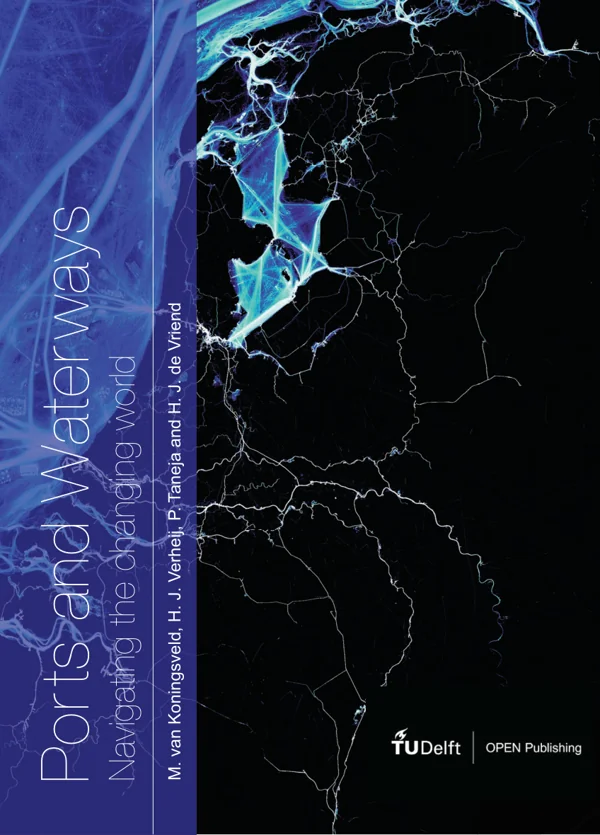
Revision 1473, 5 October 2026; four parts and eighteen chapters, 515 PDF pages. The source restarts chapter numbering in each part. The cover is taken from the linked 2026 PDF, and the original 2021 copyright is distinguished from its later revision date.
Book summary
Overview
Ports and Waterways: Navigating the Changing World treats waterborne transport as a connected system of vessels, ports, terminals, channels, infrastructure, and operations. The linked PDF is revision 1473, dated 5 October 2026, rather than only the original 2021 publication. Four parts contain eighteen chapters, with numbering restarting within each part. This guide covers those chapters individually. Mark van Koningsveld is identified as the principal editor, alongside Henk Verheij, Poonam Taneja, and Huib de Vriend and a wider contributing team. The text combines functional design, feasibility, simulation, safety, sustainability, and system performance.
How to study this book
Choose one conceptual cargo flow and follow it through every part of the book. Draw the transport chain, identify capacity constraints, and keep assumptions about demand, vessels, service times, and environmental conditions explicit. Separate functional requirements from detailed engineering dimensions. Compare alternatives using the same performance criteria and time horizon, including reliability, safety, environmental effects, and future adaptability. For simulation, verify movement and resource logic before interpreting performance statistics. The source’s exercises and examples develop system thinking; a real port or navigation design requires site data, applicable requirements, and specialist investigation.
Chapter and section study guide
Part I, Chapter 1 — Ports and Waterways Systems
Waterborne transport depends on interconnected physical and organizational elements rather than isolated facilities. Ports, channels, terminals, hinterland connections, vessels, and logistics services together determine whether cargo can move. A local improvement may have limited value if another link remains constrained. The chapter establishes system boundaries, functions, and scales for later analysis. Distinguish the infrastructure that exists from the service it is expected to provide. A useful first model traces flows, resources, interfaces, and actors before estimating capacity or proposing expansion.
Study application: Map a cargo journey from origin to destination and identify infrastructure, operations, and organizations at each interface.
Part I, Chapter 2 — A Constant Need for Change
Demand, vessels, technology, environmental expectations, and economic conditions continually reshape port and waterway needs. Infrastructure has long lives, so decisions made under uncertainty can create lock-in or opportunities for adaptation. The chapter relates system development to drivers of change rather than assuming a single stable future. Different stakeholders may value different outcomes and face different risks. Compare what is known, what can be influenced, and what remains uncertain. Flexible planning should be judged by its practical options and triggers, not merely by a claim that flexibility is desirable.
Study application: Create three plausible demand or technology scenarios and identify a design decision that would be difficult to reverse in each.
Part I, Chapter 3 — Connecting with the Next Parts
This transition chapter links the general system perspective with ports, waterways, and performance analysis. It clarifies how design elements and operating processes relate to the book’s wider objectives. A reader should be able to move from a system requirement to a component question and back to the overall service. Avoid optimizing a terminal, channel, or fleet measure without checking its consequence for the complete chain. The chapter provides a roadmap for combining technical descriptions with performance and feasibility rather than treating the remaining parts as separate subjects.
Study application: Turn one system objective into a terminal question, a waterway question, and a performance measure that connects both.
Part II, Chapter 1 — Challenges to Port Development
Port development involves spatial, economic, environmental, institutional, and operational constraints. A technically possible facility may face demand uncertainty, land competition, ecological effects, or weak connections to the wider transport system. The chapter encourages framing a development problem before selecting a favored project. Identify whose objectives matter and how alternatives distribute benefits and burdens. Constraints can interact, so solving one may intensify another. The relevant comparison is between feasible system strategies, including operational improvements, rather than only between different physical layouts.
Study application: Prepare a problem statement for a port expansion that separates demand, capacity, environmental, and stakeholder concerns.
Part II, Chapter 2 — Port Planning
Planning connects forecasts, objectives, alternatives, sequencing, and uncertainty over a long development horizon. Demand estimates should be treated as conditional inputs rather than certain outcomes. A plan needs room for adaptation while remaining specific enough to guide investments and operations. The chapter links port choices with regional transport and environmental context. Distinguish a strategic direction from the detailed design of an individual project. Compare alternatives through transparent criteria and explain when additional information would justify changing the plan.
Study application: Develop a staged expansion concept with a demand trigger, an operational alternative, and a decision point for reassessment.
Part II, Chapter 3 — Port Layout
A layout organizes navigation, basins, berths, terminals, access, and supporting areas to deliver required functions. Vessel characteristics, environmental conditions, safety, and connections constrain the arrangement. Geometric efficiency alone is insufficient if a layout creates operational conflicts or future inflexibility. The chapter develops functional reasoning before detailed dimensions. Trace how ships and cargo move through the proposed arrangement and identify crossing, waiting, and resource conflicts. A useful comparison explains why a geometry serves a stated requirement and what trade-offs it imposes elsewhere.
Study application: Sketch two conceptual layouts for the same functions and compare navigation conflicts, terminal access, and expansion possibilities.
Part II, Chapter 4 — Container Terminals
Container-terminal performance emerges from linked waterside, yard, and landside operations. Cranes, storage areas, transport equipment, gates, and information flows must work together. Increasing one resource may simply move the bottleneck to another stage. Variability in arrivals and handling times affects queues and utilization, so nominal equipment capacity is not the same as reliable throughput. The chapter connects functional layout with operating strategy and resource coordination. Evaluate performance using the complete process and identify the assumptions behind any capacity estimate.
Study application: Trace one container through a terminal and identify how a delay at each stage could affect the rest of the process.
Part II, Chapter 5 — Other Terminal Types
Different cargoes require different handling systems, storage arrangements, safety measures, and interfaces with vessels and inland transport. Bulk, liquid, and other terminal functions cannot be modeled by simply copying a container process. Cargo properties and transfer methods shape both infrastructure and operations. The chapter broadens terminal design reasoning while retaining the system perspective. Start with material flows and service requirements, then identify resources and constraints. Compare alternatives through cargo-specific performance and risk rather than a generic throughput figure alone.
Study application: Choose two cargo types and compare their handling process, storage needs, operational constraints, and environmental interfaces.
Part III, Chapter 1 — Waterway Transport
Waterways provide transport capacity through the interaction of vessels, routes, infrastructure, traffic, and operating conditions. The chapter connects navigation services with the wider logistics chain and distinguishes route characteristics from actual transport performance. Vessel size and loading affect both economics and infrastructure demands. A waterway can appear physically available while time restrictions, waiting, or reliability limit its usefulness. Study the full movement process, including access to terminals and interactions with other users. The analysis should keep the chosen vessel and service assumptions visible.
Study application: Describe a waterway transport service using route, fleet, loading, travel time, waiting, and connection requirements.
Part III, Chapter 2 — Dimensions of Waterways
Required waterway dimensions depend on vessels, water levels, maneuvering, traffic arrangements, environmental forces, and safety margins. A width or depth is meaningful only relative to those conditions. The chapter introduces functional dimensioning and the trade-offs involved in accommodating traffic. Distinguish the design vessel from the full fleet and separate a nominal geometric clearance from an operating allowance. Changes in vessel or water-level assumptions can alter feasibility. Educational calculations should make uncertainties and restrictions explicit rather than presenting one dimension as universally safe.
Study application: List the inputs needed to assess a conceptual channel’s width and depth, separating vessel geometry, environmental conditions, and operational allowances.
Part III, Chapter 3 — Waterway Elements
Channels, bends, crossings, locks, bridges, and related elements introduce distinct navigation and capacity constraints. Their arrangement affects the continuity of a route, not merely local passage. A single element can govern vessel size, waiting time, or operating windows for an entire corridor. The chapter links functional requirements with the behavior of vessels and traffic. Analyze both normal operation and interruptions. Comparing elements requires identifying their interfaces, resource needs, and consequences for upstream and downstream movements.
Study application: Map a corridor’s principal elements and explain which could become its limiting resource under increased demand.
Part III, Chapter 4 — Ship-waterway and Ship-ship Interactions
Vessel motion is affected by water depth, banks, nearby ships, and confined geometry. These interactions can change maneuvering demands and operational margins. The chapter connects physical behavior with navigation arrangements rather than treating a ship as a point moving through empty space. Speed, separation, vessel characteristics, and channel conditions all matter. Use the discussion to understand why apparently adequate geometric space may not imply unrestricted operation. A real assessment requires appropriate methods and site-specific evidence beyond a general textbook example.
Study application: Explain how changing speed or proximity to another vessel could alter the assumptions used in a confined-waterway movement plan.
Part III, Chapter 5 — Traffic Management
Traffic management coordinates movements to balance safety, efficiency, capacity, and other objectives. Rules, communication, information, scheduling, and human decisions interact with physical infrastructure. Restrictions can improve safety while reducing available movement opportunities, so their effects need system-level evaluation. The chapter encourages analyzing traffic processes and conflicts explicitly. Information does not automatically improve outcomes unless users can act on it. Compare an operational change with a physical expansion using common criteria and account for compliance, variability, and implementation demands.
Study application: Propose a conceptual traffic-management change and specify the conflict it addresses, the information required, and its possible capacity cost.
Part IV, Chapter 1 — Performance of Ports and Waterways
Performance must be defined relative to objectives such as capacity, efficiency, safety, sustainability, and reliability. Different users may evaluate the same system differently, and improving one measure can worsen another. The chapter turns the earlier design descriptions into assessable outcomes. Distinguish resources and activity from delivered service and consequences. A meaningful indicator needs a definition, boundary, unit, and time horizon. Avoid presenting utilization alone as success, since high utilization can also be associated with queues and fragile service under variable demand.
Study application: Create a balanced set of performance indicators and explain one trade-off that prevents maximizing all of them simultaneously.
Part IV, Chapter 2 — Performance Quantification
Quantification translates system questions into calculations, models, simulation, and interpretable evidence. Method choice depends on complexity, variability, available data, and the decision being supported. Verification checks whether a model behaves as intended; validation asks whether it adequately represents the relevant reality. Uncertainty in inputs and assumptions should remain visible in outputs. The chapter links analytical tools with practical performance questions. A precise numerical result can still be misleading if the model boundary, demand scenario, or operating logic does not match the problem.
Study application: Design a small simulation experiment with inputs, outputs, verification tests, validation evidence, and a sensitivity analysis.
Part IV, Chapter 3 — Ports and Terminals
Port and terminal performance requires connecting resources, arrival patterns, handling processes, storage, and onward movement. Variability creates waiting even where average demand appears below nominal capacity. A resource improvement should be tested within the full chain rather than judged by its isolated productivity. The chapter applies quantification to terminal questions and alternative designs. Compare service levels, throughput, utilization, and robustness together. Identify which constraints are physical, operational, or organizational so that the intervention addresses the mechanism actually limiting performance.
Study application: Compare adding equipment with changing an operating process, using waiting time, throughput, and downstream congestion as common outcomes.
Part IV, Chapter 4 — Waterways and Port Water Areas
Performance in waterways and water areas depends on navigation opportunities, traffic interactions, restrictions, and environmental conditions. A corridor or basin must be assessed as a sequence of movements using shared space and resources. Waiting and conflicts can emerge from timing even when individual elements appear adequate. The chapter applies system quantification to these interactions. State the fleet mix, demand pattern, operating rules, and water conditions before interpreting capacity. Evaluate reliability and safety-related restrictions alongside average travel time.
Study application: Model a conceptual access route with a restricted passing location and explain how arrival timing changes waiting and effective capacity.
Part IV, Chapter 5 — Performance of Port and Waterway Systems
The concluding substantive chapter integrates components into the performance of the complete transport system. Improvements must be evaluated across interfaces and over relevant scenarios because a bottleneck can move after intervention. Sustainability and adaptation add objectives beyond immediate throughput. The chapter encourages comparing coherent strategies rather than accumulating disconnected local optimizations. Explain how a design or operating change propagates through vessels, terminals, waterways, and connections. A defensible recommendation states its assumptions, uncertainties, distribution of effects, and conditions under which another strategy would become preferable.
Study application: Write a one-page system recommendation comparing two integrated strategies and identifying the evidence that would change your preferred option.
Reflection and review
- Why can higher equipment productivity fail to improve end-to-end service?
- How does demand variability change the meaning of capacity?
- Which decision could preserve useful options under uncertain future vessel or cargo requirements?
Source and edition notes
Revision 1473, 5 October 2026; four parts and eighteen chapters, 515 PDF pages. The source restarts chapter numbering in each part. The cover is taken from the linked 2026 PDF, and the original 2021 copyright is distinguished from its later revision date.
About access & copyright
This page provides book information and study material. Full-text access is provided by the original publisher or authorised source; a listing does not grant permission to republish the book.
Read our Library Access & Copyright policyExplore the contents
Check the chapters covered in this edition.
Visit the official source
See reading, preview or purchase options.
Save for later
Keep this textbook in your saved collection.
Reader ratings & reviews
Share your thoughts
Your review helps other students choose the right resources.
KEEP LEARNING
Your next great read
Civil Engineering Engineering & Technology
Building with Nature & Beyond: Principles for designing nature based engineering solutions
View Building with Nature & Beyond: Principles for designing nature based engineering solutions — book Applied
Introduction to Probability
View Introduction to Probability — book Civil Engineering
Basics of Fluid Mechanics
View Basics of Fluid Mechanics — book Business
Developing New Products and Services
View Developing New Products and Services — book Engineering & Technology
Notes on Diffy Qs: Differential Equations for Engineers
View Notes on Diffy Qs: Differential Equations for Engineers — book Electrical Engineering
Introduction to Linear, Time-Invariant, Dynamic Systems for Students of Engineering
View Introduction to Linear, Time-Invariant, Dynamic Systems for Students of Engineering — book Electrical Engineering
AC Circuits
View AC Circuits — book Electrical Engineering
DC Circuits
View DC Circuits — book Electrical Engineering



