
 Civil Engineering
Engineering & TechnologyTextbook
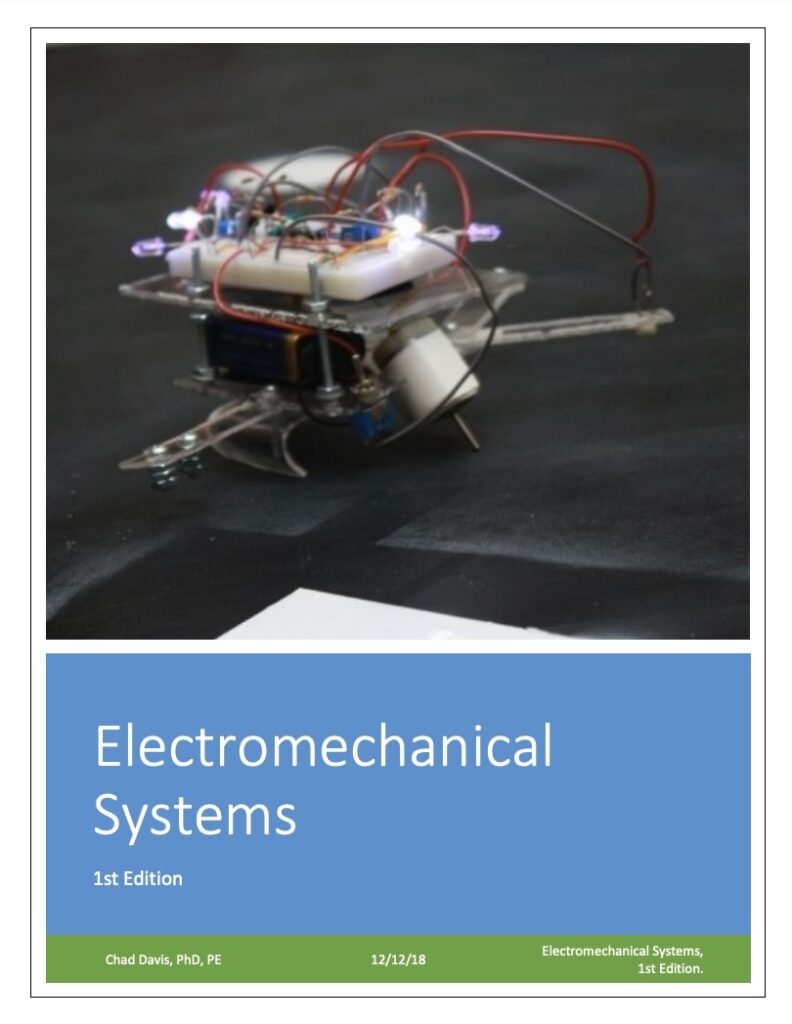
Electromechanical Systems
Not rated yetRate this bookChad E. Davis’s engineering resource introduces electromechanical topics for students outside electrical and computer engineering, connecting prior circuit study with systems projects.
Free reading is available at the official source. Opens in a new tab.
 Free
About this book
Chad E. Davis’s engineering resource introduces electromechanical topics for students outside electrical and computer engineering, connecting prior circuit study with systems projects.
This page introduces the source edition and offers a focused reading route. Use the linked original resource for the complete text, references, activities, and the author’s full explanation. The overview below is limited to the sections identified in the coverage note.
Contents and further reading
Consult the official book or repository page for the resource’s contents and publication information. Open the source PDF to read the complete available edition.
Sources and coverage
This original overview is based on Preface and source navigation information (PDF sheets 2 and 5), with repository metadata and contents checked. It is not a whole-book review. The verified source PDF contains 137 PDF sheets, including preliminary or repository pages; this may differ from its printed pagination. The source retains its own authorship, rights notices, and any separately credited third-party material.
Book summary
Chad E. Davis’s Electromechanical Systems links digital representation, measurement, sensors, electrical power, machines, and communications. Seven modules and a data-acquisition appendix build a systems view of the path from a physical quantity to a computer and back to controlled action. LabVIEW examples connect the concepts with implementation in the source teaching environment.
Chapter-by-chapter summaries
LabVIEW Overview
The overview introduces the graphical programming environment used to connect measurements and processing. Its role is practical: a system needs a way to acquire values, transform them, and communicate a result. Understanding data movement is more useful than memorizing the location of individual controls in a software interface.
Module 1: Number Systems and Character Encoding
Computers represent information through defined encodings. Number systems and character representations explain why a pattern of bits needs an interpretation before it becomes a useful value. The module establishes a foundation for later digital operations and communication, where the same stored pattern can have different meanings under different conventions.
Module 2: Digital Logic
Logic operations combine binary states into useful decisions and functions. The module moves from representation to the relationships that determine an output. Reading a circuit or expression requires identifying the inputs, the logical operation, and the conditions producing each result, rather than inferring behavior from a component's appearance.
Module 3: Measurement and Instrumentation Overview
A measurement system translates a physical condition into information that can be processed. Sensors, acquisition equipment, and software contribute different constraints. The module introduces the need to understand range, representation, and the relationship between an observed signal and the physical quantity being inferred.
Module 4: Sensors
Sensors respond to physical conditions through an observable change. Their usefulness depends on matching the sensing principle and output with the application. The chapter connects selection and interpretation: a numerical reading becomes meaningful only when the device's response, operating conditions, and limitations are understood.
Module 5: Power Systems
Power-system concepts distinguish the transfer of useful electrical energy from information-bearing signals. The module provides context for supplying and managing the energy required by electromechanical equipment. It also supports later reasoning about machines, where the source and form of electrical power affect system behavior.
Module 6: Electric Machines
Electric machines connect electrical and mechanical energy. Understanding their behavior requires relating supply, magnetic interactions, motion, and load. The module places individual machine concepts within the larger electromechanical system, making the operating condition and required task central to interpreting performance.
Module 7: Computer Communications
Communication connects devices and computers through shared conventions. A successful exchange requires more than a physical connection: information must be represented, transmitted, and interpreted consistently. The module brings earlier digital concepts into system integration and highlights the need to identify which layer of an exchange is responsible for a problem.
Appendix A: Data-Acquisition Inputs and Outputs
The appendix provides a practical route through digital, analog, and counter input/output work. These channels serve different kinds of tasks and should not be treated interchangeably. The steps become more useful when accompanied by a diagram explaining what is connected, what is measured or generated, and which quantity the software represents.
Study instructions
- Draw a complete sensor-to-computer-to-actuator chain and label the information and energy paths separately.
- For each module, explain how an incorrect representation or interface assumption could produce a misleading result.
- Use the assigned laboratory setup and instructor procedures to test one subsystem at a time.
- Record settings and units so another learner can reproduce a measurement and distinguish the physical response from software processing.
Sources and coverage
This original study guide follows the linked source edition and its chapters or explicitly identified sections. It condenses the main ideas and their relationships; examples and practice directions are for study alongside the complete text. Complete source edition.
About access & copyright
This page provides book information and study material. Full-text access is provided by the original publisher or authorised source; a listing does not grant permission to republish the book.
Read our Library Access & Copyright policyPrerequisites
Connect this book with prior circuit study.
Systems perspective
Relate individual topics to a complete application.
Simulation and observation
Explain assumptions before comparing results.
Version awareness
Check the repository’s corrections and updates.
Reader ratings & reviews
Share your thoughts
Your review helps other students choose the right resources.
KEEP LEARNING
Your next great read
Civil Engineering Civil Engineering
Ports and Waterways: Navigating the changing world
View Ports and Waterways: Navigating the changing world — book Engineering & Technology
Building with Nature & Beyond: Principles for designing nature based engineering solutions
View Building with Nature & Beyond: Principles for designing nature based engineering solutions — book Applied
Introduction to Probability
View Introduction to Probability — book Civil Engineering
Basics of Fluid Mechanics
View Basics of Fluid Mechanics — book Business
Developing New Products and Services
View Developing New Products and Services — book Engineering & Technology
Notes on Diffy Qs: Differential Equations for Engineers
View Notes on Diffy Qs: Differential Equations for Engineers — book Electrical Engineering
Introduction to Linear, Time-Invariant, Dynamic Systems for Students of Engineering
View Introduction to Linear, Time-Invariant, Dynamic Systems for Students of Engineering — book Electrical Engineering
AC Circuits
View AC Circuits — book Electrical Engineering



