
 Civil Engineering
Engineering & TechnologyTextbook
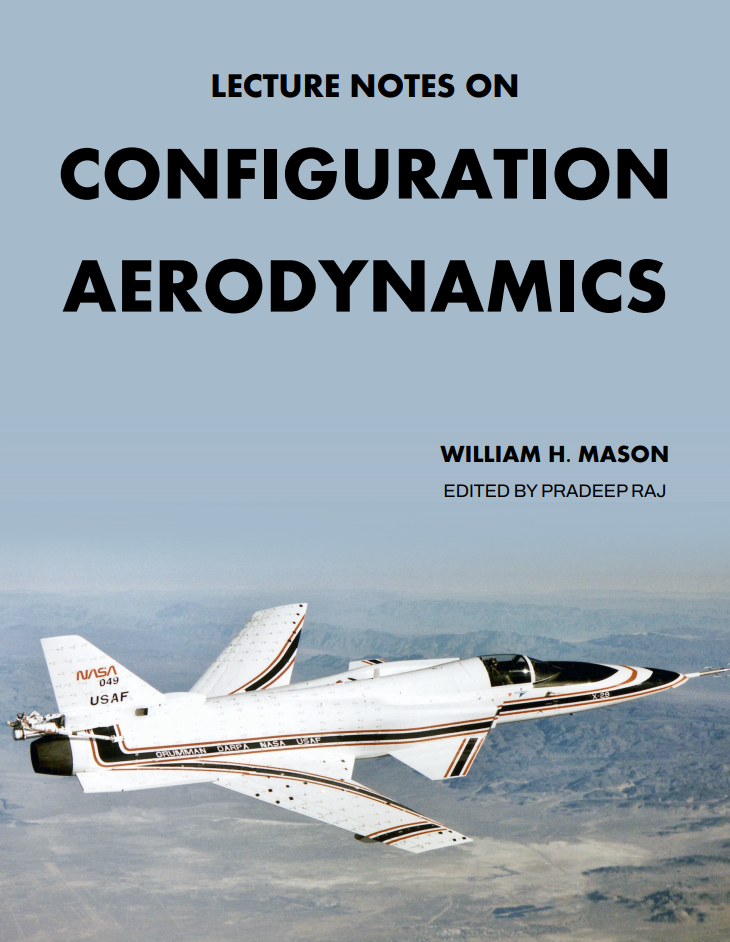
Configuration Aerodynamics
Not rated yetRate this bookWilliam H. Mason’s lecture notes, edited by Pradeep Raj, connect aerodynamic theory with aircraft-configuration design. The book emphasises physical understanding, engineering judgment, and the relationship among analytical, computational, and experimental approaches.
Read on the publisher’s website. Opens in a new tab.
 Free
About this book
The 2026 Lecture Notes on Configuration Aerodynamics is based on William H. Mason’s teaching manuscript, edited by Pradeep Raj. It is published by Virginia Tech’s Kevin T. Crofton Department of Aerospace and Ocean Engineering in association with Virginia Tech Publishing.
The official PDF contains 457 pages, including front matter; its numbered text ends on page 443. The contents address foundational fluid mechanics and drag, configuration design, flight regimes from subsonic to hypersonic, high lift, and high-angle-of-attack considerations. Appendices provide geometry, case-study, software, and reading resources.
The preface explains that much of the original material reflects the course through spring 2019, with editorial additions in the published book. The 2026 release date should therefore be distinguished from the dates of the original examples. Its intended readership includes advanced students preparing to apply aerodynamic theory.
The text is CC BY-NC-SA 4.0 with exceptions for credited components. The overview below covers the preface only and does not supply validated aircraft-design or operational instructions.
Book summary
William H. Mason’s Configuration Aerodynamics, edited for the 2026 publication by Pradeep Raj, connects aerodynamic theory with aircraft configuration decisions. Eleven chapters and seven appendices examine flow regimes, drag, computation, lift, and design resources. The sequence emphasizes why a configuration behaves as it does and which approximations are suitable, rather than treating a numerical prediction as a design explanation by itself.
Chapter-by-chapter summaries
Chapter 1: Configuration Aerodynamics
The opening frames aerodynamics as part of a configuration-design problem. Geometry, operating conditions, performance aims, and constraints interact. It establishes the need to connect theory with design judgment: an isolated improvement in one quantity may create costs elsewhere in the configuration.
Chapter 2: Governing Equations
Fluid-mechanics equations express conservation and the assumptions used to model flow. Their role is foundational, because different approximations retain or neglect different effects. The chapter prepares readers to ask whether a method represents the physics relevant to the configuration and operating condition being studied.
Chapter 3: Aerodynamic Drag
Drag is examined through its contributing mechanisms and the design choices affecting them. A useful analysis identifies what produces the resistance and how a proposed change alters it. The chapter discourages treating a total coefficient as sufficient explanation when different physical contributions can respond differently.
Chapter 4: Computational Aerodynamics
Computation provides design information when the method, geometry, conditions, and interpretation are appropriate. The chapter connects analysis capability with configuration decisions. A result requires assessment of assumptions and limitations; detailed output or numerical precision does not establish that the model answers the intended design question.
Chapter 5: Subsonic Airfoils and Wings
Subsonic flow connects section behavior with the three-dimensional wing and its configuration. The chapter develops the reasoning needed to understand lift, drag, and geometric choices within this regime. A local airfoil result should not be transferred unchanged to an entire aircraft without considering the additional relationships involved.
Chapter 6: Transonic Airfoils and Wings
Transonic conditions introduce flow features and sensitivities that change the design problem. The chapter connects those effects with airfoil and wing choices. It illustrates why an assumption useful at a lower speed can become inadequate when the operating regime changes, requiring a reconsideration of both method and geometry.
Chapter 7: High-Lift Aerodynamics
High-lift design addresses operating conditions where substantial lift is required within constrained speeds and configurations. The chapter relates devices and arrangements to the flow mechanisms they influence. Their benefits should be assessed alongside integration and other performance effects rather than as independent increases with no design cost.
Chapter 8: High-Angle-of-Attack Aerodynamics
At high angles of attack, flow behavior can differ substantially from the assumptions of simpler attached-flow analysis. The chapter connects separation, vortical behavior, and configuration effects. Understanding the regime is essential before interpreting a predicted force or extrapolating a trend from lower-angle results.
Chapter 9: Supersonic Aerodynamics
Supersonic flow requires attention to compressibility and the propagation of disturbances. The chapter connects these features with configuration choices and performance. It extends the earlier method-selection lesson: the physical regime changes which geometric relationships and analytical tools are most informative.
Chapter 10: Hypersonic Aerodynamics
The hypersonic discussion introduces another set of conditions affecting flow and design. It emphasizes the limits of transferring conclusions from other speed regimes without examining the relevant physics. The chapter places extreme operating conditions within the broader problem of selecting a configuration and an adequate model.
Chapter 11: End Note
The closing chapter reflects on the design-oriented sequence. Its value is cumulative: a reader should be able to connect a configuration decision with the flow mechanism, analytical assumption, and performance aim that justify it. Aerodynamic understanding remains a form of reasoned comparison rather than a collection of unrelated formulas.
Appendices: Geometry, Design, and Resources
The appendices address geometry, stealth considerations, regulations, design examples, software, and further reading. They connect analysis with practical representation and context. Use them to investigate a specific design question and to identify where a constraint or tool changes the problem being solved, rather than treating a resource list as a substitute for evaluating a method.
Study instructions
- For a configuration comparison, state the operating condition and performance objective before selecting a method.
- Explain the dominant flow mechanism and the assumptions that could invalidate the prediction.
- Compare a computed trend with a limiting case or another source of evidence.
- Use the design appendices to document a tradeoff and identify what additional analysis would be needed.
Sources and coverage
This original study guide follows the linked source edition and its chapters or explicitly identified sections. It condenses the main ideas and their relationships; examples and practice directions are for study alongside the complete text. Complete source edition.
About access & copyright
This page provides book information and study material. Full-text access is provided by the original publisher or authorised source; a listing does not grant permission to republish the book.
Read our Library Access & Copyright policyTheory and application
Explain the preface’s motivation for configuration-oriented study.
Physical insight
Relate a calculated result to the concept and assumptions behind it.
Complementary methods
Recognise the distinct contributions of analysis, computation, and experiment.
Historical context
Distinguish original course examples from the 2026 edited release.
Reader ratings & reviews
Share your thoughts
Your review helps other students choose the right resources.
KEEP LEARNING
Your next great read
Civil Engineering Civil Engineering
Ports and Waterways: Navigating the changing world
View Ports and Waterways: Navigating the changing world — book Engineering & Technology
Building with Nature & Beyond: Principles for designing nature based engineering solutions
View Building with Nature & Beyond: Principles for designing nature based engineering solutions — book Applied
Introduction to Probability
View Introduction to Probability — book Civil Engineering
Basics of Fluid Mechanics
View Basics of Fluid Mechanics — book Business
Developing New Products and Services
View Developing New Products and Services — book Engineering & Technology
Notes on Diffy Qs: Differential Equations for Engineers
View Notes on Diffy Qs: Differential Equations for Engineers — book Electrical Engineering
Introduction to Linear, Time-Invariant, Dynamic Systems for Students of Engineering
View Introduction to Linear, Time-Invariant, Dynamic Systems for Students of Engineering — book Electrical Engineering
AC Circuits
View AC Circuits — book Electrical Engineering



