
A Foundation Course in Reading German
HumanitiesTextbook
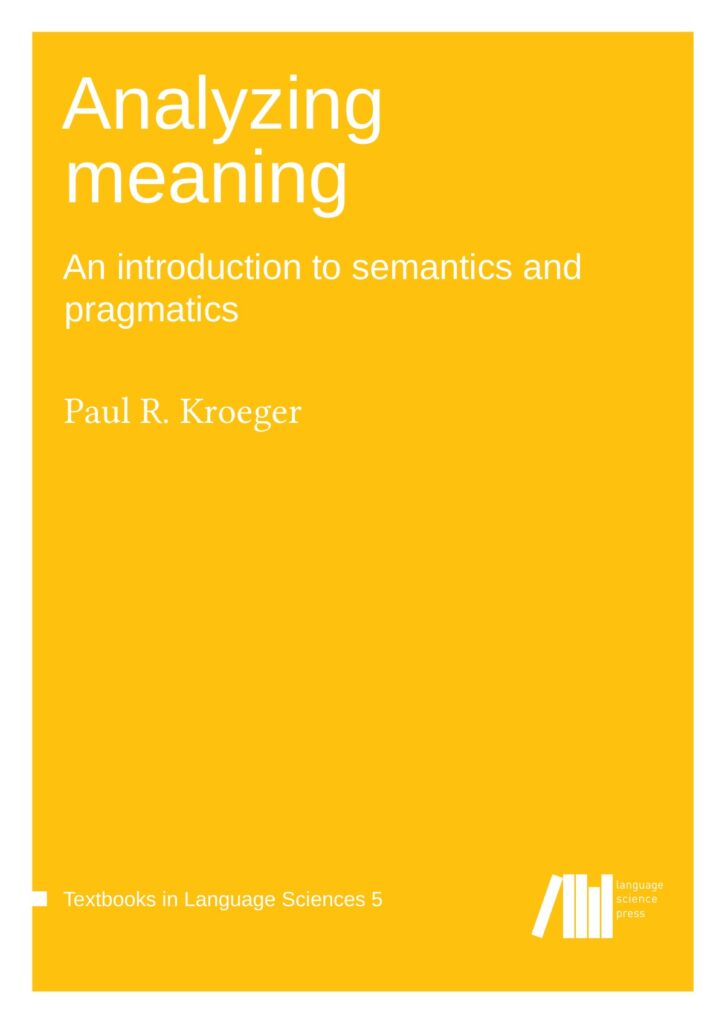
Analyzing meaning: An introduction to semantics and pragmatics
Not rated yetRate this bookAnalyzing meaning introduces semantics and pragmatics from a linguistic perspective. Paul R. Kroeger connects word meanings, context, composition, modality, causation, tense and aspect. The text is aimed at advanced undergraduates and beginning graduate students with prior linguistics study.
 Free
About this book
The preface describes a largely descriptive, non-formal approach, while introducing some logical notation. Previous study of morphology and syntax, together with familiarity with phonological concepts, is assumed; a prior course in formal logic is not. Six units organise the material, and the author stresses that later chapters depend on earlier ones. Exercises support discussion and homework, while selected chapters can be omitted to fit a course. The book also addresses fieldworkers preparing descriptions of under-documented languages. The hosted digital edition is published by Language Science Press in 2018.
The attached edition contains 502 PDF pages, including front matter. Cover: source edition cover rendered from the PDF. The textbook and its original notices are retained; Academic Master’s study material is separate from the source text.
Book summary
Study overview of the reviewed opening
Kroeger’s preface explains why semantics and pragmatics are taught together despite the breadth of each field. The book aims to provide a foundation for further study rather than exhaustive coverage. Its descriptive approach makes the subject accessible to linguistics students without requiring previous formal logic or set theory.
The assumed preparation is nevertheless substantial: students should have studied morphology and syntax and know some phonological terminology. The six-unit route moves from foundational ideas through word meaning and implicature into composition, modality, causation, tense and aspect. The preface emphasises cumulative reading because later chapters draw on earlier distinctions.
The resource also serves fieldworkers who need to discuss meaning carefully in grammatical descriptions. Translation and lexicography appear as possible applications, but they are not the main instructional focus. Exercises may be used for discussion or homework, and the preface identifies options for reducing a course’s scope. This page covers the preface and contents, not separate analyses of all semantic phenomena in the book.
Book contents
- 1 The meaning of meaning
- 2 Referring, denoting, and expressing
- 3 Truth and inference
- 4 The logic of truth
- 5 Word senses
- 6 Lexical sense relations
- 7 Components of lexical meaning
- 8 Grice’s theory of Implicature
- 9 Pragmatic inference after Grice
- 10 Indirect Speech Acts
- 11 Conventional implicature and use-conditional meaning
- 12 How meanings are composed
- 13 Modeling compositionality
- 14 Quantifiers
- 15 Intensional contexts
- 16 Modality
- 17 Evidentiality
- 18 Because
- 19 Conditionals
- 20 Aspect and Aktionsart
- 21 Tense
- 22 Varieties of the Perfect
- References
Questions for study
The following prompts are Academic Master’s editorial material.
- Why study semantics and pragmatics together?
- How can prior morphosyntax help with analysing meaning?
- What makes cumulative reading important for this course sequence?
Sources and coverage
Preface read in full (PDF pages 13–14); digital-edition identifiers, licence and contents checked.
About access & copyright
Check this edition’s source and licence before reusing its files or content. A library listing does not grant additional rights.
Read our Library Access & Copyright policyConnected fields
Recognise the joint semantic and pragmatic scope.
Prerequisites
Identify the expected linguistics background.
Cumulative concepts
Relate later topics to earlier distinctions.
Descriptive application
Connect meaning analysis with grammatical description.
Reader ratings & reviews
Share your thoughts
Your review helps other students choose the right resources.
KEEP LEARNING
Your next great read
Humanities
Intermediate Biblical Greek Reader: Galatians and Related Texts
Intermediate Biblical Greek Reader: Galatians and Related Texts
View Intermediate Biblical Greek Reader: Galatians and Related Texts — book Arts
Vocal Techniques for the Instrumentalist
View Vocal Techniques for the Instrumentalist — book Arts
Music on the Move
View Music on the Move — book Humanities
Advanced Community College ESL Composition: An Integrated Skills Approach
View Advanced Community College ESL Composition: An Integrated Skills Approach — book Humanities
Arguing Using Critical Thinking
View Arguing Using Critical Thinking — book Humanities
Philosophical Ethics
View Philosophical Ethics — book Arts
Brass Techniques and Pedagogy
View Brass Techniques and Pedagogy — book Humanities
Writing Fabulous Features
View Writing Fabulous Features — book Engineering & Technology



