
Abstract
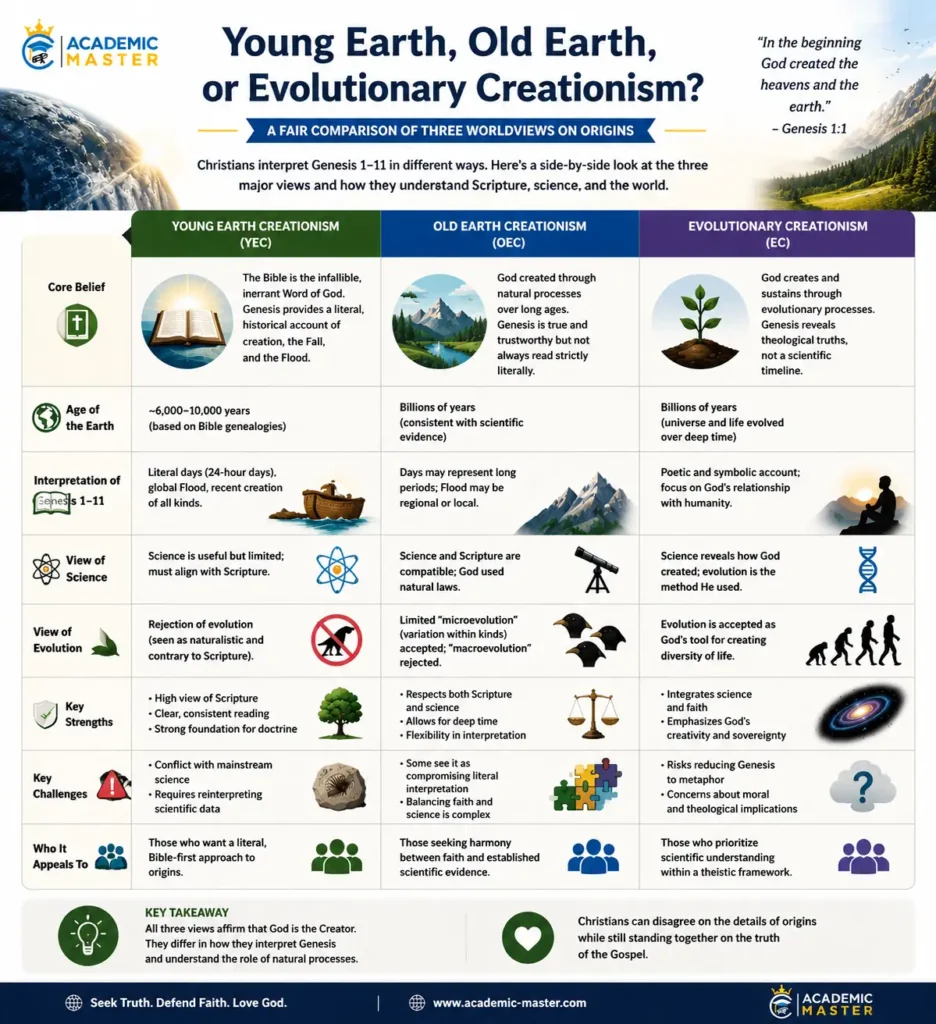
Christian discussions of origins include several distinct positions rather than a simple choice between religion and science. Young Earth creationism interprets the Genesis creation days as recent ordinary days and commonly explains much of the geological record through a global flood. Old Earth creationism accepts the scientific timescale for the universe and Earth while maintaining that divine creative action occurred through distinct interventions or stages. Evolutionary creationism accepts mainstream evolutionary science and understands evolution as compatible with belief in God as creator. This essay compares the biblical interpretation, scientific claims, theological concerns, and educational implications of these views. It distinguishes methodological science from broader philosophical naturalism and explains why mainstream science supports an ancient Earth, common ancestry, and evolutionary change. The essay argues that religious traditions may debate the theological interpretation of creation, but scientific claims presented in science education should be evaluated through testable evidence, explanatory power, and peer review. Respectful dialogue improves when participants state clearly whether a claim is theological, philosophical, historical, or scientific.
Keywords: young Earth creationism, old Earth creationism, evolutionary creationism, Genesis, evolution, science and religion
Introduction
Questions about the origin of the universe, Earth, life, and humanity involve science, philosophy, history, and theology. Conflict often arises when claims from these different domains are treated as though they use the same methods and answer the same questions (Scott, 2009).
Science investigates the natural world through observation, measurement, hypothesis testing, modeling, and critical review. Theology interprets revelation, religious tradition, and beliefs about God, purpose, creation, and human meaning. These approaches can interact, but they do not operate identically (National Academy of Sciences & Institute of Medicine, 2008; Collins, 2006).
Creationism is also not one unified position. Young Earth creationists, old Earth creationists, and evolutionary creationists disagree about biblical interpretation, natural history, and the extent to which scientific explanations describe divine creation. A fair comparison should represent each view accurately while distinguishing religious conviction from scientific consensus (Numbers, 2006; Scott, 2009).
Science and the Study of Origins
Historical sciences such as geology, cosmology, paleontology, and evolutionary biology investigate events that occurred in the past. They use evidence that remains in rocks, fossils, genomes, light, isotopes, and planetary motion. The events are not repeated in a laboratory, but hypotheses can generate testable predictions about independent evidence (National Academy of Sciences & Institute of Medicine, 2008).
For example, radiometric dating methods rely on measured decay rates and can be compared across different isotope systems. Evolutionary hypotheses predict patterns of genetic similarity, fossil succession, biogeography, and comparative anatomy. Confidence increases when independent methods converge (National Academy of Sciences & Institute of Medicine, 2008).
Science uses methodological naturalism, meaning that scientific explanations seek causes that can be investigated through natural evidence. This method does not itself prove philosophical naturalism, the broader belief that only nature exists. Science as a discipline does not test the existence or nonexistence of God (National Academy of Sciences & Institute of Medicine, 2008; Scott, 2009).
Young Earth Creationism
Young Earth creationism generally holds that the universe, Earth, and major forms of life were created within a recent period, often estimated through biblical genealogies as thousands rather than billions of years. The six days of Genesis 1 are usually interpreted as ordinary consecutive days (Numbers, 2006; Scott, 2009).
Many young Earth models treat the flood described in Genesis as a global event responsible for much of the sedimentary geological record and fossil distribution. Human beings are understood as separately created rather than sharing common ancestry with other life (Numbers, 2006; Scott, 2009).
The theological motivation often includes concern that nonliteral readings weaken biblical authority, the historical fall, doctrines of sin and death, or the uniqueness of humanity. Young Earth advocates argue that Scripture should guide interpretation of natural evidence (Numbers, 2006).
Young Earth Scientific Claims
Young Earth organizations develop models involving flood geology, accelerated processes, created maturity, and alternative interpretations of radiometric dating and fossils. These claims are presented as creation science by their supporters (Numbers, 2006; Scott, 2009).
Mainstream geology, physics, astronomy, and biology do not accept a recent Earth because multiple independent evidence lines support deep time. These include radiometric dating, ice cores, tree-ring sequences, plate tectonics, coral growth, sedimentation, stellar physics, and observations of distant light (National Academy of Sciences & Institute of Medicine, 2008).
A global recent flood does not adequately explain the ordered fossil succession, ecological distributions, multiple sedimentary environments, ancient reefs, soil horizons, and geological structures observed across the world. Creationist explanations often begin with a fixed conclusion and reinterpret evidence within that framework, which differs from the open-ended testing expected in science (National Academy of Sciences & Institute of Medicine, 2008; Scott, 2009).
Old Earth Creationism
Old Earth creationism accepts that the universe and Earth are ancient. It includes several approaches. Day-age interpretation understands the Genesis days as long periods. The framework view treats the creation account as a literary arrangement rather than a scientific chronology. Progressive creationism proposes that God introduced forms of life at different stages over deep time (Numbers, 2006; Walton, 2009).
Old Earth creationists commonly accept mainstream cosmology and geology while questioning universal common ancestry or the sufficiency of evolutionary mechanisms for major biological innovation. Some accept limited evolution within created groups while rejecting human common ancestry (Numbers, 2006; Scott, 2009).
This position seeks to preserve direct divine creative activity while accepting strong evidence for the scientific age of the cosmos and Earth (Collins, 2006).
Strengths and Challenges of Old Earth Creationism
Old Earth creationism avoids the conflict between a recent chronology and extensive physical evidence for deep time. It also reflects the fact that nonliteral interpretations of the Genesis days existed before modern evolutionary theory (Walton, 2009).
Its scientific challenge concerns the identification of distinct creative interventions. A scientific model should specify when intervention occurred, what evidence distinguishes it from evolutionary processes, and what testable predictions follow. When divine action is invoked only where current knowledge is incomplete, the explanation risks becoming a “God of the gaps” argument that changes as science advances (National Academy of Sciences & Institute of Medicine, 2008; Scott, 2009).
Old Earth creationism is best understood as a theological interpretation that accepts portions of mainstream science while disputing others (Scott, 2009).
Evolutionary Creationism
Evolutionary creationism, also called theistic evolution in some contexts, accepts the scientific account of an ancient universe and biological evolution while affirming that God is the creator and sustainer of reality. Evolution describes the process through which biological diversity developed, not an ultimate explanation of why existence has meaning or purpose (Collins, 2006).
Evolutionary creationists generally accept common ancestry, natural selection, genetic drift, mutation, speciation, and other evolutionary mechanisms. They may interpret Adam and Eve in historical, archetypal, representative, genealogical, or other theological ways. There is significant diversity within the position (Collins, 2006; National Academy of Sciences & Institute of Medicine, 2008).
This approach distinguishes claims about natural process from theological claims about divine action. God’s use of natural processes is not regarded as absence from creation, just as theological belief in providence does not require rejection of meteorology or embryology (Collins, 2006).
Scientific Basis of Evolution
Evolution is change in inherited characteristics of populations across generations. Common ancestry proposes that living organisms are related through branching descent. Natural selection is one mechanism, while mutation, genetic drift, gene flow, recombination, and developmental constraints also contribute (National Academy of Sciences & Institute of Medicine, 2008).
Evidence comes from several independent fields. Fossils document succession and transitional forms. Comparative anatomy reveals homologous structures. Biogeography shows patterns associated with isolation and geological history. Genetics demonstrates nested similarities, shared genes, and patterns expected from descent (National Academy of Sciences & Institute of Medicine, 2008).
Evolutionary biology does not claim that individuals evolve because they need to change or that evolution always produces progress. Populations change, and adaptations depend on environment and history (National Academy of Sciences & Institute of Medicine, 2008; Scott, 2009).
Age of the Universe and Earth
Modern cosmology estimates that the universe is approximately 13.8 billion years old. Geological and radiometric evidence places Earth at approximately 4.54 billion years. These estimates are not derived from one disputed measurement (National Academy of Sciences & Institute of Medicine, 2008).
Radiometric dating uses predictable decay of unstable isotopes. Different methods apply to different materials and timescales. Cross-checking among methods and geological context strengthens reliability. Scientific estimates include uncertainty, but the uncertainty is not large enough to make a recent Earth plausible (National Academy of Sciences & Institute of Medicine, 2008).
Genesis and Literary Context
Interpretation of Genesis depends on language, genre, ancient context, canonical relationships, and theology. Readers disagree about whether the creation days are chronological, analogical, literary, or theological (Walton, 2009).
The text emphasizes God as creator, the order and goodness of creation, human responsibility, and Sabbath. It was not written using modern scientific categories. Recognizing literary and ancient context does not necessarily imply that the text is unimportant or untrue; it concerns the kind of truth the passage intends to communicate (Walton, 2009).
Young Earth interpreters argue that the repeated references to evening and morning and the Sabbath command support ordinary days. Other interpreters note the literary structure, theological symbolism, and differences between ancient and modern accounts of nature (Numbers, 2006; Walton, 2009).
Death and Suffering
A major theological objection to evolution concerns death before human sin. The fossil record indicates that organisms died long before humans appeared. Young Earth theology often links all animal death to the fall (Numbers, 2006; National Academy of Sciences & Institute of Medicine, 2008).
Other traditions distinguish human spiritual death from biological mortality or argue that animal death was part of ecological creation. Evolutionary creationists must still address the theological problem of suffering, predation, extinction, and divine goodness (Collins, 2006).
Science can describe the history of death and life but does not resolve the theological meaning of suffering (Collins, 2006).
Human Uniqueness
Christian theology commonly teaches that humans bear the image of God. Young Earth and many old Earth creationists connect this status to separate biological creation. Evolutionary creationists argue that theological uniqueness need not require biological discontinuity (Collins, 2006).
Science can investigate human ancestry, cognition, behavior, and genetics. It cannot measure divine image or spiritual vocation. Human common ancestry with other organisms does not by itself determine moral worth (Collins, 2006; National Academy of Sciences & Institute of Medicine, 2008).
Ethical misuse of evolutionary ideas, including racism and social Darwinism, should be condemned. Such ideologies do not follow necessarily from biological evolution and often distort science for political purposes (Scott, 2009).
Intelligent Design
Intelligent design argues that some features of life are best explained by an intelligent cause rather than undirected processes. It often avoids identifying the designer and focuses on concepts such as irreducible complexity or specified information (Scott, 2009).
Critics argue that intelligent design has not produced a sufficiently testable research program and often treats current scientific gaps as evidence of design. Courts in the United States have also examined its religious origins in public-school disputes (Scott, 2009; National Academy of Sciences & Institute of Medicine, 2008).
Philosophical or theological arguments for design can be discussed in appropriate courses. The question for science education is whether the proposal functions as a testable scientific explanation (National Academy of Sciences & Institute of Medicine, 2008).
Science Education
Science classrooms should teach the methods and conclusions of science. The National Academies state that evolution is a central organizing principle of modern biology and that creationism does not provide a scientific alternative (National Academy of Sciences & Institute of Medicine, 2008).
Teaching evolution does not require schools to declare religious belief false. Educators can explain that many religious communities accept evolution and that scientific questions are evaluated through evidence (American Association for the Advancement of Science, 2006; National Academy of Sciences & Institute of Medicine, 2008).
Presenting a religious doctrine as scientifically equivalent to evolution creates false balance. Students should learn genuine scientific debates concerning mechanisms, rates, evolutionary history, and unresolved questions without being told that the existence of unanswered questions invalidates the field (American Association for the Advancement of Science, 2006; National Academy of Sciences & Institute of Medicine, 2008).
Public Dialogue
Constructive dialogue requires accurate representation. Evolution should not be described as a claim that life arose purely by chance, because natural selection is nonrandom with respect to differential reproduction. Creationists should not be treated as one group with identical beliefs (National Academy of Sciences & Institute of Medicine, 2008; Scott, 2009).
Participants should identify the type of claim being made. “God created the world” is theological. “The Earth is less than ten thousand years old” is also a claim about physical history and can be compared with scientific evidence. “Science proves there is no God” is a philosophical claim exceeding the method of science (National Academy of Sciences & Institute of Medicine, 2008; Scott, 2009).
Respect for people does not require treating all factual claims as equally supported.
Areas of Agreement
The three positions usually affirm that the universe is dependent on God, nature is worthy of study, humans have moral responsibilities, and creation has order. They often support scientific investigation even while disagreeing about conclusions.
Recognizing agreement can improve dialogue, but significant differences remain concerning biblical authority, method, human origins, death, and divine action. These differences should not be hidden through vague language (Collins, 2006; Scott, 2009).
Comparison of the Three Views
| Issue | Young Earth creationism | Old Earth creationism | Evolutionary creationism |
|---|---|---|---|
| Age of Earth | Thousands of years | Approximately 4.54 billion years | Approximately 4.54 billion years |
| Genesis days | Usually ordinary days | Long ages or literary framework | Usually literary or theological framework |
| Global flood | Major explanation of geology | Often local or theologically interpreted | Not used as a global geological model |
| Common ancestry | Rejected | Often partly or largely rejected | Accepted |
| Main scientific relationship | Rejects mainstream deep time and evolution | Accepts deep time with selective disagreement | Accepts mainstream cosmology, geology, and evolution |
Conclusion
Young Earth, old Earth, and evolutionary creationism represent distinct efforts to relate Christian theology to natural history. Young Earth creationism prioritizes a recent literal chronology but conflicts with extensive evidence from astronomy, geology, physics, and biology. Old Earth creationism accepts deep time while maintaining varying forms of direct creative intervention. Evolutionary creationism accepts mainstream evolutionary science and interprets it within belief in divine creation.
Science does not determine every theological question, but physical and biological claims should be evaluated by scientific evidence. Respectful dialogue becomes possible when participants distinguish science from philosophy and theology, represent opposing views accurately, and avoid false equivalence. Religious faith and acceptance of evolution are not inherently incompatible, although traditions continue to debate how they should be related.
References
American Association for the Advancement of Science. (2006). Statement on the Teaching of Evolution.
Collins, F. S. (2006). The Language of God. Free Press.
National Academy of Sciences and Institute of Medicine. (2008). Science Evolution and Creationism. National Academies Press.
Numbers, R. L. (2006). The Creationists. Harvard University Press.
Scott, E. C. (2009). Evolution vs Creationism (2nd ed.). University of California Press.
Walton, J. H. (2009). The Lost World of Genesis One. IVP Academic.
Cite This Work
To export a reference to this article please select a referencing stye below:

Academic Master Education Team is a group of academic editors and subject specialists responsible for producing structured, research-backed essays across multiple disciplines. Each article is developed following Academic Master’s Editorial Policy and supported by credible academic references. The team ensures clarity, citation accuracy, and adherence to ethical academic writing standards
Content reviewed under Academic Master Editorial Policy.





