
Abstract
PMEDM, or powder mixed electrical discharge machining, is a method of removing material that makes use of solid semi-conductive particles. The current study presents an experimental investigation of Powder Mixed EDM for Super Alloys like Inconel 718 and Titanium (Ti6Al4V), which are extremely challenging to machine due to characteristics like limited heat conductivity, a strong tendency for built-up edges, and great corrosion resistance. Additionally, it is machined utilizing the Z-axis numerically controlled electrical discharge machining (ZNC) technique. When EDM oil is utilized as the dielectric fluid, silicon carbide (SiC) powder is employed as an electrically conductive powder to increase the spark gap distance between the tool electrode and the workpiece while decreasing the dielectric fluid’s insulating strength. This article considers process factors including peak current (Ip), pulse-on time, pulse-off time, powder concentration, etc. To gauge the effectiveness of EDM, performance measures such as Material Removal Rate (MRR), Tool Wear Ratio (TWR), and Surface Roughness (SR) are determined. Based on the Taguchi orthogonal array with three levels and three factors, the number of experiments conducted is nine. When designing experiments, the Taguchi technique is applied, and Minitab 19 is utilized for the analysis. In this experiment, the L9 orthogonal array is employed with varying degrees of process parameters. L9 orthogonal array appropriate for testing powder mixed EDM Along with the created outlet pump mechanism for removing the Dielectric fuel from the tank, stirrer mechanisms are employed to prevent powder from collecting at the bottom of the EDM tank. Increased MRR, decreased TWR, improved surface roughness (SR), and lower machining costs are anticipated as a result. MRR, SR, and TWR increased as a result of a higher duty cycle. TWR varies effectively when pulse-on-time MRR initially drops and then rises. Powder concentration of 10g/l, peak current of 6A, and pulse on time of 230 s are the optimal values of the different parameters determined in the current study for MRR. Powder concentration of 10g/l, Peak current of 6A, and Pulse on time of 230 s are the optimal values of the different parameters determined in the current study for SR.
Keywords: EDM, PMEDM, MRR, SR, Taguchi Method, Ti6Al4V.
Introduction
One of the widely utilized non-conventional material removal procedures is electrical discharge machining (EDM). It can be used to successfully machine electrically conductive parts, regardless of how tough or hard they are. Despite the impressive process capabilities, EDM has drawbacks such limited volumetric material removal and subpar surface quality. The mixing of a suitable abrasive and metallic material in powder form into the dielectric fluid is one of the latest advancements for improving the innovations and enhancement capabilities of the EDM process. The name of this procedure is powder mixed EDM. Through a sequence of quickly repeated current discharges between two electrodes separated by a dielectric fluid and subjected to an electric voltage, material is removed from the workpiece. In this procedure, the EDM’s dielectric fluid is combined with a suitable material in fine powder form (such as silicon carbide, graphite, copper, or aluminum). There are additive particles along the spark gap. The performance of the EDM process is strongly impacted by the additional powder. The electrically conductive powder lengthens the spark gap between the tool electrode and workpiece and weakens the dielectric fluid’s insulating properties. The process becomes steadier as a result, which enhances the machining rate (MRR) and surface quality. EDM recently developed powder mixed EDM to improve its capabilities.
Super alloys like Inconel 718 and Hastelloy C-276 are extremely challenging to machine because of characteristics including limited thermal conductivity, a strong tendency for built-up edges, and great corrosion resistance. There is a research gap here. The objective of this research is to study the effect of various input parameters i.e., pulse on time, peak current on Material Removal Rate (MRR), Surface Roughness (SR) and Tool wear rate(TWR). This study’s goal is to examine how different SiC powder concentrations affect tool wear, surface roughness, and material removal rate (MRR) (TWR). Additionally, the construction of the stirrer mechanism to prevent powder from settling at the bottom of the EDM tank.
Literature Review
Ayanesh Y. Joshi et. al. [1] presented, the surface properties of the powder mixed electro-discharge machining (PMEDM) technique for the titanium alloy Ti6Al4V are examined utilising alumina and carborundum abrasive powder added dielectric fluid. To create an environmentally safe machining environment and reduce the emanation of dangerous compounds, deionized water is used as the dielectric. Pulse ON/OFF time (TON/TOFF), discharge current (IP), and powder concentration are the process variables utilised to examine performance factors such as surface finish, rate of material removal, and tool wear (PC). Grey relational analysis (GRA) has been used to do multi-response optimization in order to determine the ideal parametric combination of process factors that results in the best surface quality and minimal tool wear. The findings show that important factors affecting material removal rate (MRR), tool wear rate (TWR), and surface finish are discharge current (IP) and powder concentration (PC). By using a scanning electron microscope, the surface features were examined to determine the best parameter setting. Surface roughness and tool wear rate are reduced to their lowest values at IP = 06 amps, TON = 05 s, TOFF = 96 s, and PC = 0.50 g/L. Process engineers might achieve increased PMEDM machining performance, economically and with the necessary surface qualities, with the help of the optimised set of parameters. Venkata N. Raju Jampana et. al. [2] presented that the purpose of this article is to perform a thorough experimental and thermal investigation of the EDM that can predict the machining characteristic and then optimise the output parameters using a newly integrated neural network-based methodology for modelling and optimal selection of process variables involved in the powder mixed EDM (PMEDM) process. A series of studies were carried out on a specially constructed experimental setup established in the lab to compare and evaluate the impacts generated by powder of varying thermal physical properties on the process performance of EDM with each other. In order to assess the process performance in terms of material removal rate (MRR) and surface roughness, peak current, pulse period, and source voltage are chosen as the independent input parameters (Ra). Additionally, the stainless steel 630 (SS630) grade EDM thermal analysis is done using the finite element method (FEM). To identify the best fit and approximation solutions to optimization and search issues, back propagating neural network (BPNN) with feed forward architecture and analysis of variance (ANOVA) is utilised. Rafiqul Haque et. al. [3] presented through an experimental investigation, the machining performance of the PMEDM method on Ti-6Al-4V alloy using copper (Cu) powder in the EDM oil dielectric is examined. The analysis of variance (ANOVA) was carried out using Minitab-19 software using Taguchi’s L18 orthogonal array design for the design of experiments. The Taguchi-Gray Relational Analysis (GRA) integrated technique has been used to find the best parametric setting for Cu powder mixed EDM. Experimentation has also been used to validate the best parametric setting. With the use of this PMEDM technology, a revolutionary method for machining Ti6Al-4V alloy, the surface quality has been greatly enhanced by the addition of an appropriate quantity of Cu powder to the dielectric medium. Hardaha Rajkumar et. al. [4] A non-traditional machining method called electrical discharge machining is used to cut exceedingly hard and intricate geometric patterns out of conductive materials that can’t be cut out using a traditional machining method. EDM has played a significant role in the tool and die industry’s manufacturing processes for many years. Several researchers have tried using dielectric fluid suspended with various particles to enhance the performance of EDM. Further studies in this area revealed that the spark gap between the tool and workpiece increases when electrically conductive powder is combined with the dielectric fluid. This diminishes the dielectric fluid’s insulating strength. As a result, the process is more stable, and the MRR and workpiece surface polish both improve. In this review study, an effort has been made to determine the impact of various powders mixed with the dielectric on PMEDM performance parameters. The research gap for additional research and scope in this area has also been noted by the authors. Chander Prakash et. al. [5] presented the application of powder mixed electrical discharge machining (PM-EDM) for the machining of -phase titanium (β-Ti) alloy has been proposed. Ti alloys are a novel class of titanium alloys that are widely used in dentistry, orthopaedic, shape-memory, and stent applications. The current study’s objective is to create sub micro and nanoscale topography using the PMEDM technique in order to improve biocompatibility without sacrificing machining effectiveness. Investigations have been done into the impact of pulse-current, pulse duration, and Si powder concentration on surface and machining properties.
Materials and Methods
Materials:
The Ti6-Al4-V grade 5 material is chosen for workpiece that has thickness of 3 mm and 60 mm diameter. As per the research analyzed from the various research papers, it has been found that silicon carbide offers useful properties compared with other powder materials. SiC powder offers special qualities such a strong resistance to oxidation and corrosion, superior thermal conductivity, a low coefficient of thermal expansion, and mechanical stability at higher temperatures. SiC is therefore chosen as the powder material. The material chosen for the electrode is copper. The electrodes are made in a set of 8 pieces, with 8 mm in diameter and 100 mm long as shown in fig. 1. The electrode’s melting point is 1085°C, and its polarity is positive. As a dielectric fluid, EDM oil is utilized.
Table 1: Chemical composition of TI6-Al4-V Material
Content | H2 (Bar ) | H2 (Sheet ) | N2 | C | O2 | Fe | Al | V | Ti |
|---|---|---|---|---|---|---|---|---|---|
Percentage | <0.0125% | <0.015% | <0.05% | <0.08% | <0.2% | <0.25% | 0.5-6.76% | 3.56-4.6% | Balance |
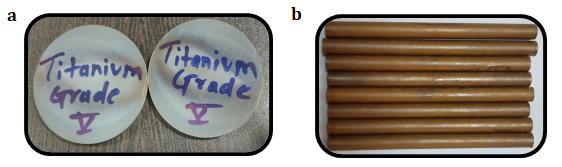
Figure 1. (a) Ti6Al4V workpieces and (b) copper electrodes.
Table 2: Mechanical properties of SiC
Property | Details |
|---|---|
Density | 3.21 g/cm³ |
Melting point | 2,730 °C |
Specific heat | 1800 j/kg-k |
Thermal conductivity (@300 K) | 490 W⋅m−1⋅K−1 |
Specific heat | 1800 j/kg-k |
Process Parameters:
Peak current and pulse on time are the primary EDM process parameters, according to the literature. The pulse current Ip (4, 6, 8 A), the pulse on time Ton (200, 230 and 260 µs), the pulse off time Toff (28.6 µs), the SiC powder concentration (5, 10 and 15 g/l).
Table 3: Input process parameters with levels.
Sr. no. | Process parameter | Symbol (Unit) | Levels | ||
|---|---|---|---|---|---|
1 | 2 | 3 | |||
1 | Pulse on time | Ton (μs) | 200 | 230 | 260 |
2 | Discharge Current | Ip (A) | 4 | 6 | 8 |
3 | Powder Concentration | P.C. (g/l) | 5 | 10 | 15 |
Performance measurements:
The performance parameters are surface roughness (SR), material removal rate (MRR) and tool wear rate (TWR). The MRR is defined as the material weight to be removed from the workpiece per minute during the machining process.
where Wb denotes the weight of the workpiece prior to machining, Wa is the workpiece’s weight after machining, is workpiece density and Tm is the time required for machining.
Similarly, TWR is defined as the material weight to be removed from the electrode during a time span in minutes.
where denotes the electrode weight prior to machining, is the electrode’s weight after machining, is electrode density and Tm is the time required for machining.
Surface Roughness is a measure of roughness on the surface and is expressed in micrometers (μm). The surface is rough if the value is more; smooth if the value is less. Ra denotes the surface roughness and is assessed with a surface roughness tester.
Design of Experiments:
The field of applied statistics dealing with the design, implementation, examination, and clarification of precise tests to investigate variables that influence the values of parameters or combinations of parameters is acknowledged as design of experiments (DOE). Taguchi’s approach reduces process variance through a strong design of experiment. The overall goal of this process is to provide manufacturers with reliable products at affordable prices. The Taguchi technique of experimental design necessitates the use of orthogonal arrays for vary the factors that impact the procedure and the levels that are changed. Arrays are selected based on the number of parameters and their states. Parameters selected as inputs include pulse-on time, peak current, and SiC powder concentration based on research literature and initial investigation trials depending on machine configuration. L9 orthogonal arrays are used in 3-factor, 3-level factorial experiments.
Taguchi approach requires evaluating the signal-to-noise ratio (S/N) of each processing parameter level for each output function to determine the optimal processing settings. The highest S/N for the analyzed machining parameter level means the ideal level. A higher signal-to-noise ratio (S/N) value indicates a control factor setting that reduces the effect of the noise component.
Experimental Setup
The EDM experiments were conducted on Electronica India ZNC 6040 Series EDM machine with all the manufactured attachments shown in Figure 2. A zinc plated mild-steel tank of about 30 liters volume and overall dimensions 450 x 250 x 253 mm with thickness of 3 mm is manufactured. It contains a EDM oil dielectric pump, an electric motor (1000 RPM) connected to a mixture containing a stainless-steel impeller, a workpiece clamping fixture, valves and pipe accessories. For the power supply, an AC/DC converter for driving the special EDM oil pump was attached to an electrical board. This board also contains a pressure gauge, wiring, switches and piping accessories. The manufacturing of the stainless-steel container was completed by using the TIG argon inert gas welding process, as shown in Figure 2. The average grain size is 95.502 µm for silicon carbide powder with density 3.21 g/cm³ and melting point is 2,730 °C. Thermal conductivity @ 300 K is 490 (W⋅m−1⋅K−1).
The surface roughness characteristics for each workpiece (9 specimens) and electrode before and after EDM and PMEDM machining are measured by using the portable surface roughness tester.
All the w/p specimens and electrodes are weighed before and after EDM machining by using the electronic weighing balance of 500 grams capacity with accuracy of (0.01g).
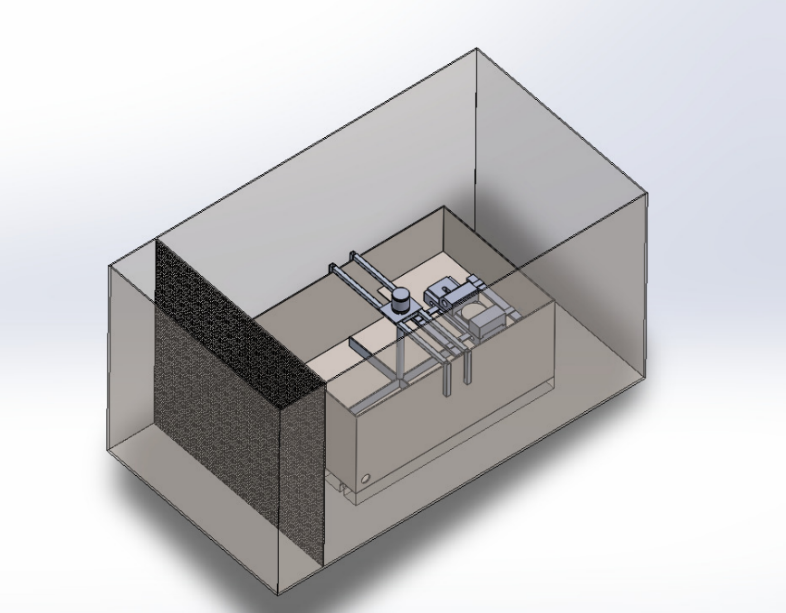
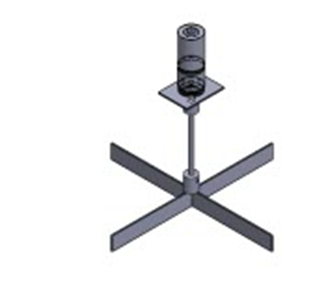
Stirrer Mechanism is used to stir the mixture of Silicon Carbide and Dielectric fluid use in powder mixed EDM Height of stirrer and mounting of it is according to tank dimension (250*450) And mounting of the mechanism should be side alignment because of the centre assembly of EDM process. When the EDM process starts the main role of the stirrer mechanism is to maintain proper concentration by stirring that mixture continuously by rotating the claw.
Figure 2. (a) Powder-mixed EDM tank arrangement and (b) stirrer assembly.
Results
The surface roughness (SR), the material removal rate (MRR), which are experimentally measured and calculated using above equations after machining with the input parameters are modeled by using the Taguchi Method and the three-level factorial design. The input EDM parameters and their levels are given in Table 4. The 9 experiments were conducted and design matrix response table were tabulated along with the average values of MRR, TWR and SR.
Table 4 Response table
Sr. No. | PC | Ton | Ip | MRR | TWR | SR |
|---|---|---|---|---|---|---|
1 | 5 | 200 | 4 | 75.519 | 2.4760 | 3.297 |
2 | 5 | 230 | 6 | 57.444 | 1.9808 | 2.540 |
3 | 5 | 260 | 8 | 85.423 | 2.9712 | 5.607 |
4 | 10 | 200 | 6 | 56.241 | 0.0000 | 6.203 |
5 | 10 | 230 | 8 | 65.367 | 2.9712 | 8.753 |
6 | 10 | 260 | 4 | 21.665 | 0.0000 | 5.173 |
7 | 15 | 200 | 8 | 60.250 | 0.0000 | 5.817 |
8 | 15 | 230 | 4 | 33.427 | 2.1223 | 5.920 |
9 | 15 | 260 | 6 | 47.045 | 1.9808 | 8.133 |
The impact on the workpiece by machining process is shown in Figure 3
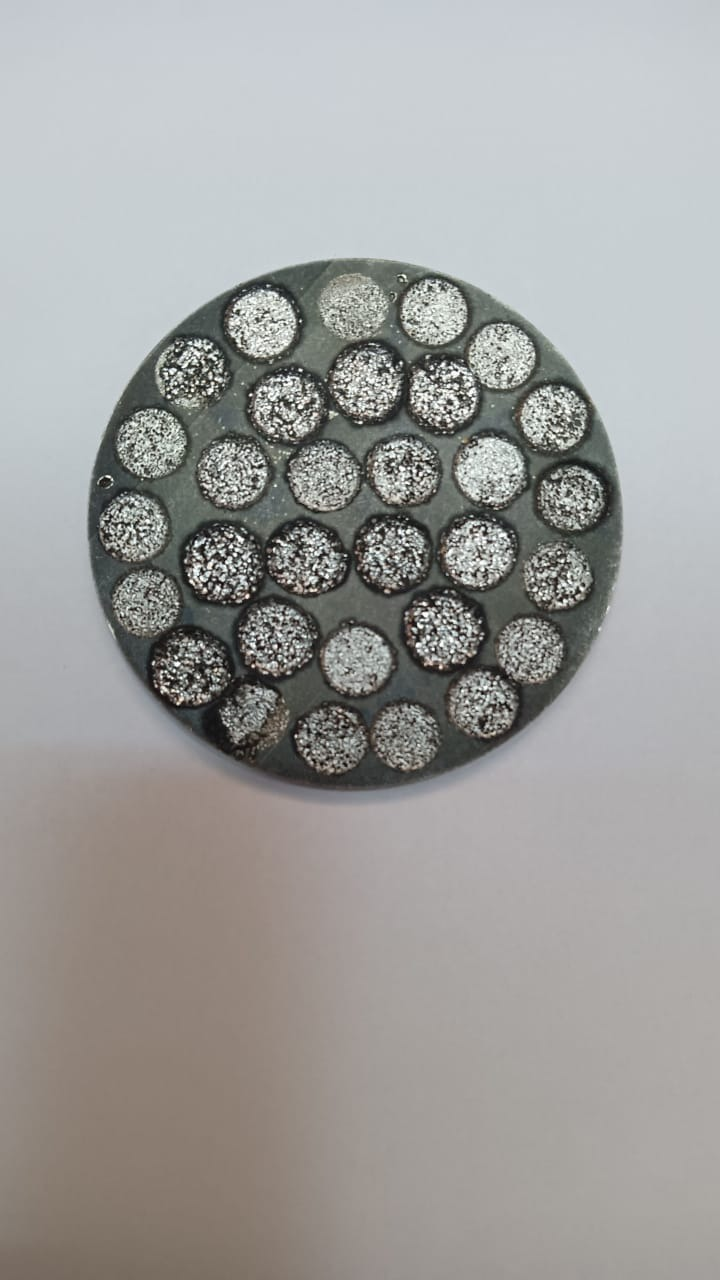
Figure 3. Ti6Al4V workpiece after machining.
To find out which parameter is most important during an experiment and comparison between conventional EDM and powder mixed EDM Taguchi design is used. The S/N ratios for MRR are calculated using Taguchi analysis method. For the MRR “Larger is better” criteria are used.
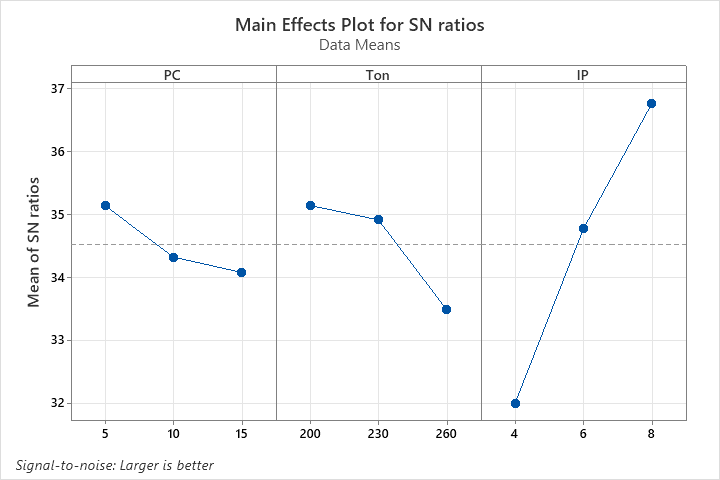
Figure 4. Taguchi analysis of MRR versus powder concentration, pulse-on time and current.
Table 5 MRR Response table for signal to noise ratios: Larger is better.
Level 1 | PC | Ton | Ip |
|---|---|---|---|
1 | 37.13 | 36.05 | 31.59 |
2 | 32.67 | 33.99 | 34.55 |
3 | 33.18 | 32.93 | 36.85 |
Delta | 4.45 | 3.12 | 5.26 |
Rank | 2 | 3 | 1 |
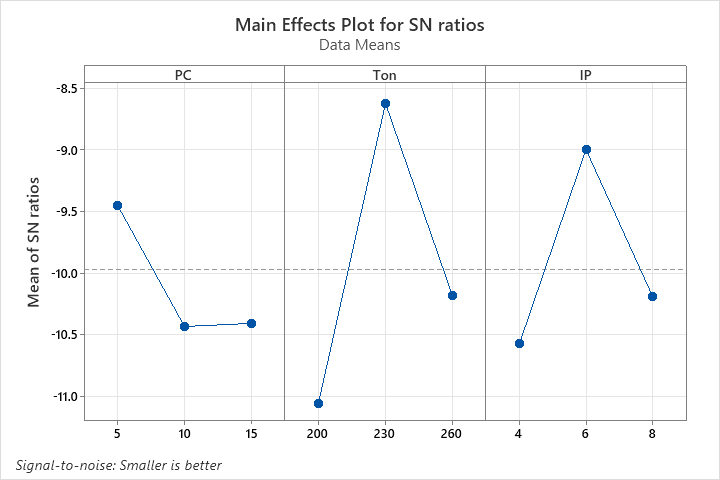
Figure 5. Taguchi analysis of TWR versus powder concentration, pulse-on time and current.
Table 6 TWR Response table for signal to noise ratios: Smaller is better.
Level 1 | PC | Ton | Ip |
|---|---|---|---|
1 | -7.757 | -7.875 | -7.206 |
2 | -9.459 | -7.311 | -5.937 |
3 | -6.236 | -7.698 | -9.459 |
Delta | 3.222 | 0.564 | 3.522 |
Rank | 2 | 3 | 1 |
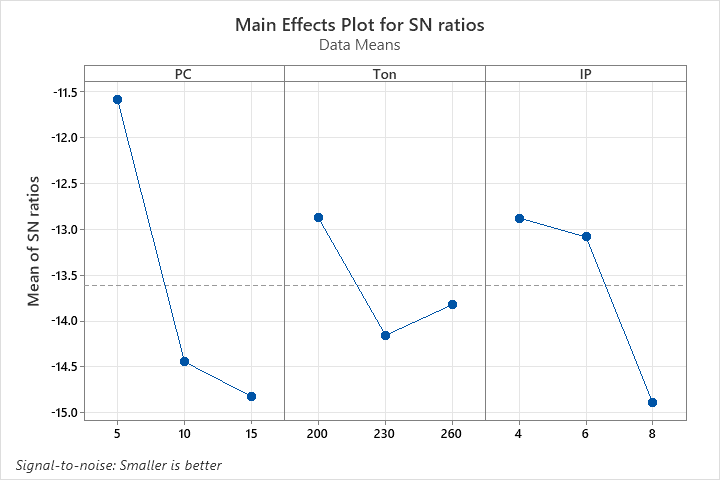
Figure 6. Taguchi analysis of surface roughness versus powder concentration, pulse-on time and current.
Table 7 SR Response table for signal to noise ratios: Smaller is better.
Level 1 | PC | Ton | Ip |
|---|---|---|---|
1 | -11.14 | -13.84 | -13.36 |
2 | -16.32 | -14.13 | -14.05 |
3 | -16.32 | -15.82 | -16.37 |
Delta | 5.18 | 1.98 | 3.01 |
Rank | 1 | 3 | 2 |
Conclusion
The following conclusions follow from the experiments and analysis:
Concentration of Silicon carbide powder, Peak current and Pulse on time have been found to be influential parameters of PMEDM.
MRR shows an increasing trend with increase in Powder concentration. Larger MRR has been achieved in Powder Mixed EDM as compared to conventional EDM.
MRR initially decreases and then increases with pulse-on time.
MRR also showed a proportional increase with increase in peak current.
In case of Surface roughness, the Powder concentration is the effective parameter; after that the peak current & pulse on time are having less effect on machined workpiece.
The optimum levels of various parameters obtained in present work for MRR are: Powder concentration 10g/l, Peak current 8A & Pulse on time 150 μs.
The optimum levels of various parameters obtained in present work for SR are: Powder concentration 5g/l, Peak current 4A & Pulse on time 50 μs.
The stated pulse-on optima of 150 μs and 50 μs lie outside the 200–260 μs range used in the nine trials. These proposed settings therefore require separate experimental validation and should not be treated as confirmed operating optima.
References
[1] Ayanesh Y. Joshi, Anand Y. Joshi, Multi response optimization of PMEDM of Ti6Al4V using Al2O3 and SiC powder added de‑ionized water as dielectric medium using gray relational analysis(2021)
[2] Venkata N. Raju Jampana , P. S. V. Ramana Rao , and A. Sampathkumar, Experimental and Thermal Investigation on Powder Mixed EDM Using FEM and Artificial Neural Networks(2021)
[3] Rafiqul Haque, Mukandar Sekh, Golam Kibria, Shamim Haidar, Improvement of surface quality of ti-6al-4v alloy by powder mixed electrical discharge machining using copper powder(2021)
[4] Hardaha Rajkumar, Manish Vishwakamra, Performance Parameters Characteristics of PMEDM: A Review(2018)
[5] Chander Prakash, H.K. Kansal, B.S. Pabla, and Sanjeev Puri, Processing and Characterization of Novel Biomimetic Nanoporous Bioceramic Surface on b-Ti Implantby Powder Mixed Electric Discharge Machining(2015)
[6] Sravankumar Gudur, V V Potdar, “Effect of Silicon Carbide Powder Mixed EDM on Machining Characteristics of SS 316L Material”, International Journal of Innovative Research in Science, Engineering and Technology, Vol. 4, Issue 9, September 2015, ISSN(Online): 2319-8753, pp. 8131-8141.
[7] Ahmed Al-Khazraji, Samir Ali Amin, Saad Mahmood Ali b, “The effect of SiC powder mixing electrical discharge machining on white layer thickness, heat flux and fatigue life of AISI D2 die steel”, Engineering Science and Technology, an International Journal, 23 April 2016.
[8] Sagar Patel, Dignesh Thesiya, Avadhoot Rajurkar, “Effect Of Aluminium Powder Concentration On Powder Mixed Electric Discharge Machining (Pmedm) Of Inconel-718”, Journal of Machining and Forming Technologies, Volume 8, Number 2017, ISSN: 1947-4369, pp. 29-40.
[9] Satish Kumar, Ashwani Kumar Dhingra and Sanjeev Kumar, “Parametric optimization of powder mixed electrical discharge machining for nickel based superalloy inconel-800 using response surface methodology”, Mechanics of Advanced Materials and Modern Processes, DOI 10.1186/s40759-017-0022-4, 17 April 2017.
[10] Saurabh Sharma, Anil Kumar, Naveen Beri, Dinesh Kumar, “Effect of aluminium powder addition in dielectric during electric discharge machining of Hastelloy on machining performance using reverse polarity”, International Journal of Advanced Engineering Technology, Vol. I, Issue III, Oct.-Dec (2010), pp. 13-24.
[11] Said Ahmad, Erween Abd Rahim, Mohd Amri Lajis, Mohd Rasidi Ibrahim, “Powder Mixed Dielectric in Electrical Discharge Machining of Inconel 718”, Journal of Mechanical Engineering, Vol SI 4(3), 110-127, 2017, ISSN 1823- 5514, pp. 110-127.
[12] M. A. Razak, A. M. Abdul-Rani, and A. M. Nanimina, “Improving EDM efficiency with silicon carbide powder-mixed dielectric fluid”, International Journal of Materials, Mechanics and Manufacturing, Vol. 3, No. 1, February 2015, pp. 40-43.
[13] S. Assarzadeh, M. Ghoreishi, A dual response surface-desirability approach to process modeling and optimization of Al2O3 powder-mixed electric discharge machining (PMEDM) parameters, Int. J. Adv. Manufact. Technol. 64 (2013)
1459–1477.
[14] Munmun Bhaumika “Effect of machining parameter on the surface roughness of AISI 304 in silicon carbide powder mixed EDM”. Decision Science Letters · June 2017.
[15] H.K. Kansal, S. Singh, P. Kumar, Performance parameters optimization (multi characteristics) of powder mixed electric discharge machining (PMEDM) through Taguchi’s method and utility concept, Ind. J. Eng. Mater. Sci. 13 (2006) 209–216.
Cite This Work
To export a reference to this article please select a referencing stye below:

Academic Master Education Team is a group of academic editors and subject specialists responsible for producing structured, research-backed essays across multiple disciplines. Each article is developed following Academic Master’s Editorial Policy and supported by credible academic references. The team ensures clarity, citation accuracy, and adherence to ethical academic writing standards
Content reviewed under Academic Master Editorial Policy.



