
Introduction
The decline of traditional television broadcasting is best understood as a loss of dominance rather than the disappearance of television itself. Audience measurement now shows that streaming has become the largest single category of U.S. television use. Nielsen reported that streaming exceeded broadcast and cable combined for the first time in May 2025, and its latest U.S. Gauge data available in September 2026 placed streaming at 49.0 percent of television use in July 2026, with YouTube alone reaching 14.2 percent (Nielsen, 2025a; Nielsen, 2026a). These figures confirm a structural change in how viewers use the television screen. Scheduled networks no longer organize household viewing as completely as they once did. Yet broadcast and cable remain important for live sports, local news, major national events, emergency information, and households that value free over-the-air access. The contemporary television environment is therefore hybrid: broadcast networks, cable channels, subscription platforms, free ad-supported streaming services, and creator-driven video compete on the same screens while increasingly borrowing one another’s business models.
From Scheduled Television to Audience Control
Streaming’s most important early advantage was control over time and selection. Traditional broadcasting required viewers to follow a schedule or use recording technology, whereas on-demand platforms allowed them to choose the program, episode, device, and viewing time. Large digital libraries also weakened the scarcity that once made prime-time scheduling so valuable. A network had only a limited number of evening hours in which to place its strongest programs, while a streaming service could make thousands of titles available simultaneously and use search and recommendation systems to guide discovery. Younger audiences adopted this flexibility especially quickly because their media habits already included smartphones, tablets, social video, gaming, and connected devices. Historical audience data showing declining conventional television use among younger age groups remains relevant because it demonstrates that the shift began before streaming became the largest TV category. Distribution changed faster than professionally produced content itself: viewers continued watching drama, comedy, sports, documentaries, and news but increasingly reached them through internet-connected platforms rather than fixed channel schedules.
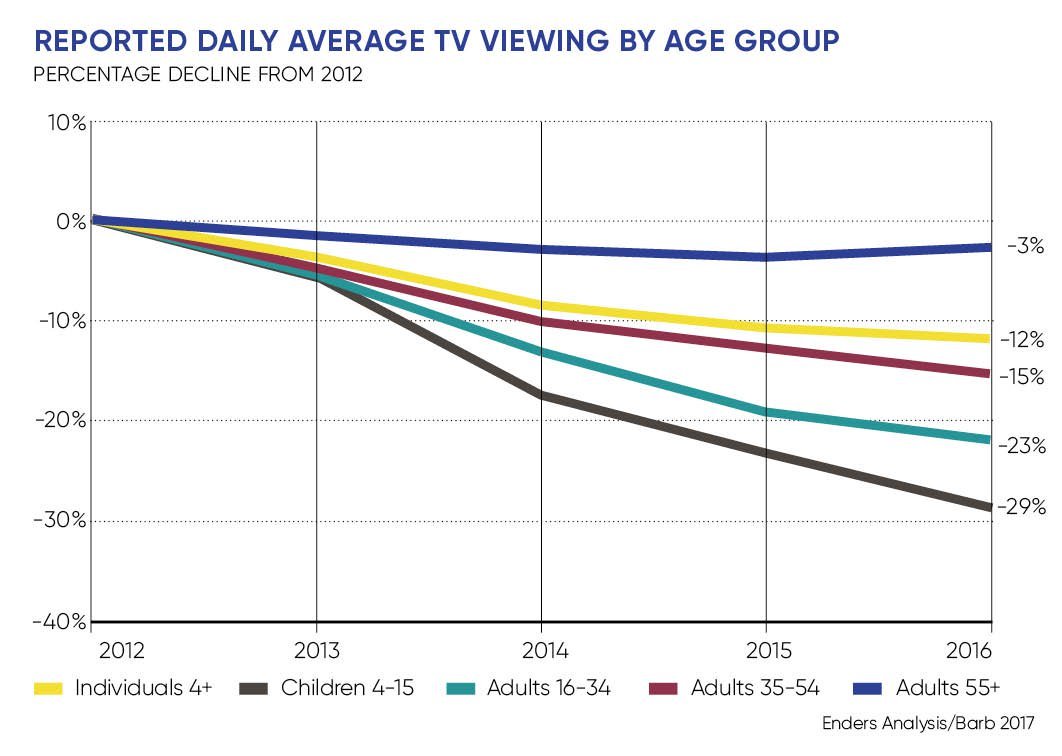
The same transition increased the economic value of older programming. Streaming platforms can monetize deep libraries that would previously have disappeared from prime-time schedules or survived only through syndication and physical media. A series released years earlier can attract a large new audience when an algorithm, cultural event, or prominent placement returns it to visibility. This long-tail effect encouraged media companies to reclaim rights to older catalogs and build proprietary services around intellectual property they once licensed elsewhere. The shift also complicates the meaning of “television.” A viewer watching a serialized drama on Netflix, a livestream on YouTube, or a sports event through an app may still be using a television set even though no conventional channel is involved. Measurement therefore has to distinguish the content, the device, and the distribution system. Nielsen’s Gauge is particularly useful because it measures television-screen usage consistently, but broader media analysis still requires separate attention to mobile and computer viewing.
The 2025–2026 Inflection Point
The numerical transition became especially clear during 2025. Nielsen measured streaming at 44.3 percent of U.S. television use in April 2025, compared with a combined 45.3 percent for broadcast and cable (Nielsen, 2025b). In May, streaming rose to 44.8 percent while broadcast and cable together accounted for 44.2 percent, making that month the first in which streaming exceeded the two traditional categories combined (Nielsen, 2025a). The pattern continued rather than reversing. Streaming reached 47.5 percent in December 2025, 48.6 percent in May 2026, and 49.0 percent in July 2026 (Nielsen, 2026a; Nielsen, 2026b; Nielsen, 2026c). Nielsen’s public U.S. data center still listed July 2026 as the latest Gauge month available on September 29, 2026. The significance of these numbers is not that linear television suddenly became irrelevant. It is that streaming moved from being an alternative distribution method to becoming the normal television environment for a very large share of viewers.
YouTube’s rise also challenges the older boundary between television and online video. In July 2026, YouTube represented 14.2 percent of U.S. television use, allowing one platform to command a share larger than many traditional channel groups (Nielsen, 2026a). Television media now includes studio productions, independent creators, podcasts, livestreams, educational video, social-video extensions, and user-generated programming competing for the same household screen. This fragmentation makes it difficult to rely on one measure of success. Subscriber counts, ratings, minutes viewed, completion rates, advertising impressions, and households reached answer different commercial questions. A streaming service can have fewer subscribers but more viewing time, while a broadcast event can still assemble a simultaneous audience of enormous advertising value. The modern media economy therefore requires cross-platform measurement and careful comparison rather than treating any one audience metric as a complete measure of cultural influence or commercial strength.
Advertising, Subscriptions, and the Return of the Bundle
Streaming was initially associated with an ad-free subscription model, but that distinction has weakened as content costs increased and mature platforms searched for additional revenue. Major subscription services now operate advertising-supported tiers, while free ad-supported streaming television has become a substantial category of its own. Nielsen reported that nearly 73 percent of overall television viewing was ad-supported in the first quarter of 2026 and that streaming captured a record 46.6 percent of ad-supported TV viewing (Nielsen, 2026d). Advertising therefore did not disappear when audiences moved online; it followed them. The important change is that connected television can combine program context with account, household, and behavioral data, allowing more individualized targeting and measurement than traditional broad-reach commercial breaks. This creates valuable opportunities for advertisers and platforms but also intensifies concerns about privacy, data collection, automated profiling, and transparency. The advertising market illustrates the broader pattern of convergence: streaming has disrupted traditional television while simultaneously rebuilding many of the commercial structures that sustained it.
Subscription economics have followed the same pattern. Early streaming promised a simpler alternative to expensive cable bundles, with relatively low prices and large libraries concentrated in a few services. Competition fragmented those libraries across multiple platforms, while price increases, password restrictions, rotating catalogs, and exclusive rights made following preferred programs more complicated. Consumers now face subscription fatigue and frequently cancel and rejoin services according to specific releases. Media companies have responded by recreating bundles through telecommunications providers, device ecosystems, and cross-company packages. The result resembles cable economically even though delivery occurs through internet applications and viewers retain greater on-demand control. Release strategies have also diversified. Full-season releases remain common, but weekly scheduling has returned because it can keep a program culturally visible for longer and reduce rapid cancellation after a binge. Streaming therefore did not permanently eliminate schedules or bundles. It transformed them into strategic choices within a more competitive and flexible distribution environment.
Why Linear Television Still Retains Value
Live sports remains one of the strongest reasons linear television continues to matter. Major games can gather large audiences at the same moment, creating advertising value and social attention that on-demand libraries rarely reproduce. Sports also demonstrates convergence because rights are increasingly divided among broadcast networks, cable channels, and streaming platforms, with some events simulcast and others available exclusively online. News and local broadcasting provide another durable function. Local stations supply weather warnings, election coverage, emergency information, community reporting, and regional journalism that global entertainment libraries do not automatically replace. Streaming services can distribute live news, but someone still has to finance reporters, editors, studios, and local newsgathering. A decline in linear advertising revenue can therefore become a civic problem when it weakens the institutions that produce local information. The continued social value of broadcasting cannot be measured solely by whether its share of entertainment viewing has declined.
Infrastructure also complicates claims that broadcasting is obsolete. Streaming depends on broadband, a compatible device, sufficient data capacity, and reliable electricity and network service. Free over-the-air broadcasting can remain important for households that do not subscribe to broadband or paid television and during some emergencies when other systems are disrupted. Traditional television also retains cultural value around shared events, including elections, major sports finals, award programs, and national news moments. At the same time, the line between “linear” and “streaming” keeps becoming less clear. Subscription services sell advertising, launch live channels, schedule sports, and release episodes weekly; broadcasters build on-demand libraries, require accounts, and personalize recommendations. The strongest surviving features of traditional television are increasingly being incorporated into streaming, while traditional media companies operate across both delivery systems. The relevant question is therefore no longer which medium will completely replace the other, but how companies combine content, access, pricing, advertising, measurement, and trust across multiple forms of distribution.
What the Decline of Broadcasting Actually Means
The decline of traditional broadcasting is real because its share of attention has fallen substantially and because younger viewers increasingly expect on-demand, personalized, and device-independent access. Broadcasters that depend entirely on fixed schedules and conventional commercial breaks face continuing pressure. Yet “death of television” is the wrong model because television has become a multi-platform cultural form rather than a single transmission technology. Companies that once operated only networks now run streaming services; streaming companies invest in sports, advertising, and live programming; independent creators compete with studios on large television screens; and viewers move among all of them. The broadcast schedule is no longer the central organizer of everyday viewing, but professionally produced television, real-time events, advertising, and shared cultural attention remain economically powerful. The change is best described as a redistribution of control. Viewers have more authority over timing and selection, platforms have more data and targeting capacity, and media companies must compete for attention across a far larger range of services and content types than the old channel bundle allowed.
Conclusion
Streaming has transformed television by giving audiences greater control over what, when, and where they watch while weakening the monopoly once held by broadcast schedules and cable bundles. Nielsen’s 2025–2026 data confirms the scale of that shift: streaming surpassed broadcast and cable combined in May 2025 and reached 49.0 percent of U.S. television use by July 2026, the latest U.S. Gauge month publicly listed in September 2026. Yet traditional television has not vanished. Live sports, local news, emergencies, free over-the-air access, and major shared events continue to give linear broadcasting distinctive value. At the same time, streaming has adopted advertising, live channels, weekly schedules, sports rights, and bundles, reproducing several features of the system it disrupted. The future of television is therefore convergence rather than simple replacement. The medium remains culturally and commercially important, but the organizing center has shifted from the fixed channel schedule toward a competitive ecosystem in which viewers, platforms, broadcasters, creators, advertisers, and rights holders share the same screens.
References
Nielsen. (2025a). Streaming reaches historic TV milestone, eclipses combined broadcast and cable viewing for first time.
Nielsen. (2025b). The Gauge: Streaming peaks again, drawing from successful multiplatform strategies.
Nielsen. (2026a). TV usage kicks usual summer slowdown, fueled by World Cup and streaming in Nielsen’s July Gauge reports.
Nielsen. (2026b). Streaming shatters multiple records in December 2025 with 47.5% of TV viewing.
Nielsen. (2026c). Streaming embarks on annual summer ascent in Nielsen’s May 2026 Gauge reports.
Nielsen. (2026d). Nielsen’s Q1 2026 Ad Supported Gauge.
Cite This Work
To export a reference to this article please select a referencing stye below:

Academic Master Education Team is a group of academic editors and subject specialists responsible for producing structured, research-backed essays across multiple disciplines. Each article is developed following Academic Master’s Editorial Policy and supported by credible academic references. The team ensures clarity, citation accuracy, and adherence to ethical academic writing standards
Content reviewed under Academic Master Editorial Policy.





