
 Mathematics
Textbook
MAT 2420 Calculus II
Not rated yetRate this bookExplore six Calculus II chapters on integration, differential equations, series and alternative coordinate descriptions. Original study tasks emphasize model setup, convergence and the conditions behind each method.
Read on the publisher’s website. Opens in a new tab.
 Free
About this book
MAT 2420 Calculus II is Brittni Lorton’s Community College of Denver course collection. Its six principal chapters are numbered 2–7, beginning with applications of integration and ending with parametric equations and polar coordinates. Integration techniques, introductory differential equations, sequences, series and power series form the intervening sequence.
The collection asks readers to connect a method with the mathematical question it answers. An area calculation starts with a region and bounds; an infinite series requires a convergence argument; a differential equation needs conditions before it identifies a particular solution. This guide supplies original study tasks to make those decisions explicit. The overviews follow the verified chapter structure and selected introductory objectives, rather than replace the worked examples or detailed proofs. Use the rendered source for mathematical notation and full method conditions. The source’s numbering is preserved so that the guide can be matched with the course; it does not imply that a missing chapter 1 has been reconstructed.
AI-assisted book summary
Reading guide
Revisit derivatives and the Fundamental Theorem before applications. Choose integration methods from expression structure, then distinguish finite calculation from limiting processes in the series chapters.
Chapter and section guide
2: Applications of Integration
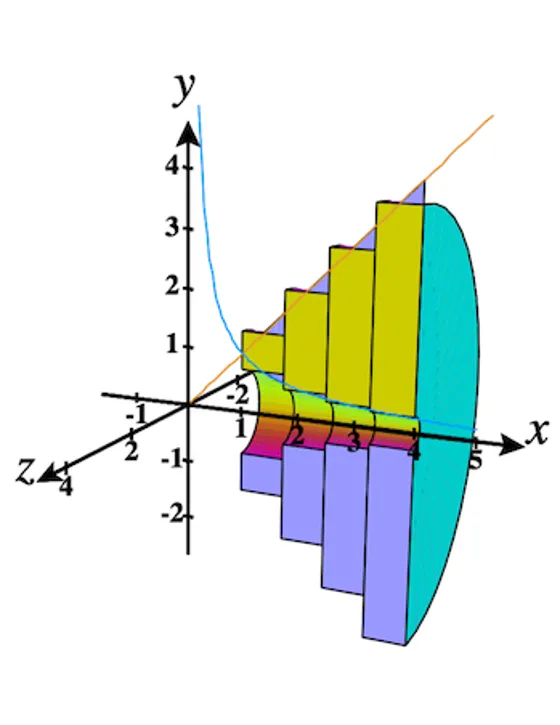
Applications of integration translate regions and physical quantities into integrals. Area between curves requires choosing an independent variable and splitting a region when its boundary changes. Establishing bounds is part of the mathematics.
Study task: Sketch a hypothetical bounded region and explain the proposed integration variable and bounds.
3: Techniques of Integration
Integration techniques extend substitution through methods such as integration by parts. The product rule helps explain why the parts formula works. Method selection depends on the expression, and improper integrals introduce a separate limiting question.
Study task: Explain why integration by parts might simplify a chosen product and how to check the result.
4: Introduction to Differential Equations
Differential equations describe relationships involving rates of change. Order, general solutions and particular solutions identify different aspects of a model. Substitution into the equation and checking an initial condition provide distinct tests.
Study task: Separate a hypothetical rate equation from an initial condition and describe both checks.
5: Sequences and Series
Sequences and series distinguish a list of terms from sums of those terms. Limits and convergence need precise objects and conditions. A term approaching zero alone does not establish convergence of the associated series.
Study task: Explain the difference between examining a term sequence and examining its partial sums.
6: Power Series
Power series represent functions within an interval of convergence. Radius and endpoint behavior matter before a representation is used. Taylor approximations add a question about accuracy as well as algebra.
Study task: List the convergence and error questions needed before using a proposed local approximation.
7: Parametric Equations and Polar Coordinates
Parametric and polar descriptions offer alternatives to a single Cartesian function. A parameter can encode direction of travel, while a polar representation can describe a point in more than one way. Domain restrictions affect the represented curve.
Study task: Compare a traced parametric curve with its Cartesian relation and explain what information may be lost.
How to study this book
Write the target quantity and assumptions before calculating. Check an antiderivative by differentiation. For a series or approximation, state where it applies and what remains to establish about convergence or error.
Reflection questions
- What quantity is being accumulated?
- Why does this method apply?
- Which convergence or domain condition remains?
Sources and coverage
Original source and online reader. This original guide uses verified contents and the selected source material described below. Study tasks are original additions, not exercises or answers attributed to the source.
Verified contents and selected chapter openings/objectives were reviewed, not every proof or exercise. Source chapters 2–7 are preserved. No numerical application or approximation error was independently audited.
About access & copyright
This page provides book information and study material. Full-text access is provided by the original publisher or authorised source; a listing does not grant permission to republish the book.
Read our Library Access & Copyright policyModeling
Bounds and units belong in the setup.
Series
Terms and partial sums answer different questions.
Coordinates
Parameter direction and domain affect the curve.
Reader ratings & reviews
Share your thoughts
Your review helps other students choose the right resources.
KEEP LEARNING
Your next great read
Mathematics Mathematics
MTH 211: Calculus II
View MTH 211: Calculus II — book Mathematics
Mathematical Reasoning
View Mathematical Reasoning — bookMTH 225 Differential Equations
MTH 225 Differential Equations
View MTH 225 Differential Equations — bookFinite Mathematics
Finite Mathematics
View Finite Mathematics — bookMATH 25: PreCalculus
MATH 25: PreCalculus
View MATH 25: PreCalculus — bookMath 4B: Differential Equations
Math 4B: Differential Equations
View Math 4B: Differential Equations — bookMath 100: Liberal Arts Mathematics
Math 100: Liberal Arts Mathematics
View Math 100: Liberal Arts Mathematics — bookCalculus I: Differential Calculus
Calculus I: Differential Calculus
View Calculus I: Differential Calculus — book Algebra and Number Theory



