
 Intellectual property law
Gender & Sexuality StudiesTextbook
Sexual Orientation and Gender Identity Employment Discrimination
Not rated yetRate this bookMatthew W. Green, Jr.’s Sexual Orientation and Gender Identity Employment Discrimination is a standalone teaching chapter published in November 2017. Its four main divisions and subsidiary case discussions examine arguments under federal employment-discrimination law before the Supreme Court’s 2020 Bostock decision. This historical position is essential: a pre-2020 dispute among courts must not be presented as an unchanged account of current protection. The guide preserves the source’s reasoning exercises while distinguishing its publication period from later authority. It is a study resource, not advice about an individual employment dispute.
Free reading is available at the official source. Opens in a new tab.
 Free
About this book
Matthew W. Green, Jr.’s Sexual Orientation and Gender Identity Employment Discrimination is a standalone teaching chapter published in November 2017. Its four main divisions and subsidiary case discussions examine arguments under federal employment-discrimination law before the Supreme Court’s 2020 Bostock decision. This historical position is essential: a pre-2020 dispute among courts must not be presented as an unchanged account of current protection. The guide preserves the source’s reasoning exercises while distinguishing its publication period from later authority. It is a study resource, not advice about an individual employment dispute.
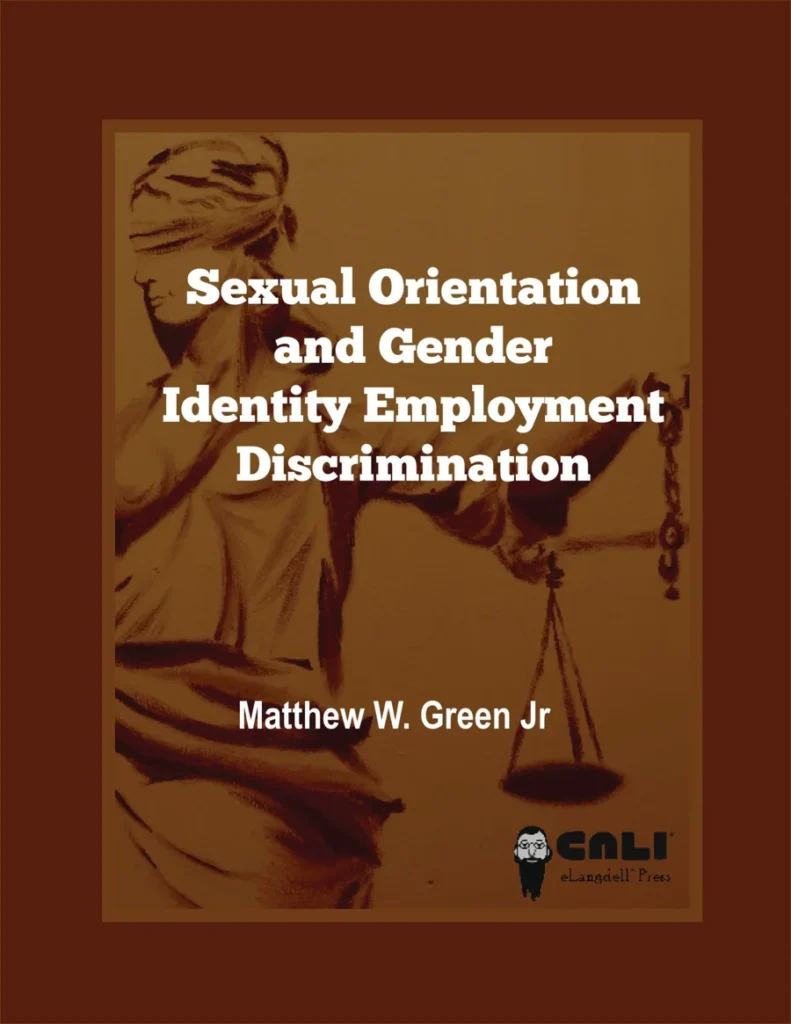
Cover: source-edition cover, displayed to identify the linked book. Publisher and third-party rights remain with their respective holders.
Book summary
Matthew W. Green, Jr.’s Sexual Orientation and Gender Identity Employment Discrimination is a standalone teaching chapter published in November 2017. Its four main divisions and subsidiary case discussions examine arguments under federal employment-discrimination law before the Supreme Court’s 2020 Bostock decision. This historical position is essential: a pre-2020 dispute among courts must not be presented as an unchanged account of current protection. The guide preserves the source’s reasoning exercises while distinguishing its publication period from later authority. It is a study resource, not advice about an individual employment dispute.
Chapter-by-chapter summaries
I. Introduction
The opening frames the relationship among sexual orientation, gender identity, gender expression, and workplace discrimination. Define the asserted claim and governing source before discussing protection generally. Federal statutory, constitutional, and state-law routes are distinct. Identify the adverse action, alleged reason, legal theory, and evidence in a hypothetical. The source’s 2017 language about available protection belongs to that date. Reading historically allows analysis of legal development without treating every earlier statement as a rule still applicable unchanged.
II. A federal statute protecting LGBT employees
The discussion of legislative protection raises questions about statutory text, coverage, proposals, and the difference between an enacted rule and a policy argument. Separate what the source describes as existing law from what it presents as a possible reform. Compare the reach of federal and state approaches without assuming they have identical definitions or remedies. The educational task is to understand why explicit protection and interpretation of an existing prohibition can present different legal and institutional arguments.
III.A. Early judicial perspectives
Earlier cases illustrate narrower interpretations of discrimination because of sex and the reasoning used to distinguish sexual orientation claims. Brief the holding and the method of statutory interpretation rather than treating an outcome as self-explanatory. Identify the comparison the court considered relevant and the assumptions supporting it. These decisions are part of the history leading to later change. A reader should ask how subsequent reasoning challenges the earlier distinction, not cite the old cases as a complete present-day answer.
III.B. The evolving meaning of sex discrimination
Gender-nonconformity and same-sex-harassment discussions test the relationship between statutory wording and circumstances not assumed by earlier interpreters. Price Waterhouse provides an important context for examining stereotypes. Distinguish a rule’s text, the decision’s actual reasoning, and later applications. A novel factual setting does not alone resolve whether conduct falls outside an existing prohibition. Compare arguments grounded in expected applications with arguments grounded in the enacted language, identifying the premise on which they diverge.
III.C. Stereotyping and sexual orientation
The Prowel material explores how courts handled allegations involving both stereotypes and sexual orientation under the source-era framework. Identify the evidence and the legal characterization rather than assuming categories sort themselves. Compare a factual account of treatment with an abstract label attached to the employee. The cases reveal the difficulty of separating intertwined reasons through a doctrinal boundary. Study the problem as part of the pre-Bostock development, keeping later authority distinct rather than rewriting what the earlier court actually held.
III.D. Sexual orientation as sex discrimination
Hively illustrates a 2017 interpretive approach recognizing sexual-orientation discrimination within the statutory prohibition on sex discrimination. Compare its reasoning with the earlier cases: identify the comparator, causal claim, and treatment of statutory language. A decision from one court of appeals did not by itself settle every jurisdiction at that time. The chapter is especially useful for tracing changes in legal argument. Distinguish that historical circuit-level development from the later Supreme Court decision.
IV.A. Gender identity, expression, and stereotyping
The Smith discussion examines how claims concerning a transgender employee were analyzed through sex-stereotyping reasoning. Separate identity, expression, treatment, and evidentiary theory rather than treating them as interchangeable terms. Identify what alleged conduct supports the claim under the assigned decision. The source’s route to protection reflects the doctrinal context then available. An accurate case brief states the reasoning actually used without assuming later developments had already resolved the question.
IV.B. Alternative routes and the appendix
The final discussion considers another interpretive route to protection and provides state-law reference material. Compare authorities by institution, jurisdiction, date, and legal effect. Agency interpretations, judicial holdings, and state statutes do different work. A dated appendix is not a current national survey. Use it to practice locating and classifying authority, then research the applicable present sources separately. The chapter concludes by making legal interpretation and source selection central to the analysis, not merely the presence of a sympathetic fact pattern.
Later authority: reading the 2017 text historically
In Bostock v. Clayton County, decided June 15, 2020, the Supreme Court held that firing someone merely for being gay or transgender violates Title VII. That later holding changes how the source’s earlier disputes should be contextualized. It does not turn this guide into a complete account of every subsequent issue, remedy, exception, or jurisdictional question. Keep three columns in your notes: the 2017 source, the later decision, and questions requiring further current research.
Study instructions
- Create a chronological authority map instead of combining decisions from different dates into one rule.
- Brief each case with its jurisdiction, interpretation method, holding, and limiting facts.
- Separate alleged treatment, evidentiary theory, and source of the legal right.
- Read the later Bostock opinion alongside the source and identify precisely which historical disputes it addresses.
Questions for reflection
- Which assumption separates an early narrow reading from a later textual argument?
- How can identity and stereotyping overlap without being identical concepts?
- Why is a historical state-law appendix insufficient for a current dispute?
Sources and coverage
This original reading guide follows the linked source edition’s chapter, module, unit, or lesson structure. Consult the source for full arguments, cases, worked examples, exercises, illustrations, and references. First edition, November 2017, a standalone chapter. Its discussion predates Bostock v. Clayton County (2020); do not treat the source-era circuit split as an unchanged current rule. Read the source edition.
Later primary authority: Bostock v. Clayton County, Supreme Court opinion (2020).
About access & copyright
This page provides book information and study material. Full-text access is provided by the original publisher or authorised source; a listing does not grant permission to republish the book.
Read our Library Access & Copyright policyExplore the contents
Check the chapters covered in this edition.
Visit the official source
See reading, preview or purchase options.
Save for later
Keep this textbook in your saved collection.
Reader ratings & reviews
Share your thoughts
Your review helps other students choose the right resources.
KEEP LEARNING
Your next great read
Intellectual property law Contract Law
The Story of Contract Law: Formation
View The Story of Contract Law: Formation — book Law
Introduction to Criminal Law
View Introduction to Criminal Law — book Law
Evidence: Best Evidence Rule
View Evidence: Best Evidence Rule — book Law
Federal Rules of Appellate Procedure
View Federal Rules of Appellate Procedure — book Law
Land Use
View Land Use — book Business
Contract Doctrine, Theory & Practice, Volume 1
View Contract Doctrine, Theory & Practice, Volume 1 — book Law
The Ethics of Tax Lawyering
View The Ethics of Tax Lawyering — book Law
Federal Rules of Bankruptcy Procedure
View Federal Rules of Bankruptcy Procedure — book Civil Law



