
Introductory Statistics
MathematicsTextbook
Proofs and Concepts: The Fundamentals of Abstract Mathematics
Not rated yetRate this bookDave Witte Morris and Joy Morris introduce the language and practice of proof through logic, sets, functions, relations, induction, and infinity. The book supports the transition from calculation to abstract mathematics: the essential skill is explaining why a claim follows from definitions and assumptions. Its nine chapters move from controlled formal deductions to broader arguments. Use the guide alongside the exercises. Recognizing a finished proof is different from constructing one, and a convincing numerical pattern is different from a justification that covers every allowed case.
Free reading is available at the official source. Opens in a new tab.
 Free
About this book
Dave Witte Morris and Joy Morris introduce the language and practice of proof through logic, sets, functions, relations, induction, and infinity. The book supports the transition from calculation to abstract mathematics: the essential skill is explaining why a claim follows from definitions and assumptions. Its nine chapters move from controlled formal deductions to broader arguments. Use the guide alongside the exercises. Recognizing a finished proof is different from constructing one, and a convincing numerical pattern is different from a justification that covers every allowed case.
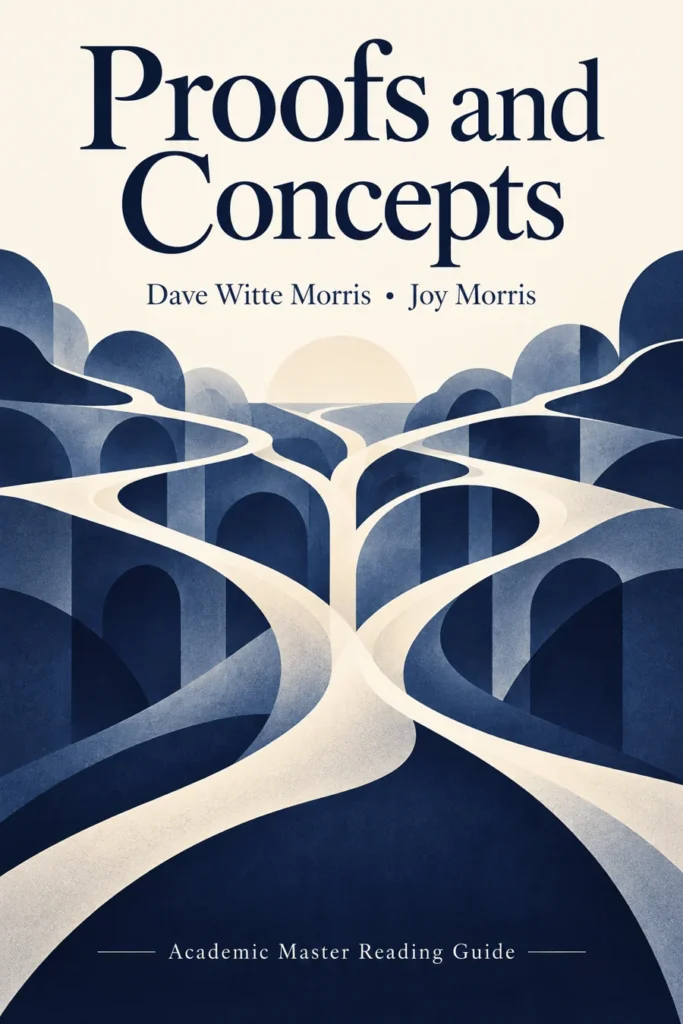
Cover: original Academic Master reading-guide design.
Book summary
About this book
Dave Witte Morris and Joy Morris introduce the language and practice of proof through logic, sets, functions, relations, induction, and infinity. The book supports the transition from calculation to abstract mathematics: the essential skill is explaining why a claim follows from definitions and assumptions. Its nine chapters move from controlled formal deductions to broader arguments. Use the guide alongside the exercises. Recognizing a finished proof is different from constructing one, and a convincing numerical pattern is different from a justification that covers every allowed case.
Chapter-by-chapter summaries
1. Propositional logic
Assertions combine through connectives whose meanings determine compound truth values. Truth tables make validity testable in a finite setting. An implication, its converse, and its contrapositive are different statements, with only the contrapositive logically equivalent to the original implication. Translate ordinary claims and evaluate all truth assignments. Then explain which deductions preserve truth. Logic puzzles expose the risk of using everyday implications in place of formal ones and provide practice identifying a faulty step precisely.
2. Two-column proofs
Each assertion is paired with a justification so that dependencies remain visible. Conditional introduction temporarily assumes an antecedent, while contradiction examines consequences of an assumption incompatible with the desired result. Restrictions on assumptions matter as much as inference rules: a statement within a subproof cannot always be carried outside unchanged. Rewrite an informal argument in this format and identify when its conclusion becomes available. Counterexamples complement proof by refuting universal assertions; they do not establish unrelated positive claims.
3. Sets
Membership, subsets, union, intersection, and complement describe collections precisely. An element differs from a subset, especially when sets themselves are elements. To establish equality, show containment in both directions. Translate operations into conditions on an arbitrary element, then use logic to justify the result. A drawing may suggest an identity without proving it for all sets. Compare an empty set, a set containing the empty set, and a set with another single element to make the distinction concrete.
4. First-order logic
Quantifiers extend propositions to claims about objects in a domain. Their order changes meaning: one object serving everyone differs from everyone having some suitable object. Negation changes both quantifier and predicate. Introduction and elimination rules control the use of arbitrary elements and existential witnesses. Translate in both directions between prose and notation, then test your reading on a small domain. Explain which choices may depend on earlier choices, since a hidden dependency can invalidate a purported general proof.
5. Sample topics
Topics including divisibility and congruence give formal reasoning concrete applications. Divisibility supplies an integer multiplier that can be carried through a proof; congruence becomes a statement about divisibility of a difference. Begin with definitions, introduce the quantities they guarantee, and calculate after the logical structure is clear. Compare direct and contradiction arguments for related claims. Numerical examples can suggest conjectures, but the proof must explain why the relationship extends beyond those examples and respects every domain restriction.
6. Functions
A function assigns exactly one output to each input in its domain. Domain and codomain belong to the specification, so the same formula can have different properties under different choices of sets. Injectivity concerns distinct inputs, while surjectivity concerns coverage of the codomain. Inverses require conditions rather than mere rearrangement. Prove injectivity by beginning with equal outputs, and disprove it through distinct inputs with a common image. For composition, verify that the intermediate values lie in the next function’s domain.
7. Equivalence relations
Reflexivity, symmetry, and transitivity identify relations that partition objects into equivalence classes. The classes cover a set without ambiguously overlapping. Congruence provides a model in which distinct integers represent the same class. Verify the three properties separately, then show why classes sharing an element coincide. This prepares for quotient constructions in later mathematics. Distinguish equality of original objects from equivalence under a chosen relation, and explain why changing the relation changes which distinctions the resulting classes preserve.
8. Proof by induction
Induction combines an initial case with a step proving the next claim from an assumed case. Neither part can be omitted. The induction hypothesis is a controlled assumption, not permission to assume the theorem for every index. Strong induction allows several earlier cases when the structure requires them. State the proposition before doing algebra and match the base case to its starting index. Recurrences and sums illustrate that induction captures a repeating logical dependency rather than merely extending an observed numerical pattern.
9. Cardinality
Bijections compare sizes beyond finite counting. A set can be infinite and countable, and a proper subset can match its parent’s cardinality. Diagonal reasoning establishes that other infinite collections cannot be listed by the natural numbers. The contradiction constructs an object differing from every listed entry at a specified position. Reproduce one countability and one uncountability argument, identifying the function or construction explicitly. The final chapter demonstrates how definitions resolve questions for which finite intuition gives unreliable guidance.
Study instructions
- Keep each definition with one example, one nonexample, and a short explanation of the difference.
- Translate quantified exercises into English before proving or refuting them.
- Label the justification for each proof step and remove unsupported intuitive jumps.
- Rebuild selected proofs after a week without looking at the source, comparing dependencies rather than wording.
Questions for reflection
- Why does one counterexample refute a universal claim?
- When does changing the codomain affect whether a function is onto?
- How can an infinite set match a proper subset in size?
Sources and coverage
This original reading guide covers the linked edition’s main chapters, or the principal sections of its two-chapter calculus text. Consult the source for full arguments, cases, worked examples, exercises, illustrations, and references. Read the source edition.
About access & copyright
This page provides book information and study material. Full-text access is provided by the original publisher or authorised source; a listing does not grant permission to republish the book.
Read our Library Access & Copyright policyExplore the contents
Check the chapters covered in this edition.
Visit the official source
See reading, preview or purchase options.
Save for later
Keep this textbook in your saved collection.
Reader ratings & reviews
Share your thoughts
Your review helps other students choose the right resources.
KEEP LEARNING
Your next great read
Applied
Applied Discrete Structures
Applied Discrete Structures
View Applied Discrete Structures — bookPrecalculus
Precalculus
View Precalculus — bookLinear Algebra
Linear Algebra
View Linear Algebra — bookCombinatorics Through Guided Discovery
Combinatorics Through Guided Discovery
View Combinatorics Through Guided Discovery — bookA Gentle Introduction to the Art of Mathematics
A Gentle Introduction to the Art of Mathematics
View A Gentle Introduction to the Art of Mathematics — bookA Computational Introduction to Number Theory and Algebra
A Computational Introduction to Number Theory and Algebra
View A Computational Introduction to Number Theory and Algebra — bookNotes on Diffy Qs: Differential Equations for Engineers
Notes on Diffy Qs: Differential Equations for Engineers
View Notes on Diffy Qs: Differential Equations for Engineers — bookCalculus
Calculus
View Calculus — book Calculus



