
 Social Sciences
Cultural & Ethnic StudiesTextbook
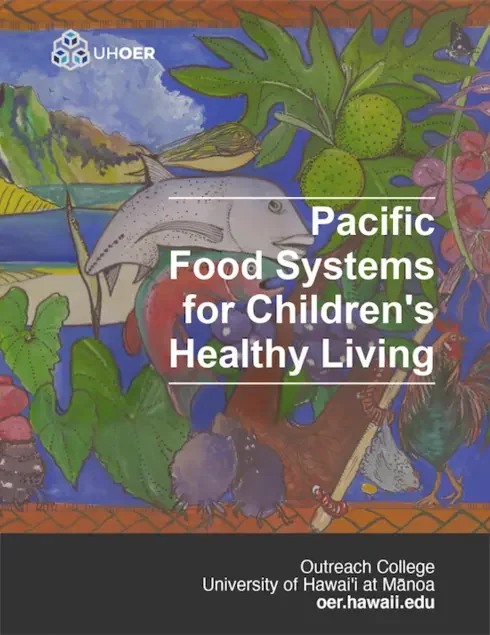
Pacific Food Systems for Children's Healthy Living
Not rated yetRate this bookPacific Food Systems for Children’s Healthy Living examines food, agriculture, environments, consumer behavior, and child well-being through a Pacific regional lens. Developed by the Children’s Healthy Living Center of Excellence and collaborating institutions, the book combines systems concepts with place-specific histories and community examples. Its 2026 PDF includes Alaska, the Commonwealth of the Northern Mariana Islands, Guam, and Hawaiʻi. Chapter 6, American Samoa, is explicitly marked Coming Soon and contains a land acknowledgment and chapter statement rather than a completed substantive chapter. This guide preserves that distinction and does not invent missing material.
Read on the publisher’s website. Opens in a new tab.
 Free
About this book
Overview
Pacific Food Systems for Children’s Healthy Living examines food, agriculture, environments, consumer behavior, and child well-being through a Pacific regional lens. Developed by the Children’s Healthy Living Center of Excellence and collaborating institutions, the book combines systems concepts with place-specific histories and community examples. Its 2026 PDF includes Alaska, the Commonwealth of the Northern Mariana Islands, Guam, and Hawaiʻi. Chapter 6, American Samoa, is explicitly marked Coming Soon and contains a land acknowledgment and chapter statement rather than a completed substantive chapter. This guide preserves that distinction and does not invent missing material.
How to study this book
Begin by drawing a food-system map that connects production, distribution, retail, assistance, households, culture, and children’s everyday environments. For each regional chapter, record its own history and institutions rather than treating the Pacific as a uniform place. Separate community strengths from barriers and distinguish association from a demonstrated causal pathway. Read land acknowledgments and positionality material alongside the analytical content. Compare community highlights by their mechanism and context, not by assuming one program transfers unchanged elsewhere. Use the text for systems learning and community inquiry, while keeping individual clinical recommendations outside the purpose of this guide.
Chapter and section study guide
Chapter 1 — Introduction
The opening chapter defines food systems and explains why a Pacific perspective changes the questions asked about children’s healthy living. It introduces the Children’s Healthy Living program, its connection with food systems, graduate training, open education, and the positionality of the resource. Food is connected with relationships, institutions, environments, and histories rather than reduced to individual choice. The chapter establishes both an analytical scope and a reason to attend to local knowledge. Understanding who produced a resource and for whom is part of interpreting its claims responsibly.
Study application: Draw a food-system map and identify one relationship that a purely individual-diet explanation would miss.
Chapter 2 — Agriculture of Pacific Food Systems
Agriculture is situated within diverse geographies, ecological conditions, land relationships, and historical transformations. Production possibilities differ across islands and other Pacific settings, while trade and political history influence what is grown and consumed. The chapter links contemporary food systems with these conditions rather than treating local production as an isolated technical problem. Compare characteristics and change over time, including the relationships among land, labor, knowledge, and markets. A useful explanation identifies mechanisms and constraints while recognizing existing community practices and strengths.
Study application: Compare two regional production settings using geography, historical change, market connections, and the role of local agricultural knowledge.
Chapter 3 — Food Environment of Pacific Food Systems
Food environments shape the options people encounter through availability, affordability, accessibility, assistance, advertising, and quality. These dimensions overlap but should be measured separately. A food item can be available in a region yet difficult for a household to reach or afford. The chapter connects institutional and commercial arrangements with everyday exposure and opportunities. Evaluate a proposed improvement by specifying which barrier it addresses and how it might affect different groups. Avoid assuming that adding information alone changes a constrained environment or that one measure captures the entire system.
Study application: Audit a hypothetical neighborhood food environment across all six dimensions and identify which evidence would support each judgment.
Chapter 4 — Consumer Behavior of Pacific Food Systems
Consumer awareness and choice are embedded in culture, resources, relationships, information, and available options. The chapter connects behavior with the wider food system rather than treating knowledge as sufficient to explain what households obtain and eat. An informed preference may not become an action when time, price, access, or social circumstances intervene. Distinguish what people know, what they value, and what they can practically do. A systems approach asks how environments and institutions interact with agency, avoiding a blame-based account of constrained choices.
Study application: Analyze a food choice using awareness, preferences, resources, access, and social context, then identify an intervention beyond education alone.
Chapter 5 — Alaska
The Alaska chapter brings together cultural and geographic context, history, food evolution, agriculture, child nutrition and health, and community highlights. Its scope makes clear that food systems are connected with place, Indigenous histories, relationships, and changing conditions. Read the land acknowledgment as part of that context rather than as unrelated front matter. The community examples illustrate responses grounded in particular settings. Comparisons should preserve differences within Alaska and avoid interpreting a regional average as the experience of every community or household.
Study application: Create an Alaska case profile connecting historical change, food access, community strengths, and one child-focused policy or program example.
Chapter 6 — American Samoa: Coming Soon
This numbered chapter is not yet a completed regional treatment in the linked 2026 source. It contains a land acknowledgment and a chapter statement under the explicit Coming Soon label. Those materials should not be expanded into an invented account of agriculture, history, or child health. The gap matters when planning a course or comparing the regional coverage of the book. Readers can examine the source’s statement and version history, then identify what evidence and community participation would be needed for a responsible future chapter.
Study application: List the questions a future regional chapter should address and the local sources or contributors needed, without supplying unsupported answers.
Chapter 7 — Commonwealth of the Northern Mariana Islands
The CNMI chapter connects cultural and geographic context with history, agriculture, food evolution, and children’s nutrition and health. Community highlights include fresh greens for the public-school system and a health-ministry policy example. These cases allow readers to trace how production and institutions can affect everyday food environments. Evaluate the specific mechanism and setting rather than assuming an initiative’s existence proves its effectiveness. Attend to local history and community knowledge when comparing the CNMI with other jurisdictions in the book.
Study application: Trace the school-greens example from production through institutional delivery to the intended food-environment change, identifying evaluation questions.
Chapter 8 — Guam
Guam’s chapter combines cultural and geographic characteristics, political history, agricultural change, food evolution, and child health context. Community highlights include Guåhan Sustainable Culture and 5-2-1-Almost None. The structure encourages connecting programs with the conditions they address rather than viewing them as isolated messages. Historical and political relationships help explain current food-system arrangements. Keep descriptive program material separate from evidence of outcomes, and recognize variation among communities and households. The educational purpose is understanding system relationships, not issuing individual health prescriptions.
Study application: Compare the two highlighted approaches by target, mechanism, setting, and the evidence needed to assess their contribution.
Chapter 9 — Hawaiʻi
The Hawaiʻi chapter connects land, culture, geography, history, agriculture, and food evolution with children’s nutrition and health. Its community examples include Kids Eating Local and DA BUX Double Up Food Bucks. These illustrate different pathways through institutions, purchasing power, and local food relationships. Analyze who can participate, which barriers are addressed, and how the initiative connects with producers and households. A program should be interpreted within its setting and evaluated using appropriate outcomes rather than generalized to the entire Pacific without adaptation.
Study application: Map how a food-purchasing incentive could affect households and producers, then identify access barriers that might remain.
Chapter 10 — Future Directions
The closing chapter looks beyond description toward continued work on food-system resilience and children’s healthy living. Its position after the regional chapters encourages synthesis without erasing differences. Future inquiry should connect community priorities, systems relationships, evidence gaps, and the capacity to act. The incomplete American Samoa chapter also illustrates that an open resource can remain a developing project. A useful next step is specific about whose knowledge is needed and how findings will inform action. Avoid replacing local participation with a universal recommendation derived from a broad comparison.
Study application: Propose one participatory research question and explain how its answer could inform a locally relevant food-system decision.
Reflection and review
- Which regional similarities reflect a shared mechanism, and which conceal important differences?
- How would you evaluate a community program without assuming its stated goal is already achieved?
- What does the unfinished chapter imply for claims about the book’s regional completeness?
Source and edition notes
2026 open textbook; ten numbered chapters, with Chapter 6 explicitly marked Coming Soon; 545 PDF pages. Coverage is based on the downloaded 2026 PDF. The American Samoa material is a placeholder, and the guide labels it accordingly. Community and health examples are summarized for education rather than individualized advice.
Book summary
Overview
Pacific Food Systems for Children’s Healthy Living examines food, agriculture, environments, consumer behavior, and child well-being through a Pacific regional lens. Developed by the Children’s Healthy Living Center of Excellence and collaborating institutions, the book combines systems concepts with place-specific histories and community examples. Its 2026 PDF includes Alaska, the Commonwealth of the Northern Mariana Islands, Guam, and Hawaiʻi. Chapter 6, American Samoa, is explicitly marked Coming Soon and contains a land acknowledgment and chapter statement rather than a completed substantive chapter. This guide preserves that distinction and does not invent missing material.
How to study this book
Begin by drawing a food-system map that connects production, distribution, retail, assistance, households, culture, and children’s everyday environments. For each regional chapter, record its own history and institutions rather than treating the Pacific as a uniform place. Separate community strengths from barriers and distinguish association from a demonstrated causal pathway. Read land acknowledgments and positionality material alongside the analytical content. Compare community highlights by their mechanism and context, not by assuming one program transfers unchanged elsewhere. Use the text for systems learning and community inquiry, while keeping individual clinical recommendations outside the purpose of this guide.
Chapter and section study guide
Chapter 1 — Introduction
The opening chapter defines food systems and explains why a Pacific perspective changes the questions asked about children’s healthy living. It introduces the Children’s Healthy Living program, its connection with food systems, graduate training, open education, and the positionality of the resource. Food is connected with relationships, institutions, environments, and histories rather than reduced to individual choice. The chapter establishes both an analytical scope and a reason to attend to local knowledge. Understanding who produced a resource and for whom is part of interpreting its claims responsibly.
Study application: Draw a food-system map and identify one relationship that a purely individual-diet explanation would miss.
Chapter 2 — Agriculture of Pacific Food Systems
Agriculture is situated within diverse geographies, ecological conditions, land relationships, and historical transformations. Production possibilities differ across islands and other Pacific settings, while trade and political history influence what is grown and consumed. The chapter links contemporary food systems with these conditions rather than treating local production as an isolated technical problem. Compare characteristics and change over time, including the relationships among land, labor, knowledge, and markets. A useful explanation identifies mechanisms and constraints while recognizing existing community practices and strengths.
Study application: Compare two regional production settings using geography, historical change, market connections, and the role of local agricultural knowledge.
Chapter 3 — Food Environment of Pacific Food Systems
Food environments shape the options people encounter through availability, affordability, accessibility, assistance, advertising, and quality. These dimensions overlap but should be measured separately. A food item can be available in a region yet difficult for a household to reach or afford. The chapter connects institutional and commercial arrangements with everyday exposure and opportunities. Evaluate a proposed improvement by specifying which barrier it addresses and how it might affect different groups. Avoid assuming that adding information alone changes a constrained environment or that one measure captures the entire system.
Study application: Audit a hypothetical neighborhood food environment across all six dimensions and identify which evidence would support each judgment.
Chapter 4 — Consumer Behavior of Pacific Food Systems
Consumer awareness and choice are embedded in culture, resources, relationships, information, and available options. The chapter connects behavior with the wider food system rather than treating knowledge as sufficient to explain what households obtain and eat. An informed preference may not become an action when time, price, access, or social circumstances intervene. Distinguish what people know, what they value, and what they can practically do. A systems approach asks how environments and institutions interact with agency, avoiding a blame-based account of constrained choices.
Study application: Analyze a food choice using awareness, preferences, resources, access, and social context, then identify an intervention beyond education alone.
Chapter 5 — Alaska
The Alaska chapter brings together cultural and geographic context, history, food evolution, agriculture, child nutrition and health, and community highlights. Its scope makes clear that food systems are connected with place, Indigenous histories, relationships, and changing conditions. Read the land acknowledgment as part of that context rather than as unrelated front matter. The community examples illustrate responses grounded in particular settings. Comparisons should preserve differences within Alaska and avoid interpreting a regional average as the experience of every community or household.
Study application: Create an Alaska case profile connecting historical change, food access, community strengths, and one child-focused policy or program example.
Chapter 6 — American Samoa: Coming Soon
This numbered chapter is not yet a completed regional treatment in the linked 2026 source. It contains a land acknowledgment and a chapter statement under the explicit Coming Soon label. Those materials should not be expanded into an invented account of agriculture, history, or child health. The gap matters when planning a course or comparing the regional coverage of the book. Readers can examine the source’s statement and version history, then identify what evidence and community participation would be needed for a responsible future chapter.
Study application: List the questions a future regional chapter should address and the local sources or contributors needed, without supplying unsupported answers.
Chapter 7 — Commonwealth of the Northern Mariana Islands
The CNMI chapter connects cultural and geographic context with history, agriculture, food evolution, and children’s nutrition and health. Community highlights include fresh greens for the public-school system and a health-ministry policy example. These cases allow readers to trace how production and institutions can affect everyday food environments. Evaluate the specific mechanism and setting rather than assuming an initiative’s existence proves its effectiveness. Attend to local history and community knowledge when comparing the CNMI with other jurisdictions in the book.
Study application: Trace the school-greens example from production through institutional delivery to the intended food-environment change, identifying evaluation questions.
Chapter 8 — Guam
Guam’s chapter combines cultural and geographic characteristics, political history, agricultural change, food evolution, and child health context. Community highlights include Guåhan Sustainable Culture and 5-2-1-Almost None. The structure encourages connecting programs with the conditions they address rather than viewing them as isolated messages. Historical and political relationships help explain current food-system arrangements. Keep descriptive program material separate from evidence of outcomes, and recognize variation among communities and households. The educational purpose is understanding system relationships, not issuing individual health prescriptions.
Study application: Compare the two highlighted approaches by target, mechanism, setting, and the evidence needed to assess their contribution.
Chapter 9 — Hawaiʻi
The Hawaiʻi chapter connects land, culture, geography, history, agriculture, and food evolution with children’s nutrition and health. Its community examples include Kids Eating Local and DA BUX Double Up Food Bucks. These illustrate different pathways through institutions, purchasing power, and local food relationships. Analyze who can participate, which barriers are addressed, and how the initiative connects with producers and households. A program should be interpreted within its setting and evaluated using appropriate outcomes rather than generalized to the entire Pacific without adaptation.
Study application: Map how a food-purchasing incentive could affect households and producers, then identify access barriers that might remain.
Chapter 10 — Future Directions
The closing chapter looks beyond description toward continued work on food-system resilience and children’s healthy living. Its position after the regional chapters encourages synthesis without erasing differences. Future inquiry should connect community priorities, systems relationships, evidence gaps, and the capacity to act. The incomplete American Samoa chapter also illustrates that an open resource can remain a developing project. A useful next step is specific about whose knowledge is needed and how findings will inform action. Avoid replacing local participation with a universal recommendation derived from a broad comparison.
Study application: Propose one participatory research question and explain how its answer could inform a locally relevant food-system decision.
Reflection and review
- Which regional similarities reflect a shared mechanism, and which conceal important differences?
- How would you evaluate a community program without assuming its stated goal is already achieved?
- What does the unfinished chapter imply for claims about the book’s regional completeness?
Source and edition notes
2026 open textbook; ten numbered chapters, with Chapter 6 explicitly marked Coming Soon; 545 PDF pages. Coverage is based on the downloaded 2026 PDF. The American Samoa material is a placeholder, and the guide labels it accordingly. Community and health examples are summarized for education rather than individualized advice.
About access & copyright
This page provides book information and study material. Full-text access is provided by the original publisher or authorised source; a listing does not grant permission to republish the book.
Read our Library Access & Copyright policyExplore the contents
Check the chapters covered in this edition.
Visit the official source
See reading, preview or purchase options.
Save for later
Keep this textbook in your saved collection.
Reader ratings & reviews
Share your thoughts
Your review helps other students choose the right resources.
KEEP LEARNING
Your next great read
Social Sciences Social Sciences
COUN 7: Blueprint for Success in College and Career
View COUN 7: Blueprint for Success in College and Career — book Social Sciences
ANTHRO 130: Intro to Cultural Anthropology
View ANTHRO 130: Intro to Cultural Anthropology — book Social Sciences
COMS 120: Small Group Communication
View COMS 120: Small Group Communication — bookCollege Success
College Success
View College Success — bookCOMS 105: Fundamentals of Public Speaking
COMS 105: Fundamentals of Public Speaking
View COMS 105: Fundamentals of Public Speaking — bookResearch Methods in Psychology
Research Methods in Psychology
View Research Methods in Psychology — bookPrinciples of Psychology for Life 1e
Principles of Psychology for Life 1e
View Principles of Psychology for Life 1e — bookAbnormal Psychology: An Introduction
Abnormal Psychology: An Introduction
View Abnormal Psychology: An Introduction — bookHuman Nutrition



