
 Arts
MusicTextbook
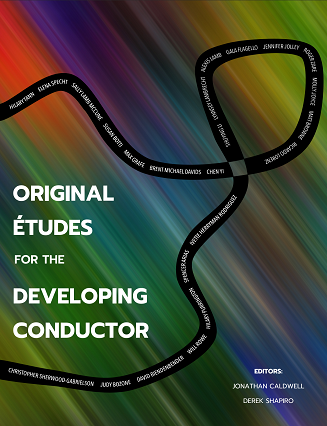
Original Études for the Developing Conductor
Not rated yetRate this bookOriginal Études for the Developing Conductor brings together short works intended for focused conducting practice. The editors’ introduction explains how the collection supplements traditional instruction with new music and specific pedagogical opportunities.
Free reading is available at the official source. Opens in a new tab.
 Free
About this book
Original Études for the Developing Conductor, edited by Jonathan Caldwell and Derek Shapiro, is a collection of 25 short works rather than a conventional prose textbook. Each étude supplies a distinct musical setting for learning gesture, pulse, cueing, articulation, phrasing, and ensemble coordination. Introductory commentary, scores, and transposed parts support flexible use with different groups. The guide below follows all 25 works and summarizes the composers’ stated ideas and the conducting questions they create. Suggested practice interpretations are editorial study aids; they do not replace reading the score, hearing the ensemble, or developing technique with a teacher.
The detailed guide below follows the book’s chapter, unit, or section structure. Read it alongside the study instructions and the complete official text.
Book summary
Chapter-by-chapter summaries
Spencer Arias: The Jester
Arias connects the piece with laughter and rapid changes of character, alternating collective gestures with more soloistic moments. The conductor must make the contrast legible without losing continuity in a very short work. Marcato writing supports the forceful ensemble character, while smaller exchanges ask for responsive cueing and a different gesture. A useful study focus is how the preparation anticipates the next sound rather than merely reacting to it. The changing social roles within the texture are part of the musical argument.
David Biedenbender: Swirl
Swirl combines a pickup, fast motion, changing asymmetrical meters, and marcato energy. Relatively static upper voices contrast with active lower voices, while octatonic material and rhythmic devices create a restless character. The conducting task is to communicate grouping and direction without making every irregular measure feel like a stop-and-restart exercise. Track which line is moving and which sustains the texture. Clear preparation and economical gesture can help the ensemble perceive the continuity beneath the changing beat patterns.
Susan Botti: Vespers (Walking in Beauty), Movement III: Les Distances
Botti's excerpt asks for fluid continuity through aleatoric cueing, changing meters, and metric modulation. The composer relates the music to motion in nature and emphasizes an internalized pulse that is reinterpreted rather than arbitrarily changed. The conductor must balance freedom with clear points of coordination. Some passages benefit from a broad one-beat feeling, with additional definition at cadences. The central learning challenge is to preserve the phrase and its momentum while using different levels of visible subdivision only where they serve the ensemble.
Judy Bozone: Lyrah
Lyrah draws on the story of Orpheus and his lyre, imagining an old, familiar sound unfolding slowly. The programmatic context supports attention to line, sustained sonority, and expressive pacing rather than a purely mechanical beat display. Study the score's changes and phrase destinations before selecting gesture size or emphasis. The conductor's preparation should communicate the intended sound and continuity. The source's mythological account explains the inspiration; the musical decisions still need to be grounded in the actual notation and the ensemble's response.
Matt Browne: Saunter
Saunter is a leisurely, lilting piece in 7/4, with recurring emphasis on beats one and five and intricate counterpoint. Its asymmetry should feel like an off-center dance rather than an obstacle to count. Conducting study can begin by hearing the larger grouping and then tracing how the lines interact across it. A gesture that marks all seven beats equally may obscure the character. The challenge is to sustain a relaxed motion while making the structural accents and individual entries understandable.
Matt Browne: Tarantella
Alternating 5/8 and 7/8 creates an energetic, unsettled dance, punctuated by percussion and ending in an intentionally depleted way. The work tests fast asymmetrical grouping and the shaping of a slowdown without losing shared subdivision. The conductor should distinguish the piece's changing surface from its underlying continuity and prepare each new grouping before it arrives. Its ending asks for a deliberate expressive trajectory rather than a generic grand finish. Character and coordination need to develop together.
Trevor Bumgarner: Choppy Frontier
The composer's imagined journey is disrupted by a missing horseshoe, an image reflected in off-balance 5/4 groupings and chorale-like harmonies that are familiar yet unsettled. The étude encourages conductors to hear how changing divisions alter emphasis while the larger journey continues. Marking the grouping is only a beginning; the gesture should also convey the unusual mixture of confidence and interruption. The program note offers a character cue, while the score determines the precise timing and ensemble demands.
Chen Yi: Ban (Beat)
Ban draws on the idea of beat in Chinese traditional theater and pitch material associated with northern Chinese folk music. It progresses from slow to fast, with changing meters and a transformation from lyrical layered lines through staccato writing to a strong unison conclusion. The conductor must prepare changes in tempo, texture, and articulation as related stages of one work. Studying where the lines converge helps organize cues and larger direction. The piece also invites attention to the composer's specific cultural explanation rather than a generalized exotic character.
Brent Michael Davids: Native American Étude
Davids designed the work to challenge meter and tempo changes while introducing some Native American song styles within contemporary concert writing. Vocalizations appear in the parts, and the editors encourage experimenting with singing as well as instrumental performance. The conductor should treat those elements as part of this composer's work, not as a universal representation of Indigenous music. Study how transitions are prepared and how vocal or instrumental choices affect ensemble coordination. The cultural context and the technical task support each other.
Gala Flagello: Bulletproof
Flagello explores resilience through forceful homophonic attacks, angular register changes, and sweeping gestures. In a compact 5/8 setting, the ensemble's coordinated punches contrast with movements that can feel destabilizing. The conductor must communicate both precision and recovery of direction. A useful question is how the preparatory motion signals the weight and articulation of an attack before it happens. The programme's question about being impervious to error should inform character without encouraging rigid, oversized gestures that interfere with the phrase.
Max Grafe: Fanfare With Afterimages
A bright, syncopated opening gives way to a quieter lyrical and polyphonic reflection. The piece tests dynamic and textural contrast, subdivision, and shifting emphasis at a slow tempo. Conductors need to make the change of character audible without treating the second section as unrelated material. The idea of an afterimage suggests retaining a relationship to what has just sounded. Score study should track which voice carries the listener's attention and how the supporting parts change around it.
Ivette Herryman Rodríguez: Tumbao Pesante
Rodríguez draws on a tumbao associated with Cuban son and salsa, adapting a characteristic piano-like rhythmic and harmonic gesture. Although written in 3/4, the composer asks for a one-beat feeling in which quarter notes function as subdivisions. Octatonic references and freely moving dominant-seventh harmonies contribute to the sound. The conducting challenge is to maintain the larger pulse and rhythmic profile without flattening the internal activity. Understanding the composer's description helps avoid imposing an unrelated three-beat waltz character.
Jennifer Jolley: Legend of the Moonlight Above
Jolley reworked material originally intended for a fantasy video-game soundtrack, describing it as too cozy and wintry for its original setting. That background supplies an expressive context for studying the score's line and atmosphere. The conductor's task is to translate the written phrasing, balance, and transitions into a coherent sound rather than illustrate a literal story. Consider how preparation, sustained attention, and the distribution of gesture can preserve a gentle character while keeping ensemble entrances and releases clear.
Molly Joyce: Offbeat
Offbeat explores quick accented material separated by silence in 2/4. The relationship between predictability and surprise is central, making rests active parts of the music rather than gaps in conducting responsibility. The ensemble needs a dependable underlying pulse even when attacks occur away from expected strong beats. Preparation should clarify when sound will happen without adding unnecessary motion during silence. The étude is a compact test of whether a gesture communicates timing and character together.
Alexis C. Lamb: Addolcimento (Sweetly, Softening)
The piece builds and releases a broad swell through range, dynamics, tempo, and changing vocalized syllables. Moving from closed to more open vowel sounds and back contributes to the overall shape. The conductor must pace the long trajectory while cueing local entrances, dynamic nuances, pauses, and releases. The exercise connects physical gesture with the changing quality of sound rather than with volume alone. Plan where tension grows and where it relaxes so that the entire miniature feels like one phrase.
Lynnsey Lambrecht: Festive Fugue
A lively four-voice fugue creates momentum through recurring rhythmic figures and shifting accents, then slows toward a final fermata. The harmonic approach to the ending supports the formal arrival. Conducting study combines fast duple clarity with attention to successive entries and the relationship among voices. A firm rhythmic foundation should not hide the contrapuntal exchange. The final slowdown is most effective when prepared as the culmination of the phrase rather than an abrupt change imposed at the last moment.
Shuying Li: Étude for Conductors
Li focuses on fractional preparation in half-note, triplet-half-note, and sixteenth-note contexts. The 6/4 setting alternates marcato rhythmic passages with faster-moving phrases. The conductor must locate exactly where a preparation belongs within the larger beat and make its energy fit the ensuing sound. Counting alone does not solve that physical timing problem. Study the transitions between rhythmic characters and ensure that the ensemble receives the necessary information before the entrance rather than on its attack.
Ricardo Lorenz: Estudio a Cuatro Voces
Lorenz uses a loose pasacalle idea with syncopation reminiscent of danzón and changing 2/4, 3/4, and 4/4 meters. The buoyant character eventually turns slower and more evocative. The conductor needs to retain a sense of phrase across changing bar lengths, while the later transformation asks for a different expressive weight. The composer's explanation distinguishes this inspiration from a narrow expectation of a northern-European passacaglia. Study how the four voices sustain continuity and how the transition prepares the nostalgic ending.
Sally Lamb McCune: Pony Hollow Trail
Repeated notes suggest echoes of journeys along a historical Finger Lakes trail, and mostly 7/8 meter creates urgency. The composer's imagined messenger supplies a reason for the forward motion. Conducting should clarify the grouping while preserving that directional energy. Repetition can sound static if every note receives an identical disconnected gesture, so larger phrasing remains important. The source's account of Indigenous paths and later roads is part of the work's stated context rather than a separate historical chapter.
Hilary Purrington: Keepsake
Keepsake combines expressive solo lines, close harmonies, a recurring chromatic three-note idea, and later octave leaps. Its nostalgic miniature character depends on phrasing, countermelodies, dynamic shapes, and tempo changes. The composer offers an optional earlier stopping point, making the chosen performance version important for planning the arc. The conductor must distinguish the current melodic voice from supporting material and shape transitions without losing the whole. The étude demonstrates how a small amount of material can carry a varied expressive trajectory.
Will Rowe: Loose Canon
A rough double canon places lyrical melodic entries above a jagged, more rigid supporting layer. The lopsided 7/8 setting offers cues at different subdivisions and asks the conductor to coordinate contrasting articulations simultaneously. One hand or aspect of the gesture may need to sustain the structural pulse while another shapes an entry. The challenge is not simply to make every part equally prominent, but to reveal the contrapuntal relationship and its phrase direction while keeping the supporting layer together.
Christopher Sherwood-Gabrielson: Last Waltz in Paris
The short waltz evokes nostalgia and whimsy, with changing meters and intentionally sparse interpretive markings. The composer encourages distinct character for each voice and imagines the hands as dancers with complementary roles. That image supports coordination between a dependable beat and expressive nuance. Score study should identify what is actually specified and where interpretation is invited. Freedom does not mean arbitrary timing: the ensemble still needs preparation and shared understanding as the character and meter change.
Elena Specht: Fortress
Fortress is severe and weighty, briefly interrupted by lighter material before the heavier style returns. Homorhythmic writing alternates with canonic exchanges, and sixteenth notes, triplets, accelerando, and ritardando require close coordination. The conductor must differentiate emphasis from indiscriminate force and make the brief contrast clear. Matching articulation across voices matters as much as synchronizing attacks. Planning the changes in texture and tempo helps the miniature retain its architectural character rather than becoming a sequence of isolated strong beats.
Hilary Tann: Moonrise
Moonrise asks for a slow but fluid beat, often energized by emphasis on the second beat. The composer allows some tempo fluctuation in the agitato passage and specifies a return before relaxation into the ending. The challenge is to sustain motion at a slow pace without making every beat equally heavy. Study how the phrase moves through local emphasis and how the return to the original tempo is communicated. Expressive flexibility needs an internal pulse and a clear larger destination.
Roger Zare: Reverie
Reverie passes melodic fragments among four independent parts in a slow, lyrical setting. A largely Phrygian color is warmed by occasional major harmonies, and the ending retains ambiguity. Each voice can briefly become the focus, so cueing and balance should follow the musical conversation. The conductor must connect fragments without forcing every phrase into the same shape. The daydream character is supported by continuity and responsive handoff between lines, while precise preparation lets that apparent wandering remain coordinated.
Study instructions
Begin with the assigned étude’s own introduction and identify the learning goals relevant to your course. Study the score to form an aural image before comparing it with a MIDI representation. Note what that representation clarifies and what it cannot communicate about interpretation.
Prepare a short practice plan linking a musical intention with the conducting action you want to investigate. Use teacher or ensemble feedback to assess whether the gesture communicates that intention. Keep observations about your own performance separate from claims about the composer’s intentions.
Full-book practice and review: Choose an étude with a specific learning goal and study the full score before conducting. Mark entrances, releases, phrasing, balance, and changes that require preparation from the conductor. Rehearse a gesture away from the ensemble, then review a recording for whether it communicates the intended musical result. Compare contrasting études to identify which difficulty is rhythmic, expressive, or related to coordinating independent parts rather than treating every problem as beat clarity.
Questions for reflection
- What musical intention should the gesture communicate?
- Which learning goals are stated in the assigned étude’s introduction?
- How can a MIDI aid differ from a prepared interpretation?
The study suggestions and questions are independent Academic Master editorial material.
Sources and coverage
Coverage follows all 25 étude introductions, with selected score material consulted for context. The summaries are prose study commentary, not reproductions of the scores or a claim to replace full score analysis. These original summaries draw on the source text, including chapter or section introductions and selected explanations, examples, exercises, and review material. They are condensed study guides, not a page-by-page account or a replacement for the complete resource. Additional synthesis sections are identified separately.
About access & copyright
This page provides book information and study material. Full-text access is provided by the original publisher or authorised source; a listing does not grant permission to republish the book.
Read our Library Access & Copyright policyRepertoire
Engage with original music by living composers.
Preparation
Read the score and its contextual introduction.
Listening
Develop an aural image beyond a MIDI rendering.
Feedback
Connect gestures with musical communication.
Reader ratings & reviews
Share your thoughts
Your review helps other students choose the right resources.
KEEP LEARNING
Your next great read
Arts Humanities
Music Copyright, Creativity, and Culture
View Music Copyright, Creativity, and Culture — book Psychology
Interpersonal Communication: A Mindful Approach to Relationships
View Interpersonal Communication: A Mindful Approach to Relationships — book Computer Science
How to Think Like a Computer Scientist: C++ Version
View How to Think Like a Computer Scientist: C++ Version — book Computer Science
Think Data Structures: Algorithms and Information Retrieval in Java
View Think Data Structures: Algorithms and Information Retrieval in Java — book Computer Science
Think DSP: Digital Signal Processing in Python
View Think DSP: Digital Signal Processing in Python — book Computer Science
Think Complexity: Exploring Complexity Science with Python
View Think Complexity: Exploring Complexity Science with Python — book Computer Science
Think Stats: Probability and Statistics for Programmers
View Think Stats: Probability and Statistics for Programmers — book Computer Science
The Little Book of Semaphores
View The Little Book of Semaphores — book Computer Science



