
Environmental Toxicology
Annual rhythmsTextbook
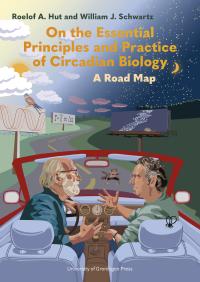
On the Essential Principles and Practice of Circadian Biology: A Road Map
Not rated yetRate this bookRoelof A. Hut and William J. Schwartz's circadian-biology road map introduces how daily rhythms are observed, investigated, and used by organisms. Three main chapters connect time-series interpretation with endogenous clocks, entrainment, functional questions, networks, seasonal timing, and navigation. This guide also covers the linked Points of Interest and emphasizes what an experiment or figure can actually establish.
Free reading is available at the official source. Opens in a new tab.
 Free
About this book
Roelof A. Hut and William J. Schwartz's circadian-biology road map introduces how daily rhythms are observed, investigated, and used by organisms. Three main chapters connect time-series interpretation with endogenous clocks, entrainment, functional questions, networks, seasonal timing, and navigation. This guide also covers the linked Points of Interest and emphasizes what an experiment or figure can actually establish.
Chapter-wise summaries and study tasks
Chapter 1. Observation: Daily Rhythmicity
A daily pattern is an observation to investigate, not immediate proof of an internal clock. The first chapter asks how measurements collected at different times can support a claim of rhythmicity. Sampling frequency, duration, variability, and the variable being observed affect what can be detected. A repeated environmental cycle can produce a daily response without establishing that an endogenous oscillator sustains it. Distinguish the observed time series from the mechanism proposed to explain it.
Actograms display successive cycles so that timing, drift, stability, and changes in behavior can be inspected. Their conventions must be understood before interpreting a sloped band or an apparent shift. When repeated measurements in the same subject are impractical, alternative sampling designs introduce different limits and sources of variation. Period, phase, and amplitude describe distinct properties, while terminology should remain tied to measurement conditions. The chapter teaches disciplined observation: identify what the record shows, what the schedule imposed, and which additional comparison would test a clock-based explanation.
Study task. Draw a fictional actogram from several days of activity and annotate the recording schedule. Describe period and phase separately, then state why the pattern alone does not demonstrate an endogenous circadian mechanism.
Chapter 2. Investigation: What is Your Question?
Investigation begins by choosing the kind of question being asked. The chapter separates mechanisms generating and expressing rhythms, the functional utility of a clock, and the organization of circadian networks. These questions are conceptually connected but require different experiments. A molecular change, a behavioral consequence, and an adaptive explanation are not interchangeable results.
Mechanistic work distinguishes endogenous timing from direct environmental effects and examines free-running behavior, entrainment, and phase responses. Masking can change the observed output without the same change occurring in the underlying oscillator. Entrainment requires more than noticing that two rhythms have similar periods; phase relationships and response to timing cues matter. Functional questions ask what timing makes possible in an ecological context, with comparisons that can distinguish benefit from correlation.
The network perspective examines interactions among oscillators, tissues, and signals rather than assuming that a single clock dictates every rhythm identically. Coupled systems can behave differently from isolated components. Human experimental protocols illustrate how schedules and observations can separate processes, but they are research designs requiring appropriate supervision and ethics, not self-experiment instructions. The chapter encourages question-led interpretation and explicit limits when moving between molecular, organismal, and environmental scales.
Study task. Choose one fictional question at each level: mechanism, function, and network organization. For each, propose observations, a comparison, and an alternative explanation; explain how masking or coupling could complicate the interpretation.
Chapter 3. Application: Consulting the Clock
The application chapter considers how organisms use timing systems to coordinate activity with other predictable features of the world. Annual and daily cycles interact, and day length can provide seasonal information. A clock's role in anticipation differs from a direct response after a condition changes. Photoperiodic responses and longer-term timing require careful distinctions among the environmental cue, internal process, and observed outcome.
Migration links seasonal preparation with orientation and movement. Time-compensated use of the sun illustrates why knowing time can contribute to wayfinding rather than only schedule an activity. The book also considers situations in which apparently familiar expectations about rhythmic expression need reconsideration. A weak or absent rhythm in one observed variable does not automatically show that every timing process is absent. Applications should be connected to the evidence and ecological setting that support them. The chapter does not provide a universal treatment schedule for human sleep, lighting, or illness; it shows how basic principles generate meaningful applied questions.
Study task. Explain a fictional example of seasonal timing and a separate example of time-compensated orientation. Identify the cue, internal process, output, and comparison that could test the clock's contribution.
Points of Interest: supplementary explanations
The Points of Interest provide expanded examples, technical clarifications, and supporting arguments linked to the main text by markers. They allow the three-chapter narrative to remain readable while giving learners a route into greater depth. Examples across organisms help separate a general timing concept from a property demonstrated only in a particular system. Figures and explanations should be read with attention to experimental conditions, axes, time conventions, and the distinction between a schematic and recorded data.
Use the supplementary material to resolve a defined question encountered in the main chapters rather than treat every aside as a disconnected fact to memorize. Trace how an example supports, qualifies, or complicates the surrounding argument. A useful study record links the main claim, the supporting example, the measurement, and an unresolved limitation. This approach builds the vocabulary needed to read the wider literature while avoiding the assumption that an introductory road map is an exhaustive account of circadian research.
Study task. Select three marked supplements from different chapters. For each, record the main-text question, what the example adds, the measurement conditions, and one conclusion that would go beyond the evidence.
How to study this book
- Read the brief circadian-system profile, then follow observation, investigation, and application in order.
- For every figure, label the measured variable, time convention, environmental schedule, and whether the display is schematic or empirical.
- Maintain separate definitions for period, phase, amplitude, entrainment, free-running behavior, and masking.
- Use the marked Points of Interest when a main-text question calls for detail and record the connection.
- Design paper-based or simulated study plans for the tasks; real biological experiments require appropriate expertise, welfare safeguards, and ethical approval.
Questions for reflection
- Does the record demonstrate a rhythm, an internal oscillator, or both?
- Which variable is observed and which mechanism is inferred?
- Would a change in output reflect phase resetting, masking, or another process?
- How does evidence from an isolated component transfer to a coupled organism?
Source edition and coverage
The guide follows the three expanded main chapters and supporting Points of Interest in the University of Groningen Press source by Roelof A. Hut and William J. Schwartz. It is an educational orientation to concepts and research reasoning, not individualized sleep, lighting, or clinical advice. These are original study explanations and learning tasks. Read the complete book at the official source.
About access & copyright
This page provides book information and study material. Full-text access is provided by the original publisher or authorised source; a listing does not grant permission to republish the book.
Read our Library Access & Copyright policyExplore the contents
Check the chapters covered in this edition.
Visit the official source
See reading, preview or purchase options.
Save for later
Keep this textbook in your saved collection.
Reader ratings & reviews
Share your thoughts
Your review helps other students choose the right resources.
KEEP LEARNING
Your next great read
Chemistry
Vaccination Programmes
Vaccination Programmes
View Vaccination Programmes — bookRelativistic Quantum Mechanics
Relativistic Quantum Mechanics
View Relativistic Quantum Mechanics — bookAerospace Structures
Aerospace Structures
View Aerospace Structures — book Abelian number fields
Number Fields
View Number Fields — book Textbook
Agricultural Meteorology and Climatology
View Agricultural Meteorology and Climatology — book Language teaching and learning
In the Community: An Intermediate Reading and Writing Textbook
View In the Community: An Intermediate Reading and Writing Textbook — book Communication Studies
Technical Writing Essentials 2nd Edition
View Technical Writing Essentials 2nd Edition — book Language learning for academic, technical and scientific purposes
Technical Communication in Engineering: A Place-Based Approach
View Technical Communication in Engineering: A Place-Based Approach — book mathematical modelling



