
 Mathematics
AlgebraTextbook
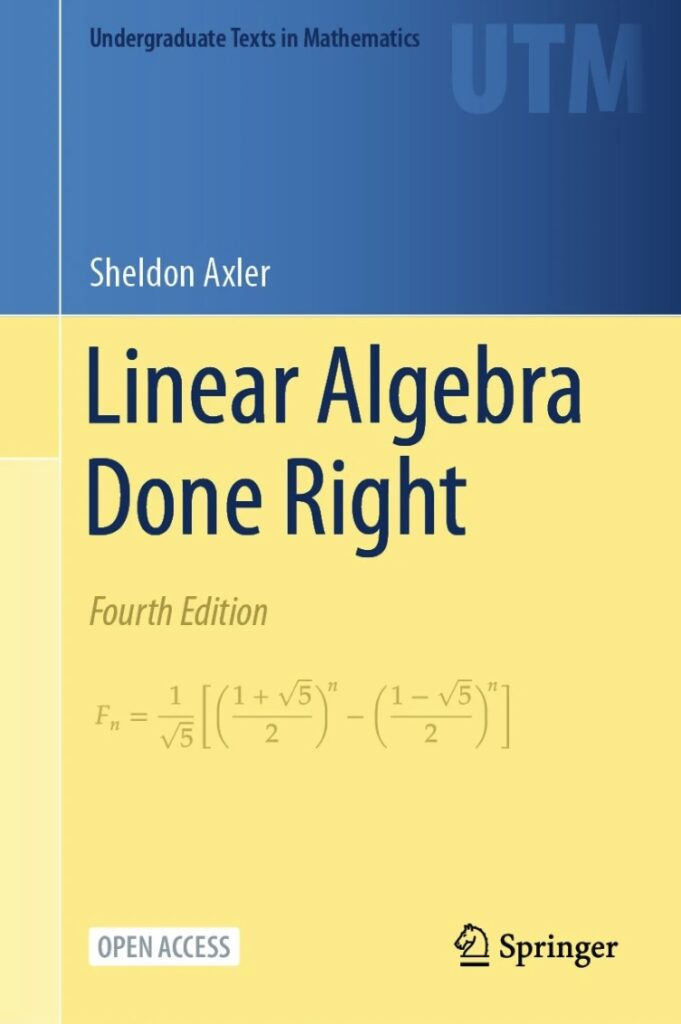
Linear Algebra Done Right
Not rated yetRate this bookSheldon Axler’s fourth-edition linear algebra textbook develops conceptual understanding of linear maps and vector spaces through proof, examples, and sustained exercise work.
Free reading is available at the official source. Opens in a new tab.
 Free
About this book
Sheldon Axler’s fourth-edition linear algebra textbook develops conceptual understanding of linear maps and vector spaces through proof, examples, and sustained exercise work.
This page introduces the source edition and offers a focused reading route. Use the linked original resource for the complete text, references, activities, and the author’s full explanation. The overview below is limited to the sections identified in the coverage note.
Contents and further reading
Consult the official book or repository page for the resource’s contents and publication information. Open the source PDF to read the complete available edition.
Sources and coverage
This original overview is based on selected Preface for Instructors discussion (PDF sheets 15–16), with fourth-edition publication information checked. It is not a whole-book review. The verified source PDF contains 408 PDF sheets, including preliminary or repository pages; this may differ from its printed pagination. The source retains its own authorship, rights notices, and any separately credited third-party material.
Book summary
Sheldon Axler’s fourth edition develops linear algebra through vector spaces, linear maps, and operators. Nine chapters emphasize proofs and conceptual structure before the final treatment of determinants. The sequence asks students to understand what an operator does independently of a particular matrix representation, while using examples and exercises to connect abstract statements with concrete consequences.
Chapter-by-chapter summaries
Chapter 1: Vector Spaces
The opening establishes the objects and operations on which the subject depends. A vector space is defined through a compatible algebraic structure, allowing familiar coordinate examples to sit alongside spaces of other objects. Subspaces and sums develop the question of how collections of vectors fit within a larger space. Definitions need to be tested through both examples and non-examples.
Chapter 2: Finite-Dimensional Vector Spaces
Span, linear independence, bases, and dimension describe how a finite set of vectors can represent a space. A basis combines completeness with the absence of redundancy. The chapter develops the consequences of changing a generating set and explains why dimension is a property of the space rather than the number of vectors in an arbitrary list.
Chapter 3: Linear Maps
Linear maps preserve the operations defining vector spaces. Null spaces and ranges connect a map with questions of solvability and uniqueness. Matrix representations provide a computational language, but the underlying map remains the central object. Quotient spaces and related constructions extend the ability to reason about structure rather than only manipulate arrays of numbers.
Chapter 4: Polynomials
Polynomial results supply tools used later in the theory of operators. Their algebraic properties become important when a polynomial is applied to a linear map or used to describe eigenvalue behavior. The chapter's role is connective: understanding the available factorizations and identities clarifies why later statements differ over real and complex scalar fields.
Chapter 5: Eigenvalues and Eigenvectors
Eigenvectors identify directions on which an operator acts by scaling, while invariant subspaces provide a broader structural language. The chapter develops these ideas into questions about decomposition and useful matrix forms. The key task is to understand what a representation reveals about the operator and when enough eigenvectors exist to simplify its action.
Chapter 6: Inner Product Spaces
An inner product adds geometry to a vector space. Length, orthogonality, and projections make approximation and decomposition possible in a new way. The chapter connects algebraic definitions with geometric consequences, showing how orthonormal structure simplifies reasoning while requiring care about the difference between real and complex settings.
Chapter 7: Operators on Inner Product Spaces
Adjoints and special classes of operators connect a transformation with the inner-product geometry. Spectral results explain when an operator admits a particularly informative orthonormal representation. Positivity and related constructions support further applications. The reader should track the assumptions of each theorem rather than treating every operator as if it shared the most convenient properties.
Chapter 8: Operators on Complex Vector Spaces
The complex setting supports further structural results involving generalized eigenvectors and decompositions. These tools address operators that cannot be understood through ordinary eigenvectors alone. The chapter develops a more complete account of operator behavior, making the distinction between a convenient diagonal form and the general situation explicit.
Chapter 9: Multilinear Algebra and Determinants
Multilinear ideas and determinants arrive after the operator framework has been established. This ordering lets the reader connect determinant properties with broader structure instead of using a determinant as the starting definition of every important concept. The chapter supplies another language for understanding dimensions, transformations, and algebraic relationships already developed in the book.
Study instructions
- Before using a theorem, list its hypotheses and construct an example showing why one of them matters.
- Work with both an abstract map and a matrix representation, explaining what changes under a basis choice.
- Write proofs in complete logical steps and separate a definition from a consequence of that definition.
- Revisit a small set of operators across the later chapters to compare the structures each new concept reveals.
Sources and coverage
This original study guide follows the linked source edition and its chapters or explicitly identified sections. It condenses the main ideas and their relationships; examples and practice directions are for study alongside the complete text. Complete source edition.
About access & copyright
This page provides book information and study material. Full-text access is provided by the original publisher or authorised source; a listing does not grant permission to republish the book.
Read our Library Access & Copyright policyConceptual understanding
Work with definitions and mathematical objects.
Proof structure
Track assumptions and dependencies.
Exercises
Use active problem-solving to develop understanding.
Course planning
A selected route can be more realistic than full coverage in one term.
Reader ratings & reviews
Share your thoughts
Your review helps other students choose the right resources.
KEEP LEARNING
Your next great read
Mathematics Mathematics
MTH 211: Calculus II
View MTH 211: Calculus II — book Mathematics
Mathematical Reasoning
View Mathematical Reasoning — book Mathematics
MAT 2420 Calculus II
View MAT 2420 Calculus II — bookMTH 225 Differential Equations
MTH 225 Differential Equations
View MTH 225 Differential Equations — bookFinite Mathematics
Finite Mathematics
View Finite Mathematics — bookMATH 25: PreCalculus
MATH 25: PreCalculus
View MATH 25: PreCalculus — bookMath 4B: Differential Equations
Math 4B: Differential Equations
View Math 4B: Differential Equations — bookMath 100: Liberal Arts Mathematics
Math 100: Liberal Arts Mathematics
View Math 100: Liberal Arts Mathematics — bookCalculus I: Differential Calculus



