
 Intellectual property law
Constitutional LawTextbook
Liberty, Equality and Due Process: Cases, Controversies, and Contexts in Constitutional Law
Not rated yetRate this bookLiberty, Equality, and Due Process: Cases, Controversies, and Contexts in Constitutional Law by Ruthann Robson develops rights analysis through cases, problems, and competing constitutional arguments. This guide follows the third edition updated June 2021. It covers twelve numbered chapters, with Chapters Four and Five divided into two parts in the source. Read decisions through text, history, institutional role, reasoning, and factual context. Later constitutional developments are not silently incorporated into the 2021 edition; this is a guide to that source rather than an assurance of current doctrine.
Free reading is available at the official source. Opens in a new tab.
 Free
About this book
Liberty, Equality, and Due Process: Cases, Controversies, and Contexts in Constitutional Law by Ruthann Robson develops rights analysis through cases, problems, and competing constitutional arguments. This guide follows the third edition updated June 2021. It covers twelve numbered chapters, with Chapters Four and Five divided into two parts in the source. Read decisions through text, history, institutional role, reasoning, and factual context. Later constitutional developments are not silently incorporated into the 2021 edition; this is a guide to that source rather than an assurance of current doctrine.
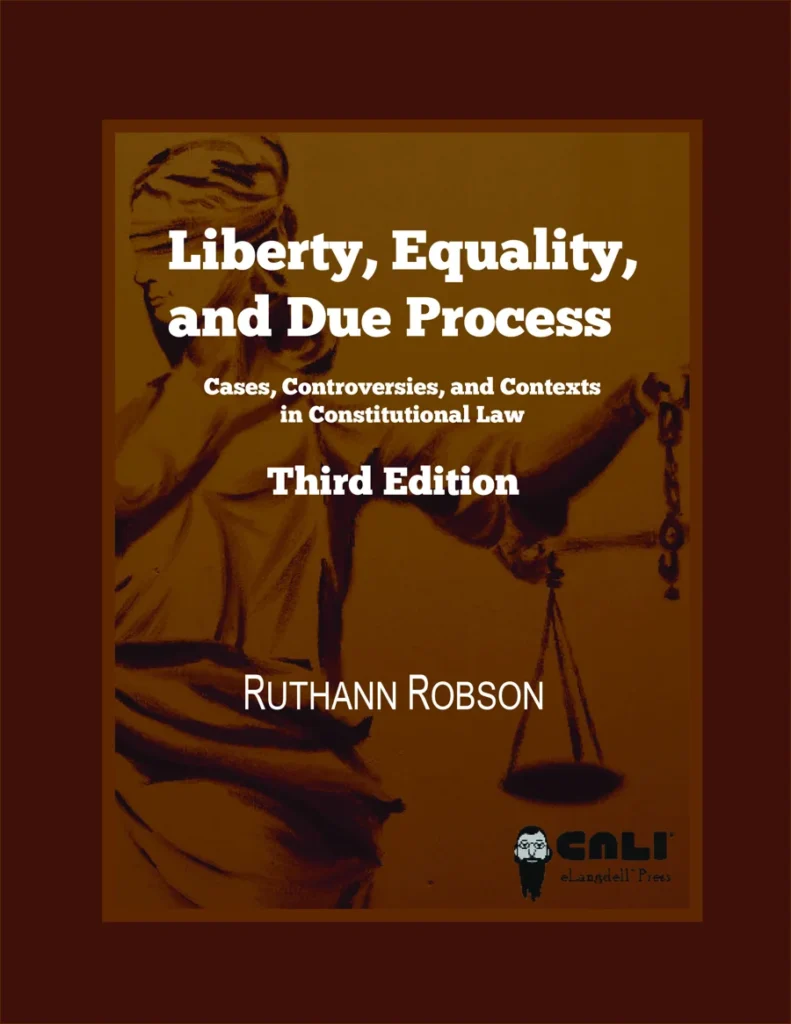
Cover: source-edition cover, displayed to identify the linked book. Publisher and third-party rights remain with their respective holders.
Book summary
Liberty, Equality, and Due Process: Cases, Controversies, and Contexts in Constitutional Law by Ruthann Robson develops rights analysis through cases, problems, and competing constitutional arguments. This guide follows the third edition updated June 2021. It covers twelve numbered chapters, with Chapters Four and Five divided into two parts in the source. Read decisions through text, history, institutional role, reasoning, and factual context. Later constitutional developments are not silently incorporated into the 2021 edition; this is a guide to that source rather than an assurance of current doctrine.
Chapter-by-chapter summaries
1. Constitutional law and state action
The state-action question determines when constitutional restrictions apply to challenged conduct. Identifying harm is not enough; the claimant must connect it with the relevant constitutional obligation and defendant. Compare private conduct, public authority, and arrangements involving both. Brief the source cases around the relationship the court treats as decisive. The chapter establishes a threshold often overlooked when analysis jumps directly to whether a practice seems unequal or coercive.
2. Interpretation and judicial review
Constitutional argument draws on competing approaches to text, precedent, history, structure, and institutional authority. Judicial review raises questions about who interprets and with what consequences. Compare a holding with the reasoning supporting it and identify the interpretive choices involved. A historical claim and a normative justification are not the same. The chapter trains readers to evaluate arguments rather than treating a preferred outcome as proof that one method uniquely determines the answer.
3. Slavery and racial equality
Constitutional history includes institutions of domination and struggles over citizenship, freedom, and equality. Reconstruct the legal arrangements and arguments in their historical context without presenting them as morally neutral background. Distinguish a change in constitutional text from its subsequent implementation and interpretation. The chapter provides foundations for later equal-protection analysis by showing how formal legal change, institutional resistance, and the meaning of membership interact.
4, Part 1. Race and equal protection
Equal-protection doctrine requires identifying the classification, governmental action, asserted objective, and applicable standard. Formal similarity does not necessarily resolve unequal treatment or its justification. Compare competing readings of the same policy and the facts each makes relevant. Separate the constitutional test from an empirical prediction about effects. The source’s cases should be analyzed through their holdings and limits rather than reduced to a single claim that race is either always relevant or never relevant.
4, Part 2. Race and equal protection continued
The second part deepens issues surrounding racial classifications, purposes, remedies, and institutional contexts. Compare a policy’s form, justification, and effects without assuming one supplies the others automatically. Ask how the claimed corrective objective fits the legal framework discussed by the source. Cases from different periods may apply distinct reasoning. Keep a chronological map so the development of doctrine remains visible and later holdings are not attributed backward to earlier courts.
5, Part 1. Nonracial classifications
Classifications involving characteristics other than race raise questions about comparison groups, scrutiny, purposes, and fit. A description of differential treatment does not itself establish which standard applies. Identify the actual governmental line and the reason asserted for it. Compare how the source’s decisions treat evidence, stereotypes, and institutional judgments. A classification’s everyday familiarity cannot replace justification under the constitutional framework relevant to the claim.
5, Part 2. Nonracial classifications continued
Further cases test the operation and limits of equal-protection analysis in different settings. Consistent terminology can conceal disagreements over how broadly a group or objective should be defined. State the comparator and the claimed relationship between means and end. Distinguish criticism of a policy from proof that it fails the applicable constitutional test. The second part develops disciplined comparison while emphasizing the factual and historical context of each source decision.
6. Fundamental rights and equal protection
A classification can implicate access to an important right as well as differential treatment. Identify the interest, the classification, and the burden separately. Compare an equality-based argument with a liberty-based one and ask whether they require the same showing. A right’s practical importance does not automatically settle its doctrinal status. The chapter helps readers see why selecting a constitutional route shapes both the facts emphasized and the form of justification demanded.
7. Privileges or Immunities
The clause’s text, history, interpretation, and relationship with other constitutional provisions raise questions about citizenship and protected rights. Separate the clause from similarly named provisions elsewhere. Trace the argument from historical purpose to judicial treatment and later claims. The chapter shows how a constitutional route can become narrow through precedent while remaining important to debates about alternative foundations. Do not assume a phrase’s ordinary meaning supplies its full legal operation.
8. Incorporation and fundamental rights
Incorporation concerns the application of protections against state government, while broader rights analysis raises related but different questions. Identify which provision is invoked, against whom, and through what doctrinal route. Compare historical and interpretive arguments in the assigned cases. Keep a map of federal and state constitutional relationships. The chapter explains why naming a right does not complete analysis of its source, reach, standard, or the government action it constrains.
9. The Second Amendment
The source’s 2021 treatment examines text, history, precedent, and controversies surrounding the right to keep and bear arms. Analyze the reasoning and scope of assigned decisions rather than extrapolating one quotation to every regulation. Identify the factual and doctrinal question actually resolved. Subsequent cases changed important aspects of the field, so this chapter must be read as source-era coursework. Current claims require updated controlling authority beyond the edition summarized here.
10. Unenumerated rights and due process
Rights not expressly listed raise questions about history, liberty, judicial role, and how an asserted interest is framed. A narrow or broad description can change the analysis. Compare competing approaches and identify the evidence each considers relevant. Distinguish procedural protection from a substantive limit on government action. The guide preserves the 2021 text’s arguments; it does not imply that later constitutional developments left every source-era formulation intact.
11. Liberty, due process, and equal protection
The chapter brings overlapping constitutional routes into dialogue. A claim may concern both freedom from interference and unequal treatment, but the arguments remain distinct. Map each theory’s protected interest, comparison, burden, and justification. Compare how a court uses or declines an alternative route. The interaction demonstrates why legal analysis is not simply choosing a favorable label: the doctrinal path affects reasoning, institutional implications, and the scope of a holding.
12. State constitutions
State constitutional sources can provide distinct grounds for claims rather than merely repeating federal analysis. Text, history, institutions, and state precedent may differ. Identify whether a decision rests on independent state grounds and distinguish the relevant courts’ authority. A federal minimum does not automatically describe the full protection available under another source. The final chapter expands the research framework while reinforcing the need to identify jurisdiction and controlling authority before applying a rule.
Study instructions
- Brief cases with the constitutional source, action, right, classification, test, holding, and limits.
- Keep a timeline that distinguishes historical decisions from the June 2021 edition and later research.
- Compare alternative constitutional arguments on the same facts.
- Separate interpretive claims, empirical premises, and normative evaluations in written analysis.
Questions for reflection
- Why does identifying a constitutional harm require a state-action inquiry?
- How can the framing of a right change an argument?
- When might a state constitution supply a distinct basis for protection?
Sources and coverage
This original reading guide follows the linked source edition’s chapter, module, unit, or lesson structure. Consult the source for full arguments, cases, worked examples, exercises, illustrations, and references. Third edition, updated June 2021. Chapters Four and Five have two source parts each. The guide does not represent source-era discussions as verified current constitutional law. Read the source edition.
About access & copyright
This page provides book information and study material. Full-text access is provided by the original publisher or authorised source; a listing does not grant permission to republish the book.
Read our Library Access & Copyright policyExplore the contents
Check the chapters covered in this edition.
Visit the official source
See reading, preview or purchase options.
Save for later
Keep this textbook in your saved collection.
Reader ratings & reviews
Share your thoughts
Your review helps other students choose the right resources.
KEEP LEARNING
Your next great read
Intellectual property law Contract Law
The Story of Contract Law: Formation
View The Story of Contract Law: Formation — book Law
Introduction to Criminal Law
View Introduction to Criminal Law — book Law
Evidence: Best Evidence Rule
View Evidence: Best Evidence Rule — book Law
Federal Rules of Appellate Procedure
View Federal Rules of Appellate Procedure — book Law
Land Use
View Land Use — book Business
Contract Doctrine, Theory & Practice, Volume 1
View Contract Doctrine, Theory & Practice, Volume 1 — book Law
The Ethics of Tax Lawyering
View The Ethics of Tax Lawyering — book Law
Federal Rules of Bankruptcy Procedure
View Federal Rules of Bankruptcy Procedure — book Civil Law



