
 Mathematics
AppliedTextbook
Introduction to Game Theory: a Discovery Approach
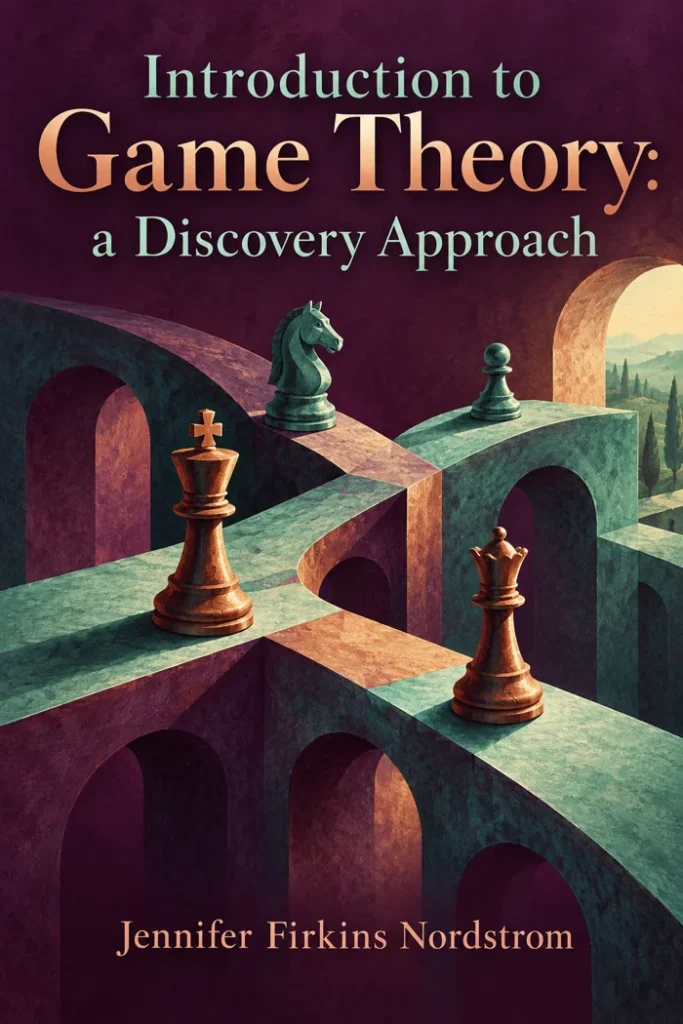
Not rated yetRate this bookIntroduction to Game Theory: a Discovery Approach develops quantitative reasoning through games and strategic choices. Jennifer Firkins Nordstrom uses inquiry-based activities to introduce mathematical models of social and economic situations.
 Free
About this book
The preface identifies a college quantitative reasoning course as the main context, with an introductory social-science game theory course as another possible use. Students are asked to make conjectures and attempt problems before all formal tools have been supplied. This discovery approach creates opportunities to compare initial intuition with a more developed model. Algebra and probability appear as needed, while popular-culture prompts connect the mathematical discussion with other interests. The hosted PDF is dated January 12, 2026; its contents distinguish zero-sum, repeated and non-zero-sum games.
The attached edition contains 121 PDF pages, including front matter. Cover: source edition title page rendered from the PDF. The textbook and its original notices are retained; Academic Master’s study material is separate from the source text.
Book summary
Introduction to Game Theory: a Discovery Approach develops strategic reasoning through games, experiments, and guided questions. This guide follows the linked PDF dated January 12, 2026. Its four main chapters progress from players and payoffs to zero-sum, mixed, repeated, and non-zero-sum settings. The important distinction is between choosing a good action against a particular opponent and identifying a strategy supported by the structure of the game.
Chapter-by-chapter summaries
Chapter 1: What Is Game Theory?
Players, strategies, matrices, and payoff vectors describe an interaction in a form that can be analyzed. A strategy specifies a choice or plan, while a payoff expresses the modeled consequence for a player. The meaning of a larger payoff must remain consistent. Translate a small interaction into a matrix and check every outcome from each player’s viewpoint. A game model is selective: what it assumes about available actions, information, and incentives determines what its conclusions can explain.
Chapter 2: Two-Person Zero-Sum Games
In a zero-sum setting, one player’s gain corresponds to the other’s loss under the chosen payoff representation. Examine how each player responds to the other’s possible action before choosing a strategy. The matrix supports systematic comparison, including strategies that can be ruled out by dominance. Distinguish a favorable outcome from a defensible strategy under uncertainty about the opponent. Work through small games by marking best responses and explaining the reasoning in words rather than relying only on a numerical pattern.
Chapter 2: Probability, Expected Value, and Equilibrium
Probability connects uncertain play with expected payoff. Expected value summarizes an average under specified probabilities and is not a guarantee about a single play. Equilibrium analysis asks whether the chosen strategies are mutually stable against unilateral change. Examine whether a pure-strategy equilibrium exists before assuming one must. The chapter’s popular-culture discussion also invites scrutiny of rationality and information assumptions. A mathematically valid conclusion should be tied to what the model lets players know and do.
Chapter 3: Repeated Games and Mixed Strategies
Repeated play provides motivation for randomizing rather than always selecting the same action. A mixed strategy assigns probabilities to available pure strategies, making predictability and expected outcomes central. Distinguish a deliberate probability distribution from simply changing one’s mind after every result. Compare observed short runs with theoretical expectations and allow for random fluctuation. The strategic question is how a distribution performs against possible responses, not whether one simulated sequence happens to win.
Chapter 3: Graphical and Expected-Value Solutions
The graphical method represents expected payoffs as functions of a mixing probability. A solution must account for the opponent’s best available response, not optimize one line in isolation. The expected-value method expresses the relevant relationships algebraically. Sage exercises connect visualization with computation, while matrix methods support solving the resulting systems. Check probability constraints and substitute the proposed strategy into the payoff calculation. Software can locate an intersection without deciding whether it belongs to the intended game or feasible range.
Chapter 3: Liar’s Poker and Undercut
The named games provide further settings for testing strategic analysis. Write the rules and information structure carefully before importing a method from a simpler example. Identify what counts as a strategy and how a payoff changes when either player changes course. Experiments can reveal behavior that differs from a simple model’s prediction. Treat that difference as a question about incentives, beliefs, learning, or the model’s assumptions rather than automatic evidence that either the mathematics or the participants are irrational.
Chapter 4: Non-Zero-Sum Games
When payoffs are not strictly opposed, players can share some interests while disagreeing about others. A payoff vector must retain both players’ values rather than reduce every outcome to one number. Best responses still matter, but equilibrium need not maximize collective benefit. Compare several possible outcomes by asking whether a player or both players would prefer a change. The distinction between individual incentives and shared welfare explains why a seemingly desirable agreement may be difficult to sustain.
Chapter 4: Prisoner’s Dilemma, Chicken, and Experiments
Prisoner’s Dilemma and Chicken have different strategic structures despite both involving conflict. Identify the payoff relationships that define a dilemma rather than apply its label to any disagreement. Class-wide and multiplayer experiments test how incentives operate beyond a single matrix. Compare predicted best responses with actual choices and explain what the observation can establish. A sample of classroom behavior is informative about that setting, but it does not independently settle every claim about human cooperation.
Chapter 4: Volunteer’s Dilemma and Repeated Cooperation
The volunteer’s dilemma examines a shared benefit that depends on someone bearing a cost. Repeated Prisoner’s Dilemma introduces the possibility that future consequences affect present action. Specify what players observe, how long interaction continues, and which strategies are available before evaluating cooperation. The final popular-culture examples become useful when analyzed through those structural questions. Finish by comparing a one-shot prediction with a repeated-game explanation and identify exactly which changed assumption permits a different result.
Study instructions
- Play or simulate each small game before formal analysis, keeping a record of rules and outcomes.
- Construct a payoff matrix and verify every cell from both players’ perspectives.
- Explain dominance, best response, and equilibrium separately; do not use them as synonyms.
- Check mixed-strategy probabilities and expected payoffs by both calculation and simulation.
- When experiments differ from predictions, identify the model assumption that may explain the gap.
- Write a comparison of two games with similar stories but different payoff structures.
Questions for reflection
- Why can an equilibrium fail to be the best outcome for the group?
- What does randomization achieve that a predictable pure strategy cannot?
- Which change in information or repetition would alter your analysis?
Sources and coverage
This original study guide follows the complete linked source edition and all of its substantive chapters or named teaching sections. It condenses their main ideas and relationships; the study tasks are guidance for reading alongside the complete resource. It does not reproduce the source exercises or answer key. Book source; Complete source PDF.
About access & copyright
Check this edition’s source and licence before reusing its files or content. A library listing does not grant additional rights.
Read our Library Access & Copyright policyDiscovery learning
Relate conjecture to later formal analysis.
Quantitative modelling
Identify the role of algebra and probability.
Game structure
Recognise the verified route through different game settings.
Reflective comparison
Compare intuition with a mathematical result.
Reader ratings & reviews
Share your thoughts
Your review helps other students choose the right resources.
KEEP LEARNING
Your next great read
Mathematics Mathematics
MTH 211: Calculus II
View MTH 211: Calculus II — book Mathematics
Mathematical Reasoning
View Mathematical Reasoning — book Mathematics
MAT 2420 Calculus II
View MAT 2420 Calculus II — bookMTH 225 Differential Equations
MTH 225 Differential Equations
View MTH 225 Differential Equations — bookFinite Mathematics
Finite Mathematics
View Finite Mathematics — bookMATH 25: PreCalculus
MATH 25: PreCalculus
View MATH 25: PreCalculus — bookMath 4B: Differential Equations
Math 4B: Differential Equations
View Math 4B: Differential Equations — bookMath 100: Liberal Arts Mathematics
Math 100: Liberal Arts Mathematics
View Math 100: Liberal Arts Mathematics — bookCalculus I: Differential Calculus



