
 Business
AccountingTextbook
Introduction to Financial Accounting: U.S. GAAP Adaptation
Not rated yetRate this bookIntroduction to Financial Accounting: U.S. GAAP Adaptation develops the accounting cycle before extending it to inventory, receivables, long-lived assets, financing, cash flows, and financial analysis. David Annand and Henry Dauderis wrote the underlying text; T. Jensen and D. Marchand adapted the linked U.S. GAAP edition. This guide follows Version 2021, Revision A, whose front matter gives a December 15, 2020 publication date. Its thirteen chapters begin with a corporate business and later compare proprietorships and partnerships. The examples and conventions belong to that source edition rather than constituting a current professional accounting standard.
Free reading is available at the official source. Opens in a new tab.
 Free
About this book
Introduction to Financial Accounting: U.S. GAAP Adaptation develops the accounting cycle before extending it to inventory, receivables, long-lived assets, financing, cash flows, and financial analysis. David Annand and Henry Dauderis wrote the underlying text; T. Jensen and D. Marchand adapted the linked U.S. GAAP edition. This guide follows Version 2021, Revision A, whose front matter gives a December 15, 2020 publication date. Its thirteen chapters begin with a corporate business and later compare proprietorships and partnerships. The examples and conventions belong to that source edition rather than constituting a current professional accounting standard.
Book summary
Introduction to Financial Accounting: U.S. GAAP Adaptation develops the accounting cycle before extending it to inventory, receivables, long-lived assets, financing, cash flows, and financial analysis. David Annand and Henry Dauderis wrote the underlying text; T. Jensen and D. Marchand adapted the linked U.S. GAAP edition. This guide follows Version 2021, Revision A, whose front matter gives a December 15, 2020 publication date. Its thirteen chapters begin with a corporate business and later compare proprietorships and partnerships. The examples and conventions belong to that source edition rather than constituting a current professional accounting standard.
Chapter-by-chapter summaries
Chapter 1: Introduction to Financial Accounting
Accounting converts economic activity into information that investors, creditors, managers, and other users can interpret. The chapter introduces business forms, accounting principles, financial statements, and transaction analysis, emphasizing the corporation from the outset. The accounting equation connects assets with creditor and owner claims, while double-entry records preserve that relationship as transactions occur. An asset purchase, borrowing, revenue, and an owner contribution can all increase resources but have different effects on income and equity. Financial statements therefore answer related but distinct questions about position, performance, changes in equity, and cash. Practice classifying transactions before choosing account names: identify what the business received or surrendered and whether the change arose from operations, financing, or an exchange of assets. A balanced equation is necessary, but it does not by itself prove that the correct accounts or reporting period were used.
Chapter 2: The Accounting Process
Accounts organize changes by category, and debits and credits specify the sides used to record them. They do not mean good and bad or universally mean increases and decreases; their effect depends on the type of account. The chapter moves from transaction analysis through journal entries, ledger posting, and the trial balance to an overview of the accounting cycle. Formal records preserve dates, explanations, and a traceable relationship between the original transaction and the reported balance. A trial balance checks debit–credit equality, yet can still balance when an entry is omitted, recorded twice, or posted to an incorrect account. Trace one transaction through the entire sequence, and reconcile the closing ledger balance with the trial balance rather than treating each document as an unrelated worksheet. When an error appears, locate the earliest incorrect step instead of adjusting a later total to force agreement.
Chapter 3: Financial Accounting and Adjusting Entries
Accrual accounting separates the recognition of economic activity from the date cash happens to move. Prepayments, unearned revenue, accrued expenses, accrued revenue, and depreciation require period-end adjustments so that balances reflect the reporting date and the period’s activity. The adjusted trial balance then supplies the amounts used to prepare the statements. Closing entries reset temporary revenue, expense, and distribution accounts while carrying permanent balances into the next period. An adjustment and a closing entry perform different tasks, even when both occur at period end. For each example, draw a timeline showing payment or collection, the underlying service or consumption, and the reporting date. Explain the unadjusted misstatement before preparing the correction. This makes the reason for the entry visible and prevents the assumption that a cash transaction always determines the expense or revenue for that same period.
Chapter 4: The Classified Balance Sheet and Related Disclosures
Classification helps readers assess financial position by grouping assets and liabilities according to their nature and expected timing. Current and longer-term categories support questions about liquidity and financing, but headings alone cannot communicate every relevant condition. Notes explain policies, estimates, obligations, and other information needed to understand the figures. The chapter also distinguishes management’s responsibility for records and internal control from the auditor’s reporting role. An audit opinion is not a guarantee that a business will succeed or that every possible error has been eliminated. Study the balance sheet together with its notes and identify which conclusions would become unreliable if the notes were ignored. When comparing businesses, ask whether classifications and accounting choices are sufficiently comparable before interpreting a numerical difference as an economic advantage.
Chapter 5: Accounting for the Sale of Goods
A merchandising business records both the revenue from selling goods and the cost of the inventory that leaves the business. The perpetual system updates inventory and cost of goods sold as relevant transactions occur; a sale can therefore require more than the entry that records cash or a receivable. Purchases, payment terms, sales returns, discounts, inventory adjustments, and the merchandising income statement connect the operating cycle with gross profit. Closing entries complete the period, and an appendix contrasts the periodic inventory system. Follow a unit of merchandise from acquisition through sale and collection, distinguishing its purchase cost from its selling price. Then explain why an inventory shortage or incorrect count can affect reported profit. Gross profit and net income are different subtotals because the business incurs additional operating expenses beyond the cost of goods sold.
Chapter 6: Assigning Costs to Merchandise
Inventory cost-flow assumptions determine how available costs are allocated between goods sold and goods remaining. The chapter compares specific identification, FIFO, LIFO, and weighted average, including perpetual and periodic applications. A cost-flow assumption is not necessarily a description of the physical order in which goods move. Different methods can produce different asset and profit amounts when purchase costs change, even for the same transactions. The U.S. GAAP adaptation also distinguishes lower-of-cost-and-net-realizable-value and lower-of-cost-or-market treatments rather than treating every inventory method identically. Estimation techniques and inventory turnover extend the analysis. Build a schedule of units and costs before calculating an answer, and reconcile beginning inventory plus purchases with costs assigned to sales and ending inventory. When examining an inventory error, trace its effects across both the balance sheet and the income statement.
Chapter 7: Cash and Receivables
Cash control combines procedures, documentation, divided responsibilities, and reconciliation rather than relying solely on trust in individuals. Petty cash and the bank reconciliation illustrate how recorded balances and outside evidence are brought into agreement. Some reconciling items explain timing differences; others require entries in the business’s books. Receivables introduce estimated uncollectible amounts, the allowance account, write-offs, recoveries, and short-term interest-bearing notes. Under an allowance approach, recording an estimated expense is a different event from writing off a particular balance. The chapter contrasts income-statement and balance-sheet estimation approaches and introduces acid-test and receivable-turnover analysis. Keep a reconciliation worksheet separate from the journal entries it triggers. For allowance exercises, determine whether a percentage supplies the period’s expense or the required ending allowance balance before calculating the adjustment.
Chapter 8: Long-lived Assets
The chapter distinguishes acquiring an asset from consuming its service potential over time. The initial cost of property, plant, and equipment includes appropriate expenditures needed to acquire and prepare it for use, while recurring servicing generally enters expense rather than automatically increasing the asset’s recorded cost. Straight-line, units-of-production, and double-declining-balance methods allocate depreciable cost differently. Partial years and revised estimates require consistent treatment of time, remaining carrying amount, useful life, and residual value. Impairment, disposal, intangible assets, goodwill, and disclosures extend the discussion beyond routine depreciation. Depreciation is not a cash reserve and should not be confused with a direct estimate of market value. Prepare an asset roll-forward from acquisition through disposal, keeping cost and accumulated depreciation separate, and explain why a disposal gain or loss differs from the cash proceeds received.
Chapter 9: Debt Financing — Current and Long-term Liabilities
Liabilities include both known obligations and amounts that require estimation. Classification, recognition, and disclosure depend on the nature and timing of the obligation, not simply the fact that payment has not yet occurred. The chapter considers payroll-related obligations, interest, warranties, other estimated liabilities, bonds, and loans. Borrowing principal is not revenue, and repaying principal is not the same as recognizing interest expense. Bonds introduce the distinction between face amount, proceeds, stated interest, and the financing cost implied by the issue terms. Appendices add present-value calculations, further payroll examples, and the effective-interest method. Trace a loan payment into its principal and interest components before preparing the entry. Read specific payroll rates, statutory examples, and similar conventions as features of the historical teaching examples rather than universal rules for every jurisdiction or reporting date.
Chapter 10: Equity Financing
The corporate structure separates a company’s accounting from its owners’ personal transactions. Common and preferred stock introduce different claims and rights, while authorized, issued, and outstanding shares describe different quantities. Stock transactions change contributed capital; they do not become operating revenue merely because cash is received. Cash dividends require attention to the declaration and payment events, and stock dividends and splits affect share information differently from a cash distribution. The appendix extends presentation to multiple stock classes. Build a timeline for a dividend and identify when an obligation arises in the textbook’s example. Reconcile changes in contributed capital and retained earnings separately. A company can report a large retained-earnings balance without holding an equal amount of cash, because retained earnings records accumulated results and distributions rather than a dedicated bank account.
Chapter 11: The Statement of Cash Flows
The statement of cash flows explains the period’s change in cash through operating, investing, and financing activities. This perspective complements accrual profit and the balance sheet instead of duplicating either one. Preparing the statement requires information about transactions as well as changes in account balances. Under the indirect approach, adjustments reconcile net income with operating cash flow; adding back depreciation in that reconciliation does not mean depreciation generated a cash receipt. Asset disposals and financing transactions must be separated from operating adjustments, and material noncash investing or financing events require appropriate supplementary disclosure. The chapter also considers interpretation and an integrated corporate-statements example. Check that the net cash change reconciles opening and closing balances, and explain what produced it. Positive total cash growth alone does not establish strong operations if it came primarily from new borrowing or asset sales.
Chapter 12: Financial Statement Analysis
Ratios and trend analysis turn reported figures into structured questions about liquidity, profitability, leverage, and market measures. A ratio has meaning only when its numerator, denominator, period, and comparison basis are understood. Some relationships compare a period’s activity with an average balance, so substituting an arbitrary year-end amount can change interpretation. Horizontal analysis examines change across periods, while vertical analysis expresses items relative to a common base within a statement. The Big Dog case combines several measures rather than allowing one favorable ratio to determine the overall conclusion. State the edition’s formula before calculating, then explain what the result suggests and what it leaves unresolved. Differences in business model, accounting choices, seasonality, and financing can limit comparisons. The chapter teaches analytical reading of statements rather than a mechanical rule for selecting investments.
Chapter 13: Proprietorships and Partnerships
The final chapter revisits the business forms introduced at the beginning and shows how familiar accounting ideas change in presentation when ownership is organized differently. A proprietor’s capital and withdrawals accounts replace the corporate separation between contributed stock, retained earnings, and dividends. Partnerships require individual capital records and an agreed method of allocating income or loss. An allocation formula can incorporate more than the initial capital contribution, so the agreement matters when preparing closing entries. Owner withdrawals are not automatically business operating expenses. Convert a simple corporate example into a proprietorship presentation and identify which account names and closing destinations change while the underlying double-entry logic remains. For a partnership, calculate each share under the stated agreement and reconcile the total allocation to the business’s income or loss before updating individual capital balances.
Solutions, self-checks, and review material
Each chapter combines learning objectives, concept self-checks, discussion questions, exercises, and longer problems. The source also contains separate solution sections for discussion questions, exercises, and problems covering all thirteen chapters. These support feedback after a serious attempt; reading a finished entry without reconstructing the transaction analysis can create false confidence. Preserve the original worksheet, identify the first incorrect assumption, and redo the exercise later without the solution. The in-chapter appendices extend inventory systems, ratio analysis, debt calculations, payroll examples, stock presentation, and integrated financial statements. Consult them when the corresponding chapter concept is secure. They are supporting parts of the source’s thirteen-chapter structure, not additional numbered textbook chapters.
Study instructions
- Read Chapters 1–3 sequentially and complete one full accounting cycle before moving to individual asset or financing topics. Keep the journal, ledger, trial balances, statements, and closing entries linked.
- For every entry, identify the economic event, affected accounts, recognition period, and reason for each debit or credit. Check equality without treating it as proof of correct classification.
- Use timelines for accruals, deferrals, interest, and dividends. Explain the original misstatement before writing an adjustment.
- Build separate schedules for inventory costs, doubtful accounts, depreciation, and loan balances. Reconcile beginning amounts, changes, and ending amounts before transferring figures to statements.
- When analyzing a ratio, state its formula, period, and comparison basis, then write a short interpretation with at least one limitation.
- Attempt concept self-checks and problems before reading solutions. Keep an error log distinguishing classification, timing, estimation, arithmetic, and posting mistakes. Review the source edition’s conventions rather than mixing it silently with another jurisdiction or revision.
Questions for reflection
- Why can a trial balance agree even when the accounts contain errors?
- How does an accrual adjustment differ from a cash transaction and a closing entry?
- What changes when an inventory method assigns a different cost to the same sale?
- Why can a profitable business experience a decline in cash?
- Which ownership transactions change equity without changing operating income?
Sources and coverage
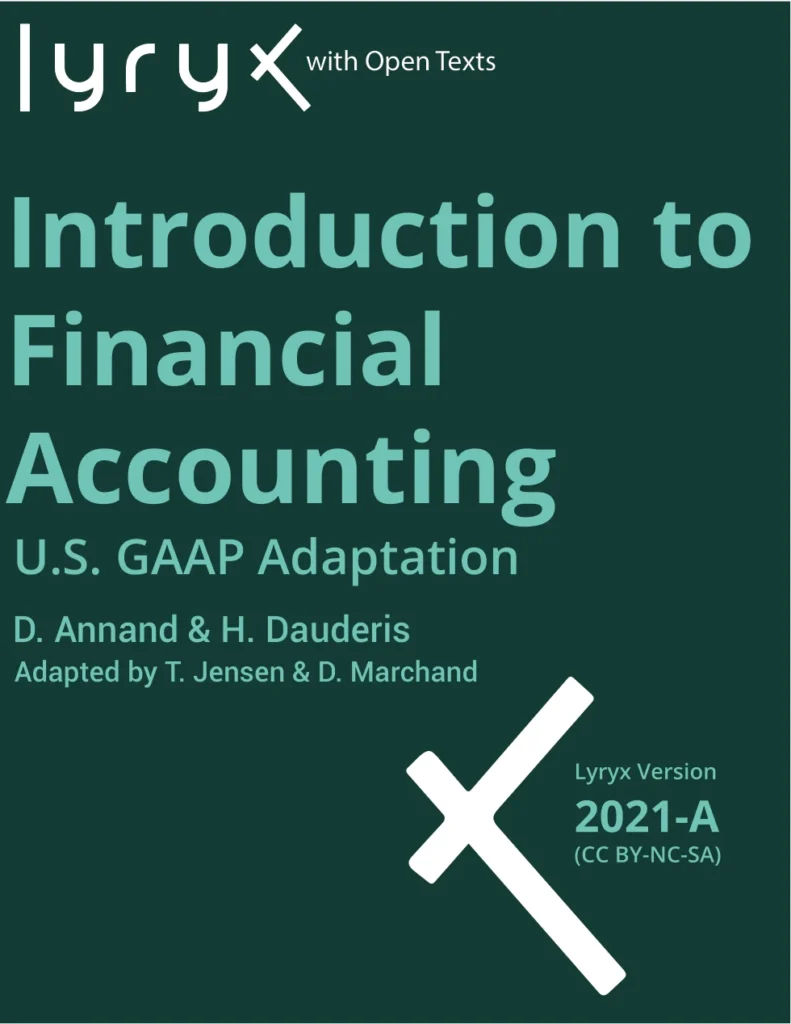
This original reading guide follows the linked source edition’s chapter, module, unit, or lesson structure. Consult the source for full arguments, cases, worked examples, exercises, illustrations, and references. Coverage follows all thirteen chapters, their appendices, and the three solution sections in Version 2021, Revision A. The linked PDF is a complete 806-page copy; its original Lyryx 2021-A cover is used. Authorship and adaptation credits are preserved. This is an original study guide, not a reproduction of the textbook or a statement of current accounting requirements. Read the source edition.
About access & copyright
This page provides book information and study material. Full-text access is provided by the original publisher or authorised source; a listing does not grant permission to republish the book.
Read our Library Access & Copyright policyExplore the contents
Check the chapters covered in this edition.
Visit the official source
See reading, preview or purchase options.
Save for later
Keep this textbook in your saved collection.
Reader ratings & reviews
Share your thoughts
Your review helps other students choose the right resources.
KEEP LEARNING
Your next great read
Business Finance
Pension Finance and Management
View Pension Finance and Management — book Accounting
Introduction to Financial Accounting : International Financial Reporting Standards (Lyryx)
View Introduction to Financial Accounting : International Financial Reporting Standards (Lyryx) — book Business enterprises—Finance
The Brownian Motion
View The Brownian Motion — book Business
Workplace Software and Skills
View Workplace Software and Skills — book Finance
Introduction to financial derivatives: Modeling, pricing and hedging
View Introduction to financial derivatives: Modeling, pricing and hedging — book Business
Principles of Microeconomics 3e
View Principles of Microeconomics 3e — book Business
Principles of Marketing
View Principles of Marketing — book Business
Principles of Management
View Principles of Management — book Business