
 Intellectual property law
Criminal LawTextbook
Introduction to Criminal Investigation: Processes, Practices and Thinking
Not rated yetRate this bookRod Gehl and Darryl Plecas present criminal investigation as disciplined thinking supported by lawful procedures and reliable evidence. The eleven chapters distinguish urgent response from structured investigation, then examine evidence, tools, witnesses, scenes, interviewing, and forensic interpretation. The book uses Canadian legal and institutional examples. This guide explains the assigned source rather than providing current legal or operational instructions. Its central lesson is to make reasoning explicit, consider alternatives, and preserve the connection between a conclusion and the information that genuinely supports it.
Read on the publisher’s website. Opens in a new tab.
 Free
About this book
Rod Gehl and Darryl Plecas present criminal investigation as disciplined thinking supported by lawful procedures and reliable evidence. The eleven chapters distinguish urgent response from structured investigation, then examine evidence, tools, witnesses, scenes, interviewing, and forensic interpretation. The book uses Canadian legal and institutional examples. This guide explains the assigned source rather than providing current legal or operational instructions. Its central lesson is to make reasoning explicit, consider alternatives, and preserve the connection between a conclusion and the information that genuinely supports it.
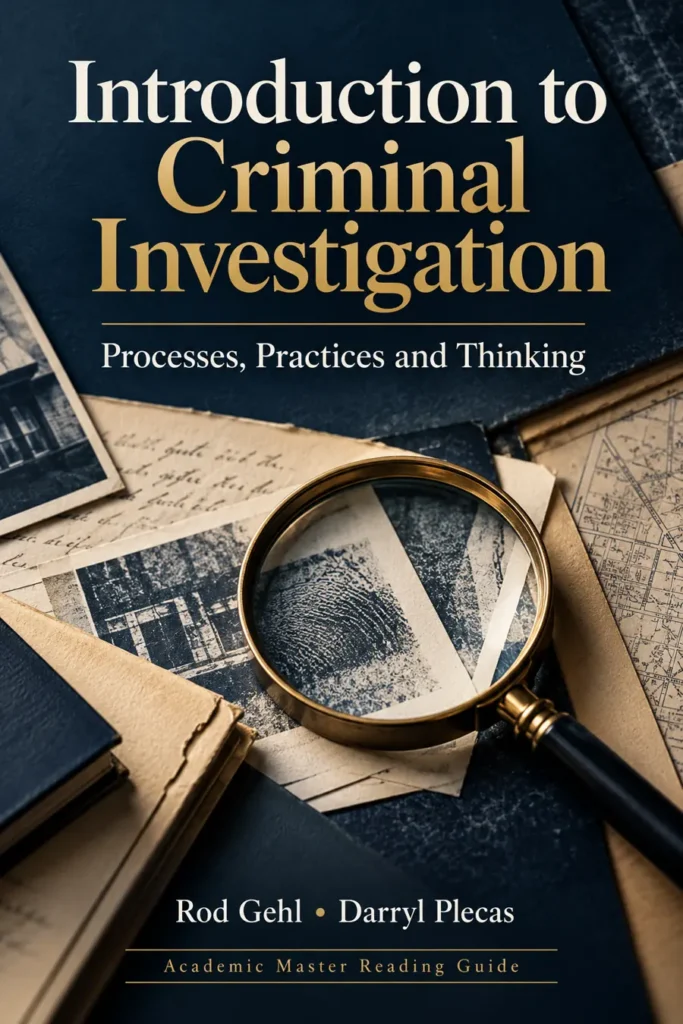
Cover: original Academic Master reading-guide design. The linked source remains the edition described above.
Book summary
Rod Gehl and Darryl Plecas present criminal investigation as disciplined thinking supported by lawful procedures and reliable evidence. The eleven chapters distinguish urgent response from structured investigation, then examine evidence, tools, witnesses, scenes, interviewing, and forensic interpretation. The book uses Canadian legal and institutional examples. This guide explains the assigned source rather than providing current legal or operational instructions. Its central lesson is to make reasoning explicit, consider alternatives, and preserve the connection between a conclusion and the information that genuinely supports it.
Chapter-by-chapter summaries
1. Introduction
Investigation involves decisions under uncertainty rather than merely assembling a convincing narrative after the event. Thinking skills and practical processes must work together. Distinguish observations, inferences, and conclusions in a short case account. Ask which facts support a proposed explanation and which remain unexplained. The opening makes reflective reasoning part of professional practice, helping readers recognize when confidence, familiarity, or urgency might replace an adequate assessment of evidence.
2. Basic concepts
Legal authority, thresholds, investigative priorities, and the distinction between tactical and strategic response shape what investigators may do and why. A plausible suspicion is not the same as a fully supported conclusion. Identify the question attached to each evidentiary threshold in the source. Separate the need to respond to an immediate risk from the later need to test explanations carefully. Canadian examples must be read within their source-era legal context rather than transferred automatically to another jurisdiction.
3. Evidence
Relevance, reliability, admissibility, direct and circumstantial information, and continuity raise different questions. Material can be informative without satisfying every legal requirement for courtroom use. Explain the proposition an item supports and the inference connecting them. Consider innocent or alternative explanations. Documentation and preservation allow others to assess authenticity and context. The chapter resists the assumption that the number of collected items determines the strength of a case independently of their quality and relationship to disputed issues.
4. The investigative process
Investigative progression moves from available information through hypotheses, planned inquiry, evaluation, and revision. Keep a timeline and separate established facts from unresolved claims. A plan should identify information capable of challenging the preferred theory, not only material likely to confirm it. Reassess when new evidence conflicts with assumptions. This structured process makes reasoning reviewable and reduces the risk that an early explanation becomes a fixed conclusion before reasonable alternatives have been examined.
5. Strategic investigative response
Once immediate priorities permit, a strategic approach organizes resources, objectives, information, and decision points. Distinguish a task list from a plan explaining why each task matters. Assign an evidentiary question to every proposed line of inquiry and state how its result could alter the analysis. Consider proportionality and legal authority. The chapter connects management with reasoning: coordinated activity is useful when it produces relevant, assessable evidence rather than a large volume of disconnected information.
6. Investigative tools
Tools and information sources serve defined questions and remain subject to authorization, reliability, and interpretation. A database return or reported association is not self-authenticating proof of involvement. Identify provenance, completeness, and possible errors. Compare the result with independent information where available. The educational focus is selecting a suitable method and understanding its limits, not treating technical access as a substitute for a justified inference or lawful process.
7. Witness management
Witness accounts are influenced by perception, memory, communication, and context. Confidence and consistency require interpretation rather than automatic acceptance. Separate what a person directly observed from what they inferred or learned later. Record circumstances and uncertainties without converting ambiguity into certainty. Consider how questions and subsequent information can affect recollection. The chapter emphasizes managing information responsibly so the resulting account preserves the witness’s knowledge rather than the investigator’s assumptions.
8. Crime-scene management
A scene contains relationships among objects, locations, conditions, and documentation, not merely collectible items. Context may be lost when information is detached from its location or sequence. Explain why preservation and records support later reconstruction and review. Distinguish a scene observation from a proposed explanation of how it arose. The chapter’s procedural examples should be studied within authorized professional practice, with the guide emphasizing evidentiary reasoning rather than operational instructions.
9. Interviewing, questioning, and interrogation
Different conversational purposes involve different legal and ethical responsibilities. Gathering an account differs from testing a suspicion, and statements must be evaluated in context. Question form, misunderstanding, pressure, and prior information can affect reliability. Analyze a source example by identifying the purpose, rights involved, and corroboration needed. An apparently detailed admission is not automatically a complete explanation. Current practice requires current jurisdiction-specific law and training beyond the textbook’s historical examples.
10. Forensic sciences
Forensic methods connect traces with propositions through techniques whose accuracy, assumptions, and limits must be understood. Distinguish a laboratory observation from the broader event-level conclusion attributed to it. A match-like finding does not necessarily explain when or how material was deposited. Examine quality control, contamination risks, uncertainty, and competing explanations conceptually. The chapter encourages collaboration with specialists while retaining critical responsibility for how technical results are communicated and combined with other evidence.
11. Summary
The closing chapter integrates lawful action, evidence management, reasoning, and communication. Revisit a case using a transparent chain from observations through competing hypotheses to a qualified conclusion. Identify unresolved information and the strongest alternative account. Assess whether the process tested the theory or merely accumulated support for it. The final emphasis is disciplined, reviewable judgment: a persuasive account must remain answerable to reliable evidence and the rules governing how that evidence was obtained and used.
Study instructions
- Maintain a fact-inference-hypothesis table for every study problem.
- Identify the source-era legal context before applying a procedural example.
- Write investigation plans around questions, competing explanations, and evidence that could change your view.
- Evaluate forensic and witness claims at the level of the proposition they actually support.
Questions for reflection
- How does a detailed narrative differ from an evidentially supported conclusion?
- When can reliable information still raise an admissibility issue?
- Which observation would most seriously challenge the preferred hypothesis?
Sources and coverage
This original reading guide follows the linked source edition’s chapter, module, unit, or lesson structure. Consult the source for full arguments, cases, worked examples, exercises, illustrations, and references. The source uses Canadian examples. The guide is for study of the linked edition, not current legal advice or operational training. Read the source edition.
About access & copyright
This page provides book information and study material. Full-text access is provided by the original publisher or authorised source; a listing does not grant permission to republish the book.
Read our Library Access & Copyright policyExplore the contents
Check the chapters covered in this edition.
Visit the official source
See reading, preview or purchase options.
Save for later
Keep this textbook in your saved collection.
Reader ratings & reviews
Share your thoughts
Your review helps other students choose the right resources.
KEEP LEARNING
Your next great read
Intellectual property law Contract Law
The Story of Contract Law: Formation
View The Story of Contract Law: Formation — book Law
Introduction to Criminal Law
View Introduction to Criminal Law — book Law
Evidence: Best Evidence Rule
View Evidence: Best Evidence Rule — book Law
Federal Rules of Appellate Procedure
View Federal Rules of Appellate Procedure — book Law
Land Use
View Land Use — book Business
Contract Doctrine, Theory & Practice, Volume 1
View Contract Doctrine, Theory & Practice, Volume 1 — book Law
The Ethics of Tax Lawyering
View The Ethics of Tax Lawyering — book Law
Federal Rules of Bankruptcy Procedure
View Federal Rules of Bankruptcy Procedure — book Civil Law



