
 Linguistics
contrastive linguisticsTextbook
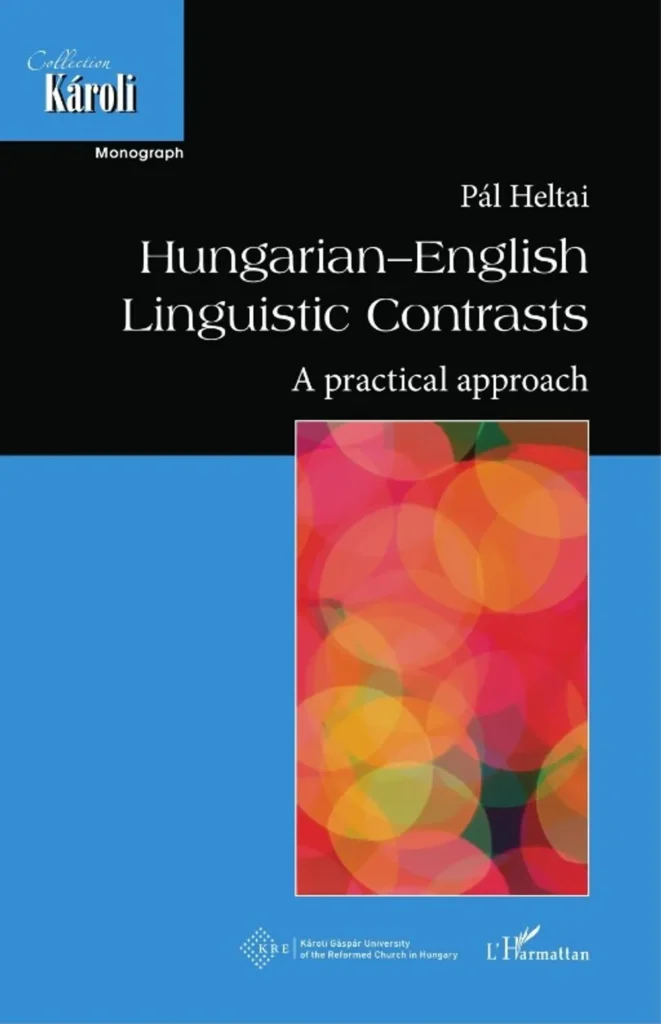
Hungarian-English Linguistic Contrasts. A practical approach
Not rated yetRate this bookPál Heltai’s Hungarian–English Linguistic Contrasts, edited by Tímea Kovács, examines how comparison can support advanced language learning, teaching, and translation. Twelve chapters move from contrastive theory and crosslinguistic influence through sound, grammar, vocabulary, phraseology, discourse, pragmatics, and translation. Written in English with examples from both languages, the book connects analysis with practical tasks. This guide emphasizes that a structural difference is not automatically a learning difficulty or a complete explanation of an error.
Free reading is available at the official source. Opens in a new tab.
 Free
About this book
Pál Heltai’s Hungarian–English Linguistic Contrasts, edited by Tímea Kovács, examines how comparison can support advanced language learning, teaching, and translation. Twelve chapters move from contrastive theory and crosslinguistic influence through sound, grammar, vocabulary, phraseology, discourse, pragmatics, and translation. Written in English with examples from both languages, the book connects analysis with practical tasks. This guide emphasizes that a structural difference is not automatically a learning difficulty or a complete explanation of an error.
Chapter-wise summaries and study tasks
Chapter 1. Contrastive Linguistics
Contrastive linguistics compares languages to clarify relationships among forms, meanings, and uses. The chapter situates practical comparison within the changing history of language teaching and theoretical approaches. Early hopes that structural comparison could predict every learning problem proved too simple. Later work extends beyond grammar to discourse and communicative use.
A useful comparison needs a shared basis: two forms should be compared because they perform a relevant function, not merely look similar. Teaching applications require evidence about actual learners and tasks. Keep a descriptive contrast separate from a claim about difficulty, transfer, or the best instructional response.
Study task. Define a comparison at sound, grammar, or discourse level. State the common function and identify learner evidence needed before turning the contrast into a prediction of difficulty.
Chapter 2. Crosslinguistic Influences
Crosslinguistic influence concerns how knowledge and use of one language affect another. Similarities can support learning, while mismatches may contribute to transfer-related choices. However, proficiency, development, context, learning history, and general learning processes also matter. An error cannot automatically be attributed to the first language simply because a contrast exists.
Compare patterns across examples and plausible explanations. A form might result from transfer, overgeneralizing a target-language rule, or task pressure. Evidence should distinguish these possibilities rather than select the most familiar label. The chapter supports diagnosis of learning needs without reducing individual learners to their language background.
Study task. Analyze a fictional error set using at least two explanations. Propose a comparison or additional task that could help distinguish crosslinguistic influence from target-language overgeneralization.
Chapter 3. The Sound Systems of English and Hungarian
Sound-system comparison includes segments and the organization of pronunciation beyond individual letters. Similar spellings can conceal different sounds, while a sound absent from one system may require new perception and production distinctions. Stress, rhythm, connected speech, and orthographic expectations can affect intelligibility and learning. The relevant unit may be a contrast within a word or a pattern across a phrase.
Do not infer pronunciation directly from a written form or treat every accent difference as a communication failure. Separate perception, production, and spelling effects. Practice should target an identifiable contrast and use feedback that reveals what changed.
Study task. Choose a sound or prosodic contrast from the source and design a perception task followed by a production task. Explain what each measures and how spelling could confound the result.
Chapter 4. Hungarian–English Grammatical Contrasts: The Verb Phrase
Verb-phrase contrasts connect tense, aspect, modality, auxiliaries, agreement, and the organization of negation or questions. Languages distribute grammatical meaning differently, so translating an isolated ending or auxiliary is rarely enough. English auxiliary patterns require attention to both meaning and construction. A contrastive account should compare contextual uses rather than assume one verb form always maps to one form in the other language.
Use examples with a clear time reference and communicative purpose. Distinguish a grammatical choice from a lexical preference and explain which interpretation changes when an alternative is used. This makes correction more informative than simply marking a form wrong.
Study task. Compare two contextualized verb-phrase examples in each language. Explain the intended time, aspect, or modality and identify why a word-for-word substitution would change the meaning or construction.
Chapter 5. Hungarian–English Grammatical Contrasts: The Noun Phrase
The noun phrase organizes reference through nouns, determiners, number, possession, modification, and related grammatical choices. Hungarian and English can encode relationships through different combinations of word forms, separate words, and order. A noun’s translation equivalent does not by itself determine the surrounding phrase. Reference must be interpreted in context, including what is known or newly introduced.
Compare complete phrases rather than isolated nouns. A change in article, number, or modifier placement can affect meaning or acceptability. Identify which information is expressed explicitly and which is supplied by the context before deciding that one language has simply omitted an equivalent.
Study task. Translate a small set of noun phrases within short contexts. Mark reference, number, possession, and modification, then explain a case where lexical equivalence does not provide an adequate phrase-level translation.
Chapter 6. Hungarian–English Grammatical Contrasts: Pronouns and Adverbs
Pronouns and adverbs reveal differences in how languages identify participants, avoid repetition, express relationships, and place information. Reference depends on grammatical and discourse context, while the same broad category can include forms with different distribution. A seemingly optional pronoun or position choice may change emphasis or clarity.
Track the intended referent and scope rather than applying a replacement list. Adverb placement can interact with the construction and intended meaning. The practical objective is to explain an interpretation and test alternatives in context, not infer a rigid rule from one sentence.
Study task. Trace pronoun reference through a short passage and compare an alternative rendering. For an adverb example, identify its scope and explain how moving it or changing its form affects interpretation.
Chapter 7. Hungarian–English Lexical Contrasts
Lexical contrasts concern how vocabulary divides meaning, combines senses, and functions in context. One word can correspond to several choices in another language, while apparent similarity can conceal a misleading association. Register, connotation, and customary use matter alongside dictionary definitions. A broad translation equivalent does not guarantee interchangeability in every phrase.
Compare examples from distinct contexts and record what guides selection. A bilingual dictionary is a starting point, not the complete evidence for use. Distinguish a missing equivalent from a difference in how a language conventionally expresses the concept.
Study task. Build a small lexical comparison with meanings, contexts, register, and candidate equivalents. Use source examples or a suitable reference to reject an attractive but contextually inappropriate choice.
Chapter 8. Hungarian–English Phraseological Contrasts
Phraseology examines recurrent combinations, collocations, idioms, and conventional ways of expressing meanings. Words that are individually appropriate may still form an unnatural combination. Literal translation can obscure a figurative or conventional meaning, while an idiom may need a different expression rather than a matching image.
Separate semantic plausibility from established usage. Compare the phrase’s function, tone, and context before selecting an equivalent. Learning combinations as units can support fluency, but the learner still needs to recognize variation and the limits of a fixed expression.
Study task. Compare several literal and idiomatic or collocational renderings. Explain which choices preserve meaning, tone, and natural usage, and design a short exercise that tests the combination rather than only individual words.
Chapter 9. Hungarian–English Text-Building Contrasts
Text-building contrasts concern how sentences connect and how information develops through a passage. Cohesion, reference, repetition, information structure, and ordering support coherence in language-specific and genre-specific ways. A translation can be grammatical sentence by sentence while remaining difficult to follow as a whole.
Analyze what the reader is expected to know at each point and how new material is introduced. Avoid turning a tendency in a particular genre into a claim about every speaker or text. Compare passages with a shared purpose and consider whether a change improves the target reader’s access to the intended relationships.
Study task. Revise a short translated passage for reference and information flow without changing its claims. Explain a paragraph-level decision that cannot be justified by examining isolated sentence grammar alone.
Chapter 10. Hungarian–English Pragmatic Contrasts
Pragmatics concerns meaning in use, including intentions, implied information, interaction, and the relationship among speakers. A formally close translation can create a different request, degree of directness, or social effect. Context, role, medium, and individual choice matter, so cultural comparisons should not become rigid predictions about all members of a group.
Compare the action being performed rather than only sentence meaning. An indirect expression may rely on shared assumptions unavailable to another audience. Evaluate alternatives through a defined situation and acknowledge where several acceptable choices serve different purposes.
Study task. Describe a request or response in a specific interaction and compare possible renderings. Explain the intended action, relationship, and inference, avoiding a claim that one form represents every speaker’s preference.
Chapter 11. Linguistic Contrasts in English–Hungarian and Hungarian–English Translation
Translation integrates grammatical, lexical, phraseological, textual, and pragmatic decisions. Direction matters because the target language imposes different expression choices and the translator’s proficiency or expectations may differ. A successful rendering preserves relevant meaning and function while allowing structural changes where necessary. Neither literalness nor freedom is a sufficient quality criterion by itself.
Document decisions through the source context and target purpose. Compare alternatives and identify what each preserves, changes, or leaves implicit. Revision should consider the whole passage, not merely remove visible grammatical errors. Source examples support reasoning but are not a universal equivalence table.
Study task. Translate a short passage in one direction, annotate the main decisions, and compare a reverse-direction task. Explain why a fluent back-translation is useful evidence but not a complete proof of translation quality.
Chapter 12. General Differences Between Hungarian and English
The concluding chapter connects earlier observations with typological differences, especially analytic and agglutinative organization and syntactic patterns. Meanings carried by several elements inside a Hungarian word may require multiple words in English, but redistribution does not automatically create a serious learning obstacle. The source explicitly distinguishes structural contrast from the difficulty of acquiring particular target-language meanings and rules.
Use the synthesis to revisit earlier predictions. Some striking differences are easy to manage, while subtle form–meaning or usage distinctions require sustained attention. A practical account needs learner and task evidence alongside typological description, avoiding a ranking of one language as inherently simpler or better.
Study task. Choose a large structural contrast and a smaller usage contrast from earlier chapters. Compare their likely learning demands using evidence, then revise a prediction that relied only on the size of the formal difference.
How to study this book
- Compare contextualized examples through a shared function, not isolated visual similarity.
- Separate descriptive contrast, transfer hypothesis, observed learner pattern, and proposed teaching response.
- Attempt the source tasks before consulting its key, and explain corrections in terms of meaning and use.
- Maintain notes at sound, phrase, sentence, text, and interaction levels so revision does not stop at grammar.
- Use reference and corpus evidence where appropriate, while recognizing genre, proficiency, and individual variation.
Questions for reflection
- Does the contrast predict a problem, or has a problem actually been observed?
- Which choice preserves function while changing form?
- When does a useful generalization become an unsupported claim about all speakers?
Source edition and coverage
This original guide covers the twelve chapters of the 2023 English-language book, with Hungarian examples retained as objects of study. The task key, appendices, and references remain in the complete source. Tímea Kovács is identified as editor on the title pages. These are original study explanations and learning tasks. Read the complete book at the official source.
About access & copyright
This page provides book information and study material. Full-text access is provided by the original publisher or authorised source; a listing does not grant permission to republish the book.
Read our Library Access & Copyright policyExplore the contents
Check the chapters covered in this edition.
Visit the official source
See reading, preview or purchase options.
Save for later
Keep this textbook in your saved collection.
Reader ratings & reviews
Share your thoughts
Your review helps other students choose the right resources.
KEEP LEARNING
Your next great read
Linguistics Humanities
The Linguistic Analysis of Word and Sentence Structures
View The Linguistic Analysis of Word and Sentence Structures — bookEnvironmental Toxicology
Environmental Toxicology
View Environmental Toxicology — bookVaccination Programmes
Vaccination Programmes
View Vaccination Programmes — bookRelativistic Quantum Mechanics
Relativistic Quantum Mechanics
View Relativistic Quantum Mechanics — bookAerospace Structures
Aerospace Structures
View Aerospace Structures — book Abelian number fields
Number Fields
View Number Fields — book Textbook
Agricultural Meteorology and Climatology
View Agricultural Meteorology and Climatology — book Language teaching and learning
In the Community: An Intermediate Reading and Writing Textbook
View In the Community: An Intermediate Reading and Writing Textbook — book Communication Studies



