
 Mathematics
AppliedTextbook
Geometry with an Introduction to Cosmic Topology
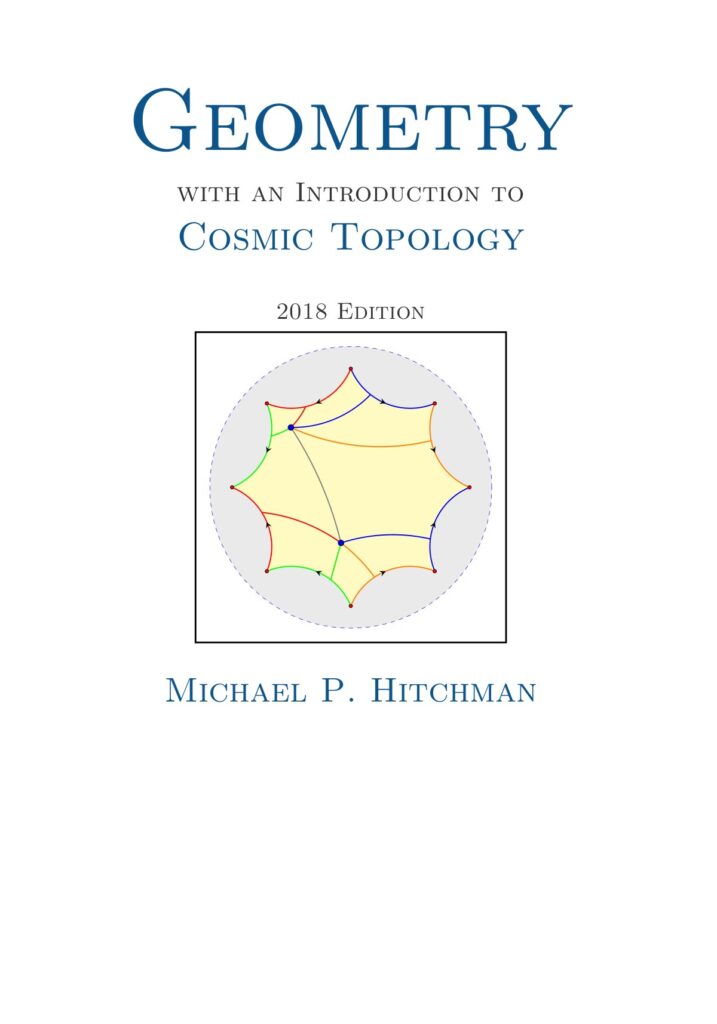
Not rated yetRate this bookGeometry with an Introduction to Cosmic Topology develops non-Euclidean geometry through questions about the universe’s shape. Michael P. Hitchman connects transformations, curvature and surfaces with an introductory route into cosmic topology.
 Free
About this book
The text is designed for undergraduates who have completed multivariable calculus and are ready to practise advanced mathematical reasoning. The preface also supports independent study through a connected mathematical narrative. Complex coordinates and transformations provide the foundation for the core geometry chapters, with inversion playing a central role. Longer essays introduce and revisit the cosmic questions motivating the course. The hosted file identifies itself as the 2018 edition compiled in October 2020. Its scientific discussion should be read within that edition’s research context.
The attached edition contains 238 PDF pages, including front matter. Cover: source edition cover rendered from the PDF. The textbook and its original notices are retained; Academic Master’s study material is separate from the source text.
Book summary
Michael P. Hitchman’s Geometry with an Introduction to Cosmic Topology develops non-Euclidean geometry through transformations, models, curvature, surfaces, and questions about the shape of space. This guide follows the 2018 edition compiled in October 2020. Eight chapters build toward cosmic topology, with multivariable calculus as useful preparation. Mathematical possibilities and the edition’s observational discussion should be distinguished: constructing a consistent space does not show that the physical universe has that shape.
Chapter-by-chapter summaries
Chapter 1: An Invitation to Geometry
Questions about a finite or infinite universe motivate a closer examination of geometry. A finite space need not have an edge: identifying opposite sides of a rectangle provides a model whose apparent boundaries are artifacts of representation. The chapter combines a brief history of geometry with a first look at surfaces. Distinguish local appearance from global structure and intrinsic measurement from the way a surface is pictured in a surrounding space. A small region can appear familiar even when the complete space has unexpected connections. The aim is to make alternatives to an infinite Euclidean plane mathematically imaginable before developing their machinery.
Chapter 2: The Complex Plane
Complex numbers provide a coordinate language for points and transformations. Cartesian and polar forms express the same number in ways suited to different questions. Multiplication and division connect naturally with scaling and angle, making algebra useful for geometry. Work through a small transformation in both forms and explain the geometric effect of each operation. Keep track of the origin, modulus, argument, and any exceptional cases where a representation or expression is undefined. The chapter prepares a language in which later geometric maps can be computed and analyzed rather than accepted solely through diagrams.
Chapter 3: Transformations
Translations, rotations, scaling, inversion, the extended plane, and Möbius transformations develop an approach to geometry through maps and their preserved relationships. Inversion requires attention to the center and to how lines and circles transform. Adding the point at infinity supports a more unified description of these behaviors. Möbius maps combine algebraic expressions with geometric structure, while composition and inverses help explain their organization. For each map, state its domain, exceptional behavior, and invariants before applying it. A transformed picture can simplify a problem only when the property under investigation is appropriately preserved or translated.
Chapter 4: Geometry
The chapter makes the relationship between a space and its transformations explicit. Geometry can be studied through the properties that remain unchanged under an allowed family of maps. The Möbius setting demonstrates why different choices of transformation produce different notions of what counts as geometrically significant. Separate a coordinate description from an invariant statement. When two figures are considered equivalent, identify the map that relates them and what that equivalence preserves. This structural viewpoint prepares readers for hyperbolic and elliptic models, where a line or distance must be defined within the geometry rather than inferred from an ordinary Euclidean drawing.
Chapter 5: Hyperbolic Geometry
The Poincaré disk model supplies points and lines with a geometry different from the surrounding Euclidean picture. The chapter develops figures, distance, angles, area, triangle trigonometry, and the upper half-plane model. A curved arc in the disk can be a hyperbolic line, and visual proximity to the boundary is not a reliable guide to hyperbolic distance. Follow the definitions and transformations that make the models work. Compare the same relationship in the disk and half-plane to understand their equivalence. The contrast between Euclidean expectations and hyperbolic measurement reveals the importance of specifying the metric and model before calculating.
Chapter 6: Elliptic Geometry
Antipodal points provide a route to elliptic geometry and distinguish it from an unqualified picture of an ordinary sphere. Identifying opposite points changes the interpretation of lines and intersections. The chapter develops measurement in this setting and revisits Euclid’s postulates to locate the structural differences. Keep the representation, identified points, and geometric objects separate in your notes. Compare a triangle or line relationship with its hyperbolic and Euclidean counterparts. A correct comparison explains which definitions and assumptions changed, rather than merely observes that the numerical result differs from a familiar formula.
Chapter 7: Curvature and Families of Geometries
Curvature connects the earlier models within a broader family. Positive, zero, and negative curvature lead to related but different measurement relationships. Scaling changes the magnitude of curvature, so a sign alone does not specify every numerical formula. Follow how the text organizes spaces and transformation groups in the family of geometries. Use a small geometric figure to compare what changes across the cases. This develops a unified understanding without erasing important differences, and it prepares the reader to distinguish the local geometry of a surface from the surface’s overall topology.
Chapter 7: Surfaces and Quotient Spaces
The second part of the chapter examines surfaces, their geometries, and quotient constructions. Identifying points according to specified rules creates a space whose global connections may not be apparent in the original polygon. Track edges, vertices, and neighborhoods through the identification rather than rely exclusively on a three-dimensional visualization. A surface’s topological description and a particular metric on it answer different questions. Explain how a traveler experiences a boundary crossing in the model and why the resulting space may have no physical edge. The construction connects the opening motivation with precise mathematical tools.
Chapter 8: Cosmic Topology
Three-dimensional geometries and manifolds extend the surface ideas toward models of space. Cosmic crystallography and matched-circle approaches illustrate ways global structure could leave observational signatures. Distinguish the mathematical construction of a candidate universe from the empirical work of identifying it. Observational limitations and assumptions affect what a proposed signature could establish or rule out. The chapter’s account of the universe belongs to the edition compiled in 2020 and is not a current cosmological assessment. Finish by tracing how transformations, curvature, and quotient spaces contribute to a concrete research question rather than treating the final chapter as a separate speculative appendix.
Reference Material and Proof Practice
The list of symbols, references, index, essays, and exercises support independent study throughout the book. Use them to clarify a specific definition or follow a mathematical connection. A diagram can suggest a theorem, while the proof must establish it from the appropriate model and assumptions. Maintain a record of what each transformation preserves and which measurement rules belong to which geometry. The strongest final review compares a small set of problems across several models, explaining both their common structure and the points at which the reasoning must change.
Study instructions
- Keep separate notebooks for complex algebra, transformations and invariants, and geometric models.
- For every model, list its points, lines, distance, angle interpretation, and transformation family.
- Redraw a figure in a second model and explain which relationships remain equivalent.
- Work through proofs with exceptional cases and domains stated explicitly.
- Build a polygon-identification example and trace the neighborhoods of interior, edge, and vertex points.
- Write a final explanation separating a mathematical topology, a proposed physical model, and the evidence that could bear on it.
Questions for reflection
- How can a finite space have no boundary?
- Why can two pictures represent the same geometry while making different features visually apparent?
- What would turn a mathematically possible cosmic topology into an empirically supported claim?
Sources and coverage
This original study guide follows the complete linked source edition and all of its substantive chapters or named teaching sections. It condenses their main ideas and relationships; the study tasks are guidance for reading alongside the complete resource. It does not reproduce the source exercises or answer key. Book source; Complete source PDF.
About access & copyright
Check this edition’s source and licence before reusing its files or content. A library listing does not grant additional rights.
Read our Library Access & Copyright policyGeometric systems
Recognise the text’s comparative approach.
Transformations
Identify the organising role of inversion.
Sequential study
Connect constructions, examples and later topics.
Edition context
Distinguish the 2018 edition from its 2020 compilation.
Reader ratings & reviews
Share your thoughts
Your review helps other students choose the right resources.
KEEP LEARNING
Your next great read
Mathematics Algebra
Fanshawe Pre-Health Sciences Mathematics 2
View Fanshawe Pre-Health Sciences Mathematics 2 — book Algebra
Fanshawe Pre-Health Sciences Mathematics 1
View Fanshawe Pre-Health Sciences Mathematics 1 — book Mathematics
Math 3080 Preparation
View Math 3080 Preparation — book Algebra
Linear Algebra with Applications
View Linear Algebra with Applications — book Business and Economics
Mathematics of Finance
View Mathematics of Finance — book Algebra
The Essence of Mathematics Through Elementary Problems
View The Essence of Mathematics Through Elementary Problems — book complex numbers
Making up Numbers: A History of Invention in Mathematics
View Making up Numbers: A History of Invention in Mathematics — book Business and Management
Inventory Analytics
View Inventory Analytics — book Challenges and roles for textbooks in a pandemic context



