
 college preparation
Budgeting and financial managementTextbook
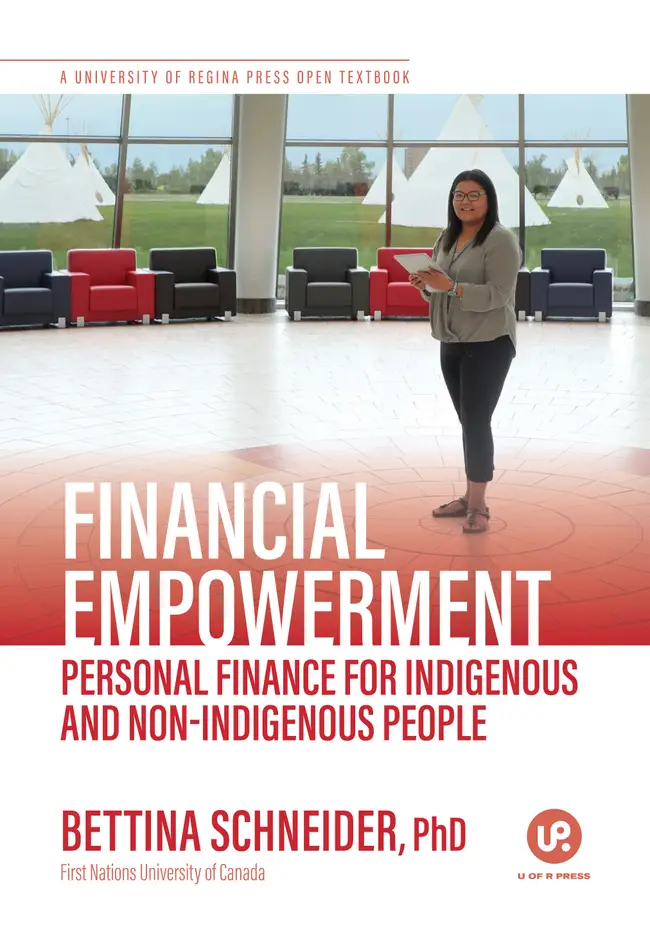
Financial Empowerment: Personal Finance for Indigenous and Non-Indigenous People
Not rated yetRate this bookBettina Schneider’s Financial Empowerment adapts personal finance to Canadian Indigenous and non-Indigenous experiences. Fifteen chapters connect financial statements, planning, borrowing, insurance, housing, investment and careers, while interviews with Elders bring historical context, community knowledge and values into the discussion.
Free reading is available at the official source. Opens in a new tab.
 Free
About this book
Bettina Schneider’s Financial Empowerment adapts personal finance to Canadian Indigenous and non-Indigenous experiences. Fifteen chapters connect financial statements, planning, borrowing, insurance, housing, investment and careers, while interviews with Elders bring historical context, community knowledge and values into the discussion.
How to study this book
Use fictional figures to practise the calculations and keep values, obligations and household circumstances visible alongside the numbers. Distinguish a general planning concept from a tax, benefit or product rule tied to a particular time and jurisdiction. Read the Elder interviews as contributions with their own context rather than treating Indigenous perspectives as one uniform financial preference.
Chapter-wise explanations and study tasks
Chapter 1 — Personal Financial Planning
Planning connects individual circumstances with economic conditions and changing goals. The chapter presents decisions as part of an ongoing process rather than a single ideal budget. Include family and community commitments in the definition of a goal, and identify which conditions a household can influence and which are systemic.
Study task: Create a fictional goal map separating personal priorities, shared responsibilities and external constraints.
Chapter 2 — Basic Ideas of Finance
Income, expenses, assets, liabilities and net worth organise different aspects of a financial position. Opportunity cost and sunk cost explain why a decision cannot be assessed only through the cash paid today. Keep stocks measured at a date separate from flows measured over a period.
Study task: Classify a small household scenario into stocks and flows and identify one opportunity cost.
Chapter 3 — Financial Statements
Statements organise financial information so that relationships and changes can be examined. Cash flow and net worth answer different questions: owning valuable assets does not guarantee cash is available when needed. Use comparisons and ratios with attention to what has been counted and the limitations of the underlying estimates.
Study task: Prepare a simple cash-flow statement and balance sheet and explain one apparent tension between them.
Chapter 4 — Time, Risk and Value
Amounts at different dates need a common basis for comparison. Time-value reasoning connects that comparison with opportunity and uncertainty, while assumptions about rates and timing materially affect the result. Distinguish a mathematical valuation from a guarantee that an expected outcome will occur.
Study task: Compare two fictional dated payments at a stated rate and test how the ranking changes under another assumption.
Chapter 5 — Budgets
A budget translates priorities into a plan and creates a basis for comparing expected and actual outcomes. Variances can indicate an unrealistic assumption, a changed circumstance or a decision requiring review. A useful budget should support learning and adaptation rather than function as a judgement detached from income instability or obligations.
Study task: Build a fictional monthly budget and explain how you would respond to an unexpected essential expense.
Chapter 6 — Taxes and Tax Planning
Taxation affects earnings, spending and accumulated resources through rules that vary by jurisdiction and circumstance. The chapter introduces concepts and sources of information in its Canadian setting. Keep the source’s historical examples distinct from present eligibility or filing requirements, including issues involving legal status and location.
Study task: Identify the facts and authoritative sources needed to investigate a hypothetical tax question without assuming the book supplies current rates or exemptions.
Chapter 7 — Financial Management
Managing payments and credit involves both immediate cash needs and longer-term obligations. Borrowing can shift consumption across time but also commits future income. Compare costs, terms and flexibility rather than relying on the size of an advertised payment alone.
Study task: Compare two fictional borrowing arrangements by total repayment, timing and the consequences of a missed payment.
Chapter 8 — Consumer Strategies
Purchases involve information, alternatives, timing and financing as well as the item’s price. The chapter moves from recurring consumption toward a major purchase such as a vehicle. Evaluate total ownership cost and suitability, and distinguish marketing claims from evidence about what the buyer actually needs.
Study task: Prepare a decision matrix for a fictional vehicle purchase including operating costs and a non-purchase alternative.
Chapter 9 — Buying a Home
Housing combines shelter, financing and exposure to changes in costs or asset value. Ownership is not assessed adequately by comparing a mortgage payment with rent. The chapter asks readers to consider acquisition, ongoing costs and the household’s circumstances. Community and land-tenure contexts also matter to the questions being asked.
Study task: Compare fictional renting and owning scenarios using stated assumptions, identifying costs omitted by a payment-only comparison.
Chapter 10 — Insurance
Risk management considers losses affecting property, income and people. Insurance transfers specified risks under contractual conditions but does not remove every uncertainty. Identify the event, financial consequence, coverage and exclusions before deciding what a policy appears to address.
Study task: Analyse a fictional policy summary for the risk covered, deductible, limit and important unresolved question.
Chapter 11 — Retirement and Estate Planning
Planning extends beyond current wages to future income, later-life needs and the transfer of accumulated resources. The chapter connects expected life changes with uncertainty and personal obligations. Estate and retirement arrangements depend on current rules and individual circumstances, so the learning focus is identifying questions and coordinating goals.
Study task: Create a timeline of future financial needs and information required, without selecting a real product or legal arrangement.
Chapter 12 — Investing
Investment decisions connect objectives, horizon and risk with the role an asset plays in a broader plan. Expected return is not a promised result, and diversification does not eliminate all possible loss. Examine why an investment might fit a goal rather than treating a high past return as sufficient justification.
Study task: Compare two hypothetical portfolios by concentration, liquidity and time horizon, stating the limits of the comparison.
Chapter 13 — Owning Stocks
Shares represent an ownership claim with returns and risks linked to business performance, valuation and market conditions. Price changes and distributions are distinct components of an outcome. Assess what information a shareholder needs and why a familiar company is not automatically a suitable holding.
Study task: Explain two ways a fictional stockholder could receive a return and two reasons the result could differ from expectations.
Chapter 14 — Bonds and Mutual Funds
Debt claims and pooled investment vehicles organise exposure differently from individual shares. Bond terms affect cash flows and risk, while a fund’s holdings, objectives and costs shape its role. A product label alone does not establish safety or diversification. Read the underlying structure before comparing expected benefits.
Study task: Compare a bond and a fund using claim type, cash flows, concentration and fees under clearly stated assumptions.
Chapter 15 — Career Planning
Employment and skill development are major parts of a financial life, linking income with interests, opportunity and changing circumstances. Career planning involves evaluating pathways rather than assuming one salary defines success. Consider costs, uncertainty and non-financial priorities alongside expected earnings.
Study task: Compare two fictional training or employment paths using cost, time, uncertainty and personal or community priorities.
Video Interviews with Elders — Context and Perspective
The interviews connect financial learning with historical experiences, guidance and community knowledge. They add dimensions that a numerical exercise cannot capture. Attend to who is speaking and the context of a contribution, then consider how it changes the questions asked of a mainstream planning model without assuming one account represents all communities.
Study task: Reflect on one interview and explain how it broadens a financial-planning question beyond an individual calculation.
Applied assignment
Create a fictional financial plan with statements, a budget and one major decision. Explain its values and shared obligations, test one adverse scenario and identify which tax, legal or product facts would require current verification.
Suggested reading plan
Read Chapters 1–6 for foundations, 7–9 for spending and housing, 10–11 for protection and later life, and 12–15 for investment and careers. Integrate the Elder interviews throughout rather than leaving them as an optional final addition.
Questions for reflection
- Whose goals and obligations are visible in a financial plan?
- How can an affordable payment conceal an expensive commitment?
- Which conclusions are mathematical and which depend on assumptions or current rules?
Edition and source notes
Based on Schneider’s 2018 Canadian adaptation, covering fifteen chapters and the Elder-interview section. These original tasks use fictional scenarios and do not provide personal financial, tax or legal advice. Historical rules, rates and product examples require current authoritative verification.
About access & copyright
This page provides book information and study material. Full-text access is provided by the original publisher or authorised source; a listing does not grant permission to republish the book.
Read our Library Access & Copyright policyExplore the contents
Check the chapters covered in this edition.
Visit the official source
See reading, preview or purchase options.
Save for later
Keep this textbook in your saved collection.
Reader ratings & reviews
Share your thoughts
Your review helps other students choose the right resources.
KEEP LEARNING
Your next great read
college preparation Business and Economics
Essentials of Project Management (v. 1.2 – January 22, 2024)
View Essentials of Project Management (v. 1.2 – January 22, 2024) — book Business and Economics
Pop-up Retail Strategies in an Omnichannel Context
View Pop-up Retail Strategies in an Omnichannel Context — book Law, Economics and Social Sciences
Research Methods: Exploring the Social World in Canadian Context
View Research Methods: Exploring the Social World in Canadian Context — book Communication Science/Journalism
Professional Communication Skills for Health Studies
View Professional Communication Skills for Health Studies — book Communication Science/Journalism
Write Like a PR Pro
View Write Like a PR Pro — book Business and Economics
Understanding Business
View Understanding Business — book Law, Economics and Social Sciences
Principles of Social Psychology - 1st International Edition
View Principles of Social Psychology - 1st International Edition — book Business and Economics
Sales Leadership Management
View Sales Leadership Management — book Early childhood care and education



