
 Mathematics
Geometry and TrigonometryTextbook
Euclidean plane and its relatives
Not rated yetRate this bookEuclidean plane and its relatives introduces the foundations of geometry through a metric approach. Anton Petrunin develops Euclidean geometry before moving to inversion, neutral and hyperbolic geometry, with additional chapters on other geometric systems.
 Free
About this book
The author bases this minimalist, proof-oriented introduction on geometry courses taught at Pennsylvania State University. The reviewed introduction identifies real numbers, continuity, elementary set theory and prior calculus as useful preparation. A metric approach defines the Euclidean plane through distance and axioms, reducing some of the technical overhead of other foundational approaches. The contents then build from basic definitions and triangles towards inversive and non-Euclidean geometry. The hosted edition is arXiv version 19, dated 21 May 2021. That version identifier is more precise than the older catalogue year imported with the record.
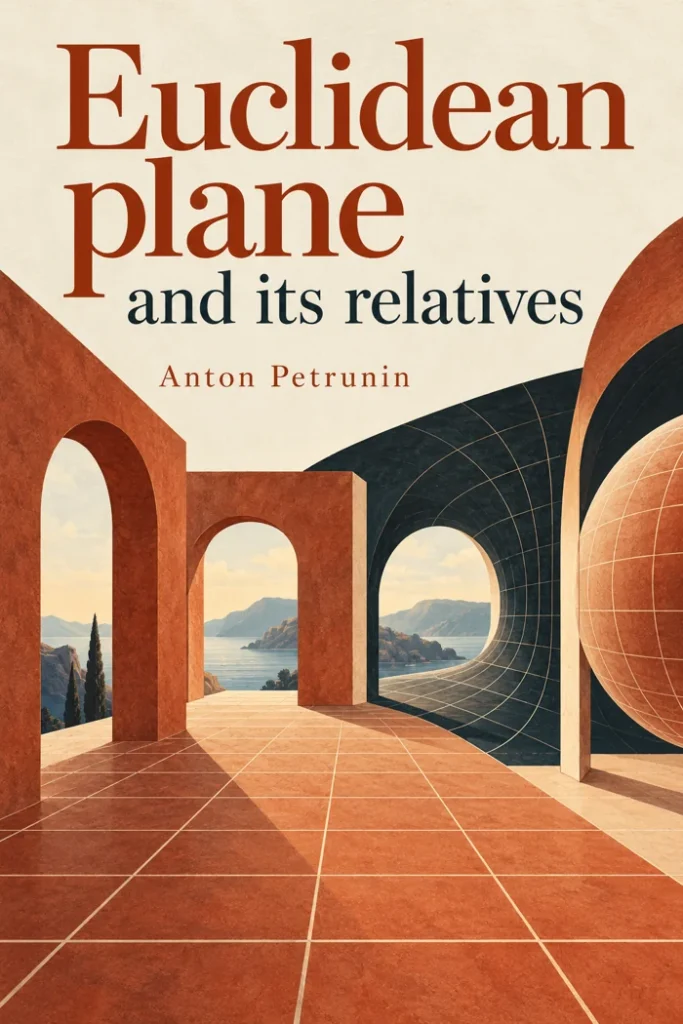
The attached edition contains 204 PDF pages, including front matter. Cover: source edition title page rendered from the PDF. The textbook and its original notices are retained; Academic Master’s study material is separate from the source text.
Book summary
Anton Petrunin’s proof-oriented text develops Euclidean geometry and then examines related geometries through axioms, models, and transformations. This guide follows arXiv version 19, dated May 21, 2021, with twenty chapters. It is especially useful for learning how a theorem depends on assumptions: a familiar diagram can suggest an argument, but a proof must establish which properties are available in the geometry being studied.
Chapter-by-chapter summaries
Chapter 1: Preliminaries
The opening chapter establishes mathematical language and the habits needed for rigorous geometric reasoning. Definitions and logical distinctions matter because later proofs combine incidence, order, distance, and angle statements. Draw diagrams to explore a claim, but record which features are given and which have actually been established. A visually obvious property may conceal an assumption. Use this chapter to build a notation sheet and practice explaining a short argument in complete steps before advancing to more complex configurations.
Chapter 2: Axioms
Axioms specify the starting structure from which geometric results will be derived. Their role differs from that of a definition or a theorem: they are assumptions of the system rather than conclusions to be proved within it. Read each axiom with examples of what it permits and what it does not yet imply. When following later proofs, refer back to the particular assumption supporting a construction or inference. This habit becomes essential when the book later changes the treatment of parallelism.
Chapter 3: Half-planes
Lines divide the plane into regions, introducing order and separation into the geometric framework. Half-plane reasoning supports arguments about where points lie and how segments and angles relate. The distinction between a boundary line and the regions it separates is especially important in constructions and intersection arguments. Annotate diagrams with side-of-line information, then justify any crossing or containment claim through the established properties. This supplies logical support for arrangements that a picture might otherwise encourage the reader to accept without proof.
Chapter 4: Congruent triangles
Congruence identifies triangles with the same metric shape and size. The chapter develops criteria that allow equality of some data to establish equality of the entire configuration. In a proof, correctly matching vertices is as important as recognizing a familiar pattern. Write the correspondence explicitly and distinguish a hypothesis from a consequence of congruence. Use triangle arguments to transfer lengths or angles between parts of a larger diagram. Check that a criterion actually applies rather than assuming any collection of three measurements suffices.
Chapter 5: Perpendicular lines
Perpendicularity develops right-angle structure and its consequences. Existence, uniqueness, and the geometric role of perpendicular constructions help organize later distance and symmetry arguments. Draw several configurations, including ones where a perpendicular meets an extension rather than the displayed segment. The location of an intersection should not silently become an extra assumption. Track how previous triangle results support each new claim. A useful study product is a chain of dependencies connecting an elementary perpendicular construction with a later theorem that uses it.
Chapter 6: Similar triangles
Similarity separates shape from scale. Corresponding angles and proportional lengths permit indirect measurement and provide a framework for comparing configurations of different sizes. Maintain a consistent order of corresponding vertices when forming ratios, and identify the assumptions behind the similarity criterion used. Dimensional reasoning can catch an inverted ratio but does not replace a proof. Try reconstructing a length relation both algebraically and geometrically. The chapter prepares the reader for transformations and circle arguments where proportional structure is more useful than direct equality.
Chapter 7: Parallel lines
The treatment of parallels clarifies a decisive feature of Euclidean geometry. Relationships among intersections, angles, and parallel lines support familiar results, but these conclusions depend on the available assumptions. Mark where the Euclidean parallel condition enters an argument so that it can later be compared with neutral and hyperbolic geometry. Test converse statements separately: reversing a theorem is a new claim requiring justification. The chapter is a conceptual hinge between ordinary plane reasoning and the book’s investigation of alternative geometric systems.
Chapter 8: Triangle geometry
The triangle chapter draws earlier tools together in more developed configurations. Auxiliary lines and smaller triangles often reveal relationships not visible in the initial diagram. For each result, identify whether the main mechanism is congruence, similarity, perpendicularity, or parallelism. Practice choosing an additional construction that serves a specific logical purpose rather than adding lines at random. Reprove selected statements with the diagram rearranged to expose hidden assumptions about position. This builds the strategic side of proof alongside the ability to follow individual deductions.
Chapter 9: Inscribed angles
Circle geometry links angles on a circumference with the arcs and configurations they determine. Precise hypotheses matter: whether points lie on the same circle and how they are ordered affects the conclusion. Use inscribed-angle relationships to recognize cyclic configurations and convert an angle problem into a circle argument. Distinguish a theorem from its converse and account for different possible positions of the points. Keep track of the angle convention used by the text, particularly when an arrangement makes an unsigned visual comparison misleading.
Chapter 10: Inversion
Inversion replaces a point by another related through a fixed circle, offering a new way to transform geometric problems. Lines and circles can change roles, so a complicated incidence or tangency configuration may become simpler after transformation. The center and exceptional cases require explicit attention. First determine the images of the basic objects, then translate the desired statement into the transformed picture. Do not assume inversion preserves every Euclidean property; identify precisely which relationship survives. This chapter also prepares tools used to construct the later hyperbolic model.
Chapter 11: Neutral plane
Neutral geometry investigates what can be established without committing to the Euclidean parallel condition. The chapter asks the reader to separate results supported by common foundational assumptions from those requiring an additional axiom. Revisit earlier proofs and mark any use of parallel-line properties that may no longer be available. A failure to reproduce an old proof does not itself show the theorem false, so distinguish an unavailable argument from an actual counterexample. This careful separation of assumptions is one of the text’s central mathematical lessons.
Chapter 12: Hyperbolic plane
The conformal disc model constructs a hyperbolic plane within a Euclidean setting using inversive geometry. The model’s points, lines, angles, and distances must be understood according to their definitions rather than ordinary visual expectations. The important achievement is demonstrating that the proposed objects satisfy neutral-plane axioms while behaving differently from the Euclidean plane. Keep the surrounding Euclidean diagram separate from the geometry represented inside it. A curved arc in the drawing can represent a straight line of the modeled geometry; that distinction is fundamental.
Chapter 13: Geometry of the h-plane
Working in the conformal disc model, the chapter develops specifically hyperbolic relationships. The angle of parallelism and asymptotic parallelism make the contrast with Euclidean parallel lines precise. Two h-lines can share an ideal endpoint without meeting inside the model. Read distance and angle statements using hyperbolic definitions, and distinguish ideal boundary points from ordinary points of the plane. Compare a proposition proved internally from neutral axioms with one established through the Euclidean construction of the model. The two methods explain the same structure from different viewpoints.
Chapter 14: Affine geometry
Affine geometry shifts attention toward incidence and parallel structure rather than the full Euclidean metric. This change asks which relationships remain meaningful when lengths and angles are no longer the principal invariants. Examine transformations by identifying what they preserve before using them in an argument. A figure may change its apparent proportions while retaining an affine relationship. Compare the hypotheses of an affine statement with those of an earlier metric theorem; this reveals whether a proof is using more structure than the conclusion actually needs.
Chapter 15: Projective geometry
Projective reasoning enlarges the setting for incidence and perspective. Relationships involving points and lines become central, while distinctions familiar from Euclidean diagrams must be reconsidered. Carefully learn how the text organizes the extended plane before interpreting a construction. Perspective can motivate the ideas, but a rigorous statement requires identifying the objects and the incidence relations involved. Compare projective and affine descriptions of the same configuration. The payoff is recognizing patterns that remain stable under transformations which do not preserve distances, angles, or ordinary parallelism.
Chapter 16: Spherical geometry
Geometry on a sphere offers another setting in which familiar planar expectations require revision. The relevant lines and distances come from the spherical structure, and global behavior matters in ways that a small local sketch can hide. Compare intersections and triangle relationships with their Euclidean counterparts while recording the changed definitions. Avoid transferring a planar construction solely because the picture looks similar. The chapter extends the book’s comparative method: different models reveal which conclusions arise from particular assumptions and which belong to a broader geometric pattern.
Chapter 17: Projective model
The Beltrami–Klein model presents hyperbolic geometry in projective form. It describes the same hyperbolic plane as the conformal disc model through a different correspondence, making some arguments easier and others less direct. Follow the map between models and ask which visual properties now represent geometric ones accurately. Straight-looking chords can simplify incidence reasoning, while angle interpretation needs care. A successful comparison explains why the models agree about the underlying geometry even though a diagram in one model looks different from its counterpart in the other.
Chapter 18: Complex coordinates
Complex numbers provide an algebraic language for geometric relationships. The chapter connects coordinate calculations with transformations and configurations previously approached synthetically. Translate each algebraic operation back into a geometric effect, and state any normalization or coordinate choice before calculating. An equation can shorten a proof, but only if the reader understands why it encodes the original condition. Compare one coordinate argument with a synthetic proof to identify their respective strengths. Check exceptional points and denominators rather than assuming every algebraic expression is defined everywhere.
Chapter 19: Geometric constructions
Construction problems require both a procedure and a justification that the procedure produces the desired object using the permitted tools. Separate finding a candidate from proving its correctness and examining when it exists or is unique. Earlier transformations and triangle or circle results become a repertoire for solving these problems. Draw a dependency diagram of the construction steps, explaining the reason for each new object. A successful drawing is evidence for exploration, while the mathematical solution must account for all configurations allowed by the statement.
Chapter 20: Area
The final chapter develops area as a mathematical quantity supported by explicit properties and arguments. Decomposing a figure can reveal a relationship, but the pieces and their recombination must be justified. Compare area-based proofs with length- or angle-based approaches to see why a different invariant can simplify a problem. Record the assumptions needed for each formula rather than applying a memorized expression indiscriminately across geometries. Finish by reviewing how the book’s metric, transformational, and axiomatic perspectives contribute different ways of understanding the same geometric question.
Study instructions
- Maintain a theorem notebook recording assumptions, conclusion, and earlier results used in each proof.
- Redraw configurations in several positions before accepting an argument based on a diagram.
- Attempt exercises independently; consult the hints only after writing down a specific obstacle.
- For each new geometry or model, list its points, lines, distance or angle interpretation, and relevant invariants.
- Write a comparative proof portfolio containing one synthetic, one transformational, one model-based, and one coordinate argument.
Questions for reflection
- Which step of a familiar Euclidean proof requires the parallel condition?
- How can two visually different models describe the same geometry?
- What must a construction solution establish beyond producing a plausible drawing?
Sources and coverage
This original study guide follows the complete linked source edition and all of its substantive chapters or named teaching sections. It condenses their main ideas and relationships; the study tasks are guidance for reading alongside the complete resource. It does not reproduce the source exercises or answer key. Book source; Complete source PDF.
About access & copyright
Check this edition’s source and licence before reusing its files or content. A library listing does not grant additional rights.
Read our Library Access & Copyright policyFoundational approach
Explain the role of metric spaces in the introduction.
Prerequisites
Identify the mathematical preparation the author expects.
Geometric comparison
Relate the route from Euclidean to non-Euclidean systems.
Proof awareness
Attend to the author’s stated levels of rigour.
Reader ratings & reviews
Share your thoughts
Your review helps other students choose the right resources.
KEEP LEARNING
Your next great read
Mathematics Mathematics
MTH 211: Calculus II
View MTH 211: Calculus II — book Mathematics
Mathematical Reasoning
View Mathematical Reasoning — book Mathematics
MAT 2420 Calculus II
View MAT 2420 Calculus II — bookMTH 225 Differential Equations
MTH 225 Differential Equations
View MTH 225 Differential Equations — bookFinite Mathematics
Finite Mathematics
View Finite Mathematics — bookMATH 25: PreCalculus
MATH 25: PreCalculus
View MATH 25: PreCalculus — bookMath 4B: Differential Equations
Math 4B: Differential Equations
View Math 4B: Differential Equations — bookMath 100: Liberal Arts Mathematics
Math 100: Liberal Arts Mathematics
View Math 100: Liberal Arts Mathematics — bookCalculus I: Differential Calculus



