
 Civil Engineering
Engineering & TechnologyTextbook
Engineering Thermodynamics
Not rated yetRate this bookEngineering Thermodynamics develops energy balances, properties, cycles and the second law using SI units. Olivier Cleynen’s 2025 international English edition connects fundamental concepts with closed and open systems, entropy and power cycles.
 Free
About this book
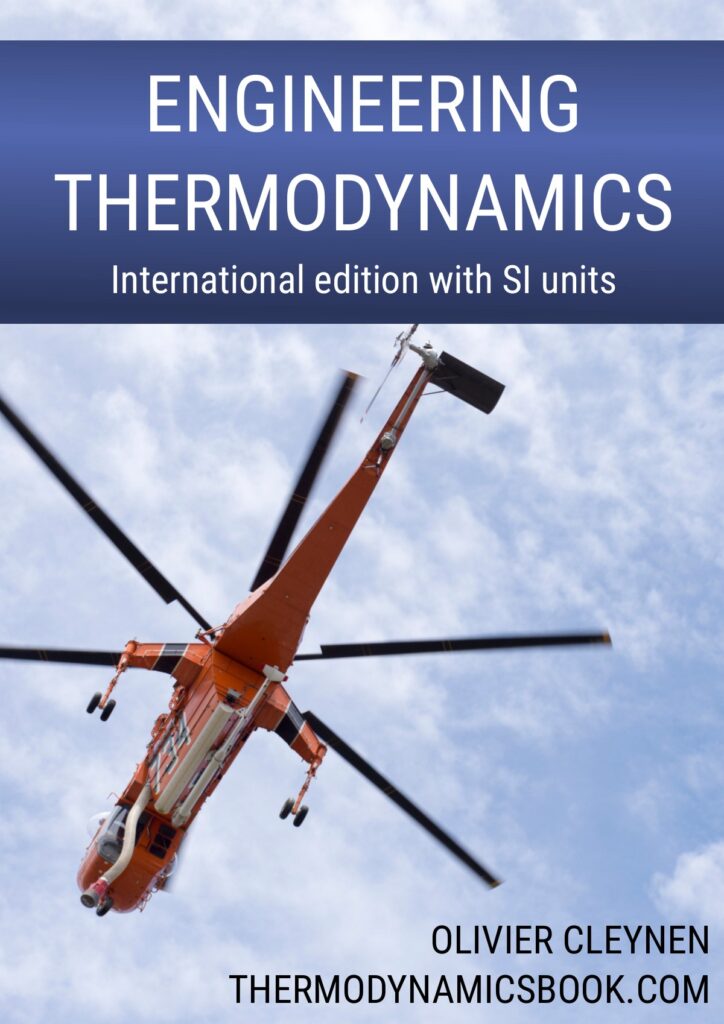
The hosted book is the first English edition, translated from the third French edition and published in June 2025. Ten substantive chapters organise the course from fundamental concepts through systems, working substances, cycles and entropy. The reviewed opening defines energy and distinguishes storage, transfer and the rate of transfer. Diagrams, worked examples, problems and historical discussions appear within the verified structure. The cover photograph, Carrickalinga Bushfire 2018, is credited to Luke Anderson under CC BY 2.5; the textbook itself is CC BY-SA 4.0.
The attached edition contains 338 PDF pages, including front matter. Cover: source edition cover rendered from the PDF. The textbook and its original notices are retained; Academic Master’s study material is separate from the source text.
Cover photograph: “Carrickalinga Bushfire 2018” by Luke Anderson, CC BY 2.5, as credited in the source. The cover is reproduced without design changes.
Book summary
Engineering Thermodynamics develops energy accounting and thermodynamic reasoning through ten chapters and supporting appendices. This guide follows the first English edition of June 2025, using the international SI presentation. Closed and open systems lead to ideal gases, phase change, cycles, the second law, entropy, and power plants. The recurring task is to define a boundary, identify assumptions, and connect a physical process with a consistent mathematical account.
Chapter-by-chapter summaries
Chapter 1: Fundamental Concepts
Energy, work, heat, and temperature describe related but different matters. Work and heat concern transfer, while a system’s stored energy is not a container holding them as substances. Mechanical examples establish sign, units, and interpretation. Define the system before classifying an interaction. The historical material helps show how concepts developed, while problem work tests whether the distinctions can guide an actual calculation.
Chapter 2: Closed Systems
A closed system does not exchange mass across its boundary, though energy transfer can occur. The first law connects stored-energy changes with interactions under the book’s accounting convention. Identify work and heat for the stated process rather than infer them from initial and final temperature alone. A boundary choice determines what belongs inside the accounting. Check signs against a physical description before accepting an algebraically correct expression.
Chapter 3: Open Systems
Open-system analysis allows mass to cross a control boundary and carry energy with it. Flow processes require terms and conventions appropriate to that exchange. Distinguish a steady operating condition from a claim that no energy moves through the system. Sketch inlets, outlets, and interactions, then justify neglected terms. The chapter connects a general balance with practical components rather than make every device require an unrelated equation.
Chapter 4: The Ideal Gas
The ideal-gas model relates properties under an assumption about the substance’s behavior. Property relations, energy and temperature, and elementary reversible processes support calculations for selected paths. A state equation does not by itself define the process between two states. Keep heat capacities, units, and restrictions consistent. Compare limiting cases and explain why a particular process relation applies instead of choosing it because the variables are familiar.
Chapter 5: Liquids and Vapors
Evaporation and condensation require an account beyond a single gas-phase relation. The chapter develops qualitative and quantitative water properties and elementary processes using appropriate property information. Identify the phase region before extracting values or applying formulas. A saturation state, a mixture, and a single-phase state require different interpretations. Tables support a calculation only when their pressure, temperature, and property conventions match the defined state.
Chapter 6: Thermodynamic Cycles
A cycle returns a working substance to its starting state while transferring energy through several processes. Net changes and individual transfers must be distinguished. Graphical conventions help relate paths with work and heat where appropriate. Efficiency expresses a relationship among useful output and input under a stated definition. Follow each stage and reconcile the complete cycle, rather than rely on a remembered diagram whose assumptions do not match the problem.
Chapter 7: The Second Law
The second law constrains transformations that the first-law energy balance alone would allow. Heat engines and the Carnot cycle illustrate limits and the role of reversible comparison processes. A maximum efficiency is a bound under assumptions, not a performance guarantee for a real device. Use absolute temperature where required and explain the reservoirs and interactions involved. The chapter connects physical directionality with the limits of thermal-machine performance.
Chapter 8: Entropy
Entropy is a state quantity used to analyze transfer, production, and the direction of processes. Separate an entropy change in a system from entropy generation associated with irreversibility. A system can lose entropy while the complete process remains compatible with the second law. Define the boundary and account for exchanges before interpreting a sign. The chapter also considers broader temporal and universal questions, while problem solving requires precise local balances.
Chapter 9: Steam Power Cycles
Steam plants combine components whose processes can be represented through state points and property data. The chapter examines evaluation criteria, plant components, and cycle arrangements. Trace the working fluid and identify where work or heat enters and leaves. Compare an idealized model with the losses or constraints it omits. A cycle improvement should be evaluated through its full consequences rather than one favorable component result in isolation.
Chapter 10: Air-Based Power Cycles
Reciprocating engines and gas turbines organize air-based processes differently. Evaluation, component models, and modified turbine cycles connect theory with design choices. State the assumptions behind an air-standard or other simplified representation before comparing results. A change that improves one measure can introduce another cost or constraint. Follow a complete cycle and explain how each modification changes energy transfer, not only the appearance of its diagram.
Appendices and Reference Tools
Steam tables, pressure conventions, additive and state quantities, unit conversions, notation, and other supporting material help maintain consistency. Gauge and absolute pressure must not be interchanged silently. The appendices also provide student-support and reuse information. Use the tables with an explicit state description and verify interpolation and units. A final integrated solution should show the boundary, assumptions, states, balances, property sources, and physical interpretation of the answer.
Study instructions
- Begin every problem with a labeled system or control-volume sketch.
- Write the accounting convention and identify mass and energy transfers before simplifying a balance.
- Record state properties in a table with units and the source of each value.
- Distinguish state relations from process-specific assumptions.
- Check both first- and second-law consistency where relevant.
- Compare an ideal cycle with one explicitly stated real-world departure and explain the effect.
Questions for reflection
- Why can an energy balance permit a process the second law excludes?
- What changes when the same device is analyzed with a different boundary?
- How do phase region and pressure convention affect the property calculation?
Sources and coverage
This original study guide follows the complete linked source edition and all of its substantive chapters or named teaching sections. It condenses their main ideas and relationships; the study tasks are guidance for reading alongside the complete resource. It does not reproduce the source exercises or answer key. Book source; Complete source PDF.
About access & copyright
Check this edition’s source and licence before reusing its files or content. A library listing does not grant additional rights.
Read our Library Access & Copyright policyEnergy accounting
Relate transformations to conservation.
Storage and transfer
Distinguish internal energy, heat and work.
Rates
Separate energy quantities from power.
Normalisation
Recognise the purpose of specific quantities.
Reader ratings & reviews
Share your thoughts
Your review helps other students choose the right resources.
KEEP LEARNING
Your next great read
Civil Engineering Civil Engineering
Ports and Waterways: Navigating the changing world
View Ports and Waterways: Navigating the changing world — book Engineering & Technology
Building with Nature & Beyond: Principles for designing nature based engineering solutions
View Building with Nature & Beyond: Principles for designing nature based engineering solutions — book Applied
Introduction to Probability
View Introduction to Probability — book Civil Engineering
Basics of Fluid Mechanics
View Basics of Fluid Mechanics — book Business
Developing New Products and Services
View Developing New Products and Services — book Engineering & Technology
Notes on Diffy Qs: Differential Equations for Engineers
View Notes on Diffy Qs: Differential Equations for Engineers — book Electrical Engineering
Introduction to Linear, Time-Invariant, Dynamic Systems for Students of Engineering
View Introduction to Linear, Time-Invariant, Dynamic Systems for Students of Engineering — book Electrical Engineering
AC Circuits
View AC Circuits — book Electrical Engineering



