
 General and Comparative Literary Studies and Linguistics
HumanitiesTextbook
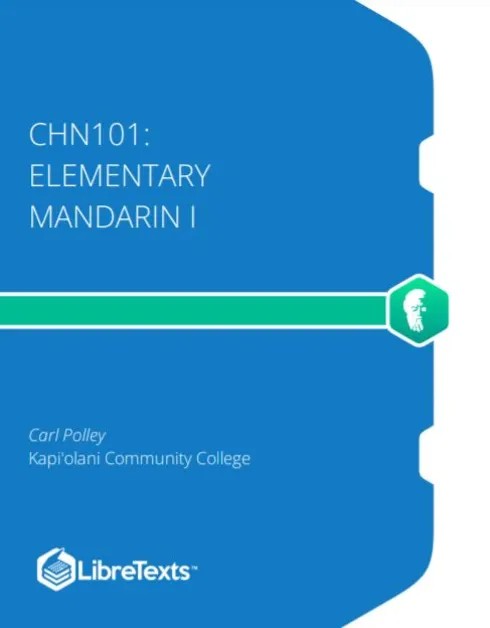
Elementary Mandarin
Not rated yetRate this bookCarl Polley’s Elementary Mandarin provides English-language instruction for a beginning Mandarin course. It combines pronunciation and character foundations with seven practical lessons on introductions, family, food, travel, and shopping, followed…
Read on the publisher’s website. Opens in a new tab.
 Free
About this book
Carl Polley’s Elementary Mandarin provides English-language instruction for a beginning Mandarin course. It combines pronunciation and character foundations with seven practical lessons on introductions, family, food, travel, and shopping, followed by review. The online book includes dialogue guidance, vocabulary work, grammar explanations, writing worksheets, and assessments. Its English explanations make it an English instructional resource despite the Chinese examples it necessarily contains. This guide follows all nine main units and connects their grammar to communicative purposes. Older course-platform references are treated as part of the original teaching context; independent learners can practice the same listening, speaking, reading, and writing skills with equivalent methods.
The detailed guide below explains the book’s chapter, unit, or module sequence. Use it alongside the study instructions and the complete official text.
Book summary
Chapter-by-chapter summaries
Unit 1: Introduction
The course begins by separating several skills that English-speaking beginners may initially confuse. Pinyin represents pronunciation; characters represent the writing system; tones help distinguish spoken syllables. The sound-system material therefore needs listening practice rather than an assumption that familiar Roman letters have their English values. Character instruction introduces basic strokes, stroke order, and radicals as recurring components. These provide a method for observing and remembering a character instead of copying it as an undifferentiated picture. Self-assessment and review tasks help identify which sounds or symbols need more work. Choosing or discussing a Chinese name introduces another cultural and linguistic convention. The unit’s main purpose is to create a reliable foundation: later vocabulary learning becomes easier when a student records pronunciation, tone, meaning, and written form as related but distinguishable information.
Unit 2: First contact
The first conversation lesson introduces greetings and personal identification. The verbs 叫 and 姓 serve different naming functions, while 是 connects noun expressions in basic identification statements. It should not be inserted everywhere English uses a form of be. Possession is introduced with 的, and 也 expresses an additional parallel fact before the relevant predicate. Question words remain in the position associated with the missing information; learners should avoid automatically moving them to the front as in English. The particle 呢 supports reciprocal questions in an established context. Dialogue study progresses from understanding an exchange to listening and producing it. Writing worksheets, vocabulary review, and a lesson test reinforce the same material across modes. The result is a short introductory exchange whose structure can be adapted to new people rather than merely recited.
Unit 3: Origin and languages
The next unit extends introductions to countries, origins, and languages. Its grammar explanations establish basic subject-predicate and subject-verb-object patterns while warning against assuming that Chinese and English word order always coincide. A location expression introduced by 在 commonly precedes the action it describes. Negation with 不 and yes-no questions with 吗 allow students to vary a statement’s communicative purpose without abandoning its core structure. This also clarifies the difference between a question-word question and a yes-no question: the same question marker should not simply be added to every sentence that asks for information. Listening and dialogue work connect the grammar with realistic exchanges about where someone is from and what they speak. The key advance is sentence flexibility—learners can affirm, deny, ask, and locate an action using a growing but controlled vocabulary.
Unit 4: Family
Family conversations bring together names, places, siblings, ages, and occupations. 有 expresses possession and can also introduce what exists in a place. Number structures and the measure word 个 make quantity expressions more systematic. The lesson distinguishes possession marked with 的 from close relationships in which that particle can often be omitted. 还 adds another related fact, while 都 applies a statement across a relevant group. These grammatical choices help students move from isolated labels to a connected description of a household. Speaking activities and self-introduction work require retrieving information in sequence rather than recognizing words on a quiz alone. A useful review asks what each small word contributes: quantity, inclusion, addition, possession, or existence. Understanding that contribution makes it easier to build new family descriptions without translating English sentence patterns word for word.
Unit 5: Ordering food and drink
Food and drink provide a practical setting for requests, quantities, time, and social coordination. 要 has several uses, so the meaning of a request must be interpreted in context; 想 introduces wanting or wishing to do something. Measure words connect numbers with the things counted, extending the earlier introduction to 个. The unit also develops the order of time, place, and descriptive material within a sentence. Dates use larger units before smaller ones, and time expressions require attention to their own conventions. 吧 can soften a suggestion, while constructions involving 给 introduce actions directed toward someone. The midterm material consolidates these skills through both written and oral work. The underlying task is to coordinate a small interaction: identify an item, specify quantity, express a preference, and respond appropriately to another speaker.
Unit 6: At the restaurant
Restaurant exchanges introduce choices and descriptions as well as further requests. The lesson distinguishes 或者 in statements from 还是 in alternative questions. These are not interchangeable translations of English or. Separable verbs are treated as verb-object combinations whose parts may admit intervening material, making their behavior different from that of an indivisible English verb. Descriptive predicates also require a different structure from noun identification with 是; the lesson discusses the frequent role of 很 in neutral adjective-like statements. Tag questions and the wanting-to use of 要 add ways to check agreement or state an intention. Speaking practice brings these elements into connected interaction. The main learning challenge is structural discrimination: students need to recognize whether they are identifying something, describing it, offering alternatives, or expressing a desired action before choosing the sentence pattern.
Unit 7: At the hotel
The hotel lesson moves through getting a room, reservations, checking in, complaints, checking out, and leaving luggage. Its grammar adds movement and obligation. Directional complements specify how an action proceeds in relation to direction, while 去 introduces going to a destination without copying an English to phrase mechanically. 得 pronounced děi expresses necessity, and 别 introduces a negative command. The differing uses and pronunciations associated with the written form 得 also prepare learners for the descriptive-complement material that follows. The practical objective is to understand what kind of response a service exchange requires: a request, a destination, an obligation, or an instruction. Reviewing complete dialogue sequences helps because a grammatically possible sentence may still be inappropriate at a particular point in the interaction. The unit combines functional vocabulary with attention to the action being performed through language.
Unit 8: Shopping
Shopping expands language for evaluation, quantity, timing, and transactions. 怎么 can ask how come with an implication of surprise, extending its more familiar how meaning. Descriptive complements with 得 explain the manner or quality of an action. 有点 introduces a somewhat unfavorable evaluation in relevant contexts, while 就 and 才 express timing relative to expectations rather than simply replacing clock-time expressions. Ordinal numbers use 第, and double-object verbs introduce patterns involving a recipient and something transferred. These are useful distinctions in shopping dialogues because speakers compare items, explain preferences, and respond to information about price or availability. The lesson’s exercises require more than learning product names. Students must interpret the speaker’s stance and select a pattern that expresses both the basic proposition and its intended nuance.
Unit 9: Review and conclusion
The concluding unit returns to accumulated course skills through review and assessment. By this stage, learners have moved from sound and stroke recognition to exchanges about identity, family, food, accommodation, and shopping. Effective revision needs to test those skills separately and together: recognizing a character does not guarantee accurate pronunciation, and recognizing a dialogue does not guarantee the ability to respond spontaneously. The unit’s role is to identify such gaps before a final performance. Learners can revisit earlier vocabulary and grammar in mixed tasks rather than reviewing only one lesson at a time. The broader outcome is a foundation for continued study, not comprehensive Mandarin proficiency. Progress is visible when the student can understand and adapt familiar patterns in a new exchange while maintaining intelligible pronunciation and appropriate word order.
Supplementary study focus: Connecting the four skills
The course repeatedly cycles through dialogues, vocabulary, writing, grammar, and speaking. An effective independent adaptation follows the same connections: understand a short exchange, listen for tones and phrasing, practice speaking it, and reconstruct useful sentences in writing. Character copying should include attention to components and stroke sequence, while vocabulary retrieval should sometimes begin from meaning or sound rather than always from the printed character. A brief recording can reveal pronunciation problems that silent study misses. This is a study synthesis of the course design, not an additional original chapter. Its purpose is to explain why repeated exposure alone may be insufficient: the learner needs to retrieve and use the material under several conditions before it becomes available in conversation.
Study instructions
- Begin with the introductory pronunciation material. Listen to the provided models, imitate short segments, and compare your recording with the model before increasing speed.
- For each lesson, keep sound, meaning, and written form connected. Study a manageable set of expressions and use each in a complete communicative exchange.
- Practice greetings, origins, and family topics with a partner, alternating questions and answers. Change one detail so that the exchange requires understanding rather than a memorized sequence.
- Use the food, restaurant, hotel, and shopping units for role-play. Prepare the information you need to communicate, then attempt the exchange without reading a complete script.
- Revisit earlier listening and reading material after a delay. Record what you can understand independently and which sound, word, or structure still needs attention.
Practice and review task
Make a short spoken introduction and a written message on a familiar topic, then revise both after feedback.
Questions for reflection
Can you understand the question when its wording or order changes? Which part of the exchange can you produce without a prompt?
Sources and coverage
The nine original units are followed by one clearly labeled supplementary study focus. These original summaries draw on review of the source text, including chapter or section introductions and selected explanations, examples, exercises, and review material. They are condensed study guides, not a page-by-page account or a replacement for the complete resource. Supplementary study discussions are identified separately.
About access & copyright
This page provides book information and study material. Full-text access is provided by the original publisher or authorised source; a listing does not grant permission to republish the book.
Read our Library Access & Copyright policyExplore the contents
Check the chapters covered in this edition.
Visit the official source
See reading, preview or purchase options.
Save for later
Keep this textbook in your saved collection.
Reader ratings & reviews
Share your thoughts
Your review helps other students choose the right resources.
KEEP LEARNING
Your next great read
General and Comparative Literary Studies and Linguistics General and Comparative Literary Studies and Linguistics
Beginning Japanese for Professionals, Book 1
View Beginning Japanese for Professionals, Book 1 — book History
 of Applied Science & Technology
View History of Applied Science & Technology — book General and Comparative Literary Studies and Linguistics
EmpoWORD: A Student-Centered Anthology and Handbook for College Writers
View EmpoWORD: A Student-Centered Anthology and Handbook for College Writers — book English
Provincial English
View Provincial English — book General and Comparative Literary Studies and Linguistics
Verb Tenses for English for Academic Purposes
View Verb Tenses for English for Academic Purposes — book Cultural Studies in the narrower sense
Historical and Contemporary Realities: Movement Towards Reconciliation
View Historical and Contemporary Realities: Movement Towards Reconciliation — book Berkeley
Modern Philosophy
View Modern Philosophy — book Humanities
Writing Guide with Handbook
View Writing Guide with Handbook — book Humanities



