
Introductory Statistics
CalculusTextbook
Calculus Volume 3
Not rated yetRate this bookThe linked book is OpenStax Calculus Volume 3, with Gilbert Strang and Edwin Jed Herman as senior contributing authors. Its seven chapters develop parametric and polar curves, vectors, vector-valued functions, multivariable differentiation and integration, vector calculus, and second-order differential equations. This guide makes the volume explicit so readers do not expect a first course covering limits and elementary derivatives. The main habit is translating geometry into an appropriate mathematical representation, then checking assumptions, domains, orientation, and units before interpreting a result.
Free reading is available at the official source. Opens in a new tab.
 Free
About this book
The linked book is OpenStax Calculus Volume 3, with Gilbert Strang and Edwin Jed Herman as senior contributing authors. Its seven chapters develop parametric and polar curves, vectors, vector-valued functions, multivariable differentiation and integration, vector calculus, and second-order differential equations. This guide makes the volume explicit so readers do not expect a first course covering limits and elementary derivatives. The main habit is translating geometry into an appropriate mathematical representation, then checking assumptions, domains, orientation, and units before interpreting a result.
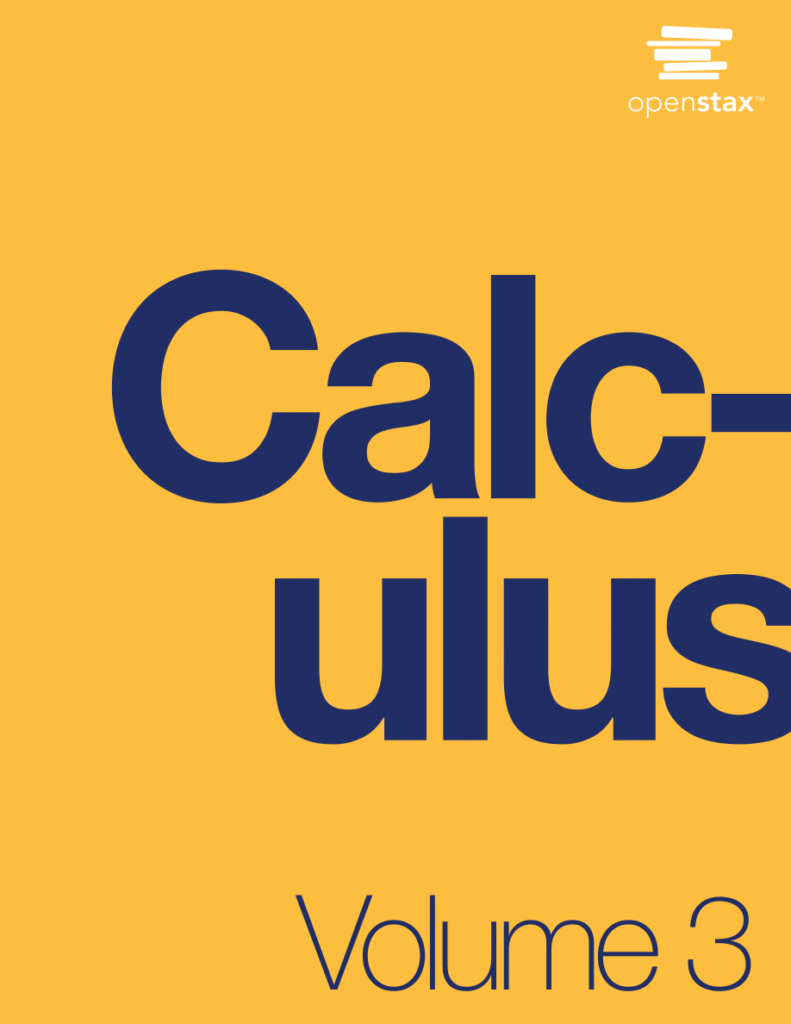
Cover: source-edition cover, displayed to identify the linked book. Publisher and third-party rights remain with their respective holders.
Book summary
About this book
The linked book is OpenStax Calculus Volume 3, with Gilbert Strang and Edwin Jed Herman as senior contributing authors. Its seven chapters develop parametric and polar curves, vectors, vector-valued functions, multivariable differentiation and integration, vector calculus, and second-order differential equations. This guide makes the volume explicit so readers do not expect a first course covering limits and elementary derivatives. The main habit is translating geometry into an appropriate mathematical representation, then checking assumptions, domains, orientation, and units before interpreting a result.
Chapter-by-chapter summaries
1. Parametric Equations and Polar Coordinates
Parametric descriptions separate a curve from the particular way it is traced. Derivatives, arc length, and area must account for the parameter and possible repeated traversal. Polar coordinates describe points through radius and angle, requiring care with equivalent representations and bounds. Sketch before calculating and identify how the curve is covered. The chapter extends single-variable tools into new representations rather than assuming a familiar Cartesian formula applies unchanged.
2. Vectors in Space
Coordinates, vectors, dot and cross products, lines, planes, surfaces, and coordinate systems express three-dimensional geometry. Distinguish a point from a displacement and a scalar product from a vector result. Use geometric meaning to choose an operation: projection, angle, perpendicular direction, or area ask different questions. Check the direction and units of an answer. The chapter supplies the language used throughout the later multivariable material.
3. Vector-Valued Functions
A vector-valued function describes a changing position or quantity through several components. Differentiation, integration, motion, arc length, and curvature connect component calculations with geometry. Velocity and speed differ because one includes direction. Trace a curve and mark its tangent before computing. A correct component derivative is only part of an interpretation when the question concerns motion, distance traveled, or change in direction.
4. Functions of Several Variables and Differentiation
Domains, level sets, limits, continuity, partial derivatives, chain rules, directional derivatives, gradients, tangent approximations, and optimization extend local analysis. A partial derivative holds specified variables fixed, while a total change can involve several paths. Explain the direction or constraint before differentiating. For extrema, distinguish a critical-point condition from proof of the required maximum or minimum. Constraints change the feasible set and the meaning of the optimization problem.
5. Multiple Integration
Double and triple integrals accumulate quantities over regions. Iterated integration requires describing bounds consistently, while polar, cylindrical, spherical, and general changes of variables alter both coordinates and area or volume factors. Draw the region before choosing the order. Distinguish a geometric volume from an integral of density or another field. The Jacobian represents how the transformation changes local measure; omitting it changes the problem rather than simplifying the calculation.
6. Vector Calculus
Vector fields, line integrals, conservative fields, flux, divergence, curl, and the major integral theorems relate local and global descriptions. Identify whether the quantity concerns work, circulation, or flux before selecting an integral. Orientation and boundary relationships are essential. Green’s, Stokes’, and the divergence theorem require their stated conditions; visual similarity alone does not justify applying one. Check a simple field or alternative method to verify signs and interpretation.
7. Second-Order Differential Equations
Linear second-order equations connect solution methods with homogeneous structure, forcing, and initial or boundary information. Independent solutions provide a general form, while conditions select a particular solution. Distinguish the complementary and particular parts and substitute the result back into the equation. Applications connect mathematical behavior with the model’s assumptions. The final chapter reinforces the need to verify both the differential equation and the supplied conditions, not merely recognize a familiar formula.
Study instructions
- Review the single-variable differentiation and integration needed for each chapter before attempting multivariable problems.
- Sketch curves, regions, surfaces, and orientations; label parameters, domains, and bounds.
- State what is held fixed, what varies, and what the result represents before applying a formula.
- Check dimensions, signs, simple limiting cases, and results obtained through another representation.
- For integral theorems and differential equations, verify the hypotheses and all boundary or initial conditions explicitly.
Questions for reflection
- How can the same curve have different parametrizations?
- Why is speed different from velocity?
- What does a Jacobian contribute to an integral?
- When can a critical point fail to solve an optimization problem?
- Why does orientation matter in vector calculus?
Sources and coverage
This original study guide covers all main chapters of the linked edition, or all instructional sections where the work has no numbered chapters. The explanations and suggested practice are written for study; consult the full source for cases, worked examples, illustrations, exercises, and references. The linked source is OpenStax Calculus Volume 3, not a complete single-volume introductory calculus sequence. Read the source edition.
About access & copyright
This page provides book information and study material. Full-text access is provided by the original publisher or authorised source; a listing does not grant permission to republish the book.
Read our Library Access & Copyright policyExplore the contents
Check the chapters covered in this edition.
Visit the official source
See reading, preview or purchase options.
Save for later
Keep this textbook in your saved collection.
Reader ratings & reviews
Share your thoughts
Your review helps other students choose the right resources.
KEEP LEARNING
Your next great read
Applied
Applied Discrete Structures
Applied Discrete Structures
View Applied Discrete Structures — bookPrecalculus
Precalculus
View Precalculus — bookLinear Algebra
Linear Algebra
View Linear Algebra — bookCombinatorics Through Guided Discovery
Combinatorics Through Guided Discovery
View Combinatorics Through Guided Discovery — bookA Gentle Introduction to the Art of Mathematics
A Gentle Introduction to the Art of Mathematics
View A Gentle Introduction to the Art of Mathematics — bookA Computational Introduction to Number Theory and Algebra
A Computational Introduction to Number Theory and Algebra
View A Computational Introduction to Number Theory and Algebra — bookNotes on Diffy Qs: Differential Equations for Engineers
Notes on Diffy Qs: Differential Equations for Engineers
View Notes on Diffy Qs: Differential Equations for Engineers — bookCalculus
Calculus
View Calculus — book Mathematics



