
Precalculus
CalculusTextbook
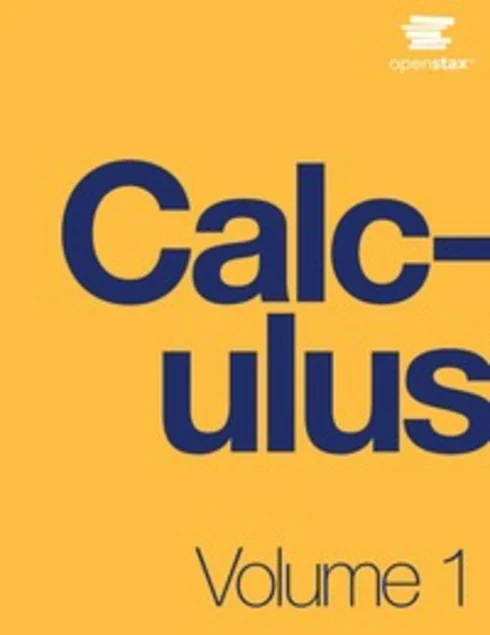
Calculus Volume 1
Not rated yetRate this bookOpenStax Calculus Volume 1 by Gilbert Strang and Edwin Herman develops single-variable differential and integral calculus. The imported page was titled simply Calculus, but its source is specifically Volume 1. Six main chapters move from functions and limits through derivatives, integration, and applications. The guide follows that linked volume and adds labeled study focuses to clarify important connections without presenting them as extra source chapters.
Free reading is available at the official source. Opens in a new tab.
 Free
About this book
OpenStax Calculus Volume 1 by Gilbert Strang and Edwin Herman develops single-variable differential and integral calculus. The imported page was titled simply Calculus, but its source is specifically Volume 1. Six main chapters move from functions and limits through derivatives, integration, and applications. The guide follows that linked volume and adds labeled study focuses to clarify important connections without presenting them as extra source chapters.
Book summary
About this book
OpenStax Calculus Volume 1 by Gilbert Strang and Edwin Herman develops single-variable differential and integral calculus. The imported page was titled simply Calculus, but its source is specifically Volume 1. Six main chapters move from functions and limits through derivatives, integration, and applications. The guide follows that linked volume and adds labeled study focuses to clarify important connections without presenting them as extra source chapters.
Chapter and section guide
1. Functions and Graphs
Functions organize relationships among inputs and outputs and supply the objects studied throughout calculus. The chapter reviews major function classes, trigonometry, inverses, exponentials, and logarithms. Algebraic expressions must be interpreted on valid domains, and a graph can reveal behavior hidden by a formula. Students should connect notation with meaning before applying new operations to a function. An inverse requires suitable restrictions, and a composite function must respect the intermediate domain.
Study application: Choose one function and describe it using a formula, graph, and verbal interpretation. Identify its domain and explain how a proposed composition could restrict that domain further.
2. Limits
A limit describes behavior near an input and is distinct from the function’s value at that input. Limit laws, continuity, and a precise definition support the transition from approximation to rigorous reasoning. Students should distinguish one-sided and two-sided behavior and recognize when a formula’s apparent discontinuity can be removed. A few numerical values can suggest a limit without proving it. Continuity requires a connection among the value, the limit, and the point under consideration.
Study application: Construct a function whose limit exists at a point but whose value differs from it. Explain which condition of continuity fails and how redefining one value could change the conclusion.
3. Derivatives
The derivative expresses an instantaneous rate of change and a local linear relationship. The definition through difference quotients connects geometry with symbolic rules. Product, quotient, chain, implicit, and inverse-function methods expand the range of functions that can be differentiated. Students should identify the dependent quantity and its units before interpreting a derivative. A formula for a derivative also has a domain, which can differ from the original function’s domain.
Study application: Differentiate a composite function using both its structure and an explicit simplification when possible. Interpret the derivative’s units in an original application and check a point where differentiability may fail.
Chapter 3 study focus: Related Rates and Local Approximation
Related-rate problems require a relationship among changing quantities before differentiation. Local linear approximation uses a derivative to estimate a nearby value and should not be mistaken for an exact global equation. Both applications demand a clear reference point and consistent units. Students should distinguish a variable’s current value from its rate of change. The validity of the approximation or rate interpretation depends on the model and the region being studied.
Study application: Set up a small geometric related-rate example, differentiate before inserting the specified instant’s values, and explain why substituting too early can erase the dependency being modeled.
4. Applications of Derivatives
Derivatives help analyze increase, decrease, extrema, curvature, optimization, and related questions. Critical points are candidates requiring further investigation, not automatic maxima or minima. Endpoints and constraints matter in an applied optimization problem. The chapter also develops theoretical and approximation tools that connect a graph’s features with derivative information. Students should organize a solution around the question being asked and verify whether a calculated candidate belongs to the permitted domain.
Study application: Optimize an original quantity over a closed interval, checking critical points and endpoints. Explain how an unconstrained algebraic optimum could fail to solve the contextual problem.
Chapter 4 study focus: Theorems and Numerical Methods
A theorem’s conclusion depends on hypotheses such as continuity and differentiability on specified intervals. Numerical methods produce approximations through a process that needs a starting choice and a check of convergence or error. Students should not use a theorem’s familiar name as a substitute for verifying its conditions. A calculator’s output is one part of the argument, not evidence that every required assumption holds.
Study application: Choose a theorem from the chapter and give an example satisfying its hypotheses and a nonexample that violates one. Explain why the conclusion is guaranteed only in the first setting.
5. Integration
Integration begins with accumulation and area-oriented sums and develops the connection between definite integrals and antiderivatives. The Fundamental Theorem of Calculus joins two previously distinct questions: accumulation over an interval and local rate of change. Signed area is not always the same as total geometric area. Students should keep the variable of integration, bounds, and units explicit and distinguish an indefinite family from a definite numerical result.
Study application: For a function crossing the horizontal axis, compare its definite integral with total area. Explain how the sign convention and interval splitting produce different quantities.
Chapter 5 study focus: Substitution and Accumulation Functions
Substitution changes variables in a structured way and must preserve the integral’s meaning. In a definite integral, bounds must correspond to the chosen variable or the result must be translated back consistently. Accumulation functions connect a moving endpoint with differentiation and provide a useful way to interpret the theorem conceptually. Students should explain which function is being differentiated rather than mechanically cancel symbols.
Study application: Perform one definite integral by substitution using transformed bounds, then verify it by an alternative route. State why mixing old bounds with a new variable is invalid.
6. Applications of Integration
Areas between curves, volumes, arc length, surface area, work-related quantities, moments, and other applications share a common modeling pattern: identify a small contribution and accumulate it. Geometry determines the expression and bounds. A correct antiderivative cannot rescue an incorrectly modeled slice or force element. Students should draw the representative piece, state its dimensions, and explain how the limiting sum corresponds to the requested quantity.
Study application: Model one volume by slicing and another by shells, explaining the radius, height, thickness, and bounds. Check dimensions before evaluating either integral.
Chapter 6 study focus: Exponential Processes and Differential Equations
The volume connects integration with exponential and logarithmic relationships and introduces elementary differential-equation models. An equation involving a derivative describes a rate relationship, while an initial condition selects a particular process. Students should distinguish a mathematical model’s solution from evidence that the model fits a real system. Parameters and units make the interpretation testable, and predictions should remain within the assumptions used to construct the equation.
Study application: Solve a simple constant-proportional-rate model with an initial value and verify it in the differential equation. Explain one real-world condition under which the same formula would cease to be adequate.
Appendices and Solutions
Tables of integrals and derivatives and a precalculus review support efficient work, while the solutions provide a way to check selected exercises. Each table entry has a form and conditions that must match the problem. Students should use the review material when an algebraic gap blocks a calculus idea rather than conceal the gap with a symbolic tool. A listed final answer is a diagnostic, not a complete explanation.
Study application: Audit a completed solution for algebra, domain, theorem hypotheses, units, and interpretation. Use a reference table only after identifying the exact pattern and conditions needed.
Study instructions
- Review the function’s domain and graph before differentiating or integrating it.
- Link each symbolic operation with a geometric, rate, or accumulation interpretation.
- Check theorem hypotheses and all boundary or endpoint conditions explicitly.
- Attempt examples and exercises independently before consulting solutions.
- Verify calculations using differentiation, dimensions, limiting behavior, and interpretation of the original question.
Practice and review task
Create a single-variable model with a defined domain. Analyze its limits and continuity, use derivatives to study behavior and an optimization question, and use a definite integral to answer an accumulation question. Explain why the derivative and integral answer different questions about the same function.
Questions for reflection
How does a limit differ from a value, and an antiderivative from a definite integral? Why must modeling a small contribution come before evaluating an application integral?
Sources and coverage
This original study guide follows OpenStax Calculus Volume 1, linked six-chapter PDF. It draws on the source contents, chapter introductions, selected explanations and examples, and review material. It condenses the resource rather than replacing the full text; study applications are original exercises.
About access & copyright
This page provides book information and study material. Full-text access is provided by the original publisher or authorised source; a listing does not grant permission to republish the book.
Read our Library Access & Copyright policyExplore the contents
Check the chapters covered in this edition.
Visit the official source
See reading, preview or purchase options.
Save for later
Keep this textbook in your saved collection.
Reader ratings & reviews
Share your thoughts
Your review helps other students choose the right resources.
KEEP LEARNING
Your next great read
Calculus
College Trigonometry
College Trigonometry
View College Trigonometry — bookWhitman Calculus
Whitman Calculus
View Whitman Calculus — bookVector Calculus
Vector Calculus
View Vector Calculus — bookBasic Analysis: Introduction to Real Analysis
Basic Analysis: Introduction to Real Analysis
View Basic Analysis: Introduction to Real Analysis — bookCalculus for the Life Sciences: A Modeling Approach
Calculus for the Life Sciences: A Modeling Approach
View Calculus for the Life Sciences: A Modeling Approach — book Applied
Introductory Statistics
View Introductory Statistics — book Applied
 Discrete Structures
View Applied Discrete Structures — book Calculus
Precalculus
View Precalculus — book Algebra



