
 Intellectual property law
Contract LawTextbook
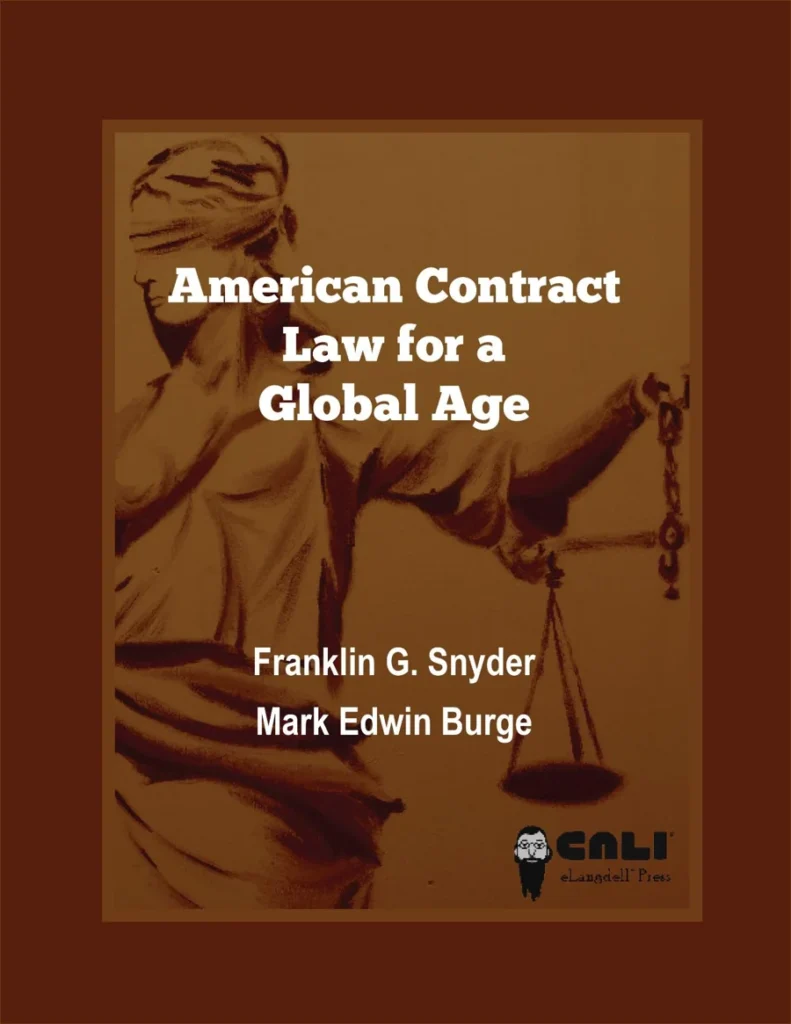
American Contract Law for a Global Age
Not rated yetRate this bookAmerican Contract Law for a Global Age by Franklin G. Snyder and Mark Edwin Burge develops contract doctrine through cases, questions, problems, and attention to different legal frameworks. This guide follows the first edition, December 2017, across nine chapters. The global perspective makes source selection especially important: common law, statutory rules, and international sales materials are not interchangeable. Organize every problem around the relevant authority, transaction, formation or performance issue, and remedy. These summaries support study of the edition rather than current advice about an actual agreement.
Free reading is available at the official source. Opens in a new tab.
 Free
About this book
American Contract Law for a Global Age by Franklin G. Snyder and Mark Edwin Burge develops contract doctrine through cases, questions, problems, and attention to different legal frameworks. This guide follows the first edition, December 2017, across nine chapters. The global perspective makes source selection especially important: common law, statutory rules, and international sales materials are not interchangeable. Organize every problem around the relevant authority, transaction, formation or performance issue, and remedy. These summaries support study of the edition rather than current advice about an actual agreement.
Cover: source-edition cover, displayed to identify the linked book. Publisher and third-party rights remain with their respective holders.
Book summary
American Contract Law for a Global Age by Franklin G. Snyder and Mark Edwin Burge develops contract doctrine through cases, questions, problems, and attention to different legal frameworks. This guide follows the first edition, December 2017, across nine chapters. The global perspective makes source selection especially important: common law, statutory rules, and international sales materials are not interchangeable. Organize every problem around the relevant authority, transaction, formation or performance issue, and remedy. These summaries support study of the edition rather than current advice about an actual agreement.
Chapter-by-chapter summaries
I. Introduction to contract law
Contract law gives legal consequences to some promises and transactions under defined conditions. Identify the sources and institutions governing a dispute before applying a familiar rule. Policy explanations can illuminate doctrine without replacing its actual requirements. Compare a moral expectation with a legally enforceable obligation. The chapter provides the framework for reading cases: facts, posture, issue, holding, and reasoning must be separated so that a memorable outcome is not mistaken for an unlimited rule.
II. Formation
Offer, acceptance, objective manifestation, timing, and the relevant transaction framework organize whether an agreement was formed. A participant’s undisclosed intention differs from evidence of assent. Trace communications chronologically and identify what each legally accomplishes under the assigned authority. Forms and changing terms create questions that cannot be resolved by a generic claim that both sides wanted a deal. Compare possible governing regimes explicitly, keeping the legal test connected with the facts it requires.
III. Consideration
Consideration concerns the relationship between a promise and the exchange supporting enforcement under the relevant doctrine. A benefit or detriment must be assessed through the bargain relationship rather than identified in isolation. Compare a gift promise, a conditional promise, and an exchanged commitment. Explain why value adequacy differs from the existence of consideration. The cases train readers to examine the transaction’s legal structure instead of assuming every serious or costly promise necessarily meets the same enforceability requirements.
IV. Alternative regimes
Reliance, restitution, and other grounds can address obligations that a conventional bargain analysis does not fully capture. Each has its own elements and remedial logic. Identify what injustice or transfer the doctrine addresses before applying it. A finding that a contract claim fails does not automatically prove an alternative claim succeeds. Compare the factual basis and measure of recovery under different approaches. This chapter broadens analysis while preventing the alternatives from becoming an unrestricted appeal to fairness.
V. Defenses
Capacity, coercion, misrepresentation, mistake, unconscionability, policy, and related issues can affect enforcement even when an apparent agreement exists. Distinguish failure of formation from a defense to enforcement. State the relevant factual conditions and the consequence the doctrine permits. Difficult circumstances alone do not establish every defense. Analyze both the information and bargaining context, using the assigned cases to identify limits. The chapter encourages careful issue separation rather than accumulating labels for an outcome that merely seems undesirable.
VI. Terms and interpretation
Interpretation determines what obligation the parties undertook, drawing on text, context, practices, and applicable legal rules. A dispute about the meaning of a term differs from whether additional evidence may be considered. Map the writing, communications, and claimed usage before applying a rule. Plain language arguments still require a justified account of what the words mean in context. Compare interpretations through their evidentiary and doctrinal basis rather than selecting the result that appears commercially convenient.
VII. Performance and breach
Duties, conditions, substantial performance, excuse, and breach affect whether and when obligations become enforceable. Not every shortfall has the same consequences. Build a sequence of promised acts, triggering events, actual conduct, and asserted excuses. Distinguish an obligation to perform from a condition governing another obligation. Analyze the effect of a failure under the relevant framework before turning to remedy. The chapter shows why proving that something went wrong does not settle which party bears the legal consequence.
VIII. Remedies
Expectation, reliance, restitution, and specific relief pursue different objectives and face different limits. Establish the remedial interest before calculating. Causation, certainty, foreseeability, mitigation, and applicable rules constrain recovery. Compare two measures on the same facts and explain their assumptions. A damages figure cannot simply combine every expenditure and disappointment. The chapter connects entitlement with proof and highlights the distinction between a legally supported valuation and an intuitive estimate of what would feel fair.
IX. Nonparties
Assignment, delegation, and third-party-beneficiary questions examine how contractual relationships affect people beyond the original pair. Distinguish transfer of a right from transfer of performance responsibility. Identify whose consent, expectations, and defenses matter under the assigned rules. A person who benefits incidentally is not automatically entitled to enforce. Draw the relationships before analyzing claims. This final chapter broadens the transaction while retaining precise attention to the source and scope of each asserted obligation.
Study instructions
- Brief cases with authority, jurisdiction, procedural posture, holding, and a limiting fact.
- Use a timeline and identify the governing framework before evaluating communications or conduct.
- Analyze formation, defenses, interpretation, performance, and remedies in separate stages.
- Calculate alternative remedial measures independently and explain their different objectives.
Questions for reflection
- Why does a failed bargain claim not establish a reliance claim automatically?
- How does a condition differ from a promise?
- What changes when a right is assigned but a duty is delegated?
Sources and coverage
This original reading guide follows the linked source edition’s chapter, module, unit, or lesson structure. Consult the source for full arguments, cases, worked examples, exercises, illustrations, and references. First edition, December 2017. The source compares legal materials within a teaching framework; current legal questions require updated controlling authority. Read the source edition.
About access & copyright
This page provides book information and study material. Full-text access is provided by the original publisher or authorised source; a listing does not grant permission to republish the book.
Read our Library Access & Copyright policyExplore the contents
Check the chapters covered in this edition.
Visit the official source
See reading, preview or purchase options.
Save for later
Keep this textbook in your saved collection.
Reader ratings & reviews
Share your thoughts
Your review helps other students choose the right resources.
KEEP LEARNING
Your next great read
Intellectual property law Contract Law
The Story of Contract Law: Formation
View The Story of Contract Law: Formation — book Law
Introduction to Criminal Law
View Introduction to Criminal Law — book Law
Evidence: Best Evidence Rule
View Evidence: Best Evidence Rule — book Law
Federal Rules of Appellate Procedure
View Federal Rules of Appellate Procedure — book Law
Land Use
View Land Use — book Business
Contract Doctrine, Theory & Practice, Volume 1
View Contract Doctrine, Theory & Practice, Volume 1 — book Law
The Ethics of Tax Lawyering
View The Ethics of Tax Lawyering — book Law
Federal Rules of Bankruptcy Procedure
View Federal Rules of Bankruptcy Procedure — book Civil Law



