
 college preparation
Business communication, etiquette and presentationTextbook
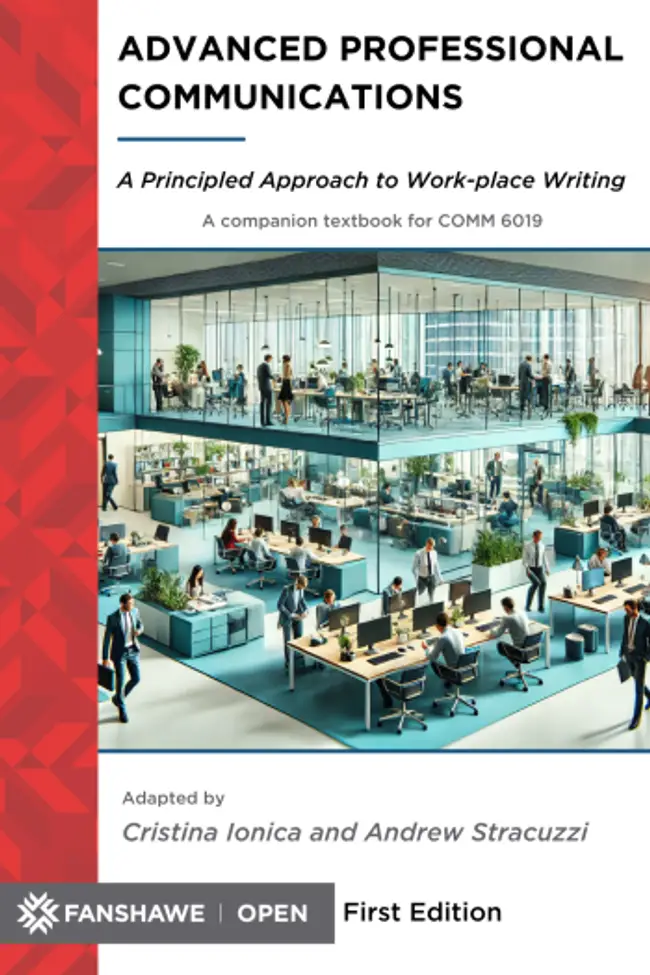
Advanced Professional Communication
Not rated yetRate this bookAdvanced Professional Communication connects workplace writing with audience, purpose, research and collaboration. Cristina Ionica and Andrew Stracuzzi’s compiled resource moves through eighteen chapters on business messages, intercultural communication, employment, reports, visual design, groups and public speaking.
Free reading is available at the official source. Opens in a new tab.
 Free
About this book
Advanced Professional Communication connects workplace writing with audience, purpose, research and collaboration. Cristina Ionica and Andrew Stracuzzi’s compiled resource moves through eighteen chapters on business messages, intercultural communication, employment, reports, visual design, groups and public speaking.
How to study this book
Use one continuing workplace scenario to practise each form. Before drafting, name the reader, the required decision and the information that reader needs. Revise first for purpose and organisation, then for style, design and correctness. Compare the chapter’s examples with your draft and explain why a change helps the reader rather than merely copying its format.
Chapter-wise explanations and study tasks
Chapter 1 — Introduction to Communication Studies
Communication is a process shaped by participants, context, channels and feedback. The chapter introduces models, principles, competence and verbal communication as a foundation for workplace decisions. A message is not successful merely because it was sent: readers interpret it through expectations and circumstances the sender may not share.
Study task: Map a workplace misunderstanding using sender, message, channel, context and feedback, then propose a specific repair.
Chapter 2 — Form and Style
Formality, the six Cs and document design connect wording with usability. Headings, spacing, lists, visuals and accessibility can determine whether important information is found and understood. Treat design as part of meaning: an accurate instruction hidden in a dense paragraph may fail the reader just as a vague sentence does.
Study task: Revise a short message for clarity and accessible layout, explaining three choices in relation to its audience.
Chapter 3 — Patterns of Communication
Direct and indirect patterns arrange a message according to purpose and anticipated response. Neither is a universally superior template. The chapter asks the writer to decide when the main point should lead and when context should prepare the reader, while retaining enough clarity that organisation does not become evasion.
Study task: Write direct and indirect versions of one message and justify which better suits the stated situation.
Chapter 4 — Business Message Formats
Email, memos and letters provide different conventions for identifying participants, organising content and recording action. Subject lines, openings, attachments and closing instructions matter because they help readers interpret and use a message. Format should serve a communication decision rather than substitute for a clear request or complete information.
Study task: Turn one request into an email and a memo, explaining what changes with the audience and channel.
Chapter 5 — Case Studies and Common Business Messages
Information sharing, requests, replies, complaints and negative messages involve different reader needs. The cases require the writer to infer a problem from a situation rather than fill an empty template. For bad news or crisis messages, assess accuracy, responsibility and the next useful action alongside tone.
Study task: Draft a response to a complaint that acknowledges the issue, explains the decision and gives a realistic next step.
Chapter 6 — Cultural Communication
Cultural frameworks help identify differences in expectations without predicting every individual’s behaviour. The chapter connects intercultural communication with international business, encouraging attention to assumptions about directness, relationships and context. Use these categories as questions to investigate, and confirm an interpretation through interaction rather than assigning a person a fixed cultural script.
Study task: Analyse an ambiguous exchange using two plausible explanations and propose a respectful question that could clarify it.
Chapter 7 — Social Media and Professional Environments
Online engagement leaves traces across audiences that may not remain separate. Digital footprints, self-presentation, disclosure and crisis communication make professional judgement part of everyday platform use. The chapter’s broader social discussion invites readers to distinguish a platform’s technical affordances from the relationships and incentives shaping its use.
Study task: Audit a fictional professional profile for audience overlap, privacy and credibility, then propose a consistent communication approach.
Chapter 8 — Employment Communication
The job search links research about an employer with a résumé, cover letter and interview. The central task is to demonstrate relevant capability through evidence rather than generic claims. Keep the documents mutually consistent, and prepare examples that can be explained accurately in conversation.
Study task: Match three job requirements to concrete evidence, then use that evidence in a résumé bullet and a cover-letter paragraph.
Chapter 9 — Report Writing
Reports support decisions through a purpose, evidence and structure suited to their audience. Different report types require different levels of formality and detail. Plan what the reader needs to know, distinguish findings from recommendations and make the document easy to navigate. A long report is not necessarily a more useful one.
Study task: Create an outline for a recommendation report, showing how each section contributes to a specific decision.
Chapter 10 — The Research Process
A focused question guides the selection and evaluation of sources. The chapter connects source types, search planning, interviews and surveys with a manageable research scope. Difficulty finding evidence may signal that a question needs revision rather than that any available source should be used.
Study task: Develop a research question and source plan, identifying what each source type can establish and one likely limitation.
Chapter 11 — Sources, Academic Integrity and Professional Research
Attribution distinguishes the writer’s contribution from borrowed evidence and ideas. Workplace and academic conventions may differ, but both require honest representation of sources. Traceability matters: readers should be able to identify what supports a claim. Citation also does not excuse a misleading quotation or a source used outside its scope.
Study task: Audit a paragraph for unattributed ideas, unsupported assertions and mismatched citations, then revise it.
Chapter 12 — Argumentation and Research at School and Work
An argument connects a claim with reasons and evidence, while synthesis brings sources into a relationship rather than presenting disconnected summaries. Evaluate how sources agree, differ or answer different questions. A recommendation becomes stronger when it addresses a reasonable objection instead of concealing uncertainty.
Study task: Write a short recommendation supported by two sources and explain one counterargument that changes its limits.
Chapter 13 — Research Writing Components
Methodology, purposeful reading, source credibility and the use of quotation, paraphrase and summary are revisited as connected writing decisions. APA documentation supports that process but cannot replace accurate understanding. Use notes that separate source wording from your own interpretation to reduce accidental appropriation and improve synthesis.
Study task: Prepare a quotation, paraphrase and summary from one passage, explaining why each would serve a different writing purpose.
Chapter 14 — Visual Communication Strategies
Graphics should answer an audience’s question and work with the surrounding explanation. The chapter connects graphic types and Gestalt principles with document design and revision. Check whether scale, emphasis and grouping make the intended comparison clear. An attractive visual can still be misleading or inaccessible.
Study task: Choose a suitable graphic for a small dataset and explain its scale, labels, grouping and accompanying text.
Chapter 15 — Public Speaking
Speaking in business settings requires a clear purpose and an understanding of what the audience needs to remember or do. Oral communication differs from a written document because listeners cannot scan backwards at will. Use explicit signposting and a manageable amount of information, then evaluate comprehension rather than merely completion of the speech.
Study task: Prepare a two-minute workplace briefing with one central message and an explicit action request.
Chapter 16 — Small Group Communication
Group development, dynamics, conflict and management styles help explain why assembling capable people does not guarantee effective collaboration. The chapter asks readers to examine relationships and procedures as well as individual contributions. Separate disagreement over a task from personal conflict, and make expectations for communication and work visible.
Study task: Create a team agreement covering roles, deadlines, decision-making and a procedure for addressing disagreement.
Chapter 17 — Leadership, Roles and Group Problem Solving
Leadership and member roles shape how groups define problems, generate alternatives and reach decisions. The chapter connects participation with a deliberate problem-solving process. A quick agreement may conceal missing information or silence a useful concern. Evaluate the reasoning behind a decision as well as whether members accepted it.
Study task: Facilitate a fictional group decision using stated criteria and record how a minority concern affects the outcome.
Chapter 18 — Preparing and Delivering a Speech
Topic selection, research, organisation, outlining and rehearsal turn a purpose into a deliverable presentation. Vocal and physical delivery support the message, while anxiety management and practice help make performance more dependable. Revise from observed rehearsal evidence rather than assuming that rereading notes is equivalent to speaking to an audience.
Study task: Record a short presentation, assess structure and delivery separately, then rehearse a revision addressing one weakness in each.
Appendices A–E — Supporting Resources
The appendices group support for visual communication, work-integrated learning, EAP/ESL writing, language mechanics and APA documentation. Use them in response to a specific difficulty revealed by your draft or presentation. They complement the main chapters rather than supply a separate sequence of new workplace genres.
Study task: Identify a recurring problem in your work, select the relevant support resource and document the improvement in a revised example.
Applied assignment
Build a workplace portfolio containing a request, a negative message, a research-based recommendation report and a short presentation. Explain the audience and purpose of each, document sources accurately and submit a revision note showing how feedback changed the work.
Suggested reading plan
Read Chapters 1–5 for message foundations, 6–8 for social and employment contexts, 9–14 for research and document design and 15–18 for speaking and teamwork. Consult the appendices during revision and finish by comparing the same message across written and spoken formats.
Questions for reflection
- What changes when the audience must act rather than merely receive information?
- When does indirect organisation help comprehension, and when can it hide the point?
- How can research, design and delivery each strengthen or weaken the same claim?
Edition and source notes
Based on the linked Fanshawe resource Advanced Professional Communication: A Principled Approach to Workplace Writing, credited to Cristina Ionica and Andrew Stracuzzi. The guide follows eighteen chapters and groups five supporting appendices. The repository PDF includes revisions beyond the original catalogue year; institutional requirements and documentation examples should be checked for the task at hand. All tasks here are original.
About access & copyright
This page provides book information and study material. Full-text access is provided by the original publisher or authorised source; a listing does not grant permission to republish the book.
Read our Library Access & Copyright policyExplore the contents
Check the chapters covered in this edition.
Visit the official source
See reading, preview or purchase options.
Save for later
Keep this textbook in your saved collection.
Reader ratings & reviews
Share your thoughts
Your review helps other students choose the right resources.
KEEP LEARNING
Your next great read
college preparation Business and Economics
Essentials of Project Management (v. 1.2 – January 22, 2024)
View Essentials of Project Management (v. 1.2 – January 22, 2024) — book Business and Economics
Pop-up Retail Strategies in an Omnichannel Context
View Pop-up Retail Strategies in an Omnichannel Context — book Law, Economics and Social Sciences
Research Methods: Exploring the Social World in Canadian Context
View Research Methods: Exploring the Social World in Canadian Context — book Communication Science/Journalism
Professional Communication Skills for Health Studies
View Professional Communication Skills for Health Studies — book Communication Science/Journalism
Write Like a PR Pro
View Write Like a PR Pro — book Business and Economics
Understanding Business
View Understanding Business — book Law, Economics and Social Sciences
Principles of Social Psychology - 1st International Edition
View Principles of Social Psychology - 1st International Edition — book Business and Economics
Sales Leadership Management
View Sales Leadership Management — book Early childhood care and education



