
Precalculus
AlgebraTextbook
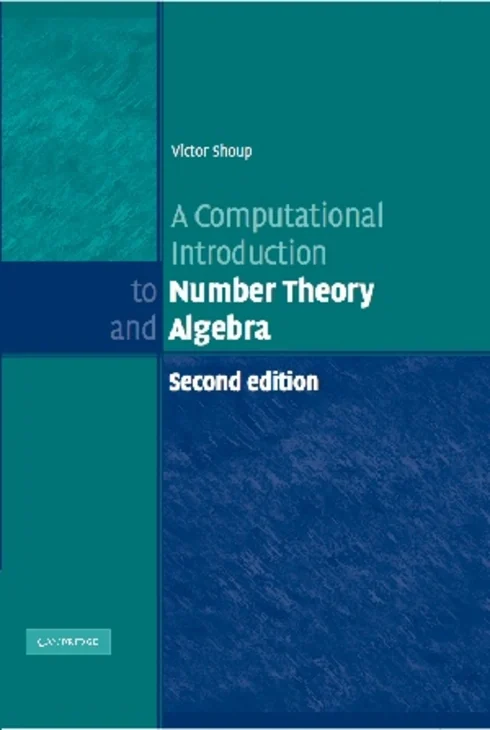
A Computational Introduction to Number Theory and Algebra
Not rated yetRate this bookVictor Shoup’s A Computational Introduction to Number Theory and Algebra joins mathematical structure with algorithms and their analysis. The linked version 2 has twenty-one chapters progressing from integers and modular arithmetic to probability, abstract algebra, finite fields, factoring, and primality testing. This guide distinguishes proving an algorithm correct, bounding its cost, and understanding the probability of a randomized result. It assumes willingness to work through both proofs and explicit computations.
Free reading is available at the official source. Opens in a new tab.
 Free
About this book
Victor Shoup’s A Computational Introduction to Number Theory and Algebra joins mathematical structure with algorithms and their analysis. The linked version 2 has twenty-one chapters progressing from integers and modular arithmetic to probability, abstract algebra, finite fields, factoring, and primality testing. This guide distinguishes proving an algorithm correct, bounding its cost, and understanding the probability of a randomized result. It assumes willingness to work through both proofs and explicit computations.
Book summary
About this book
Victor Shoup’s A Computational Introduction to Number Theory and Algebra joins mathematical structure with algorithms and their analysis. The linked version 2 has twenty-one chapters progressing from integers and modular arithmetic to probability, abstract algebra, finite fields, factoring, and primality testing. This guide distinguishes proving an algorithm correct, bounding its cost, and understanding the probability of a randomized result. It assumes willingness to work through both proofs and explicit computations.
Chapter and section guide
1. Basic Properties of Integers
Divisibility, prime numbers, and basic integer structure supply the language for later algorithms. Definitions must be used precisely: a divisor relation differs from an approximate numerical comparison. Existence and uniqueness statements perform different work in a proof. Students should reconstruct the argument behind familiar arithmetic properties rather than assume they remain obvious in every later algebraic setting.
Study application: Prove a small divisibility claim from the definition and identify which integer properties the argument uses.
2. Congruences
Congruence organizes integers by their remainders modulo a stated integer. Addition and multiplication respect this relation, while division requires an invertibility condition. Students should distinguish a residue class from one chosen representative and verify the hypotheses before canceling. Modular arithmetic becomes an efficient computational setting only when those structural conditions remain visible.
Study application: Solve a small congruence and explain why a coefficient with no modular inverse changes the existence or number of solutions.
3. Computing with Large Integers
An algorithm’s input length is measured in digits or bits, so a procedure that seems short in terms of the numerical value may be expensive in its representation length. The chapter connects basic arithmetic algorithms with cost analysis. Students should distinguish a mathematical operation from its implementation cost and state the model of computation used.
Study application: Compare repeated addition with a multiplication algorithm on inputs described by bit length. Explain why counting only the number’s magnitude gives a misleading efficiency description.
4. Euclid’s Algorithm
The Euclidean algorithm computes a greatest common divisor through a sequence of smaller problems. Its extended form also finds coefficients expressing that divisor as an integer combination. Correctness depends on an invariant, while efficiency depends on how quickly the values decrease. These results support inverses and other later constructions.
Study application: Run the extended algorithm on two modest integers, verify the resulting identity, and explain how it yields an inverse when the required coprimality condition holds.
5. Distribution of Primes
The chapter examines how primes occur and what can be said about their abundance. Exact individual locations differ from estimates describing large ranges. Students should distinguish a theorem’s asymptotic statement from a guaranteed count in one small interval. These distributional ideas help explain why randomized searches for primes can be practical without making every candidate prime.
Study application: Compare a prime-count estimate with an exact count in a small range and explain what the discrepancy does and does not say about an asymptotic result.
6. Abelian Groups
Groups abstract an associative operation with identity and inverses, with commutativity adding the abelian condition. Examples connect the definitions with familiar modular structures. Students should identify the operation and underlying set before invoking a theorem. The chapter establishes a language for later algorithms that manipulate algebraic objects rather than merely integers.
Study application: Give an abelian-group example and a superficially similar set that fails one group condition. Identify the exact obstruction.
7. Rings
Rings organize addition and multiplication and their compatibility. Units, zero divisors, ideals, and quotient constructions help distinguish systems that look similar symbolically but support different algebraic steps. Students should not assume cancellation or division is always available. The chapter supplies foundations needed for polynomial and finite-field algorithms.
Study application: Find a zero divisor in a modular ring and show explicitly why an inference valid over a field can fail there.
8. Finite and Discrete Probability
Probability provides the framework for later randomized algorithms. Random variables, expectation, and bounds describe different aspects of a computation’s behavior. Students should state the probability space and distinguish independent choices from correlated ones. Expected running time is not a promise about every run, and a small error probability requires a specified event and model.
Study application: Define a simple randomized experiment, compute an expectation, and explain a possible outcome that differs substantially from the average.
9. Probabilistic Algorithms
Randomized methods can trade deterministic behavior for useful efficiency or simpler construction. The chapter distinguishes the kinds of guarantees an algorithm can provide. Correctness, probability of error, and expected cost must be stated separately. Students should identify where random choices enter and how repetition affects the claimed guarantee under its assumptions.
Study application: Describe a fictional algorithm with one-sided error and explain which output can be trusted absolutely under the model and which requires a probabilistic qualification.
10. Probabilistic Primality Testing
Primality tests use arithmetic structure to distinguish primes from composites with stated guarantees. Passing a test and possessing a proof of primality are different outcomes. Students should inspect the assumptions behind witness selection and repeated trials instead of attaching a confidence claim without justification. The chapter connects number theory with algorithmic error analysis.
Study application: Work a small composite example through a test described in the source. Identify the witness and state what the test’s conclusion establishes.
11. Generators and Discrete Logarithms
Cyclic structure supports questions about generating elements and recovering exponents. Computing a power and reversing that operation can have very different costs. Students should identify the group and relevant order before discussing an algorithm. A discrete-logarithm problem is defined within a particular structure, so notation alone does not determine its difficulty.
Study application: List powers in a small cyclic group, identify a generator, and solve a small discrete logarithm by enumeration. Explain why the example does not establish an efficient method for large inputs.
12. Quadratic Reciprocity and Modular Square Roots
Quadratic residues and reciprocity connect structural theorems with computation of square roots modulo suitable integers. An equation can have no solution or multiple solutions, and the modulus’s properties matter. Students should separate deciding whether a root exists from constructing it. The chapter illustrates how deeper number-theoretic information can improve an algorithm.
Study application: Solve a small modular square-root problem by checking residues, then identify which structural result could replace exhaustive search in the setting studied by the chapter.
13. Modules and Vector Spaces
Modules generalize familiar linear combinations over a ring, while vector spaces use a field. The difference affects which linear-algebra conclusions remain available. Students should state the scalar system and operations before transferring a theorem from an earlier course. The chapter develops algebraic language needed to organize later computations.
Study application: Compare a vector-space argument with a module example where division by a scalar is unavailable. Identify the precise step that requires a field.
14. Matrices
Matrix methods supply algorithms for linear problems within the relevant algebraic setting. Dimensions, invertibility, and the underlying scalar system affect what can be computed. Students should connect row operations with the equations they preserve and distinguish correctness from operation count. The chapter prepares later applications where linear relations encode more abstract objects.
Study application: Perform a small elimination calculation and identify which operations require a nonzero invertible scalar. Explain why the field assumption matters.
15. Subexponential Algorithms
The chapter examines more advanced approaches to discrete logarithms and factoring. The main learning task is to understand how structural information changes the search and how the running-time claim is measured. Subexponential does not mean fast for every input or equivalent to polynomial time. Students should distinguish proved guarantees, heuristics, and practical parameter choices.
Study application: Compare the growth categories of exhaustive, subexponential, and polynomial methods conceptually. State why an asymptotic improvement does not by itself determine the best implementation for a tiny input.
16. More Rings
Further ring theory develops the structures and results needed for later polynomial and field algorithms. Definitions that appear abstract have computational consequences: factorization, quotients, and representations affect which operations can be performed and verified. Students should keep examples beside the formal statements and identify each theorem’s hypotheses.
Study application: Choose one quotient construction and describe how its elements are represented and operations computed. Explain which properties depend on the object used to form the quotient.
17. Polynomial Arithmetic
Polynomial operations become algorithmic building blocks rather than only symbolic classroom exercises. The coefficient domain, degree, representation, and choice of method affect cost and validity. Division and greatest-common-divisor ideas connect with earlier integer algorithms while requiring their own assumptions. Students should distinguish evaluating a polynomial from treating it as an algebraic object.
Study application: Compute a polynomial remainder over a small field and verify the division identity. Explain why the coefficient domain must be specified.
18. Linearly Generated Sequences
Linear recurrence structure allows a sequence to be represented and analyzed through algebraic tools. Initial data, a recurrence relation, and a method for recovering structure are distinct ingredients. The chapter connects sequences with computational applications. Students should verify a proposed recurrence beyond a few convenient terms and identify what information is needed for a general conclusion.
Study application: Generate a small recurrence sequence and test a proposed relation. Explain the difference between matching a finite prefix and proving the relation for the entire sequence.
19. Finite Fields
Finite fields combine a finite number of elements with field operations and have tightly constrained structure. Their construction and representation matter to actual computation. A field’s size should not be confused with using integers modulo any number of that size. Students should connect abstract elements with a concrete representation while preserving the algebraic rules.
Study application: Construct a small extension-field example through the source’s framework and explain why the chosen defining polynomial must satisfy the required condition.
20. Algorithms for Finite Fields
The chapter turns finite-field structure into computational procedures. Arithmetic, factorization-related tasks, and representation choices need both correctness arguments and cost analysis. Students should state the input format and field parameters before comparing methods. An algorithm that is efficient under one representation may require additional work under another.
Study application: Outline one finite-field procedure by inputs, outputs, key invariant, and cost parameters. Identify a result that can be checked independently after the algorithm finishes.
21. Deterministic Primality Testing
The final main chapter returns to primality with deterministic methods. It connects earlier algebraic ideas with guarantees different from those of probabilistic testing. A deterministic theorem about polynomial running time is distinct from a claim that the method is always the fastest practical choice. Students should compare the type of assurance, assumptions, and resource use rather than rank methods by one adjective.
Study application: Prepare a comparison of deterministic and probabilistic testing that separates mathematical guarantee, running-time model, and practical implementation considerations.
Appendix and Reference Material
Supporting facts, notation, references, and the index help reconstruct arguments whose prerequisites may be unfamiliar. They should be used to verify definitions and hypotheses rather than skip a difficult dependency. A reference can also help distinguish a result proved in the book from one assumed or cited. Students should make the dependency chain of a major argument explicit.
Study application: Choose one algorithm and draw a short dependency map linking its correctness to earlier definitions and theorems.
Study instructions
- Work small exact examples before attempting a general proof or algorithm analysis.
- State input representation and bit-length parameters whenever discussing efficiency.
- Separate correctness, expected cost, and probability of error in every randomized method.
- Check algebraic hypotheses before division, cancellation, or use of a field theorem.
- Maintain a dependency map connecting algorithms with the structural results they require.
Practice and review task
Prepare an algorithm dossier for extended Euclid and one primality test: pseudocode, small trace, correctness idea, cost model, output guarantee, and an independent verification step. Explain how their guarantees differ.
Questions for reflection
Why can a randomized algorithm be mathematically rigorous? What changes when a computational problem is moved from integers to a quotient ring or finite field?
Sources and coverage
This original study guide follows Version 2, complete author-hosted PDF. It draws on the source contents, chapter introductions, selected explanations and examples, and review material. It condenses the resource rather than replacing the full text; study applications are original exercises.
About access & copyright
This page provides book information and study material. Full-text access is provided by the original publisher or authorised source; a listing does not grant permission to republish the book.
Read our Library Access & Copyright policyExplore the contents
Check the chapters covered in this edition.
Visit the official source
See reading, preview or purchase options.
Save for later
Keep this textbook in your saved collection.
Reader ratings & reviews
Share your thoughts
Your review helps other students choose the right resources.
KEEP LEARNING
Your next great read
Calculus
College Trigonometry
College Trigonometry
View College Trigonometry — bookWhitman Calculus
Whitman Calculus
View Whitman Calculus — bookVector Calculus
Vector Calculus
View Vector Calculus — bookBasic Analysis: Introduction to Real Analysis
Basic Analysis: Introduction to Real Analysis
View Basic Analysis: Introduction to Real Analysis — bookCalculus for the Life Sciences: A Modeling Approach
Calculus for the Life Sciences: A Modeling Approach
View Calculus for the Life Sciences: A Modeling Approach — book Applied
Introductory Statistics
View Introductory Statistics — book Applied
 Discrete Structures
View Applied Discrete Structures — book Calculus
Precalculus
View Precalculus — book Algebra



