
Introduction
This comparative reflection examines two famous works that produce very different responses in me: Leonardo da Vinci’s Mona Lisa, which I strongly admire, and Gustav Klimt’s The Kiss, which I find more difficult to appreciate. Personal preference is important in art criticism, but it becomes more meaningful when it is connected to accurate information about medium, period, composition, technique, symbolism, and historical context. The Mona Lisa is not an ink drawing but an oil painting on poplar, and The Kiss belongs to Klimt’s Golden Period in early twentieth-century Vienna rather than to a broad nineteenth-century Romantic tradition. The comparison is therefore not a judgment between “good” and “bad” art. It is an attempt to explain why Leonardo’s restraint, ambiguity, and spatial depth appeal to me more than Klimt’s dense ornament, gold surface, and enclosed embrace, while still recognizing the artistic achievements of both works.
The Mona Lisa: Context, Composition, and Technique
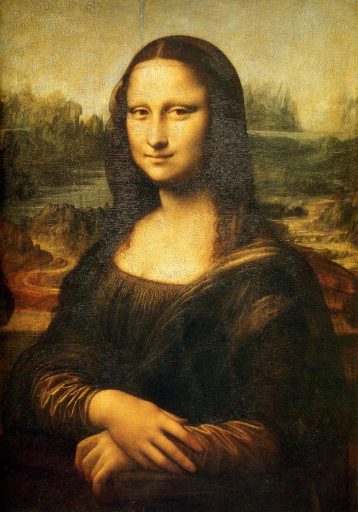
Title: Portrait of Lisa Gherardini, Wife of Francesco del Giocondo, commonly known as the Mona Lisa
Artist: Leonardo da Vinci
Date: approximately 1503–1519
Medium: oil on poplar panel
Location: Musée du Louvre, Paris (Musée du Louvre; Delieuvin; Kemp).
Leonardo began the portrait during the Italian Renaissance, a period in which artists were investigating anatomy, optics, geometry, perspective, landscape, and the expressive potential of oil paint. The sitter is generally identified as Lisa Gherardini, wife of the Florentine merchant Francesco del Giocondo. Her three-quarter pose differs from the strict profile format often used in earlier portraiture. The body turns slightly while the face addresses the viewer, and the folded hands contribute to a sense of composure rather than serving as a symbol of masculinity or dominance. A low parapet separates the figure from the distant landscape, while the chair and armrest organize the foreground and create a stable visual base.
Leonardo’s use of sfumato is one of the painting’s defining features. Thin layers of oil create gradual transitions rather than hard outlines, especially around the eyes, mouth, cheeks, and jaw. The face therefore seems to change subtly according to viewing distance and attention. The celebrated smile does not literally appear and disappear, but perception of broad tonal information differs from perception of fine detail, which helps explain why the expression can feel unstable. I admire this ambiguity because the painting never reduces the sitter to a single emotion. She can appear calm, amused, distant, observant, or reserved without the work forcing one interpretation.
The landscape strengthens this ambiguity. Roads, water, rocks, bridges, and distant mountains create atmospheric depth, but the setting is not simply a record of one identifiable place. It feels geologically ancient and slightly unreal, connecting the stillness of the sitter with a world shaped by water, erosion, and time. Leonardo uses atmospheric perspective to make distant forms less distinct, and the horizon shifts subtly from one side of the figure to the other. Rather than functioning as a decorative background, the landscape expands the portrait into a meditation on human presence within a larger natural order.
Why I Admire the Mona Lisa
My admiration comes from the balance between technical control and unresolved meaning. The painting is carefully constructed, but it does not feel rigid. The pose is quiet, yet the viewer remains alert to small changes in expression and gaze. The face is realistic without being photographically explicit, and the landscape is detailed without competing with the sitter. Leonardo shows that realism can involve perception and psychology as much as exact description. The painting’s fame can sometimes make it difficult to see because reproductions have turned it into a cultural symbol, but close looking restores its complexity as an intimate portrait.
I also admire the way the sitter retains a degree of privacy. The viewer can study her for a long time without fully possessing her identity or emotional state. Renaissance portraiture often communicated status, family, wealth, or social role through clothing and accessories, yet Leonardo reduces obvious display and directs attention toward expression, posture, and presence. Comparisons with images of the Virgin Mary may be useful because Leonardo drew on compositional traditions familiar from religious painting, but the work should not be confused with a sacred Madonna image. Its power comes partly from giving a secular portrait extraordinary dignity without dissolving Lisa Gherardini into a generic symbol.
The object’s material history also contributes to my response. The poplar panel has required stabilization, varnishes have aged, and the surface bears cracks and changes accumulated over centuries. Protective glass, climate control, conservation, and crowded museum viewing conditions now shape the experience. Authenticity cannot be determined simply by looking at a famous image; scholars rely on provenance, technical imaging, materials analysis, documentation, and comparison. The painting’s physical vulnerability contrasts with its extraordinary cultural durability, which makes the act of preservation part of its modern significance.
The Kiss: Context, Pattern, and Ambiguity
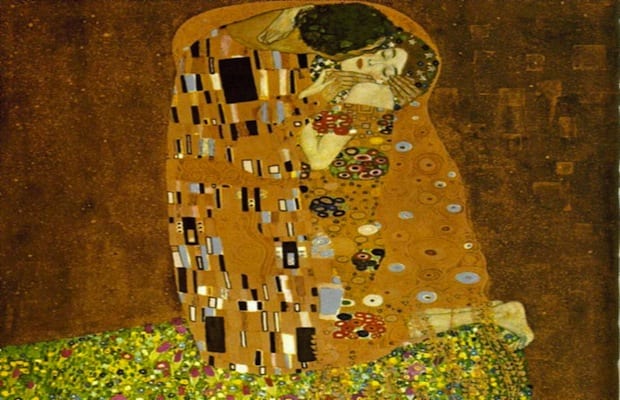
Title: The Kiss (Lovers)
Artist: Gustav Klimt
Date: 1908–1909
Medium: oil and gold leaf on canvas
Location: Österreichische Galerie Belvedere, Vienna (Österreichische Galerie Belvedere; Natter).
The Kiss belongs to Klimt’s Golden Period and to the artistic culture of Vienna around 1900. Klimt was associated with the Vienna Secession, whose artists challenged academic conventions and blurred boundaries between painting, design, architecture, and decorative art. His use of gold was influenced in part by Byzantine mosaics and by his interest in luminous, ornamental surfaces. The nearly square composition reduces conventional spatial depth and surrounds the figures with a field of gold, allowing the lovers to appear almost detached from ordinary place and time.
The man’s garment contains strong rectangular forms, while the woman’s clothing uses circular and floral motifs. These contrasting patterns are often interpreted as gendered, although such symbolism should not be treated as fixed fact. Their bodies nearly disappear into shared ornament, making the embrace visually unified while preserving difference through pattern. I find this density both impressive and overwhelming. The gold surface creates an iconic quality, but it also distances me emotionally from the human figures. Leonardo’s portrait leaves air, landscape, and quiet spatial depth around the sitter, while Klimt’s lovers seem almost sealed inside decoration.
The emotional meaning of the embrace is also ambiguous. The woman’s closed eyes, tilted head, bent arm, and hand around the man’s neck can suggest tenderness, surrender, uncertainty, or discomfort. His face is largely hidden as he bends toward her. It would be too confident to claim that the work clearly depicts unwillingness, but it is reasonable for contemporary viewers to notice the asymmetry of posture and ask how intimacy, power, and consent are represented. My discomfort comes from that ambiguity and from the enclosing composition rather than from certainty about one narrative.
Comparing the Two Works and Revising My Judgment
The Mona Lisa and The Kiss create intimacy through almost opposite visual strategies. Leonardo uses soft modeling, atmospheric depth, a restrained pose, and an individual gaze. Klimt uses flattened gold, repeated pattern, physical closeness, and the near-merging of two bodies into one decorative field. In Leonardo’s portrait, identity remains separate from the surrounding world; in Klimt’s painting, individuality is partly absorbed into ornament and embrace. My preference for the Mona Lisa therefore has less to do with the subject matter than with how each artist organizes access to the figures. Leonardo’s restraint gives me room to observe without feeling that the emotional meaning has been declared, while Klimt’s saturation of surface feels more insistent.
At the same time, my criticism of The Kiss becomes stronger when I avoid trying to “correct” it. I would not improve the painting by making the woman’s response more obviously passionate or by reducing the ambiguity of the embrace. That ambiguity is part of what allows the work to remain open to interpretation. Gold leaf traditionally carries associations with religious icons, wealth, radiance, and transcendence, and Klimt transfers that visual language to erotic intimacy. The lovers appear almost sacred, yet the same transformation can feel excessive or possessive. The features that limit my personal enjoyment are also the features that make the painting intellectually interesting.
This comparison has changed the way I understand personal taste. A work can be successful without giving me pleasure, and a famous work can deserve close examination without demanding automatic admiration. Critical judgment becomes more useful when it explains form, history, and response rather than simply announcing preference. I still admire Leonardo’s subtlety more than Klimt’s ornamental intensity, but I can recognize why The Kiss has become one of the most recognizable images of modern European art.
Conclusion
I admire Leonardo da Vinci’s Mona Lisa for its oil technique, balanced composition, atmospheric landscape, perceptual subtlety, and respect for the sitter’s unresolved identity. I find Gustav Klimt’s The Kiss less personally appealing because its dense gold pattern and enclosing embrace create emotional distance and a sense of visual pressure. Accurate historical context strengthens this judgment: the Mona Lisa is an oil portrait on poplar from the Italian Renaissance, while The Kiss is a Viennese modernist work of 1908–1909 created with oil and gold leaf. My preference remains subjective, but it is grounded in how each work organizes space, surface, identity, and intimacy. Art criticism becomes most meaningful when admiration and discomfort encourage closer looking rather than quick dismissal.
References
- Musée du Louvre. “Portrait of Lisa Gherardini, Wife of Francesco del Giocondo, Known as the Mona Lisa.”
- Delieuvin, Vincent. Leonardo da Vinci. Musée du Louvre, 2019.
- Österreichische Galerie Belvedere. “Gustav Klimt, The Kiss (Lovers).”
- Natter, Tobias G., editor. Gustav Klimt: The Complete Paintings. Taschen, 2017.
- Kemp, Martin. Leonardo da Vinci: The Marvellous Works of Nature and Man. Oxford University Press, 2006.

Academic Master Education Team is a group of academic editors and subject specialists responsible for producing structured, research-backed essays across multiple disciplines. Each article is developed following Academic Master’s Editorial Policy and supported by credible academic references. The team ensures clarity, citation accuracy, and adherence to ethical academic writing standards
Content reviewed under Academic Master Editorial Policy.





