
Introduction to Human Resource Outsourcing
HR stands out as one of the most basic resources of an association. The degree to which an association can understand its objectives depends, to a great extent, on its capacity to draw in, create, keep up, and retain the correct quality and quantity of human resource (HR) capital. The HR role must make sure that the required quality and number of employees are accessible when and where they are required in the company. The general objective is basically to empower the association to accomplish its targets by taking inventiveness into account and giving direction and support on all issues regarding the workforce.
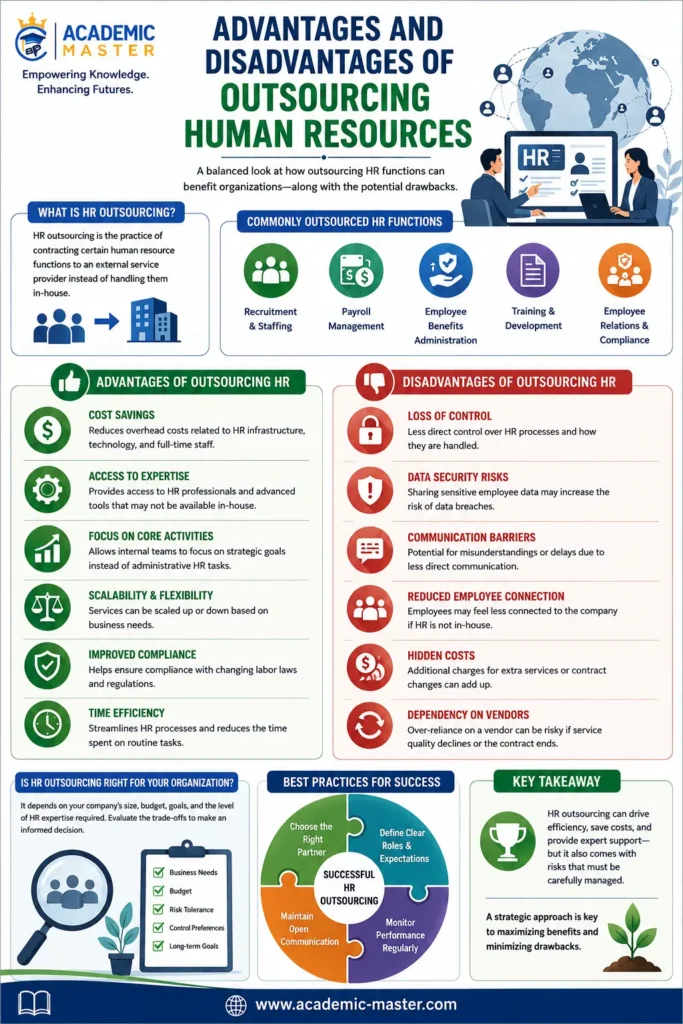
Growth of Strategic Outsourcing
Requests for expanded efficiency, gainfulness, and development have urged organizations to analyze their internal HR procedures, bringing about a move toward strategic outsourcing activities. Outsourcing has become a common practice in Human Resource Management. A Chartered Institute of Personnel and Development (CIPD) Survey Report on the present state of Human Resource Outsourcing (HRO) among individuals and their associations shows that most associations are expanding their utilization of HRO (Chartered Institute of Personnel and Development [CIPD], 2025). As indicated by the report, nearly every part of the HR function (human resource planning, evaluation procedure, worker relations, data frameworks, outplacement, compensation and benefits, employee support, recruitment and selection, training, pensions, payroll, and legal services) is currently being outsourced or considered for outsourcing.
Definition of Outsourcing
Linder characterizes outsourcing as the acquisition of ongoing services from an external organization that an organization currently provides or that most organizations typically provide themselves. It has similarly been considered as the delegation of at least one business process to an external provider, which then owns, manages, and directs the specified processes based on defined and measurable performance metrics.
Drivers of HR Outsourcing
Various pressures and drivers are urging firms to consider outsourcing (Munjal et al., 2023). One reason is that there are essential business matters on which to focus resources. Research by Personnel Today demonstrated that HR staff spend up to 85% of their time managing routine administrative procedures and only 15% on strategic activities. In best-practice organizations, these rates would normally be turned around. By outsourcing these non-core business activities, HR functions can concentrate management effort on delivering strategic and high-impact policy matters, for example, winning the war for talent, which is genuinely important to accomplishing business objectives. Subsequently, the time and effort required to manage routine administrative and information-management work can be reduced, and core resources can be reassigned to more valuable work. Another reason is the need to diminish the cost of HR work and, furthermore, the need to increase service efficiency (Deloitte, 2023).
Classification of Human Resource Activities
Human resource activities are divided into seven ranked classes, devised in ascending order of the significance of the events to the methodology, effectiveness, and attainment of the association’s goal, as follows: (1) subsidiary undertakings, (2) repetitive exercises, (3) activities with the potential to achieve economies of scale, (4) activities requiring specialized knowledge, (5) activities requiring extensive organizational knowledge, (6) activities requiring high confidentiality, and (7) activities requiring specialized management decisions. Number 1, The Chain of Command of HR Subcontracting, provides a visual representation of the seven stages of the HR department organized in ascending order of significance. The chain of command proposes that the lower the level of HR activity, the greater the likelihood of outsourcing it; the more complex the level of activity, the less likely it is to be outsourced. Examples of specific HR activities are given in relation to their respective stages in the hierarchy.
Organizational Factors Behind Outsourcing
A few components are driving HR outsourcing in present-day organizations. To stay focused, organizations must deliver quality products and services. This implies that associations must have the right people doing the right things reliably at the right time. These sorts of individuals, wherever they might be found, become essential assets for organizational productivity and survival. Another antecedent to the effective usage of HR outsourcing is a careful understanding of the advantages and disadvantages of outsourcing.
Advantages of Human Resource Outsourcing
To accurately weigh the benefits against the drawbacks of outsourcing, both factors must be fully considered. Among the advantages to be derived from outsourcing are as follows:
As indicated by a CIPD subcontracting summary, the three main reasons cited for HR outsourcing are access to skills and knowledge (71%), excellence (64%), and cost reduction (61%).
Risks and Implementation Challenges
The outcome of an outsourcing initiative can significantly benefit the organization or can be damaging, depending on how well it is planned and executed. To accurately weigh the benefits against the drawbacks of outsourcing, both factors must be carefully considered.
| Advantages | Disadvantages |
| Access to specialists and propelled innovation; Time encumbrance; Decreased costs; Strategic concentration; Elasticity; Progressive excellence; Shift the burden of danger and vulnerability |
|
| Table 1: Advantages and Disadvantages of Outsourcing | |
Outsourcing isn’t a solution. While a few potential advantages of outsourcing may tempt any association forerunner to use the technique, it is vital to recognize that outsourcing is not necessarily a solution to organizational problems. There are certain HR activities that, depending on the organization, should generally never be outsourced. Activities related to strategic decision-making, those requiring specialized management knowledge, and those requiring confidentiality should rarely be outsourced.
Organizational and Cultural Limitations
The study found that organizations did not engage in HR outsourcing because they considered it unsuitable for their business operations. The beliefs, values, and standards practiced by the organizations made them exceptionally difficult for external suppliers to understand. Also, some organizations find that the cost of engaging in HR outsourcing is greater than the cost of performing the work internally. Apart from this, organizations are also concerned about data confidentiality. They are concerned that their data may be accessed or misused by external contractors. Challenging issues may happen if a clear determination of what should and should not be outsourced is not made.
Conclusion
The changing business environment poses new challenges for HR management in companies. To enable associations to choose whether HR outsourcing might be an appropriate option, they should know about these potential disadvantages and the potential advantages that an HR outsourcing arrangement may offer. Human resource outsourcing is a potentially useful approach for handling numerous activities; however, it is not a universal solution to organizational HR issues. Effective outsourcing requires knowing what can and cannot be outsourced. HR outsourcing is a system that enables the HR function to respond to the challenges posed by the present business environment by allowing it to focus on core strategic issues that guarantee that the association can achieve a competitive advantage through the people it employs and practices that make it a value-driven strategic ‘business accomplice.’ (Brown et al., 2023)
References
Brown, D., Thompson, W., & Smith, K. (2023). Human resources business process outsourcing: Key competencies and considerations. Deloitte. https://www.deloitte.com/us/en/services/consulting/blogs/human-capital/hr-business-process-outsourcing-competencies.html
Chartered Institute of Personnel and Development. (2025, December 5). HR outsourcing. https://www.cipd.org/en/knowledge/factsheets/outsourcing-factsheet/
Deloitte. (2023, September 21). Cost optimisation strategies. https://www.deloitte.com/uk/en/services/tax/research/cost-optimisation-strategies.html
Munjal, S., Requejo, I., & Kundu, S. K. (2023). What we know about the trends, prospects, and challenges of human resource outsourcing: A systematic literature review. Heliyon, 9(8), e19018. https://doi.org/10.1016/j.heliyon.2023.e19018
Cite This Work
To export a reference to this article please select a referencing stye below:

Academic Master Education Team is a group of academic editors and subject specialists responsible for producing structured, research-backed essays across multiple disciplines. Each article is developed following Academic Master’s Editorial Policy and supported by credible academic references. The team ensures clarity, citation accuracy, and adherence to ethical academic writing standards
Content reviewed under Academic Master Editorial Policy.



