
Intellectual Property Licensing and Transactions
Water Systems TechnologyTextbook
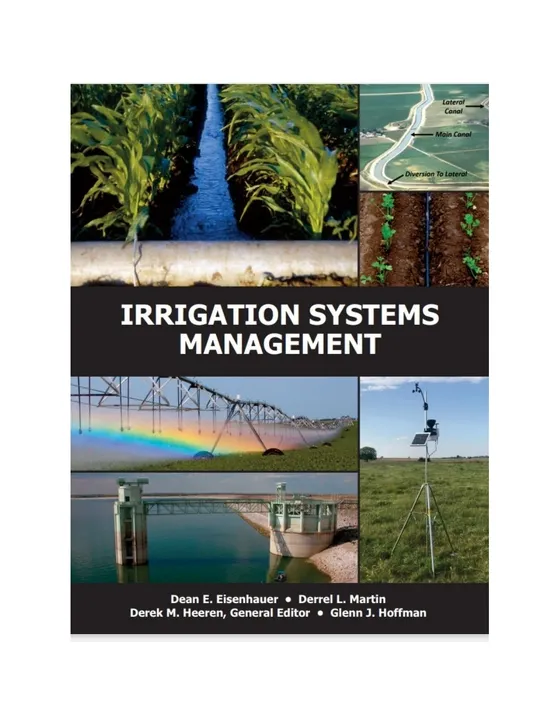
Irrigation Systems Management (AET 021)
Not rated yetRate this bookConnect soil water, crop demand and system performance across fifteen irrigation chapters. Original tasks compare measurements, scheduling concepts and system types without prescribing site-specific designs or chemical procedures.
Read on the publisher’s website. Opens in a new tab.
 Free
About this book
Irrigation Systems Management (AET 021), associated with Dean E. Eisenhauer, Derrel L. Martin, Derek M. Heeren and Glenn J. Hoffman, connects crop-water needs with system performance and management. Fifteen chapters move from irrigation purposes and soil-water relationships to measurement, plant use, scheduling, salinity, hydraulics and supply. Later chapters compare surface, sprinkler, moving and microirrigation systems before chemigation.
The structure makes clear that choosing an irrigation action depends on several linked questions: what the crop uses, what the soil stores, what can be supplied and how evenly a system applies it. This guide adds original tasks involving conceptual balances, comparisons and data requirements. It does not provide a site-specific design, equipment setting or chemical-injection procedure. Overviews reflect selected chapter introductions and contents, not every calculation, table or performance standard. Numerical examples, water-rights discussions and regulatory references remain in their source setting. Use the complete text for technical detail and current local professional information for practical design or legal decisions.
AI-assisted book summary
Reading guide
Build soil-water and measurement concepts before crop use and performance. Connect these with scheduling, salinity, hydraulics and supply. Compare system types against the same stated objectives and constraints.
Chapter-by-chapter guide
1: Introduction to Irrigation
The introduction links irrigation with water availability, timing and crop-production questions. Benefits depend on context rather than the mere presence of equipment. Define the objective before comparing approaches.
Study task: State a fictional irrigation objective and identify the constraints relevant to it.
2: Soil Water
Soil water is framed as a root-zone reservoir. Storage, entry and plant access require distinct concepts. A measurement needs its depth and location context.
Study task: Draw a conceptual root-zone water balance with stores and flows separated.
3: Measuring Water Applications
Water measurement connects flow rate, volume and equivalent depth. These quantities answer different questions and use different units. Accurate bookkeeping precedes an interpretation of application.
Study task: Compare flow, volume and depth using labeled quantities without selecting an operating duration.
4: Plant Water Use
Plant water use is introduced through evapotranspiration and seasonal change. Crop stage and conditions affect the question. A source example is not a universal water requirement.
Study task: Map the information needed to compare two fictional crop-water contexts.
5: Irrigation System Performance
Performance learning compares objectives, constraints and system characteristics. Efficiency, uniformity and adequacy are different properties. One favorable measure does not establish overall suitability.
Study task: Compare two fictional systems using separate performance questions.
6: Irrigation Scheduling
Scheduling connects crop use with rainfall, stored water and irrigation. The task is a balance over time, not just a fixed calendar. Site measurements and assumptions need to remain explicit.
Study task: Build a non-numerical scheduling concept map showing the information inputs.
7: Salinity Management
Salinity learning connects water, soil, crop and environmental questions. A measurement and a diagnosis of its significance are different. No reclamation treatment is derived from this overview.
Study task: List evidence needed to interpret a fictional salinity observation.
8: Pump and Pipeline Hydraulics
Hydraulics relates moving water to energy, pressure and distribution. Component interactions matter to performance. The guide does not size pumps or specify installation settings.
Study task: Map the relationship between pressure, flow and losses at a conceptual level.
9: Water Supply Systems
Supply systems raise questions about source, quantity, quality and rights. These are distinct constraints. Source legal descriptions require a current local check before practical reliance.
Study task: Organize a fictional supply inquiry into physical, quality and legal information needs.
10: Surface Irrigation
Surface irrigation connects water advance, infiltration and field conditions. A method label does not establish performance on a particular site. Compare the conditions needed for an interpretation.
Study task: Identify site information needed to compare two fictional surface-system settings.
11: Sprinklers
Sprinkler learning links application with pressure, distribution and management questions. The source develops technical details beyond this guide. No nozzle, pressure or runtime is recommended here.
Study task: Separate a coverage question from a total-volume question in a fictional system.
12: Moved-Lateral, Gun, and Traveler Sprinkler Systems
Moved-lateral and traveler systems combine equipment characteristics with operational and resource constraints. A general capability and performance in a particular layout are different claims.
Study task: Compare system types by information needs rather than choosing equipment.
13: Center Pivots and Lateral Moves
Center pivots and lateral moves require attention to their particular movement and application patterns. The source discusses management alongside system design. Historical adoption figures are not current estimates.
Study task: Draw a conceptual movement pattern and identify a resulting distribution question.
14: Microirrigation
Microirrigation connects localized application with components, uniformity and clogging-related concerns. A small flow rate does not automatically establish good performance. Define the intended outcome and evidence.
Study task: Map components and performance questions without maintenance or chemical instructions.
15: Chemigation
Chemigation introduces chemical application through irrigation and emphasizes protection of the water supply. Regulation, materials and devices require current professional guidance. This guide supplies no injection rates or procedures.
Study task: Identify the categories of professional and regulatory information a chemigation question would require.
How to study this book
For a fictional system, identify the objective, water stores, flows, measurements and uncertainties. Keep depth, volume and flow rate distinct. Use source equations for coursework and leave practical settings and chemical handling to approved professional procedures.
Reflection questions
- Which quantities need measurement rather than assumption?
- What makes application uniformity different from total volume?
- How do site constraints alter a comparison?
Sources and coverage
Source: Irrigation Systems Management (AET 021) — LibreTexts.
Original reader guide based on the verified contents and selected substantive chapter or section openings, introductions and learning objectives in the linked source PDF. It is not a full review of every subsection, exercise, figure, procedure, story or linked media item. Study tasks are original additions, not exercises or solutions attributed to the source.
Selected chapter introductions and contents were reviewed. No field measurements, system design, equipment calibration or chemical procedures were performed. Water-rights and regulatory examples are source-context material, not current advice.
About access & copyright
This page provides book information and study material. Full-text access is provided by the original publisher or authorised source; a listing does not grant permission to republish the book.
Read our Library Access & Copyright policyBalance
Soil storage, crop use and supply are connected.
Performance
Several measures describe different system properties.
Context
Designs and operating decisions require site-specific information.
Reader ratings & reviews
Share your thoughts
Your review helps other students choose the right resources.
KEEP LEARNING
Your next great read
frand
Recent Improvements of Power Plants Management and Technology
Recent Improvements of Power Plants Management and Technology
View Recent Improvements of Power Plants Management and Technology — book Corrections
Criminal Law
View Criminal Law — book Manufacturing
 Processes 4-5
View Manufacturing Processes 4-5 — book Corrections
Criminal Investigations
View Criminal Investigations — book Languages
Reading for Academic Success - An OER Textbook for Reading 7
View Reading for Academic Success - An OER Textbook for Reading 7 — book Philosophy
Arguments in Context - An Introduction to Critical Thinking
View Arguments in Context - An Introduction to Critical Thinking — book History
Western Civilization I
View Western Civilization I — book Literature and Literacy
Off the Shelf: A Digital Anthology of Classic and Contemporary Short Stories
View Off the Shelf: A Digital Anthology of Classic and Contemporary Short Stories — book History



