
 Philosophy
EthicsTextbook
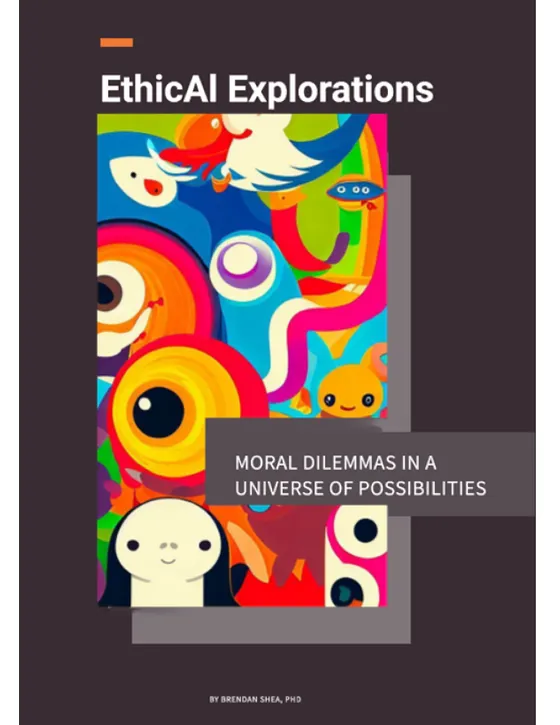
Ethical Explorations: Moral Dilemmas in a Universe of Possibilities
Not rated yetRate this bookCompare twelve approaches and topics in ethics through imaginative cases, philosophical principles and original argument tasks. Follow each story into its reasons, assumptions and possible objections.
Read on the publisher’s website. Opens in a new tab.
 Free
About this book
Brendan Shea’s Ethical Explorations: Moral Dilemmas in a Universe of Possibilities introduces moral philosophy through imaginative stories and explanatory discussions. Twelve chapters move from Plato’s cave to utilitarianism, duty, virtue, natural law and social contract theory. The second half examines Marx, Nietzsche, Simone de Beauvoir, race and racism, environmental ethics and bioethics.
The narrative format gives readers a situation to question before turning to the chapter’s philosophical ideas. A memorable story is useful for comparison, but it is not itself evidence that a theory is correct. This guide adds original argument-mapping and perspective-comparison tasks that separate a principle, a reason and an objection. Chapter overviews reflect reviewed introductory discussions and the verified contents rather than an assessment of every argument or fictional episode. The applied chapters remain exercises in ethical reasoning; they do not resolve a personal medical, legal or political decision on the reader’s behalf.
AI-assisted book summary
Reading guide
Read each narrative alongside its explanatory discussion. State the ethical question before selecting a principle. Revisit earlier theories when later chapters raise issues of identity, institutions, environment or health.
Chapter and section guide
1: Introducing Ethics—Out of Plato’s Cave
Plato’s cave introduces questions about appearance, understanding and moral inquiry. Variations of the story invite readers to examine their assumptions. Distinguish what a narrative helps illustrate from what an argument still needs to establish.
Study task: Identify a belief challenged by a fictional scenario and state the reason for reconsidering it.
2: Balancing the Scales—The Calculus of Utilitarian Ethics
Utilitarian learning evaluates actions through consequences and well-being. The story gives a setting for comparing benefits and harms. A judgment still requires assumptions about whose interests count and how uncertain outcomes are assessed.
Study task: Compare two fictional choices while making the relevant interests and uncertainties explicit.
3: Duty Calls—Exploring Deontological Ethics
Deontological ethics emphasizes duties, rights and features of action beyond outcomes alone. A golem story introduces rule-guided reasoning. The study challenge is to explain why a duty applies and how a conflict between duties might be understood.
Study task: State a fictional duty-based argument and formulate one objection about its scope.
4: Virtue Ethics—The Role of Character in Moral Philosophy
Virtue ethics centers character and flourishing. The narrative explores a world in which virtues can be imprinted, prompting questions about development and moral agency. Possessing a label for a trait differs from showing its thoughtful exercise.
Study task: Compare a repeated habit with a reasoned expression of a virtue in a fictional case.
5: Universal Order—Unveiling Natural Law Theory
Natural law is introduced through Aquinas and a speculative spacecraft narrative. The chapter connects human purposes with moral reasoning and includes double-effect questions. A claimed purpose needs explanation before it can support a normative conclusion.
Study task: Map an argument from a proposed human good to a moral claim and identify its contested step.
6: Bound by Agreement—The Principles of Social Contract Theory
Social contract theory asks which rules people could justifiably agree to. A fictional experiment introduces fairness before historical and contemporary positions. Actual agreement, hypothetical agreement and justified authority should not be treated as identical.
Study task: Compare a rule chosen with knowledge of one’s position and a rule chosen without that knowledge.
7: Marxism—The Class Struggle and Its Ethical Implications
The Marx chapter connects class, exploitation and historical change, while introducing a contrasting market-oriented perspective. Its speculative narrative raises questions about commodification. Compare the assumptions behind rival explanations rather than substitute slogans for an argument.
Study task: Identify a shared social problem and two competing explanations of its cause.
8: Breaking the Moral Mold—Nietzsche on Value Creation and Perspectivism
Nietzsche’s value creation and perspectivism challenge inherited moral assumptions. A digital narrative opens the discussion. Questioning a convention is a beginning; the reader must still explain what grounds an alternative evaluation.
Study task: Select a fictional inherited norm and distinguish a critique of its origin from a critique of its justification.
9: The Ethics of Simone De Beauvoir—Feminism, Existentialism, and Ambiguity
Beauvoir’s ethics connects freedom, ambiguity, identity and relations with others. A teenage-werewolf story offers a way into those questions. Read the narrative alongside the concepts rather than treating the character’s experience as a universal account.
Study task: Explain how a fictional choice can involve personal agency and dependence on others.
10: Du Bois, King, and Appiah on Race and Racism
Du Bois, King and Appiah frame inquiry into race, justice and responsibility. The chapter begins with literary interpretation before philosophical comparison. Historical context and the distinction between a category and its social effects are important to the analysis.
Study task: Compare two arguments about justice by their premises, intended audience and evidence needs.
11: Environmental Ethics
Environmental ethics examines the grounds of responsibility toward the natural world. The story supports comparison among ways of valuing human and nonhuman life. An empirical environmental claim and a moral claim require different kinds of support.
Study task: Separate a factual premise from a value premise in a fictional environmental argument.
12: Bioethics
Bioethics introduces principles such as autonomy, benefit, harm and justice through a fictional physician narrative. Principles can illuminate tensions without mechanically resolving them. The guide supports classroom analysis rather than treatment decisions or judgments about a real patient.
Study task: Map a fictional ethical disagreement by the principles in tension and the missing information.
How to study this book
Use a four-part note: claim, reason, assumption and objection. Apply two theories to the same fictional case, then explain precisely where their reasoning diverges. Distinguish understanding a view from endorsing it.
Reflection questions
- What makes the conclusion follow from the principle?
- Which assumption could an opponent question?
- Does the fictional case clarify the theory or conceal a difficulty?
Sources and coverage
Original source. This original study guide is based on the linked book’s verified contents and the selected source sections described below. It does not replace the full book.
The source contents print “De Bois” in chapter 10; the guide uses the thinker’s name, Du Bois, as explained in the chapter introduction. Introductory discussions were reviewed, not every argument, reference or audiovisual supplement.
About access & copyright
This page provides book information and study material. Full-text access is provided by the original publisher or authorised source; a listing does not grant permission to republish the book.
Read our Library Access & Copyright policyArguments
Moral conclusions need reasons and assumptions.
Comparison
Theories can identify different features as morally relevant.
Stories
A narrative is a tool for inquiry rather than a proof.
Reader ratings & reviews
Share your thoughts
Your review helps other students choose the right resources.
KEEP LEARNING
Your next great read
Philosophy Humanities
Introduction to Humanities
View Introduction to Humanities — book Chinese
Learning Chinese: A Foundation Course in Mandarin
View Learning Chinese: A Foundation Course in Mandarin — book Cognitive Science
Transcribing Prosodic Structure of Spoken Utterances with ToBI
View Transcribing Prosodic Structure of Spoken Utterances with ToBI — book Humanities
How to Think Critically
View How to Think Critically — book General and Comparative Literary Studies and Linguistics
Beginning Japanese for Professionals, Book 2
View Beginning Japanese for Professionals, Book 2 — book General and Comparative Literary Studies and Linguistics
Beginning Japanese for Professionals, Book 1
View Beginning Japanese for Professionals, Book 1 — book History
 of Applied Science & Technology
View History of Applied Science & Technology — book General and Comparative Literary Studies and Linguistics
EmpoWORD: A Student-Centered Anthology and Handbook for College Writers
View EmpoWORD: A Student-Centered Anthology and Handbook for College Writers — book English



