
Abstract
COVID-19 lockdowns exposed many adults to social isolation, restricted activity and financial uncertainty. This literature review examines associations between indoor and outdoor greenery and adult mental health during that period. It brings together six primary studies identified through a literature-search and appraisal process, with findings organised around mental health, changes in green-space use and differences between population groups. The studies generally suggest that access to greenery could support well-being, although patterns of use and associations with distress differed across settings. Most of the evidence is observational, so it does not establish that green-space exposure caused improvements in mental health. The review highlights the importance of accessible outdoor spaces and opportunities to experience nature at home, alongside the need for stronger longitudinal evidence and attention to inequalities in access.
Introduction
Defining Green Spaces
Green spaces include vegetated environments such as parks, gardens, woodlands and recreational grounds. Their definition varies across health, landscape and planning disciplines; water environments are often discussed separately as blue spaces (Taylor and Hochuli, 2017). Nature exposure has been investigated in relation to stress, mood and well-being, but the strength and meaning of the evidence depend on the population and the type of exposure measured (Trøstrup et al., 2019). During lockdown, greenery could be encountered outdoors, through access to a garden, or indoors through plants and views of vegetation. Distinguishing these experiences is important because access, activity and social contact may contribute differently to mental health.
The emergence of COVID-19 in late 2019 and the restrictions introduced in 2020 created stressful circumstances across many countries. Lockdowns, physical distancing and changes to employment and daily routines were accompanied by concerns about psychological well-being (Lanza-León et al., 2023). Opportunities to visit parks or spend time in gardens differed according to local restrictions, housing and neighbourhood conditions. Contact with nature therefore became a potential coping resource, although access was unequally distributed. Pouso et al. (2021) examined contact with blue-green spaces during lockdown, while earlier research on park visitation and equitable access provides background to these inequalities (Hamstead et al., 2018). The latter predates COVID-19 and should not be treated as evidence about pandemic lockdown outcomes.
Mental Health
Mental health concerns emotional, psychological and social well-being, including how people cope with stress, maintain relationships and participate in everyday life. The World Health Organization (2022) describes mental disorders and their substantial effects on functioning and quality of life. Mental well-being is broader than the absence of a diagnosed disorder. Accordingly, this review distinguishes self-reported distress, depressive or anxiety symptoms, and general well-being. These outcomes are related but are not interchangeable, and questionnaire results should not automatically be interpreted as clinical diagnoses.
The COVID-19 Pandemic
Countries responded to COVID-19 with combinations of travel restrictions, workplace and school closures, distancing requirements and limits on gatherings. These measures changed everyday activities and access to social support. Holmes et al. (2020) identified mental health as a research priority, while Gunnell et al. (2020) discussed the need to address risks among vulnerable groups. Racine et al. (2021) reviewed symptoms among children and adolescents; that work provides wider pandemic context but does not directly answer this review’s question about adults. The present review focuses on adult experiences and the possible role of green-space access during restrictions.
Mental Health During the Pandemic
Lockdowns were intended to reduce infection transmission, but prolonged isolation and disruption could also be associated with psychological distress. Fiorillo et al. (2020), for example, examined mental health symptoms in Italy during the pandemic. Such research underlines the importance of considering social and economic circumstances alongside exposure to greenery. People experiencing financial insecurity, limited living space or pre-existing difficulties may have had different opportunities to use parks and gardens. These differences also complicate interpretation: an association between green-space access and mental health may partly reflect other advantages rather than the independent effect of greenery.
Mental disorders represent a substantial global burden, with consequences for individuals, families and economies (Arias et al., 2022). Population estimates provide background to the importance of mental health but do not demonstrate the effectiveness of a particular intervention (Ritchie et al., 2018). Nature-based opportunities may complement wider support for well-being, as discussed by Bratman et al. (2019). They should not be presented as a proven replacement for psychological care or medication. A focused review is therefore needed to examine what the pandemic-era studies actually measured, how their findings differed, and which limitations affect the conclusions that can be drawn.
Research Questions
What were the effects of green spaces on the mental health of adults during the Covid-19 pandemic?
Aims and Objectives
Aims
To identify any positive effects that accessing green spaces had on the mental health of adults during the COVID-19 pandemic.
To identify any challenges that accessing green spaces posed for the mental health of adults during the COVID-19 pandemic.
Objectives
To synthesise the evidence regarding the positive effects that accessing green spaces had on the mental health of adults during the Covid 19 pandemic.
To synthesise the evidence regarding any challenges that accessing green spaces posed for the mental health of adults during the COVID-19 pandemic.
To identify any factors that may have affected the mental health effects of adults accessing green spaces during the COVID-19 pandemic.
Methodology And Methods
Study Design
This study uses a literature-review design to identify, assess and synthesise existing evidence about adult mental health and green-space exposure during COVID-19 restrictions. Linking the research question to existing knowledge helps clarify where studies agree and where uncertainty remains (Snyder, 2019). The review does not collect new participant data or test a clinical intervention. Instead, it examines the designs, measures, findings and limitations of selected primary studies. Earlier methodological literature is used to guide the review process, while the outcome studies concern experiences during the pandemic.
Search Strategy
A literature-search strategy should connect the research question to relevant terms, databases and eligibility criteria. Its coverage affects the completeness of the resulting review (Atkinson and Cipriani, 2018). The reported search focused on pandemic-era primary studies published between 2020 and 2023. Search terms covered adults, green spaces, COVID-19 restrictions and mental health. Different descriptions of nature exposure and psychological outcomes were considered because relevant studies do not always use identical terminology. Recommendations about duplicate screening or extraction are methodological safeguards; the manuscript does not provide enough information to establish that every review stage was conducted independently by two reviewers.
The review question was organised using the Population, Intervention or exposure, and Outcome framework (PIO). PubMed and Embase were identified as the main databases. Developing a search also involves selecting synonyms, combining them with Boolean operators, and documenting how records are screened (Atkinson and Cipriani, 2018; Gusenbauer and Haddaway, 2020). In this review, the exposure is access to or experience of greenery rather than a consistently administered intervention. That distinction matters when interpreting observational evidence. Search methods should be transparent enough for readers to assess their coverage without assuming that every potentially relevant study was retrieved.
PIO Framework
The PIO framework helps translate a broad topic into searchable concepts (Subject Librarians, 2017; Mezaoui et al., 2019). Here, the population is adults experiencing COVID-19 restrictions; the exposure is contact with indoor or outdoor greenery; and the outcomes include mental well-being, distress, and depressive or anxiety symptoms. A comparison group was not required for every study because the included evidence used different designs. Burnett et al. (2021) illustrate how pandemic restrictions and green-space experiences can be studied in adult populations. The framework guides selection without making studies with different exposures or outcome measures directly equivalent.
Boolean Operators
Boolean operators combine search concepts in a structured way. OR joins synonyms and broadens a search, AND combines separate concepts, and NOT excludes specified terms (Bramer et al., 2018). These operators can help retrieve studies relevant to green-space exposure and mental health during lockdown. They must nevertheless be adapted to each database. Excessively restrictive combinations can miss relevant records, particularly where a study addresses several age groups or uses a broad description of well-being. A clear search strategy therefore requires both relevant keywords and careful screening of the retrieved material.
For the environmental concept, terms such as “green spaces”, “parks” and “natural environments” can be combined with OR. For outcomes, “mental health” and “psychological well-being” capture related but distinct descriptions. The purpose of these combinations is to account for terminology differences across studies, rather than to treat every term as a precise synonym (Gusenbauer and Haddaway, 2020). Indoor plants, garden access and neighbourhood vegetation also need to be distinguished when the findings are synthesised, even if they are grouped more broadly during searching.
AND connects the main concepts, for example “green spaces” AND “mental health”, with terms for COVID-19 restrictions and adults. This narrows retrieval to records that address more than one component of the question (Bramer et al., 2018). The resulting records still require title, abstract and full-text screening because a search match does not establish eligibility. A paper might discuss mental health only as background or report outcomes for children rather than adults. The screening stage therefore determines whether the actual population, exposure and outcomes answer the review question.
NOT can remove unwanted terms, but it needs particular care. Excluding every record mentioning children, adolescents or financial effects could also remove studies with eligible adult data or relevant confounding variables. The manuscript describes exclusion examples involving these terms; such exclusions should not be interpreted as a complete reproducible search string. Clear eligibility decisions are preferable to assuming that automated term exclusion reliably separates relevant from irrelevant evidence (Bramer et al., 2018; Gusenbauer and Haddaway, 2020). Financial and social circumstances may remain important when interpreting adult mental health findings.
Electronic Database Searched
PubMed and Embase were selected because they cover biomedical and public health literature relevant to the review question. PubMed provides free access to MEDLINE records and additional life-science material; it is not simply a free version of the entire Embase database or every journal article. Searches were directed towards studies linking pandemic restrictions, environmental exposure and adult mental health. Abstracts helped identify potentially relevant records, but the interpretation of results also requires attention to the full study design, measures and limitations rather than abstract headings alone.
Database coverage and indexing differ, so using more than one source can improve retrieval (Atkinson and Cipriani, 2018). Google Scholar was also considered as a supplementary search source. The reported concepts included COVID-19, adults, mental health, lockdown and green spaces. Search terms should be adjusted for each platform’s search functions and indexing. The use of several sources does not eliminate the possibility of missed studies, language bias or incomplete reporting. These remain limitations when assessing how comprehensively the review represents the available evidence.
Database Search Outcomes
The manuscript reports an initial set of 2,452 deduplicated records, followed by 504 records after an earlier screening stage, and six studies in the final synthesis. Intermediate eligibility counts are inconsistent: the narrative gives 101, whereas the figure caption gives 72. The available records do not establish which intermediate count is correct. The review therefore retains the reported initial and final totals without treating the intermediate figures as a verified screening sequence. This reporting limitation affects reproducibility and should be distinguished from the substantive findings of the six identified studies.
Eligibility Criteria
Eligibility was restricted to primary research concerning adults aged 18 or over and the relationship between greenery and mental health during COVID-19 restrictions. Reviews and meta-analyses were excluded from the primary-study synthesis because the purpose was to examine original data, rather than because secondary research is inherently low quality. Qualitative, quantitative and mixed-methods studies were potentially eligible. Study quality was considered through appraisal of each design and its execution. Age, exposure and outcome criteria needed to be applied to the actual participant data rather than inferred from a paper’s title.
The review focused on pandemic-era studies available in English. Earlier literature could inform the background and methods but could not itself report experiences of COVID-19 lockdowns. Studies were assessed for their ability to distinguish the environmental exposure from other interventions or contextual factors. Comparisons could involve different environments, different levels of access, or changes in use over time. Because the included studies measured different forms of greenery, their results were synthesised narratively rather than treated as a single uniform effect. Restricting the search to English-language publications may have introduced language bias.
Critical Appraisal and Synthesis of Selected Articles
Critical appraisal examines the strengths and limitations of a study and the confidence that can be placed in its findings (Hong and Pluye, 2019). The manuscript reports using Critical Appraisal Skills Programme (CASP) tools, considering validity, findings and relevance (Long et al., 2020). Appraisal can identify bias; it cannot guarantee its absence. The synthesis considered how study design, sampling and measurement affected interpretation (Carroll and Booth, 2015; Porritt et al., 2014). Findings were organised into themes rather than statistically pooled. Equal attention to studies in a narrative discussion should not be mistaken for equal evidential strength, particularly where their designs and populations differ.
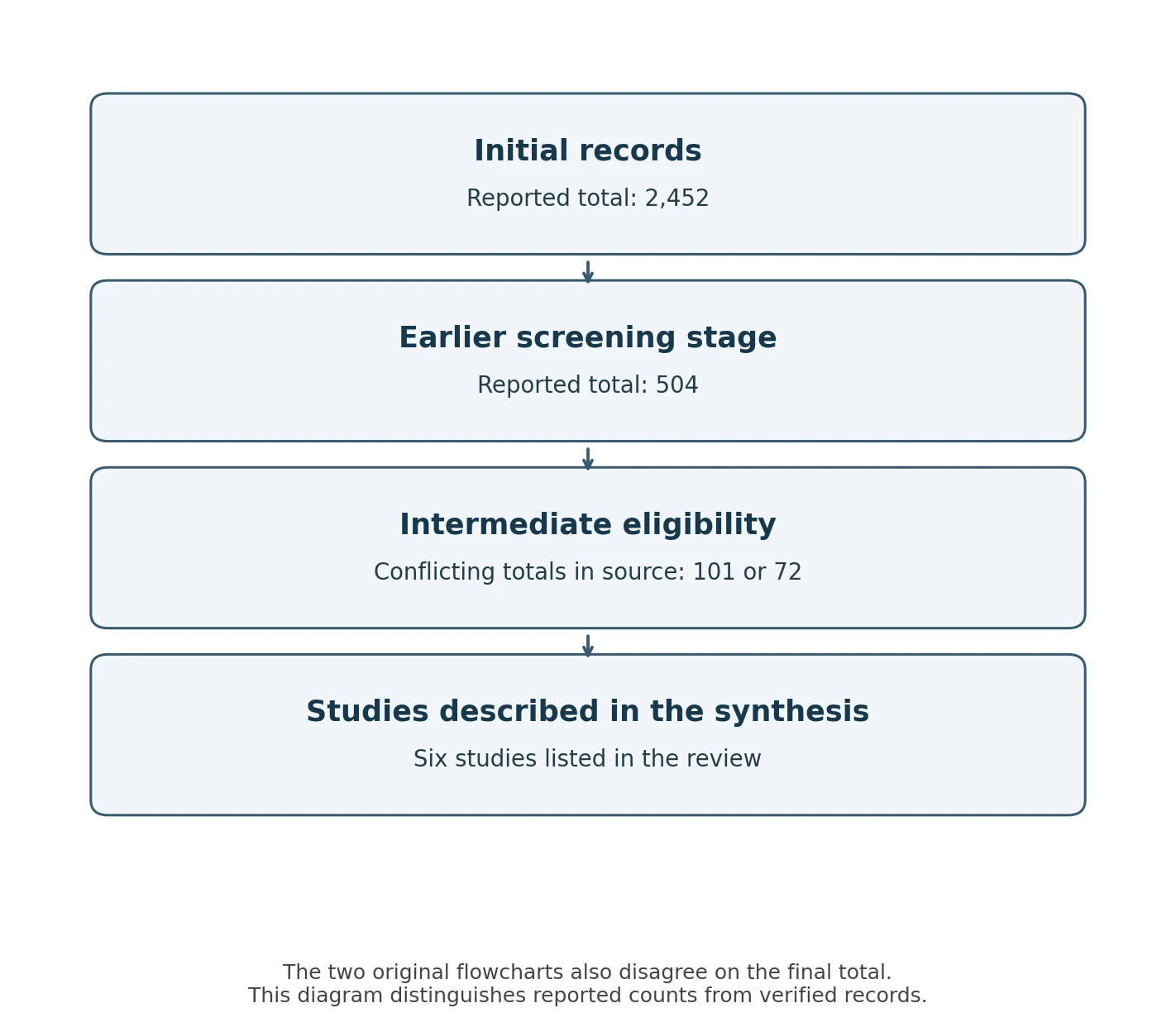
Figure 1. The reported selection process, with inconsistent totals identified. The source gives intermediate eligibility counts of 101 and 72, and its two screenshots show final totals of four and six. Six studies are listed in the synthesis. The underlying search records are unavailable, so a corrected intermediate count cannot be established.
Research Findings
The six studies in the synthesis used observational quantitative or mixed-methods approaches. Their settings included Italy, Australia, Scotland, the United States, South Korea and Bulgaria. They examined different forms of greenery and different mental health outcomes. Their findings therefore provide a range of perspectives rather than a single estimate applicable to all adults. Cross-sectional designs, self-report measures and differences in restrictions need to be considered when interpreting any association between environmental access and well-being.
Themes
Three themes organise the findings: mental health in relation to greenery, changes in green-space use, and differences in mental health associated with access or use. Indoor greenery, views of vegetation, gardens and visits to public spaces are distinguished where the studies permit. This structure brings related findings together while retaining differences in population and measurement. It also helps identify where an interpretation concerns perceived benefits, questionnaire symptoms or a broader discussion of potential mechanisms.
Greenery and Adult Mental Health
Dzhambov et al. (2021) examined greenery experienced at home and in the surrounding environment, whereas Hubbard et al. (2021) investigated rurality, deprivation, outside space and green-space visits. These exposures should not be conflated: Hubbard’s study was not specifically an experiment involving indoor plants. Both papers contribute to the discussion of environmental resources during restrictions, but neither establishes a universal benefit independent of individual circumstances. Their observational findings require attention to demographic, social and health differences between participants.
The evidence suggests that greenery could offer opportunities for restoration and everyday coping during periods spent at home. Dzhambov et al. (2021) measured self-reported greenery and mental health among 323 students. Its findings do not demonstrate that all adults with indoor plants experience fewer clinical disorders. Hubbard et al. (2021) likewise assessed associations rather than assigning people to a controlled environmental intervention. Together, the studies support investigating access to nature as a possible resource while leaving uncertainty about the direction and size of any causal effect.
Restoration and connection with nature provide possible explanations for the reported relationships. Such explanations should be separated from outcomes directly measured by a study. The included observational evidence does not by itself establish improvements in every aspect of cognition, problem-solving or work performance. Nor should self-reported well-being be converted into a claim about measured stress-hormone changes. A careful interpretation is that the studies identify associations consistent with a restorative role for greenery, while further research is needed to test the mechanisms involved (Dzhambov et al., 2021).
Changes in Green Space Use
Green-space use did not change uniformly across settings. Borgi et al. (2023) studied changes among Italian twins, while Berdejo-Espinola et al. (2021) surveyed residents of Brisbane. The latter found substantial movement in both directions: some people increased their visits, some reduced them, and some previous non-users began visiting. These findings do not support the claim that most participants simply remained satisfied with unchanged access. Local restrictions, the availability of gardens and people’s perceptions of risk help explain why patterns differed.
In the Brisbane survey of 1,002 people, about 36% increased their urban green-space use and 26% reduced it; 45% of previous non-users began using such spaces during restrictions (Berdejo-Espinola et al., 2021). Older respondents were less likely to increase use. This is an observed association, not a basis for assuming that older adults were passive or lacked interest in nature. Borgi et al. (2023) also identified demographic and risk-perception differences in changed use. The review should therefore consider age, housing, perceived infection risk and other contextual factors without attributing behaviour to unsupported stereotypes or assumptions about immunity.
Changes in Use and Mental Health
Borgi et al. (2023) linked changes in green-space use with mental health measures, including depressive, anxiety and stress symptoms. The study supports examining the consequences of reduced access, but its findings do not justify describing one group as uniformly energetic and another as uniformly distressed. Changes in use and psychological symptoms may influence one another, and both may be affected by restrictions or personal circumstances. The distinction between unchanged use, increased use and reduced use must therefore remain clear.
Heo et al. (2021) found that 64.9% of 322 surveyed adults in South Korea reported fewer green-space visits than before the outbreak. Reduced visits were associated with higher odds of probable major depression at the study’s less stringent significance threshold of p < 0.10, but not with a statistically significant increase in probable generalised anxiety disorder. The authors also considered reverse causation: people experiencing poorer mental health may have visited less. This result supports a cautious discussion of associations rather than a claim that green-space visits necessarily prevent depression or reduce measured cortisol levels.
Summary of Included Studies
| Study | Population and design | Contribution to this review | Strengths and limitations |
|---|---|---|---|
| Borgi et al. (2023) | Italian twin cohort; questionnaires and twin-pair comparisons | Reduced green-space use was associated with greater depression, anxiety and distress. | Twin comparisons help address shared influences, but self-report and observational data limit causal interpretation. |
| Berdejo-Espinola et al. (2021) | Survey of 1,002 Brisbane residents | Use increased for some residents and decreased for others; many previous non-users began visiting. | Timely pandemic data; retrospective self-report and a single-city setting limit generalisation. |
| Hubbard et al. (2021) | Cross-sectional CHARIS-E studies in Scotland | Examined rurality, deprivation, outside space and green-space visits in relation to mental health. | Considers environmental and individual circumstances; cross-sectional associations do not establish causation. |
| Bustamante et al. (2022) | Mixed-methods study of US adults aged 55 and over | Examined neighbourhood parks, symptoms and accounts of outdoor experiences. | Combines quantitative and qualitative evidence; an older-adult sample does not represent every age group. |
| Heo et al. (2021) | Online survey of 322 adults in South Korea | Reduced visits were linked to probable depression at p < 0.10; the anxiety association was not statistically significant. | Uses symptom screening; recruitment and cross-sectional design limit causal and population-wide conclusions. |
| Dzhambov et al. (2021) | Online survey of 323 students in Bulgaria | Examined indoor and outdoor greenery in relation to self-reported mental health. | Distinguishes forms of greenery; a student convenience sample limits generalisation to all adults. |
Discussion
The discussion considers how the studies answer the review question and where their findings remain uncertain. Access, use, perceived quality and type of greenery are related but different concepts. Interpreting the evidence requires attention to these distinctions as well as study design. The findings can inform planning and future research without being treated as proof of a single mental health effect across all settings.
Greenery and Adult Mental Health
Indoor plants, views of vegetation and outdoor spaces may provide different ways of encountering nature during restrictions. Dzhambov et al. (2021) examined greenery experienced at home, while Bustamante et al. (2022) considered neighbourhood parks and outdoor experiences among US older adults. Combining them under one broad theme is useful only if their different exposures remain visible. The studies suggest potential benefits for well-being, but the extent of access and the activities possible in each setting were shaped by housing, restrictions and individual needs.
Practical conditions also affect whether greenery is usable. Indoor plants require suitable space and maintenance, while outdoor visits depend on accessibility and applicable public health restrictions. Findings about one form of greenery cannot automatically be applied to another. The broader literature discusses the potential role of green spaces in resilience and mental health (Aerts et al., 2021; Li et al., 2022), but stronger designs are needed to identify which environmental features matter most and for whom.
A fuller account should distinguish plants and views inside the home from gardens, parks and neighbourhood vegetation. It should also consider whether reported benefits reflect physical activity, social interaction, visual exposure or opportunities for relaxation. These pathways may overlap, and the included studies do not isolate them consistently. The evidence is compatible with a supportive role for nature, but claims of large or universal benefits would exceed what the review can establish (Dzhambov et al., 2021; Reid et al., 2022).
Changes in Green Space Use
Restrictions altered daily routines, but changes in green-space use varied by setting and population. The Brisbane findings illustrate that increased and reduced use could occur within the same city (Berdejo-Espinola et al., 2021). Italian and South Korean studies also show the relevance of perceived risk and changing circumstances (Borgi et al., 2023; Heo et al., 2021). These patterns should not be described as a uniform response across Europe, America and Asia. Islam et al. (2021) provide broader context on lifestyle changes in Bangladesh rather than direct evidence that every region showed the same green-space pattern.
Reduced use may reflect restrictions, concern about infection, changes in routines or poorer psychological health. These explanations are difficult to separate in cross-sectional research. The type of activity also matters: sitting in a garden, walking in a park and participating in sport are different experiences. Seasonal conditions, local facilities and mobility limitations may influence exposure. Future research should record these features explicitly rather than treating all green-space contact as equivalent (Borgi et al., 2023; Heo et al., 2021).
Interpreting Differences in Access and Outcomes
Observational associations between greenery and mental health need cautious interpretation. Confounding may arise from income, housing, physical health, social support or pre-existing mental health difficulties. Hubbard et al. (2021) considered several individual and environmental factors, but a cross-sectional analysis cannot establish the temporal direction of a relationship. The absence of experimental assignment is not proof that a study is uninformative; it limits the causal claims that can be drawn from its findings.
Longitudinal studies could help establish whether changes in environmental access precede changes in symptoms, while qualitative research can explain how people experience those changes. Such work should include participants from different socioeconomic groups and housing conditions. Bustamante et al. (2022) demonstrate the value of combining quantitative patterns with accounts of outdoor experiences. Future studies should also distinguish general adult populations from student or older-adult samples, since findings from one group may not apply directly to another.
Conclusion
The reviewed studies suggest that greenery was a potentially valuable resource for adult well-being during COVID-19 restrictions. Opportunities to experience nature at home or outdoors were associated with mental health measures and perceived benefits in several settings. However, patterns of use differed, and most of the evidence was observational. The review therefore supports attention to accessible green spaces and inequalities in provision without claiming that exposure alone caused improvements or replaced other support. Clearer reporting of the search process and stronger longitudinal studies would improve confidence in future syntheses.
Recommendations
Planning for future movement restrictions should consider safe and equitable access to outdoor spaces, taking account of the public health guidance applicable at the time. Possible measures include managing crowding and improving access for people without gardens. Indoor plants and views of vegetation may offer additional opportunities to experience nature, although suitability varies by home and individual needs. Virtual nature experiences and pop-up spaces are proposals for further evaluation rather than interventions proven effective by this review. Research should examine accessibility, maintenance, disability, socioeconomic disadvantage and the activities people actually undertake, alongside repeated measures of mental health.
References
Aerts, R., Vanlessen, N. and Honnay, O., 2021. Exposure to green spaces may strengthen resilience and support mental health in the face of the COVID-19 pandemic. BMJ, 373.
Arias, D., Saxena, S. and Verguet, S., 2022. Quantifying the global burden of mental disorders and their economic value. eClinicalMedicine, 54, 101675.
Atkinson, L. Z. and Cipriani, A., 2018. How to carry out a literature search for a systematic review: a practical guide. BJPsych Advances [online], 24 (2), 74–82. Available from: https://www.cambridge.org/core/journals/bjpsych-advances/article/how-to-carry-out-a-literature-search-for-a-systematic-review-a-practical-guide/629E710311A566E54F951E5E83621122.
Berdejo‐Espinola, V., Suárez‐Castro, A.F., Amano, T., Fielding, K.S., Oh, R.R.Y. and Fuller, R.A., 2021. Urban green space use during a time of stress: A case study during the COVID‐19 pandemic in Brisbane, Australia. People and Nature, 3(3), pp.597-609.
Borgi, M., Collacchi, B., Cirulli, F. and Medda, E., 2023. Reduction in the use of green spaces during the COVID-19 pandemic and its impact on mental health. Health & Place, 83, p.103093.
Bramer, W. M., De Jonge, G. B., Rethlefsen, M. L., Mast, F. and Kleijnen, J., 2018. A Systematic Approach to Searching: an Efficient and Complete Method to Develop Literature Searches. Journal of the Medical Library Association [online], 106 (4), 531–541. Available from: https://www.ncbi.nlm.nih.gov/pmc/articles/PMC6148622/.
Bratman, G. N., Anderson, C. B., Berman, M. G., Cochran, B., de Vries, S., Flanders, J., Folke, C., Frumkin, H., Gross, J. J., Hartig, T., Kahn, P. H., Kuo, M., Lawler, J. J., Levin, P. S., Lindahl, T., Meyer-Lindenberg, A., Mitchell, R., Ouyang, Z., Roe, J. and Scarlett, L., 2019. Nature and mental health: An ecosystem service perspective. Science Advances [online], 5 (7). Available from: https://advances.sciencemag.org/content/5/7/eaax0903.full.
Burnett, H., Olsen, J.R., Nicholls, N. and Mitchell, R., 2021. Change in time spent visiting and experiences of green space following restrictions on movement during the COVID-19 pandemic: A nationally representative cross-sectional study of UK adults. BMJ open, 11(3), p.e044067.
Bustamante, G., Guzman, V., Kobayashi, L.C. and Finlay, J., 2022. Mental health and well-being in times of COVID-19: A mixed-methods study of the role of neighbourhood parks, outdoor spaces, and nature among US older adults. Health & place, 76, p.102813.
Carroll, C. and Booth, A., 2015. Quality assessment of qualitative evidence for systematic review and synthesis: is it meaningful, and if so, how should it be performed? Research synthesis methods, 6(2), pp.149-154.
Dzhambov, A.M., Lercher, P., Browning, M.H., Stoyanov, D., Petrova, N., Novakov, S. and Dimitrova, D.D., 2021. Does greenery experienced indoors and outdoors provide an escape and support mental health during the COVID-19 quarantine? Environmental Research, 196, p.110420.
Fiorillo, A., Sampogna, G., Giallonardo, V., Del Vecchio, V., Luciano, M., Albert, U., Carmassi, C., Carrà, G., Cirulli, F., Dell’Osso, B. and Nanni, M.G., 2020. Effects of the lockdown on the mental health of the general population during the COVID-19 pandemic in Italy: Results from the COMET collaborative network. European Psychiatry, 63(1), p.e87.
Gunnell, D., Appleby, L., Arensman, E., Hawton, K., John, A., Kapur, N., Khan, M., O’Connor, R.C., Pirkis, J., Caine, E.D. and Chan, L.F., 2020. Suicide risk and prevention during the COVID-19 pandemic. The Lancet Psychiatry, 7(6), pp.468-471.
Gusenbauer, M. and Haddaway, N. R., 2020. Which academic search systems are suitable for systematic reviews or meta‐analyses? Evaluating retrieval qualities of Google Scholar, PubMed, and 26 other resources. Research Synthesis Methods, 11 (2), 181–217.
Hamstead, Z. A., Fisher, D., Ilieva, R. T., Wood, S. A., McPhearson, T. and Kremer, P., 2018. Geolocated social media as a rapid indicator of park visitation and equitable park access. Computers, Environment and Urban Systems, 72, 38–50.
Heo, S., Desai, M.U., Lowe, S.R. and Bell, M.L., 2021. Impact of changed use of greenspace during COVID-19 pandemic on depression and anxiety. International journal of environmental research and public health, 18(11), p.5842.
Holmes, E.A., O’Connor, R.C., Perry, V.H., Tracey, I., Wessely, S., Arseneault, L., Ballard, C., Christensen, H., Silver, R.C., Everall, I. and Ford, T., 2020. Multidisciplinary research priorities for the COVID-19 pandemic: a call for action for mental health science. The Lancet Psychiatry, 7(6), pp.547-560.
Hong, Q.N. and Pluye, P., 2019. A conceptual framework for critical appraisal in systematic mixed studies reviews, Journal of mixed methods research, 13(4), pp.446-460.
Hubbard, G., den Daas, C., Johnston, M., Murchie, P., Ward Thompson, C. and Dixon, D., 2021. Are rurality, area deprivation, access to outside space, and green space associated with mental health during the COVID-19 pandemic? A cross-sectional study (CHARIS-E). International Journal of Environmental Research and Public Health, 18(8), 3869. https://doi.org/10.3390/ijerph18083869.
Islam, M.S., Ullah, M.A., Islam, U.S., Hossain, S., Araf, Y., Das, A., Khan, A.N., Islam, N.N., Sarkar, B. and Shohael, A.M., 2021. Influence on attitudes and lifestyle due to lockdown amidst COVID-19 pandemic: a perception-based analysis among Bangladeshi residents. BMC Public Health, 21, pp.1-13.
Lanza-León, P., Pascual-Sáez, M. and Cantarero-Prieto, D., 2023. Alleviating mental health disorders through doses of green spaces: an updated review in times of the COVID-19 pandemic. International Journal of Environmental Health Research, 33 (1), 98–115.
Li, H., Browning, M.H., Dzhambov, A.M., Zhang, G. and Cao, Y., 2022. Green Space for Mental Health in the COVID-19 era: a pathway analysis in residential Green Space users. Land, 11(8), p.1128.
Long, H.A., French, D.P., and Brooks, J.M., 2020. Optimising the value of the critical appraisal skills programme (CASP) tool for quality appraisal in qualitative evidence synthesis. Research Methods in Medicine & Health Sciences, 1(1), 31-42.
Mezaoui, H., Gontcharov, A. and Gunasekara, I., 2019. Enhancing PIO element detection in medical text using contextualised embedding. arXiv preprint arXiv:1906.11085.
Mind, 2017. About Mental Health Problems [online]. www.mind.org.uk. Available from: https://www.mind.org.uk/information-support/types-of-mental-health-problems/mental-health-problems-introduction/about-mental-health-problems.
Office for National Statistics, 2019. Milestones: Journeying into Adulthood – Office for National Statistics [online]. www.ons.gov.uk. Available from: https://www.ons.gov.uk/peoplepopulationandcommunity/populationandmigration/populationestimates/articles/milestonesjourneyingintoadulthood/2019-02-18.
Patsopoulos, N. A. and Ioannidis, J. P., 2009. The use of older studies in meta-analyses of medical interventions: a survey. Open Medicine [online], 3 (2), e62–e68. Available from: https://www.ncbi.nlm.nih.gov/pmc/articles/PMC2765773/.
Pennisi, E., 2018. Land plants arose earlier than thought—and may have had a bigger impact on the evolution of animals [online]. www.science.org. Available from: https://www.science.org/content/article/land-plants-arose-earlier-thought-and-may-have-had-bigger-impact-evolution-animals.
Porritt, K., Gomersall, J. and Lockwood, C., 2014. Study selection and critical appraisal: the steps following the literature search in a systematic review. Am J Nurs, 114(6), pp.47-52.
Pouso, S., Borja, Á., Fleming, L.E., Gómez-Baggethun, E., White, M.P. and Uyarra, M.C., 2021. Contact with blue-green spaces during the COVID-19 pandemic lockdown beneficial for mental health. Science of The Total Environment, 756, p.143984.
Racine, N., McArthur, B.A., Cooke, J.E., Eirich, R., Zhu, J. and Madigan, S., 2021. Global prevalence of depressive and anxiety symptoms in children and adolescents during COVID-19: a meta-analysis. JAMA pediatrics, 175(11), pp.1142-1150.
Reid, C.E., Rieves, E.S. and Carlson, K., 2022. Perceptions of green space usage, abundance, and quality of green space were associated with better mental health during the COVID-19 pandemic among residents of Denver. PloS one, 17(3), p.e0263779,
Ritchie, H., Roser, M. and Dattani, S., 2018. Mental health [online]. Our World in Data. Available from: https://ourworldindata.org/mental-health.
Schmidt, L., Olorisade, B.K., McGuinness, L.A., Thomas, J. and Higgins, J.P., 2021. Data extraction methods for systematic review (semi) automation: A living systematic review. F1000Research, 10.
Snyder, H., 2019. Literature Review as a Research methodology: an Overview and Guidelines. Journal of Business Research [online], 104, 333–339. Available from: https://www.sciencedirect.com/science/article/pii/S0148296319304564.
Subject Librarians, 2017. Research Guides: ERHS693C Career and Professional Development: Frameworks (PICO & PEO) [online]. Colostate.edu. Available from: https://libguides.colostate.edu/erhs693C/frameworks.
Taylor, L. and Hochuli, D. F., 2017. Defining greenspace: Multiple uses across multiple disciplines. Landscape and Urban Planning [online], 158, 25–38. Available from: https://www.sciencedirect.com/science/article/pii/S0169204616302146.
Trøstrup, C. H., Christiansen, A. B., Stølen, K. S., Nielsen, P. K. and Stelter, R., 2019. The effect of nature exposure on the mental health of patients: a systematic review. Quality of Life Research [online], 28 (7), 1695–1703. Available from: https://link.springer.com/article/10.1007%2Fs11136-019-02125-9.
Ugolini, F., Massetti, L., Calaza-Martínez, P., Cariñanos, P., Dobbs, C., Ostoić, S.K., Marin, A.M., Pearlmutter, D., Saaroni, H., Šaulienė, I. and Simoneti, M., 2020. Effects of the COVID-19 pandemic on the use and perceptions of urban green space: An international exploratory study. Urban forestry & urban greening, 56, p.126888.
World Health Organization, 2022. Mental disorders [online]. World Health Organization. Available from: https://www.who.int/news-room/fact-sheets/detail/mental-disorders.
Cite This Work
To export a reference to this article please select a referencing stye below:

Academic Master Education Team is a group of academic editors and subject specialists responsible for producing structured, research-backed essays across multiple disciplines. Each article is developed following Academic Master’s Editorial Policy and supported by credible academic references. The team ensures clarity, citation accuracy, and adherence to ethical academic writing standards
Content reviewed under Academic Master Editorial Policy.



