
 Algebra
Textbook
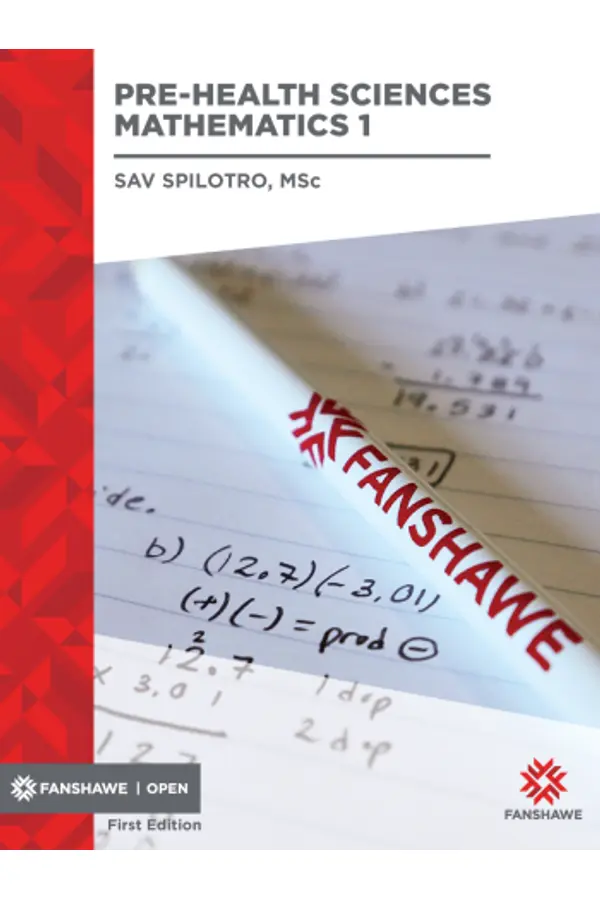
Fanshawe Pre-Health Sciences Mathematics 1
Not rated yetRate this bookFanshawe Pre-Health Sciences Mathematics 1 builds foundational numeracy, algebra, measurement, geometry, and trigonometry for first-term pre-health study. This guide follows Sav Spilotro’s six-unit course resource and emphasizes clear workings, units, reasonable estimates, and independent checking.
Free reading is available at the official source. Opens in a new tab.
 Free
About this book
Fanshawe Pre-Health Sciences Mathematics 1 builds foundational numeracy, algebra, measurement, geometry, and trigonometry for first-term pre-health study. This guide follows Sav Spilotro’s six-unit course resource and emphasizes clear workings, units, reasonable estimates, and independent checking.
How to study this book
Attempt the examples before reading solutions and practise foundational arithmetic without a calculator where your course requires it. Translate word problems into diagrams or equations before manipulating symbols. Keep an error log that distinguishes concept errors from arithmetic slips, and revisit corrected problems after a delay.
Chapter-wise explanations and study tasks
Unit 1. Real Numbers and Introduction to Algebra
Whole numbers, integers, fractions, decimals, real-number properties, and algebraic language establish the tools used throughout the course. Equivalent forms must preserve value, and the distributive property connects arithmetic with symbolic manipulation. Develop confidence with signs and order of operations before accelerating through later units.
Study task: Complete a mixed set of fraction, decimal, signed-number, and expression problems, explaining one equivalence or property at each step in two selected solutions.
Unit 2. Measurement
Measurement combines values with units and an appropriate level of precision. Unit conversion, rounding, and scientific notation address different aspects of a calculation. Distinguish accuracy from precision and avoid rounding intermediate values when it changes the intended final result.
Study task: Carry out a multi-step conversion with unit cancellation, express the result in scientific notation, and justify the final rounding using the question’s instructions.
Unit 3. Linear Equations, Graphs, and Applications
Equation-solving operations must preserve equality. Rearranging formulas, modelling mixtures or motion, and graphing linear relationships extend the same reasoning into applications. A slope has units and contextual meaning; an intercept may be a model feature without being meaningful over every possible input.
Study task: Model a fictional constant-rate situation with an equation and graph, interpret slope and intercept, and check a calculated result against the original words.
Unit 4. Systems of Linear Equations
Two equations describe simultaneous conditions, and their common solution must satisfy both. Graphing gives a visual interpretation, while substitution and elimination offer algebraic routes. Recognize systems with a unique solution, no solution, or infinitely many solutions and relate those outcomes to the context.
Study task: Solve one system by two methods and construct separate examples with no solution and infinitely many solutions, explaining the graph of each.
Unit 5. Introduction to Polynomials
Polynomial operations build on distribution and exponent rules. Adding like terms, multiplying, dividing, and recognizing special products require different procedures. Graphing introduces a visual perspective on polynomial behaviour, but a plotted image should be connected with the underlying expression.
Study task: Expand and simplify a special product, divide a polynomial by an appropriate divisor, and verify the division by reconstructing the original expression.
Unit 6. Geometry and Trigonometry
Angles, triangles, the Pythagorean theorem, area, volume, surface area, and trigonometric ratios address different geometric questions. A diagram clarifies which measurements belong to the model. Choose the appropriate relationship and distinguish linear, square, and cubic units when interpreting the answer.
Study task: Solve a fictional right-triangle measurement problem and a composite area or volume problem, showing diagrams, unit checks, and a reasonableness estimate.
Applied assignment
Create a foundational numeracy portfolio with one problem from each unit. Include a measurement conversion, a linear model, a simultaneous-equation application, polynomial verification, and a geometric diagram. Explain the method before presenting the calculation, and add an estimate or independent check.
Suggested reading plan
Master Unit 1 before relying on symbolic shortcuts. Study measurement in Unit 2 alongside unit checks in later applications. Connect Units 3–4 through graphical and algebraic views, then use separate practice blocks for polynomials and geometry–trigonometry. Finish with a cumulative set where method names are not supplied.
Questions for reflection
- What does the unit of an answer reveal about a possible setup error?
- When is a mathematical solution infeasible in the original situation?
- How does checking by a second representation improve confidence?
Edition and source notes
Based on Sav Spilotro’s linked Fanshawe first-term MATH-1024 resource, listed in the library as 2022. The source contains six units, not the medication-administration sequence of Medical Mathematics. These original prompts are foundational educational exercises.
About access & copyright
This page provides book information and study material. Full-text access is provided by the original publisher or authorised source; a listing does not grant permission to republish the book.
Read our Library Access & Copyright policyExplore the contents
Check the chapters covered in this edition.
Visit the official source
See reading, preview or purchase options.
Save for later
Keep this textbook in your saved collection.
Reader ratings & reviews
Share your thoughts
Your review helps other students choose the right resources.
KEEP LEARNING
Your next great read
Algebra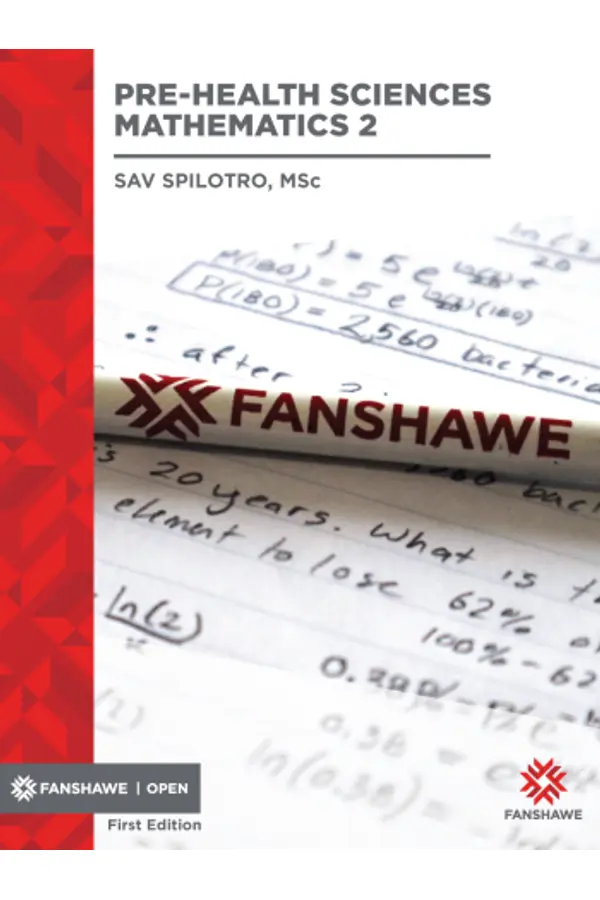 Algebra
Fanshawe Pre-Health Sciences Mathematics 2
View Fanshawe Pre-Health Sciences Mathematics 2 — book
AlgebraFanshawe Pre-Health Sciences Mathematics 1
View Fanshawe Pre-Health Sciences Mathematics 1 — book Algebra
Linear Algebra with Applications
View Linear Algebra with Applications — book Algebra
The Essence of Mathematics Through Elementary Problems
View The Essence of Mathematics Through Elementary Problems — book Algebra
Intermediate Algebra I
View Intermediate Algebra I — book Algebra
Basic Review
View Basic Review — book Algebra
Introductory Algebra
View Introductory Algebra — book Algebra
Intermediate Algebra
View Intermediate Algebra — book Algebra



