
 Complaints; Family medicine; General practice; Symptoms; Primary care; Prognosis; Diseases; Practice
Air PollutionTextbook
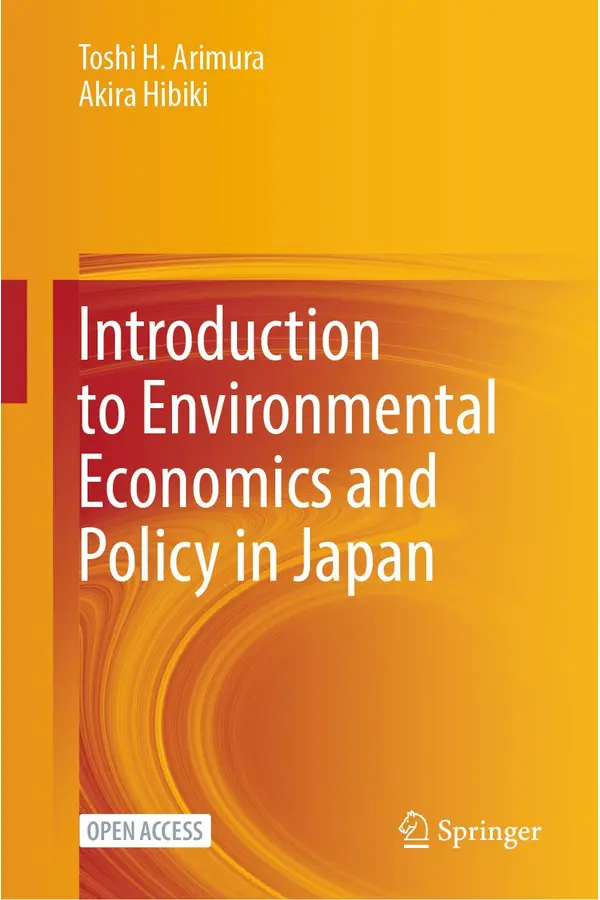
Introduction to Environmental Economics and Policy in Japan
Not rated yetRate this bookIntroduction to Environmental Economics and Policy in Japan connects economic reasoning about pollution with Japanese policy examples. Toshi H. Arimura and Akira Hibiki's nine chapters move from externalities and instrument choice to waste, environmental liability, recycling, air pollution, and climate policy.
Free reading is available at the official source. Opens in a new tab.
 Free
About this book
Introduction to Environmental Economics and Policy in Japan connects economic reasoning about pollution with Japanese policy examples. Toshi H. Arimura and Akira Hibiki's nine chapters move from externalities and instrument choice to waste, environmental liability, recycling, air pollution, and climate policy.
How to study this book
Draw the economic diagrams yourself and label private benefits, private costs, external costs, and social outcomes before interpreting a policy. Keep efficiency, distribution, implementation, and uncertainty separate. Read the Japan chapters as applications in their publication context and verify any current legal or policy claim independently.
Chapter-wise explanations and study tasks
Chapter 1 — Environmental Problems: A Market Failure
Consumer and producer surplus provide a starting point for examining how external costs change the socially preferred outcome. The chapter distinguishes private incentives from social effects and introduces regulation, taxes, and subsidies. Identify the assumptions behind a diagram before treating its optimum as a directly measured policy target.
Study task: Draw a market with a negative externality, label the private and social outcomes, and explain the source of the welfare loss.
Chapter 2 — Choice of Policy Instruments: Tax, Regulation or Subsidy
Taxes, regulatory requirements, and subsidies create different incentives and resource transfers. Compare how each changes behaviour and who pays or receives funds. A similar environmental target does not imply identical distributional or implementation effects.
Study task: Analyze a fictional emissions problem under all three instruments, identifying incentives, public-budget effects, and information requirements.
Chapter 3 — Property Right Approach and Emissions Trading Schemes
Property rights and trading connect environmental access with allocation and exchange. Examine how the model assigns rights and how trading affects incentives and the distribution of gains. Distinguish the role of an overall limit from the role of transactions within that limit.
Study task: Construct a two-firm trading example and compare initial allocation, abatement choices, and the distribution of costs.
Chapter 4 — Uncertainty and Policy Choice: Carbon Tax or Emissions Trading Scheme
Imperfect information can make a policy selected under expected conditions perform differently from the intended outcome. Compare price and quantity approaches by tracing the uncertainty through costs, benefits, and social surplus. Avoid assuming that uncertainty always favours the same instrument.
Study task: Use two alternative cost scenarios to compare a tax and an emissions limit, explaining which assumptions drive the ranking.
Chapter 5 — Waste Management: Optimal Disposal Fee and Intergenerational Use of the Landfill
Waste charges influence disposal decisions, while limited landfill capacity links present choices with future users. Distinguish the immediate cost of handling waste from the scarcity of remaining capacity. The intergenerational analysis asks how timing changes the relevant opportunity cost.
Study task: Create a two-period landfill example and explain why the preferred current disposal decision may differ when future capacity is considered.
Chapter 6 — Precaution Against Environmental Accidents and Liability Rules for Damages
Liability arrangements influence incentives to take precautions against uncertain harm. Compare prevention costs with expected damages and examine how responsibility changes a firm's decisions. Distinguish an economic model of incentives from a statement of the law applicable to a real event.
Study task: Compare two hypothetical liability arrangements using precaution, expected harm, information, and enforcement assumptions.
Chapter 7 — Recycling Laws and Their Evaluation in Japan
The Japanese recycling examples connect institutional arrangements with incentives across the product and waste chain. Evaluation requires asking what changes in collection, disposal, resource use, and costs can be attributed to an arrangement. A recycling rate alone may not describe the full outcome.
Study task: Choose one source case and create an evaluation table with objectives, affected parties, incentives, measures, and potential unintended effects.
Chapter 8 — Air Pollution in Japan and the World
Sources, causes, health effects, and policy responses connect environmental conditions with economic and institutional change. Compare the Japanese experience with the wider examples while keeping pollutants, locations, and periods distinct. Assess trends against relevant context rather than infer causation from a simple before-and-after graph.
Study task: Analyze one source figure by pollutant, period, location, possible policy influence, and other factors needed for a causal interpretation.
Chapter 9 — International Efforts on Climate Change and Carbon Pricing in Japan
Climate agreements and Japanese carbon-pricing examples connect international coordination with domestic incentives. Compare policy objectives, coverage, and implementation rather than treating all pricing arrangements as equivalent. Publication-period descriptions should not be assumed to establish today's policy position.
Study task: Prepare a policy comparison from the chapter with objective, coverage, incentive, international context, and questions requiring current verification.
Applied assignment
Write an environmental-policy appraisal for a fictional pollution or waste problem. Include an externality diagram, instrument comparison, uncertainty analysis, distributional effects, and an evaluation plan, using a Japanese case to illustrate a reasoning method.
Suggested reading plan
Read Chapters 1–3 for foundations, 4–6 for uncertainty and specialized problems, and 7–9 for Japanese applications. Revisit the diagrams when comparing empirical policy outcomes.
Questions for reflection
- Which costs are excluded from private decisions?
- What information does the proposed instrument require?
- How would distribution or uncertainty change your recommendation?
Edition and source notes
Based on the 2024 Springer text by Toshi H. Arimura and Akira Hibiki, organized into nine chapters and two parts. Policy and legal examples reflect the book's period. The guide develops economic analysis rather than claiming to provide a current inventory of Japanese regulation.
About access & copyright
This page provides book information and study material. Full-text access is provided by the original publisher or authorised source; a listing does not grant permission to republish the book.
Read our Library Access & Copyright policyExplore the contents
Check the chapters covered in this edition.
Visit the official source
See reading, preview or purchase options.
Save for later
Keep this textbook in your saved collection.
Reader ratings & reviews
Share your thoughts
Your review helps other students choose the right resources.
KEEP LEARNING
Your next great read
Complaints; Family medicine; General practice; Symptoms; Primary care; Prognosis; Diseases; Practice 4DVar
Data Assimilation Fundamentals
View Data Assimilation Fundamentals — book agriculture public-private parternship
Wheat Improvement
View Wheat Improvement — book bioinformatics
Systems Biology
View Systems Biology — book Capital Budgeting
Corporate Finance for Long-Term Value
View Corporate Finance for Long-Term Value — book Biology
Environmental Science
View Environmental Science — book Basic models of the enterprise
Management in a Dynamic Environment
View Management in a Dynamic Environment — book Built Environment
Introduction to Space Syntax in Urban Studies
View Introduction to Space Syntax in Urban Studies — book college
Prose Fiction: An Introduction to the Semiotics of Narrative
View Prose Fiction: An Introduction to the Semiotics of Narrative — book Cultural Rights



