
 Air Pollution
Capital BudgetingTextbook
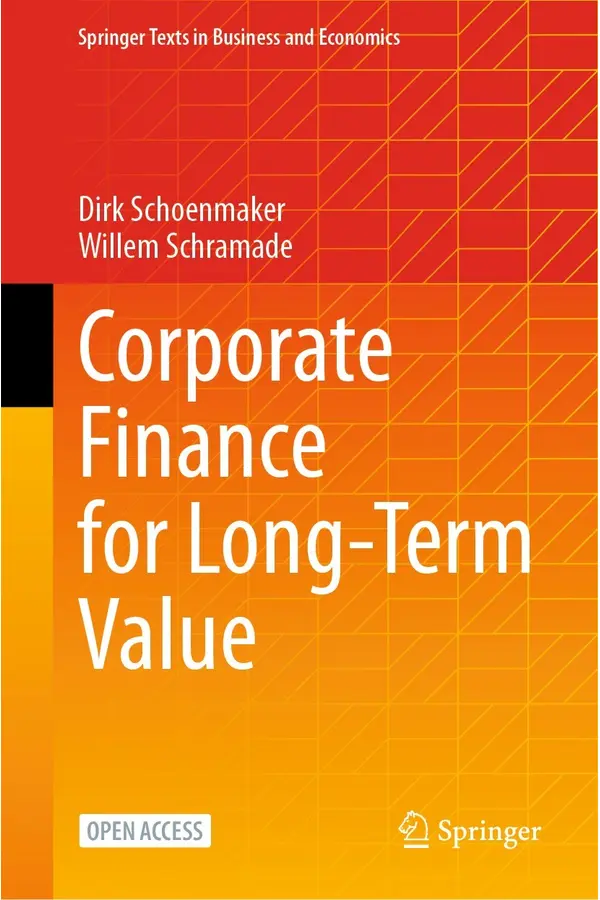
Corporate Finance for Long-Term Value
Not rated yetRate this bookCorporate Finance for Long-Term Value extends financial decision-making to social and environmental value. Dirk Schoenmaker and Willem Schramade's eighteen chapters connect integrated value creation with discounting, investment appraisal, company valuation, risk, financing, reporting, and acquisitions.
Free reading is available at the official source. Opens in a new tab.
 Free
About this book
Corporate Finance for Long-Term Value extends financial decision-making to social and environmental value. Dirk Schoenmaker and Willem Schramade's eighteen chapters connect integrated value creation with discounting, investment appraisal, company valuation, risk, financing, reporting, and acquisitions.
How to study this book
Maintain separate financial, social, and environmental assumptions before combining results. Rework the textbook's examples, show discounting and valuation steps, and test sensitivity to uncertain inputs. Evaluate both the calculation and the authors' framework rather than assuming that a single integrated number eliminates trade-offs.
Chapter-wise explanations and study tasks
Chapter 1 — The Company within Social and Planetary Boundaries
The opening chapter places company activity within social needs and environmental constraints. Externalities and sustainability transitions challenge a narrow focus on immediate financial outcomes. Identify which impacts arise from the business model and how responsibilities and incentives affect decisions.
Study task: Map a fictional company's financial activities and social or environmental impacts, distinguishing internal costs from effects borne elsewhere.
Chapter 2 — Integrated Value Creation
Integrated value links financial, social, and environmental dimensions. Examine how the framework represents positive and negative outcomes and the choices involved in combining them. A transparent valuation makes assumptions and trade-offs visible rather than treating monetization as an unquestionable fact.
Study task: Create a three-dimension value map for one project and explain where measurement uncertainty or competing interests affect the assessment.
Chapter 3 — Corporate Governance
Governance connects purpose, decision rights, accountability, and long-term value creation. Consider how oversight and incentives influence the treatment of impacts and the time horizon of decisions. A stated purpose requires supporting processes if it is to affect actual choices.
Study task: Draft a governance brief linking a long-term objective with board oversight, management incentives, stakeholder information, and review measures.
Chapter 4 — Discount Rates and Scarcity of Capital
Discounting converts outcomes at different times into comparable values, but the appropriate rate depends on what is being valued and the assumptions involved. Examine the treatment of financial and wider capital scarcity. Sensitivity analysis is essential when the rate strongly influences distant effects.
Study task: Recalculate a hypothetical stream at two discount rates and explain how timing changes the comparison between alternatives.
Chapter 5 — Calculating Social and Environmental Value
The chapter develops ways to translate impacts into social and environmental values. Track the path from physical outcomes to valuation factors and identify attribution, scope, and data-quality questions. Avoid double counting related effects or treating uncertain estimates as precise measurements.
Study task: Construct an impact-to-value table with quantities, valuation assumptions, source needs, uncertainty ranges, and possible overlap.
Chapter 6 — Investment Decision Rules
Investment rules organize choices among projects with different timing and outcomes. Compare their decision logic and the extension to integrated value. A rule's usefulness depends on its assumptions, so examine cases where financial and wider assessments point in different directions.
Study task: Compare two fictional projects under the decision rules discussed and explain any ranking conflict and its underlying assumptions.
Chapter 7 — Capital Budgeting
Capital budgeting translates project decisions into incremental outcomes over time. Distinguish relevant changes from sunk costs and separate financial flows from wider impacts before integration. Forecasts should reflect a coherent counterfactual and make uncertain drivers explicit.
Study task: Build a project-appraisal outline with a baseline, incremental cash flows, social and environmental effects, and sensitivity tests.
Chapter 8 — Valuing Bonds
Bond valuation connects promised payments, discounting, and risk with the book's broader value perspective. Distinguish contractual cash flows from expected outcomes and consider how issuer activities create additional impacts. A price calculation alone does not settle questions about contribution or sustainability.
Study task: Value a simplified fictional bond, vary the discount assumption, and list the separate information required to assess its wider impacts.
Chapter 9 — Valuing Public Equity
Public-equity valuation links business drivers and financial forecasts with social, environmental, and integrated value. The value-driver adjustment approach makes the relationship between transition assumptions and estimates explicit. Compare methods without hiding differences in forecast horizons or input definitions.
Study task: Prepare a valuation-driver table for a fictional listed company and test one transition assumption's effect on the estimated value.
Chapter 10 — Valuing Private Equity
Private-company valuation requires attention to information availability and the context of ownership and transactions. Apply the integrated perspective while identifying assumptions that are less observable than in public markets. Separate a modelled estimate from a verified transaction price.
Study task: Compare a public and private valuation scenario, explaining differences in data, comparability, and uncertainty.
Chapter 11 — Case Study Integrated Valuation: Inditex
The Inditex case demonstrates how the book combines financial and impact analysis in a company setting. Follow the chain from business model through inputs to valuation, identifying which results are sensitive to assumptions. Treat it as a historical instructional case rather than a current investment recommendation.
Study task: Reconstruct the case's valuation structure and identify three assumptions whose revision could materially change its conclusions.
Chapter 12 — Risk-Return Analysis
Risk-return analysis examines uncertain outcomes and how risks interact across holdings and dimensions of value. Distinguish expected return from a guaranteed result and diversification from elimination of all risk. Explain how the integrated perspective changes the questions asked.
Study task: Compare two fictional outcome distributions and explain how correlation and impact uncertainty affect their combined assessment.
Chapter 13 — Cost of Capital
The cost of capital provides a benchmark linked to financing, risk, and opportunity costs. Examine its estimation and application within the book's framework. Avoid using a company-wide rate mechanically for every project regardless of risk or value dimension.
Study task: Create a cost-of-capital calculation plan and identify the inputs and project differences that would require careful justification.
Chapter 14 — Capital Market Adaptability, Investor Behaviour, and Impact
Investor behaviour and market adjustment affect how information and transitions enter prices and financing conditions. Distinguish a change in ownership or price from an additional real-world effect. Evaluate the mechanisms through which an investor might influence outcomes.
Study task: Compare two investor actions and trace the proposed route from action to company response to measurable impact.
Chapter 15 — Capital Structure
Financing choices affect claims, risks, incentives, and resilience. The chapter connects debt and equity decisions with long-term and integrated value. Examine the conditions behind a proposed financing advantage instead of assuming that one leverage level is universally best.
Study task: Compare two financing structures for a fictional company, identifying effects on risk, flexibility, and the ability to pursue long-term objectives.
Chapter 16 — Issues and Payouts: Changes in Capital Structure
Raising and distributing capital changes financing relationships and resources available for future activity. Compare issue and payout decisions with investment needs and the firm's broader objectives. A payout policy should be evaluated within the company's circumstances rather than in isolation.
Study task: Draft a capital-allocation proposal comparing reinvestment, a capital issue, and a payout, with assumptions and trade-offs.
Chapter 17 — Reporting and Investor Relations
Reporting communicates performance, prospects, and impacts to users with different information needs. Examine connections among measures, narrative explanations, and valuation assumptions. Useful disclosure should permit scrutiny of uncertainty and progress rather than provide favourable indicators without context.
Study task: Design an integrated reporting outline with financial and impact measures, boundaries, assumptions, and questions for investor dialogue.
Chapter 18 — Mergers and Acquisitions
Acquisitions combine valuation, financing, strategy, and integration risks. Assess claimed synergies and changes in social and environmental outcomes against a credible baseline. A higher combined revenue figure does not itself establish value creation.
Study task: Prepare an acquisition assessment with standalone values, synergy assumptions, integration risks, financing effects, and impact changes.
Applied assignment
Develop an integrated appraisal of a fictional company or project. Include financial forecasts, an impact-to-value map, discounting assumptions, risk and financing analysis, a reporting outline, and sensitivity tests that reveal where the conclusion could change.
Suggested reading plan
Read Chapters 1–3 for the framework, 4–7 for appraisal methods, 8–11 for valuation applications, 12–14 for risk and markets, and 15–18 for financial policy.
Questions for reflection
- Which impacts are excluded from the valuation boundary?
- Where could double counting occur?
- Which assumption would most change the decision?
Edition and source notes
Based on the 2023 Springer textbook by Dirk Schoenmaker and Willem Schramade, organized into eighteen chapters and five parts. Company examples and market information reflect the source period. The guide teaches the authors' analytical framework and does not provide personalized investment advice or current company valuations.
About access & copyright
This page provides book information and study material. Full-text access is provided by the original publisher or authorised source; a listing does not grant permission to republish the book.
Read our Library Access & Copyright policyExplore the contents
Check the chapters covered in this edition.
Visit the official source
See reading, preview or purchase options.
Save for later
Keep this textbook in your saved collection.
Reader ratings & reviews
Share your thoughts
Your review helps other students choose the right resources.
KEEP LEARNING
Your next great read
Air Pollution Complaints; Family medicine; General practice; Symptoms; Primary care; Prognosis; Diseases; Practice
Morbidity in primary care
View Morbidity in primary care — book 4DVar
Data Assimilation Fundamentals
View Data Assimilation Fundamentals — book agriculture public-private parternship
Wheat Improvement
View Wheat Improvement — book bioinformatics
Systems Biology
View Systems Biology — book Basic models of the enterprise
Management in a Dynamic Environment
View Management in a Dynamic Environment — book Built Environment
Introduction to Space Syntax in Urban Studies
View Introduction to Space Syntax in Urban Studies — book college
Prose Fiction: An Introduction to the Semiotics of Narrative
View Prose Fiction: An Introduction to the Semiotics of Narrative — book Cultural Rights
Non-Territorial Autonomy
View Non-Territorial Autonomy — book Business enterprises—Finance



