
Abstract
Economic dispatch allocates available generation to meet load demand at minimum operating cost while satisfying equality and inequality constraints. Fossil-fuelled power plants supply a substantial share of electricity and release carbon oxides, sulphur oxides and nitrogen oxides. These emissions create environmental concerns and motivate operating restrictions. Economic dispatch minimises fuel cost, whereas emission dispatch focuses on pollutant output. Combined economic and emission dispatch (CEED) addresses the trade-off between the two objectives. This paper applies an artificial immune system (AIS) algorithm to the CEED problem. The approach is evaluated on the IEEE 30-bus reliability test system with six generating units under base and increased-load conditions. The manuscript reports the resulting generation schedules, fuel costs, emissions and computation times and discusses comparisons with genetic algorithm, modified genetic algorithm and evolutionary programming approaches.
Keywords: Economic dispatch, emission dispatch, artificial immune system, optimisation, IEEE 30-bus reliability test system.
Introduction
Increasing electricity consumption creates pressure to reduce the cost of energy production in thermal power plants [1, 2]. Several generating units operate simultaneously to meet system demand, but each has a different generation-cost characteristic. Economic load dispatch (ELD) distributes the required output among these units to minimise total generation cost while satisfying demand and operational constraints. Environmental concerns have increased interest in including pollutant emissions in this process [3]. A combined approach therefore considers both fuel expenditure and the environmental consequences of the generation schedule.
Generating units that burn fossil fuels release pollutants such as carbon dioxide (CO₂), sulphur dioxide (SO₂) and nitrogen oxides (NOₓ) [4, 5]. These emissions contribute to environmental degradation and create a need to control releases from electricity generation [6]. Possible responses include using lower-sulphur fuels, installing flue-gas cleaning equipment and electrostatic precipitators, and replacing ageing burners or generating units [7, 8]. Such measures often require expensive equipment or modifications and may be regarded as longer-term investments. Emission dispatch offers a shorter-term operational response by changing how the existing units share the demand [9, 10].
The conventional aim of economic dispatch is to minimise total fuel cost. Emission dispatch instead seeks a generation schedule with lower pollutant output. Considering only one objective may produce an undesirable outcome for the other [11, 12]. CEED combines them so that the relationship between cost and emissions can be examined while the demand and operating constraints remain satisfied. These constraints can include power balance, voltage limits, line-flow limits, ramp-rate limits and prohibited operating zones [13]. The resulting multi-objective problem can be expressed as a single objective through a weighted-sum method or a price-penalty factor.
Thermal power plants convert fuel energy into mechanical energy and then electricity. Their operating schedules determine how much each unit contributes to the total demand. As electricity requirements grow, scheduling the units efficiently becomes increasingly important for controlling production cost [14]. Fuel combustion also produces gases and particulate matter with environmental consequences. These effects make it necessary to consider the generation schedule in relation to both economic and environmental performance rather than fuel cost alone [15].
CEED aims to operate generating units with low fuel costs and low emissions while meeting demand and operational requirements [16]. It concerns the allocation of total system demand among the available units. Researchers have investigated heuristic and computational-intelligence algorithms to address this scheduling problem, particularly where the objective functions or constraints make a straightforward analytical solution difficult.
Fuel expenditure and emission output are separate objectives, making CEED a bi-objective optimisation problem [17]. The two objective functions can be combined into a single function using a price-penalty factor. This conversion allows the algorithm to evaluate candidate generation schedules on a common basis. The present paper uses that formulation to examine the performance of AIS.
The objective of this study is to apply AIS to combined economic and emission dispatch for fuel-cost and emission minimisation.
Methodology
Problem Formulation
ELD determines the generating-unit outputs that meet the required demand at minimum operating cost, subject to operational constraints. A cost-only formulation gives limited attention to the pollutants released by fossil-fuelled plants. Sulphur dioxide, carbon dioxide and nitrogen oxides must also be considered because of their environmental and health consequences. The dispatch problem therefore involves more than choosing the least expensive generation schedule.
Emission-control options include lower-sulphur fuel, post-combustion gas cleaning, electrostatic precipitators and replacement of ageing burners or generating units. These options generally require new equipment or modifications to existing assets. Their capital requirements can make them long-term measures. Emission dispatch offers an operational alternative that seeks lower pollutant output from the units already available.
CEED balances cost and emissions by considering the two objectives together while meeting system demand and operating requirements. The formulation may account for power balance, voltage and line-flow limits, ramp rates and prohibited operating zones. Weighted-sum and price-penalty methods are among the ways of expressing this multi-objective task as a single-objective optimisation problem.
In this study, the economic and emission objectives are combined using the price-penalty factor h. The factor brings the fuel-cost function, expressed in dollars per hour, and the emission function, expressed in tonnes per hour, into the combined objective. The formulation uses the quadratic cost and emission relationships set out below.
The combined economic and emission dispatch problem is written as follows:
Minimize f(FC,EC) | (1) |
Subject to:
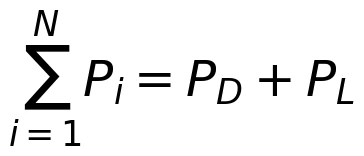
Equality constraint:
| (2) |
Inequality constraint:
Pi min≤Pi≤Pi max | (3) |
The system is subject to the following equality constraint:
| (4) |
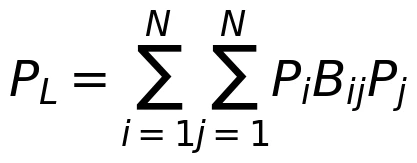
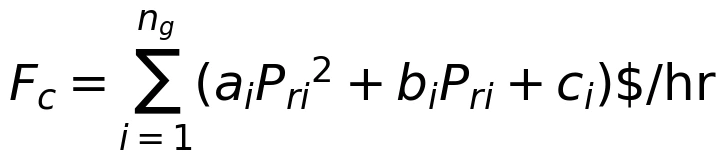
The input–output cost characteristic of generator i is represented by Fi(Pi). The total generation cost FC is calculated as follows:
| (5) |
Similarly, Ei(Pi) represents the emission output of generator i, and EC is the total emission output:
| (6) |

Introducing the price-penalty factor h converts the multi-objective formulation into a single objective:
Minimize ɸ=FC+h(EC) $/hr | (7) |
Here, h combines the emission-related term with the normal fuel cost.
| (8) |
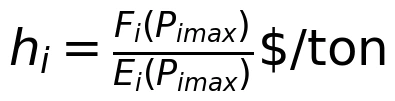
The values hi, for i = 1, 2, …, ng, are arranged in ascending order. The maximum capacities Pmax of the corresponding units are added one at a time, beginning with the unit having the smallest hi, until the demand condition in Equation (9) is met.
| (9) |
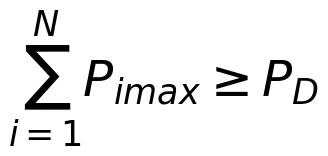
The hi associated with the last unit included in this process supplies the price-penalty factor for the specified demand. The manuscript describes this factor in monetary units per unit of emission.
The fitness function used to evaluate the affinity of an antibody is expressed as follows:
| (10) |
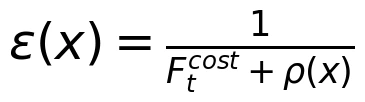
In Equation (10), ε(x) is the fitness of string x, representing an antibody; Ftcost is its total operating cost; and ρ(x) represents the extent of constraint violation.
Artificial Immune System
AIS is an optimisation approach inspired by the processes of the vertebrate immune system. It uses analogies with learning, memory and recognition to search for solutions. In the biological system, immune responses distinguish foreign substances from the body’s own cells and molecules. From an information-processing perspective, this suggests a distributed adaptive system in which recognition and response develop through repeated exposure. AIS algorithms translate selected aspects of these processes into procedures for optimisation and classification.
The biological analogy centres on antibodies and antigens. Lymphocytes participate in recognising foreign material, and clonal expansion increases the number of cells associated with a response. B-lymphocytes and T-lymphocytes have different roles in this process. A B-cell displays a particular antibody receptor, while other cells and signals help regulate activation and proliferation. Activated B-cells can develop into plasma cells, which secrete antibodies. The optimisation model uses these ideas as an analogy for identifying promising candidate solutions and increasing their representation in a population.
In the algorithm, cloning corresponds to reproducing a candidate solution. Affinity is represented through the objective function and the satisfaction of constraints. A candidate that satisfies the required conditions and performs well under the evaluation function has higher affinity. The biological concepts of clonal expansion and maturation therefore become computational operations that generate and modify candidate schedules. In this CEED application, the constraints act as requirements against which a candidate schedule is evaluated, while affinity reflects the quality and feasibility of that schedule.
The search begins with randomly generated solutions representing an antibody population. Each initial solution is cloned according to the selected procedure. Mutation then modifies the clones to explore the search space. Affinity affects the reproduction and maturation processes: stronger candidates receive preferential treatment, while weaker candidates can undergo larger changes or be removed. Repeated fitness evaluation allows the algorithm to retain feasible schedules with improved objective values. This process combines exploration of alternative schedules with preservation of promising solutions.
Memory provides a further analogy: useful responses can be retained as the search progresses. AIS repeats cloning, mutation, evaluation and selection until a specified stopping condition is satisfied. A stopping rule limits the computation and identifies the final population for the run. The resulting schedule is an algorithmic solution under the stated settings; convergence of the population is the criterion used by the manuscript to terminate the search.
Figure 1 shows the AIS procedure used for the combined economic and emission dispatch problem. Its principal steps are described below.
Initialisation
An initial population is formed from randomly generated binary strings. Each string is decoded into its corresponding values and checked for constraint violations. Infeasible candidates are penalised, while feasible individuals form the population pool. The stated settings are a population size of 20, a string length of 10, a maximum of 100 generations and a mutation probability of 0.010.
Evaluation
The initial candidates are evaluated using the fitness and constraint checks described above. Their decoded values determine the operating cost and any penalty associated with infeasibility. The evaluation supplies the affinity information used in subsequent cloning and selection. The same population and stopping settings apply throughout the described search.
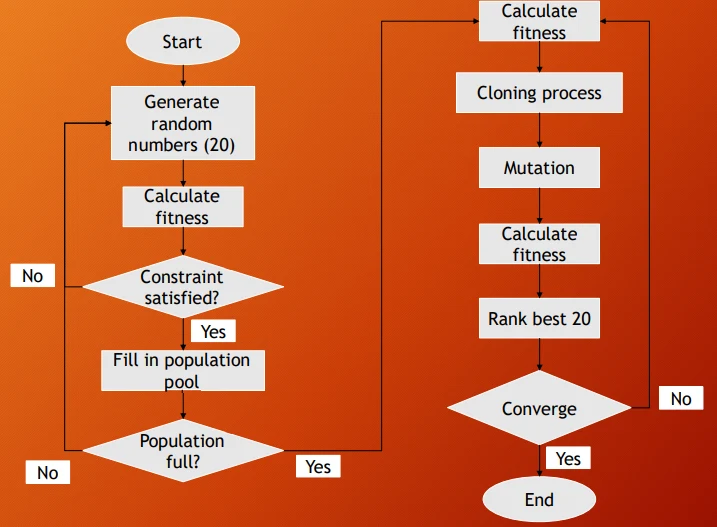
Figure 1. Showing the flowchart for combined economic emission dispatch.
Mutation
The cloned population undergoes maturation through affinity-based hypermutation. Lower-affinity clones receive larger mutation rates, while higher-affinity clones receive smaller rates. The manuscript describes expanding the initial population of 20 through cloning and mutation to obtain 100 candidates. The modified clones are then evaluated, with penalties applied where constraints are violated, before the selection step identifies the candidates to retain.
Selection
A new antibody population of the original size is selected from the mutated clones. A clone replaces its original antibody when it performs better; otherwise, the original is retained. The best 20 individuals proceed to the convergence test. If they satisfy the stopping condition, the run terminates. If they do not, the selected population undergoes further cloning and mutation, and the process repeats. Figure 1 summarises this cycle [3].
Convergence Test
Equation (11) specifies the convergence criterion used by AIS. The text describes stopping when the difference between the first and twentieth fitness values is below 0.0001. Otherwise, the algorithm returns to the cloning stage. The equation is reproduced with the notation provided in the manuscript.
Fitness1st-Fitness20th=0.0001 | (11) |
Results and Discussion
Two conditions are considered: the base case and an increased-load case. The base case uses the original test-system data. The loaded cases increase demand by 35%, 50%, 75% and 100%. The method description refers to increasing demand at bus 5, while the later results discussion refers to increases across load buses. The supplied results are retained under their stated load-case labels.
The technique is tested on an IEEE 30-bus system containing six generating units, including the slack unit at bus 1. The base power is 100 MVA. The manuscript discusses comparison with genetic algorithm (GA), modified genetic algorithm (MGA) and evolutionary programming (EP) approaches. Figure 2 shows the benchmark network used for the evaluation.
Table 1 gives the generation-cost coefficients, and Table 2 gives the emission coefficients. The two objectives are fuel-cost minimisation and emission minimisation. The analysis is performed in MATLAB R2020b.
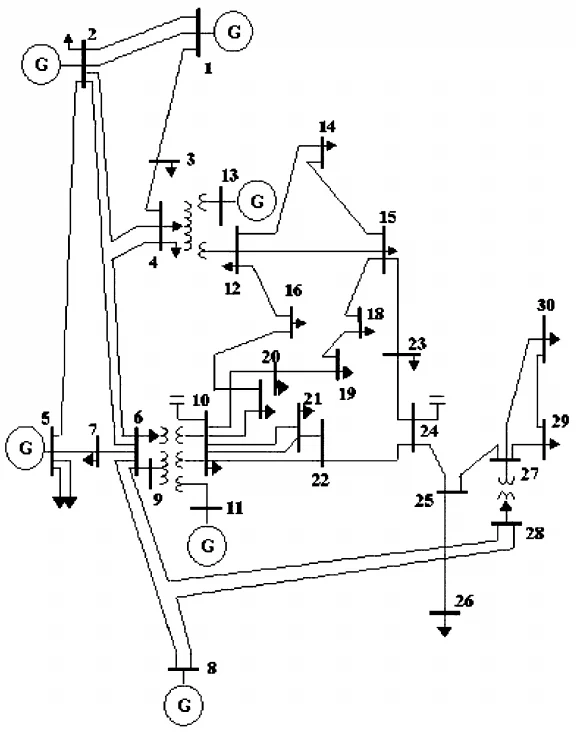
Figure 2. Single-line diagram of the IEEE 30-bus reliability test system.
Table 1. Generation-cost coefficients for the IEEE 30-bus test case.
Generating unit | a | b | c |
1 | 0.0375 | 2 | 0 |
2 | 0.0175 | 1.75 | 0 |
5 | 0.0625 | 1 | 0 |
8 | 0.00834 | 3.25 | 0 |
11 | 0.025 | 3 | 0 |
13 | 0.025 | 3 | 0 |
Table 2. Emission coefficients for the IEEE 30-bus test case.
Generating unit | Emission coefficient | ||||
d(10-2) | e(10-4) | f(10-6) | g(10-4) | h(10-2) | |
1 | 4.091 | -5.554 | 6.490 | 02.00 | 2.857 |
2 | 2.543 | -6.047 | 5.638 | 05.00 | 3.333 |
3 | 4.258 | -5.094 | 4.586 | 00.01 | 8.000 |
4 | 5.326 | -3.550 | 3.380 | 20.00 | 2.000 |
5 | 4.258 | -5.094 | 4.586 | 00.01 | 8.000 |
6 | 6.131 | -5.555 | 5.151 | 10.00 | 6.667 |
MATLAB R2020b is used to run AIS on the six-generator system. The manuscript checks consistency of the final objective values across the algorithm’s output and discusses the method in relation to GA, MGA and EP. The following tables present the AIS results for the base and increased-load conditions. These numerical results describe the reported experiment rather than an independently verified global optimum.
Table 3. Showing the emission minimization results
Case | Pg1 (MW) | Pg2 (MW) | Pg5 (MW) | Pg8 (MW) | Pg11 (MW) | Pg13 (MW) | Cost ($/hr) | Emission (ton/hr) | Computational time (s) |
Base Case | 172.58 | 37.23 | 21.24 | 13.84 | 21.43 | 26.05 | 0.79 | 0.30 | 37.39 |
Load buses increased by 35% | 228.77 | 59.23 | 29.56 | 27.53 | 28.21 | 25.24 | 1.16 | 0.57 | 38.07 |
Load buses increased by 50% | 277.48 | 59.23 | 29.56 | 27.53 | 28.21 | 25.24 | 1.35 | 1.12 | 38.22 |
Load buses increased by 75% | 361.70 | 59.24 | 29.56 | 27.53 | 28.21 | 25.24 | 1.72 | 7.02 | 38.43 |
Load buses increased by 100% | 450.82 | 59.23 | 29.56 | 27.53 | 28.21 | 25.24 | 2.17 | 79.76 | 38.93 |
Table 4. Showing the cost minimization results
Case | Pg1 (MW) | Pg2 (MW) | Pg5 (MW) | Pg8 (MW) | Pg11 (MW) | Pg13 (MW) | Cost ($/hr) | Emission (ton/hr) | Computational time (s) |
Base Case | 147.44 | 55.70 | 24.18 | 25.07 | 24.22 | 14.43 | 0.79 | 0.35 | 37.43 |
Load buses increased by 35% | 228.77 | 59.23 | 29.56 | 27.53 | 28.21 | 25.24 | 1.16 | 0.57 | 42.09 |
Load buses increased by 50% | 277.49 | 59.23 | 29.56 | 27.53 | 28.21 | 25.24 | 1.35 | 1.12 | 38.63 |
Load buses increased by 75% | 361.70 | 59.23 | 29.56 | 27.53 | 28.21 | 25.24 | 1.72 | 7.02 | 44.96 |
Load buses increased by 100% | 450.82 | 59.23 | 29.56 | 27.53 | 28.21 | 25.24 | 2.17 | 79.76 | 39.23 |
Table 3 presents the schedules obtained for emission minimisation, while Table 4 presents those obtained for cost minimisation. Both objectives are examined for the base case and for load increases of 35%, 50%, 75% and 100%. The lowest reported cost and emission values occur in the base case. As demand increases, the reported emission output also increases. A particularly large increase is recorded in the case labelled as a 100% load increase.
The tables report the lowest values for the base case and the highest values for the 100% load-increase case. In the base case, emission minimisation gives 0.30 tonnes per hour, compared with 0.35 tonnes per hour for cost minimisation. The manuscript reports matching objective values for several of the other load conditions. The generation schedules and associated numerical values are reproduced as supplied.
Computation time varies with execution conditions and whether the program has already been run. The discussion gives an approximate average of 38–39 seconds, while the tables retain the individual times recorded for each case.
Conclusion
This paper applies an artificial immune system algorithm to combined economic and emission dispatch. The method is evaluated using a six-generator test system under base and increased-load conditions. The reported results illustrate how the schedules and associated cost and emission values change with demand. The study presents AIS as a promising computational-intelligence approach for this optimisation task, based on the population search, fitness evaluation and stopping procedure described above.
ELD seeks generating-unit outputs that meet demand at minimum operating cost while satisfying unit and system constraints. Emission dispatch instead seeks lower pollutant output. CEED combines the economic and environmental objectives. Computational-intelligence methods, including evolutionary programming, AIS and hybrid algorithms, have been used to address such problems. The manuscript discusses AIS alongside approaches such as PSO–GA, artificial bee colony with simulated annealing, and quantum-inspired PSO. Its reported test cases provide an illustration of the selected AIS method for fuel-cost and emission minimisation.
References
Mohammad, S. H., Mansor, M. H., Musirin, I., Abdullah, M. N., Shaaya, S. A., Rahmat, N. A., … Razali, N. S. (2018). Economic dispatch of generators with valve-point loading effect using immune evolutionary programming. In AIP Conference Proceedings (Vol. 2030, p. 020246). American Institute of Physics Inc. https://doi.org/10.1063/1.5066887
Bhattacharya, K. K. Mandal & N. Chakraborty (2011). A hybrid cultural approach for combined economic and emission dispatch. 2011 Annual IEEE India Conference, Hyderabad, pp. 1-4.
M. S. Syed, A. R. Syed & Y. S. Rao (2013). A novel seeker optimization approach for solving combined economic and emission dispatch. 2013 International Conference on Power, Energy and Control (ICPEC), Sri Rangalatchum Dindigul, pp. 371-376.
M. Khalil, R. S. Wibowo & O. Penangsang (2018). Combined economic emission dispatch with cubic criterion function using cuckoo search algorithm. 2018 International Conference on Information and Communications Technology (ICOIACT), Yogyakarta, pp. 36-40.
J. A. Momoh & S. S. Reddy (2014). Combined Economic and Emission Dispatch using Radial Basis Function. 2014 IEEE PES General Meeting | Conference & Exposition, National Harbor, MD, pp. 1-5.
G. P. Dixit, H. M. Dubey, M. Pandit & B. K. Panigrahi (2011). Artificial bee colony optimization for combined economic load and emission dispatch. International Conference on Sustainable Energy and Intelligent Systems (SEISCON 2011), Chennai, pp. 340-345.
W. A. Augusteen, R. Kumari & R. Rengaraj (2016). Economic and various emission dispatch using differential evolution algorithm. 2016 3rd International Conference on Electrical Energy Systems (ICEES), Chennai, pp. 74-78.
A.Y. Abdelaziz, E.S. Ali, S.M. Abd Elazim (2016). Implementation of flower pollination algorithm for solving economic load dispatch and combined economic emission dispatch problems in power systems. Energy, vol. 101, pp. 506-518.
U. Güvenç, Y. Sönmez, S. Duman, N. Yörükeren (2012). Combined economic and emission dispatch solution using gravitational search algorithm. Scientia Iranica, vol. 19, no. 6, pp. 1754-1762.
Huijun Liang, Yungang Liu, Fengzhong Li, Yanjun Shen (2018). A multiobjective hybrid bat algorithm for combined economic/emission dispatch. International Journal of Electrical Power & Energy Systems, vol. 101, pp. 103-115.
R. Gopalakrishnan & A. Krishnan (2012). Intelligence technique to solve combined economic and emission dispatch. International Conference on Pattern Recognition, Informatics and Medical Engineering (PRIME-2012), Salem, Tamilnadu, pp. 347-352.
P. Nagalakshmi, Y. Harish, R. K. Kumar & C. Jada (2011). Combined economic and emission dispatch using intelligent water drops-continuous optimization algorithm. 2011 INTERNATIONAL CONFERENCE ON RECENT ADVANCEMENTS IN ELECTRICAL, ELECTRONICS AND CONTROL ENGINEERING, Sivakasi, pp. 168-173.
Bishwajit Dey, Shyamal Krishna Roy, Biplab Bhattacharyya, (2019). Solving multi-objective economic emission dispatch of a renewable integrated microgrid using latest bio-inspired algorithms. Engineering Science and Technology, an International Journal, vol. 22, no. 1, pp. 55-66,
Lahouaria Benasla, Abderrahim Belmadani, Mostefa Rahli (2014). Spiral Optimization Algorithm for solving Combined Economic and Emission Dispatch. International Journal of Electrical Power & Energy Systems, vol. 62, pp. 163-174.
G. K. Venayagamoorthy (2009). Potentials and promises of computational intelligence for smart grids,” 2009 IEEE Power & Energy Society General Meeting, Calgary, AB, pp. 1-6.
Huijun Liang, Yungang Liu, Fengzhong Li, Yanjun Shen (2018). A multiobjective hybrid bat algorithm for combined economic/emission dispatch. International Journal of Electrical Power & Energy Systems, vol. 101, pp. 103-115.
M. Khalil, R. S. Wibowo & O. Penangsang (2018). Combined economic emission dispatch with cubic criterion function using cuckoo search algorithm. 2018 International Conference on Information and Communications Technology (ICOIACT), Yogyakarta, pp. 36-40.
Cite This Work
To export a reference to this article please select a referencing stye below:

Academic Master Education Team is a group of academic editors and subject specialists responsible for producing structured, research-backed essays across multiple disciplines. Each article is developed following Academic Master’s Editorial Policy and supported by credible academic references. The team ensures clarity, citation accuracy, and adherence to ethical academic writing standards
Content reviewed under Academic Master Editorial Policy.



