
Abstract
Human emotions are often excluded from studies of artificial intelligence. Human thinking is represented computationally through operations and cognitive symbols intended to imitate intelligence, yet such representations may overlook its emotional dimension. This article examines different perspectives on emotional thinking and its relevance to AI. It argues that emotions help people process information and make decisions, and that incorporating emotional capabilities into computing is important when attempting to simulate human intelligence through emotional artificial intelligence.
Keywords: Emotions; Artificial Intelligence; Human intelligence; Rational thinking; Decision making.
Introduction
Technological innovation creates new workplace opportunities while threatening to make some occupations obsolete. Countries therefore need to strengthen education systems to reduce the impact of automation on the workforce. Alongside technical training, education should develop creativity, empathy and communication. Teamwork, responsibility, accountability and an innovative spirit are human qualities that robots and AI may find difficult to replicate. Incorporating these qualities into AI development could help technologies respond more appropriately to human needs (Krafft et al., 2020).
Cognitive computing provides a theoretical foundation for artificial intelligence. AI seeks to simulate aspects of human intelligence through computer programs and automated control, producing behaviour that resembles human intelligent activity.
Despite these developments, AI has practical limitations. Critics argue that artificial representations remain distant from human experience, particularly in their treatment of emotion. The human brain processes both rational and emotional information when making decisions. This process is dynamic: it may depend on the issue, the person or the situation. Bringing an emotional component into computational models offers a proposed paradigm of cognitive computing called emotional artificial intelligence.
A Brief History of Artificial Intelligence
Attempts to imitate human behaviour extend back two millennia (Nilsson, 2010). McCulloch and Pitts (1943) developed a model intended to simulate a human neural cell. Research on associative learning and electrical networks subsequently contributed to computational models (Hebb, 1948, 1949; Rosenblatt, 1958). McCarthy (1988) was among the pioneers of artificial intelligence. During the 1990s, researchers increasingly focused on speech recognition, natural language processing and visual pattern recognition. An enduring challenge is that human intelligence cannot be fully represented through computation alone.
Intelligence
Human intellectual capacity encompasses linguistic, logical and mathematical abilities. Other proposed forms include musical, spatial, bodily-kinesthetic, naturalistic and personal intelligence. Personal intelligence includes intrapersonal and interpersonal abilities, which overlap with emotional intelligence.
Intelligence can be understood as a capacity to solve complex problems, anticipate future developments, analyse patterns and synthesise information. From the perspective advanced in this paper, failures of intelligent analysis may also reflect insufficient attention to emotional intelligence.
Software systems have long been used to predict patterns of behaviour. Security analysis illustrates the difficulty of this task: people may conceal their intentions, change plans and behave unpredictably. Computing typically relies on logical reasoning, while human behaviour also involves creativity and emotion.
When Computing Lack Emotional Quotient, It Results in Analytical Failures
Software alone may therefore be insufficient for understanding unpredictable behaviour. Analysts examine large amounts of information to anticipate people’s actions, making intelligence analysis a demanding task. Rational analysis does not always explain such behaviour, which motivates interest in creativity and emotional artificial intelligence.
A Few Selected Definitions from Literature Samples
Intelligence is marked by the ability to recognize emotions (both of others and oneself), generate and adapt them, and apply emotional information in goal accomplishment and problem-solving. A precondition of these abilities is the capability to differentiate between different emotions. As a vital part of human intelligence, emotional intelligence is the ability to perceive, integrate, understand, and regulate emotions (Fjelland, 2020).
Emotions are physical experiences universal to all human beings and many other animals. Robots are expected to become capable of perceiving others’ emotions, developing their emotional state, and manifesting it (Blanch, 2016).
Emotional intelligence became prominent in the late 1980s, although Thorndike (1920) had discussed the related concept of social intelligence much earlier. Social intelligence concerns the ability to understand and manage people and engage in adaptive social interactions (Kihlstrom, 2000). Emotional intelligence deals more specifically with perceiving, understanding, managing and expressing emotions in oneself and in interactions with others (Salovey, 1990).
Salovey & Mayer (1990) define five domains critical to emotional intelligence: knowing one’s emotions, managing emotions, motivating oneself, recognizing emotions in others, and handling relationships. A common measure of Emotional Intelligence is EQ (emotional intelligence quotient), as gauged by a myriad of widely published EQ tests.
The New Smart
In the changing world of work, AI places greater emphasis on the relationship between cognitive and emotional skills. Humans remain important in activities requiring higher-order creativity, critical thinking, innovation and emotional engagement. The proposed idea of being smarter concerns the quality of thinking as well as its quantity. Computational development should therefore pay closer attention to skills traditionally associated with emotional intelligence.
Emotional Thinking for Computing
Emotion refers to a person’s perceptual experience and mental state. Mood is closely related to emotion and shapes how experiences are felt over time. Feelings, moods and emotional responses involve reactions in the mind and body.
Emotions are reflected in facial expressions, eye movements, posture, other body movements and voice modulation (Damasio, 2010). Mood can influence these outward expressions. Emotional experience involves a complex combination of consciousness, beliefs, ideals, values, moral behaviour and practical experience (Cui, 2006).
Thinking is a human process involved in problem-solving, decision-making and conceptualisation (Holyoak & Morrison, 2005).
Human emotions have both internal and outward dimensions. Internal experience is accompanied by facial expressions and actions, involving physiological and psychological responses through interactions between the mind and body. Recognising these dimensions is relevant to attempts to integrate emotional information into AI decision-making and responses.
Emotional factors help explain how humans behave and think (Damasio, 2010). This study focuses on thinking and psychology as foundations for incorporating emotional capabilities into AI. In the workplace, values, rewards, punishments, motivation and recognition can trigger different feelings and reactions. Emotional or psychological thinking can therefore be described as the way people process information, make decisions and respond within a particular environment.
Two Dimensions of Emotional Thinking
Positive emotional thinking can support appropriate responses, whereas negative emotions may contribute to cognitive bias. Positive emotions are associated with security and satisfaction; negative emotions can include fear and disgust. Balancing these responses is important because emotions play a significant role in cognitive development (Dolan, 2002).
Gazzaniga (2011) examines the relationship between emotions and different brain functions. Emotional thinking encompasses trust, regret, pleasure, anger, embarrassment, sadness and joy. It contributes to recognising faces, judging threats and assessing trustworthiness. Emotional responses help guide behaviour.
Emotional processes in the brain play a critical role in decision-making. Stimuli can induce emotions that affect the body and produce corresponding emotional experiences.
Values and AI
The paper distinguishes between weak AI, which operates with given values, and strong AI, which could generate new values (Saari & Judge, 2004). Samsonovich (2020) addresses related questions through an emotional biologically inspired cognitive architecture that integrates moral schemas and semantic maps.
Emotion as the basis for consciousness and memory
Emotion is presented as an important foundation for consciousness and memory (Baars, 2014). Emotionally significant events can be easier to recall. The reconstruction of memory is shaped by emotional thinking, making this relationship relevant to cognitive psychology.
Emotions are the basis for Decision making
Judgement and decision-making involve both rational and emotional processes. Rational deliberation can take longer, whereas emotionally driven decisions may be made quickly. The information available, time constraints, the decision-maker’s personality and the external environment influence the process used.
Emotions as a basis for personality and human intelligence
Human thinking develops through interaction with adults and the surrounding environment. Before language skills are established, expressions and sounds help infants communicate and form connections. Emotions are a mental resource for adaptation and survival from infancy (Menary, 2010). Interaction between emotion and cognition supports psychological development and the formation of personality over time.
Emotional Recognition and Processing of AI
Natural dialogue and interactive storytelling with AI are used in video games (Yannakakis & Togelius, 2018), healthcare (Oh et al., 2019) and marketing (Muller & Bostrom, 2014). Chatbots support these conversations (Shawar & Atwell, 2007) and provide information without a human operator (Zumstein & Hundertmark, 2017).
Emotional computing and AI
Picard and Klein (2002) discuss computing systems that recognise and respond to human emotions. External manifestations of emotion can be measured and analysed computationally. This approach is commonly described as affective computing.
Emotional AI aims to create computing systems that can sense, recognise and respond to emotions while making decisions and interacting with humans. In this proposed model, emotional capabilities form an important part of cognition. Emotional computing combines simulated emotional responses with the arithmetic, mathematical and logical operations traditionally associated with AI.
The development of emotional computing has encouraged discussion of the relationship between computation and human intelligence (Liu, 2014). Humans experience feelings whether or not they express them. Computers produce expressions according to triggered programs, using symbols such as a smiling face or a warm greeting. These expressions may satisfy emotional needs even when they do not arise from a human-like purpose.
Critics argue that emotions expressed by computers are program outputs reflecting their developers’ intentions. On this view, a computer does not experience the emotional impact of good, bad or shocking news. It remains a tool that assists human activity, much like a calculator or a reminder application.
The alternative vision explored in this paper is an emotional AI that is creative, flexible and independent, with forms of processing intended to support thought and awareness.
Thinking is complex, and AI attempts to represent aspects of learning, judgement and imagination computationally. Emotional computing is proposed as a way to support more creative and sustainable mechanisms of interaction. Mechanical operations based on rational rules are comparatively easier to model than emotionally influenced decisions.
The debate remains unresolved. Nevertheless, the paper advocates continued exploration of AI that combines creative emotional capabilities with thinking. Figure 1 illustrates this proposed relationship between emotional computing and AI.
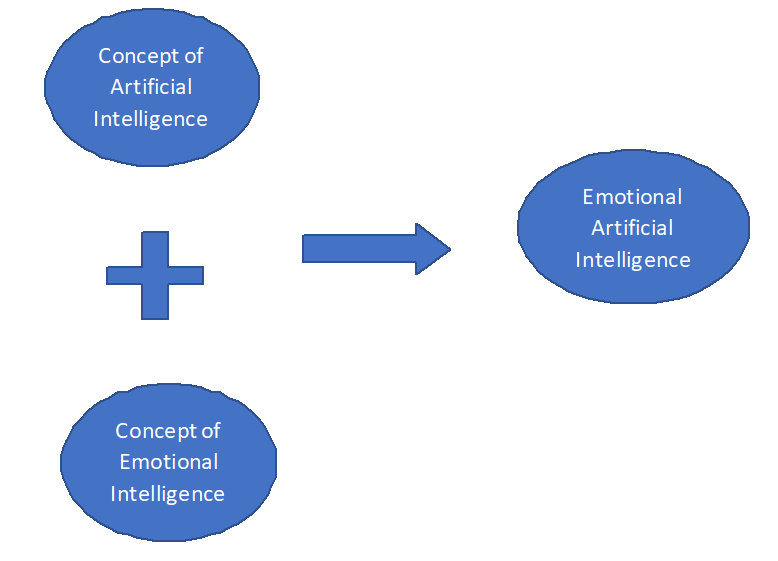
Figure 1: Emotional computing and AI
Applications
The new emotional artificial intelligence in Recruitment
The paper considers recruitment as one application of emotional AI, including CV screening and the interpretation of facial expressions during interviews. It proposes that emotional information could contribute to recruitment analysis alongside other AI capabilities.
Emotional Artificial intelligence in Information Security
Artificial intelligence and emotional intelligence have roles in information security, particularly where data privacy and employee privacy intersect. Facial-recognition predictions can involve bias and errors. As AI develops, leadership that values human connections and considers emotional dimensions remains important.
Emotional artificial intelligence as player partners
Programmers develop chess systems that can defeat highly skilled players by following computational strategies. The paper proposes that combining evolutionary algorithms with emotional capabilities could help systems develop strategies, learn from experience and generate responses to unusual problems. It also discusses affective computing as a way to support analysis of emotions and symptom triggers in healthcare.
Challenges of Artificial Intelligence
AI has achieved strong performance in data classification, anomaly detection, prediction and optimisation. Even where processing is fast and precise, difficulties remain in interpreting behavioural context, unfamiliar circumstances and common-sense information. Understanding the motivations behind human behaviour is a further challenge. The paper proposes emotional intelligence as one way to address narrowly specialised forms of computational intelligence.
Conclusion
Developing more comprehensive AI requires continued examination of human intelligence and its emotional foundations. Emotions influence moral judgement, values and decision-making, making them relevant to the design of human-oriented systems. The paper concludes that integrating emotional capabilities into AI could support more holistic and effective decisions.
Conflict of Interests
The authors declare that they have no known competing financial interests or personal relationships that could have appeared to influence the work reported in this paper.
References
Baars, B. J. (2014). Cognitive Theory of Consciousness, translated by An H. Beijing: Science Press.
Blanch, A. (2016). Expert performance of men and women: a cross-cultural study in the chess domain, Personality and Individual Differences, 101, pp.90 -7.
Cui, N. (2006). Explore the World of Thinking. Beijing: Science and Technology Academic Press.
Damasio, A. (2010). Self Comes to Mind: Constructing the Conscious Brain. New York: Pantheon Books.
Dolan, R.J. (2002). Emotion, cognition, and behavior. Science (New York, N.Y.) 298(5596): 1191–1194.
Fjelland, R. (2020) ‘Why general artificial intelligence will not be realized’, Humanities and Social Sciences Communications, 7, 10, pp.1–9.
Gazzaniga, M. (2011). Cognitive Neuroscience: The Biology of the Mind, translated by Zhou XL. Beijing: China Light Industry Press (in Chinese)
Hebb, D. (1949). The Organisation of Behavior, Wiley, New York.
Holyoak, K.J. and Morrison, R.G. (2005). Thinking and Reasoning: A Reader’s Guide. Cambridge: Cambridge University Press
Krafft, P. M., Young, M., Katell, M., Huang, K., & Bugingo, G., (2020). Defining Artificial Intelligence in Policy versus Practice. In Proceedings of the 2020 AAAI/ACM Conference on AI, Ethics, and Society (AIES).
Liu, G.Y. (2014). The Affective Calculation Method of Human Physiological Signal. Beijing: Science Press (in Chinese).
McCarthy, J. (1988). ‘Mathematical logic in artificial intelligence’, Daedalus, 117, 1, pp.297–311.
McCulloch, W. and Pitts, W. (1943). A logical calculus of the ideas immanent in nervous activity’, Bulletin of Mathematical Biophysics, 5, pp.115 -33.
Menary, R. (2010). The Extended Mind. Massachusetts: The MIT Press.
Müller, V. and Bostrom, N. (2014). Future progress in artificial intelligence: a survey of expert opinion in Müller, V. (ed.) Fundamental Issues of Artificial Intelligence, Springer, Berlin.
Nilsson, N. (2010). The Quest for Artificial Intelligence: A History of Ideas and Achievements, Cambridge University Press, Cambridge.
Oh, K.J., Lee, D., KoHo-Jin, B., Ho-Jin, C. (2017). A Chatbot for Psychiatric Counseling in Mental Healthcare Service Based on Emotional Dialogue Analysis and Sentence Generation. Biologically Inspired Cognitive Architectures II: Papers from the AAAI Fall Symposium (FS-09-01). 371-376.
Picard, R. and Klein, J. (2002). “Computers that recognize and respond to user emotion: theoretical and practical implications.” Interacting with Computers 14: 141-169.
Rosenblatt, F. (1958). ‘The perceptron: a probabilistic method for information storage and organization in the brain’, Psychological Review, 65, 6 pp.3.
Saari, L. M., & Judge, T. A. (2004). Employee attitudes and job satisfaction. Human Resource Management: Published in Cooperation with the School of Business Administration, the University of Michigan and in Alliance with the Society of Human Resources Management, 43(4), 395–407.
Salovey, P. Mayer, J.D. (1990). Emotional intelligence. Imagination, Cognition, and Personality, 9, 185-211
Samsonovich, A.V., (2013). Emotional biologically inspired cognitive architecture Biologically Inspired Cognitive Architectures, 6, pp. 109-125.
Shawar, B.A., and Atwell, E., (2007). Chatbots: are they really useful? Ldv forum, 22 (1), pp. 29-49.
Thorndike, E.L. (1920). Intelligence and its use. Harper’s Magazine, 140, 227-235.
Yannakakis, G. N. and Togelius, J., (2018). Artificial intelligence and games. Berlin: Springer.
Zumstein, D., and Hundertmark, S., (2017). Chatbots-An interactive technology for personalized communication, transactions and services. IADIS International Journal, 15(1), pp.96-109.
Cite This Work
To export a reference to this article please select a referencing stye below:

Academic Master Education Team is a group of academic editors and subject specialists responsible for producing structured, research-backed essays across multiple disciplines. Each article is developed following Academic Master’s Editorial Policy and supported by credible academic references. The team ensures clarity, citation accuracy, and adherence to ethical academic writing standards
Content reviewed under Academic Master Editorial Policy.



