
 Language learning for academic, technical and scientific purposes
Communication StudiesTextbook
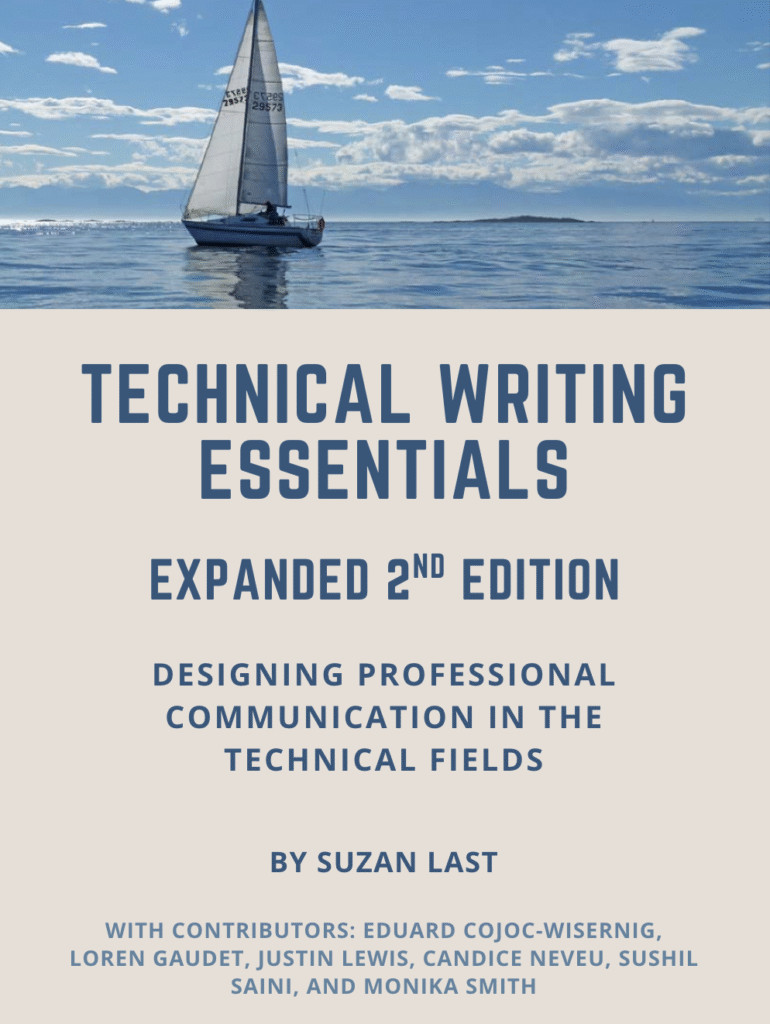
Technical Writing Essentials 2nd Edition
Not rated yetRate this bookTechnical Writing Essentials, expanded second edition, treats professional communication as a reader-centered problem-solving process. Suzan Last and contributors connect writing style, information design, teamwork, research, user experience, document genres, and team presentation. This guide covers the eight main parts and six academic-writing appendices in the linked 2026 source, with attention to generative AI, evidence, accessibility, and revision.
Free reading is available at the official source. Opens in a new tab.
 Free
About this book
Technical Writing Essentials, expanded second edition, treats professional communication as a reader-centered problem-solving process. Suzan Last and contributors connect writing style, information design, teamwork, research, user experience, document genres, and team presentation. This guide covers the eight main parts and six academic-writing appendices in the linked 2026 source, with attention to generative AI, evidence, accessibility, and revision.
Chapter-wise summaries and study tasks
1. WHAT IS TECHNICAL COMMUNICATION?
Technical communication helps people understand a situation, make a decision, or complete a task. The opening chapter treats communication as problem-solving: identify the problem, desired state, audience, constraints, and available evidence before choosing a document or solution. Technical conventions make information usable, while rhetorical moves organize what a writer does within a genre. Planning, drafting, feedback, and revision form an iterative process rather than a single pass from first sentence to final copy.
The expanded edition also examines generative AI in relation to learning, professional work, ethics, and wider costs. A plausible output is not the same as verified evidence or demonstrated competence. Writers retain responsibility for accuracy, appropriate use of information, and the decisions represented in a document. Case studies of communication failure connect these principles with consequences beyond grammar. Analyze what information was missing, misunderstood, or prevented from influencing action rather than assuming that every failure could have been solved by more polished wording.
Study task. Define a fictional technical communication problem before proposing a document. State audience, action, evidence, constraints, and success criteria; add an AI-use decision explaining verification, learning goals, and accountability.
2. PROFESSIONAL STYLE
Professional style begins with the reader's needs and the relationship between writer, audience, purpose, and context. A reader-centered message makes the relevant action and reasoning accessible without becoming evasive or patronizing. Persuasion should connect evidence and justified claims, not rely on promotional language unsupported by the analysis. The chapter's rhetorical perspective treats writing as a response to a problem rather than a performance of expertise.
Precision involves selecting words, sentence structures, and verbs that express the intended meaning clearly. The seven-Cs framework helps diagnose qualities such as clarity, concision, completeness, and coherence, but the criteria must be balanced in context. Shortening a sentence can remove necessary conditions, while a long sentence may remain clear if relationships are explicit. Verbs reveal who acts and what happens; vague noun-heavy constructions can conceal responsibility. Revision should therefore ask whether the style helps a reader understand and act, not simply whether it sounds formal.
Study task. Revise a fictional technical email for a defined reader. Replace vague actions, justify a recommendation with evidence, and explain one place where extra detail is necessary despite a goal of concision.
3. INFORMATION DESIGN
Information design makes structure and relationships visible. Genre conventions, style guides, and templates can support usability when they fit the actual task, but copying a format does not guarantee readable content. Headings should distinguish levels and communicate useful topics; lists should have a clear lead-in, parallel structure, and an appropriate choice of bullets or numbering. A reader should be able to scan the document without losing the argument.
Figures and tables need to be selected, labeled, introduced, and interpreted as part of the text. Different visuals answer different questions, and graphical choices can mislead even when underlying values are correct. Contrast, repetition, alignment, and proximity provide a framework for arranging information. Accessibility adds requirements such as meaningful descriptions, navigable structure, and usable contrast. The revision section brings these features together: inspect the document's organization and reader experience before limiting attention to sentence-level corrections. Design is part of the explanation rather than decoration applied after writing.
Study task. Redesign a two-page fictional report with hierarchical headings, a justified list, and one appropriate visual. Add its text explanation and alternative text, then test whether a reader can locate the main decision quickly.
4. TEAMWORK AND COMMUNICATION
Team communication requires shared goals, roles, processes, and working relationships. The chapter compares models including GRIP, team-development stages, trust-related team difficulties, behavioral preferences, and conflict modes. These models can help organize observations, but they should not become fixed labels that explain every member's behavior. Conflict may arise from tasks, expectations, resources, or relationships and needs a response suited to its source.
Project documents make collaboration inspectable. Charters define expectations, agendas and minutes support meetings, Gantt charts and work plans connect tasks with time, and status reports or logs record progress and problems. A post-project review can turn experience into learning. Collaborative writing adds decisions about shared planning, drafting, integration, version control, and consistent voice. Peer review should respond to the assignment and reader needs with specific, prioritized evidence. Dividing a report into isolated pieces without a shared argument often produces repetition and gaps, so integration must be planned as real work.
Study task. Create a team charter and a short writing plan with ownership, deadlines, review stages, and integration responsibility. Practise peer feedback that identifies a reader problem, points to evidence, and proposes a revision goal.
5. CONDUCTING RESEARCH
Research begins by defining a manageable question and scope. Methods and terminology help distinguish the kind of evidence needed, while source evaluation considers credibility, relevance, reasoning, and limitations. A claim can be widely repeated and still poorly supported. Logical-fallacy checks help expose gaps between evidence and conclusion, but identifying a label is less useful than explaining the defective reasoning.
Synthesis organizes relationships among sources rather than presenting one summary after another. Quotation, paraphrase, and summary serve different purposes, all requiring accurate representation and documentation. Signal phrases make the relationship between a source's claim and the writer's analysis clearer. Engagement and consultation extend research beyond published material by asking whose experience and knowledge should shape the project. Human-research ethics addresses participants, consent, privacy, and appropriate institutional procedures. Consultation should be designed around a real opportunity to influence decisions, not used to validate an outcome already fixed. The chapter connects evidence gathering with accountable use of what people contribute.
Study task. Develop a scoped research question, a source-evaluation table, and a synthesis paragraph. Add a consultation plan naming affected groups, decision influence, consent or ethics requirements, and how findings will be returned to participants.
6. USER EXPERIENCE DESIGN AND TECHNICAL COMMUNICATION
User experience design examines how people encounter a product, interface, or service while trying to achieve a goal. The chapter connects UX with technical communication through audience, purpose, context, and the effects of design choices. An interface is not neutral merely because it is implemented in code: its labels, sequence, defaults, and assumptions guide behavior and can create barriers.
The five-plane framework moves from strategy and scope through structure and skeleton to surface, linking high-level needs with concrete interaction and presentation. Improving surface appearance cannot reliably fix an underlying task or navigation problem. Research methods such as interviews, contextual inquiry, surveys, and personas should connect design decisions with evidence about users rather than invented stereotypes. The final step is translating findings into choices that can be tested. A useful UX explanation states who is trying to do what, under which conditions, where difficulty occurs, and how a proposed change will be evaluated.
Study task. Map one fictional service across the five UX planes. Propose a small research activity, distinguish observed evidence from assumptions, and define a usability outcome that would justify revising the design.
7. COMMON DOCUMENT TYPES
Common document types answer different recurring needs. Correspondence and memos communicate actions or decisions within particular relationships and settings. Technical descriptions explain a mechanism or object through relevant features and organization. Proposals argue for a course of action using a defined problem, feasible plan, resources, and benefits; progress reports explain completed work, remaining tasks, and issues requiring attention.
Short and long reports need structures suited to their purpose. Feasibility and recommendation work compare alternatives against explicit criteria, while executive summaries communicate the decision and its basis for readers who may not read the full analysis. Weighted-objectives tools make judgments visible but depend on justified criteria and weights. Lab reports connect methods, observations, interpretation, and limitations. Instructions organize actions so a defined user can perform them, with clear steps, conditions, and relevant warnings. Treat genres as adaptable responses to situations: the same template can be inappropriate when the reader's knowledge or decision changes. The writer remains responsible for evidence and usability across every format.
Study task. Use one fictional engineering problem to outline a proposal, progress report, and recommendation report. Explain how each document's purpose changes its evidence and structure, then draft a short instruction sequence for a defined user.
8. PUBLIC SPEAKING
The available public-speaking chapter introduces oral communication but explicitly states that the part is awaiting revision. Its substantive included section focuses on presenting as a team. This source limitation matters: the listed objectives should not be mistaken for complete standalone sections on every advertised presentation topic.
The team-presentation material emphasizes shared planning, deliberate practice, coordinated handoffs, suitable visuals, and preparation for questions. An interactive session or focus-group-style activity also requires decisions about the feedback sought, neutral prompts, roles, recording, and what the team is willing to change. Participants should have meaningful opportunities to respond rather than be led toward approval. A polished delivery does not compensate for unclear purpose or a failure to collect usable evidence. Use the linked online resources where the PDF omits video, and apply the team's feedback to revision rather than treating presentation as the final unchangeable stage.
Study task. Plan a short interactive team presentation with a purpose, neutral feedback questions, timed roles, handoffs, and a recording method. Rehearse once and revise based on what participants actually understood.
Appendix A: Referring to Authors and Titles
Referring accurately to authors and titles helps locate a writer's contribution within a conversation. Names, titles, and the wording used to introduce a source clarify whose position is being represented. A signal phrase can identify a claim, method, agreement, or disagreement, but its verb should not exaggerate what the source establishes. Consistency matters across references to the same work. This appendix supports attribution as part of reasoning, not merely as a formatting requirement added after the paragraph is written.
Study task. Introduce the same source in two paragraphs for different purposes, selecting accurate signal verbs and checking names, title treatment, and consistency.
Appendix B: Writing a Summary
A summary condenses a source's central ideas without turning into a review or inserting the summarizer's opinion as if it belonged to the original. Selection depends on the purpose of the surrounding document, but it must preserve the source's argument and important qualifications. Effective summaries identify the work, distinguish main claims from examples, and use original phrasing with appropriate attribution. Compression can mislead when limitations disappear. Compare the finished summary with the whole relevant source rather than with a few highlighted sentences.
Study task. Write a short summary of an assigned source, mark each sentence's function, and check that an important qualification survived the reduction.
Appendix C: Writing Comparisons
Comparison requires a reason for bringing items together and criteria that permit meaningful evaluation. A list of similarities and differences becomes analysis when it supports a conclusion relevant to the reader's question. Parallel attention prevents a writer from giving detailed advantages for one option and only superficial treatment of another. Organization may proceed by criterion or by item, but the relationships should remain explicit. The appendix helps turn comparison into an argument whose evidence and limitations can be inspected.
Study task. Compare two fictional tools using the same three criteria and a defined user need; explain which evidence supports the conclusion and which missing fact could change it.
Appendix D: Transitional Words and Phrases for University Writing
Transitions identify relationships such as contrast, cause, concession, sequence, and consequence. Choosing a more sophisticated connector does not repair a missing logical connection between ideas. The appendix encourages writers to move beyond repetitive additive signals and show precisely how one statement relates to the next. Some transitions also affect sentence structure and punctuation. During revision, first identify the intended relationship in plain language, then select wording that expresses it accurately without claiming stronger causation or certainty than the evidence supports.
Study task. Revise a short paragraph with weak transitions, explaining each relationship before selecting a connector; remove any causal link the evidence does not justify.
Appendix E: Sentence Structure
Sentence structure connects grammatical form with relationships among ideas. Simple sentences can emphasize a point, coordination can balance ideas, and subordination can express dependence, qualification, or unequal emphasis. Compound-complex constructions require particular care because readers can lose the main action. Identifying subjects, verbs, and clauses helps diagnose fragments and run-ons. Variety serves meaning rather than a quota of different sentence types. Choose a structure that makes responsibility and logical priority clear, then check whether punctuation matches the clauses actually present.
Study task. Express the same two ideas through coordination and subordination, compare the implied emphasis, and correct a fragment and a run-on using clause analysis.
Appendix F: Punctuation Matters
Punctuation helps readers interpret boundaries and relationships. Commas, semicolons, colons, and other marks have different functions and cannot be exchanged solely to create a desired pause. Errors can alter scope, emphasis, or meaning in technical communication, especially where qualifications and lists matter. The appendix connects punctuation with grammatical understanding and reader interpretation. Editing should therefore involve explaining the sentence's structure and intended meaning, not merely applying visual preferences. A final check should include both correctness and whether the intended relationship remains unmistakable.
Study task. Revise several punctuation errors in a fictional technical paragraph, explaining the clause or list structure behind each change and identifying one change that affects meaning.
How to study this book
- Begin with a communication brief stating the problem, reader, intended action, evidence, constraints, and success criteria.
- Plan substantive revision, usability checks, and peer review before sentence-level editing.
- Build a small portfolio across genres using one fictional project, explaining how each audience and purpose changes the document.
- Keep a source and contribution record, including any permitted AI assistance and the independent verification performed.
- Use webbook links for excluded media and treat sections marked for revision according to the coverage actually available.
Questions for reflection
- What does this reader need to know or do, and what design best supports that action?
- Which claim depends on evidence the document has not supplied?
- Could an apparently polished interface or report still conceal an important barrier?
- How did feedback change the substance rather than only the appearance of the work?
Source edition and coverage
The guide follows the linked 2026 Technical Writing Essentials (Expanded 2nd edition), by Suzan Last with contributing authors. It covers eight main parts and Appendices A-F. The PDF's public-speaking part is explicitly marked for revision and includes substantive section 8.3; the guide does not claim full coverage of sections only listed as forthcoming. Other numbering gaps are retained as features of the source rather than filled with invented material. These are original study explanations and learning tasks. Read the complete book at the official source.
About access & copyright
This page provides book information and study material. Full-text access is provided by the original publisher or authorised source; a listing does not grant permission to republish the book.
Read our Library Access & Copyright policyExplore the contents
Check the chapters covered in this edition.
Visit the official source
See reading, preview or purchase options.
Save for later
Keep this textbook in your saved collection.
Reader ratings & reviews
Share your thoughts
Your review helps other students choose the right resources.
KEEP LEARNING
Your next great read
Language learning for academic, technical and scientific purposes Language learning for academic, technical and scientific purposes
Technical Writing Essentials - H5P Edition
View Technical Writing Essentials - H5P Edition — book Communication Studies
Technical Writing Essentials
View Technical Writing Essentials — bookEnvironmental Toxicology
Environmental Toxicology
View Environmental Toxicology — bookVaccination Programmes
Vaccination Programmes
View Vaccination Programmes — bookRelativistic Quantum Mechanics
Relativistic Quantum Mechanics
View Relativistic Quantum Mechanics — bookAerospace Structures
Aerospace Structures
View Aerospace Structures — book Abelian number fields
Number Fields
View Number Fields — book Textbook
Agricultural Meteorology and Climatology
View Agricultural Meteorology and Climatology — book Language teaching and learning



