
Environmental Toxicology
interdisciplinary methodsTextbook
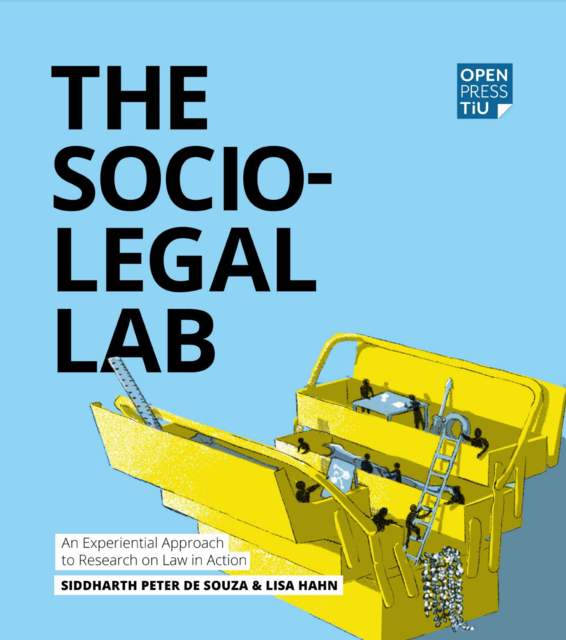
The Socio-Legal Lab: An Experiential Approach to Research on Law in Action
Not rated yetRate this bookThe Socio-Legal Lab offers an experiential route into research on law in action. Siddharth Peter de Souza and Lisa Hahn organize eight chapters across lab-based learning, theory, and application, using reflection, games, simulations, and research-design activities. This guide follows that sequence and connects interdisciplinary thinking with ethics, data, qualitative methods, communication, and research community.
Free reading is available at the official source. Opens in a new tab.
 Free
About this book
The Socio-Legal Lab offers an experiential route into research on law in action. Siddharth Peter de Souza and Lisa Hahn organize eight chapters across lab-based learning, theory, and application, using reflection, games, simulations, and research-design activities. This guide follows that sequence and connects interdisciplinary thinking with ethics, data, qualitative methods, communication, and research community.
Chapter-wise summaries and study tasks
Chapter 1 Introduction: a Lab Approach to Socio-Legal Studies
The book proposes a lab as a shared space for trying out socio-legal research rather than learning methods only as abstract prescriptions. Law in action concerns how legal rules, institutions, practices, and experiences operate in social settings. A lab allows researchers to discuss uncertainty, test an approach, and learn from one another before committing to a complete project. Its value comes from the relationship between reflection and activity, not from imitating the equipment or experimental control of a natural-science laboratory.
The opening chapter explains audiences, ways to use the workbook, and conditions for organizing a productive group. Activities such as reverse brainstorming help participants question assumptions and surface obstacles. A successful session needs an intelligible purpose, suitable exercises, participation arrangements, time, and a way to turn discussion into a revised research decision. Games are not substitutes for rigor; they create opportunities to examine thinking that might otherwise remain implicit. A learner should leave with a clearer question or design choice, not only the memory of an enjoyable activity.
Study task. Design a short lab session around a fictional socio-legal research problem. Specify participants, purpose, exercise, ground rules, timing, and the concrete research decision to review afterward.
Chapter 2 Interdisciplinary Research on Law
Interdisciplinary research connects bodies of knowledge that may use different definitions, assumptions, standards of evidence, and methods. Socio-legal work needs more than adding a social-science citation to a doctrinal argument. The chapter asks what kind of integration a project requires and what each perspective contributes to understanding the question. Developing a common language is practical research work because apparently shared terms such as evidence or validity may have different disciplinary meanings.
Exercises help locate a project, formulate a research question, and compare perspectives. Benefits can include a richer account of a problem and challenges to familiar assumptions, while costs include additional learning, coordination, and possible incompatibility. Combining methods without a rationale can obscure rather than strengthen a design. Explain where the disciplines meet and what will happen when they offer conflicting interpretations. A defensible interdisciplinary plan states the added value, limits, resources, and criteria by which the integrated result will be assessed.
Study task. Describe a fictional question from two disciplinary perspectives. Create a small shared glossary and explain what integration would add, what conflict it might create, and how you would judge the combined contribution.
Chapter 3 What Happens to Research When Put Into Action?
Research changes when a planned method encounters participants, institutions, access barriers, unexpected observations, and practical constraints. The chapter treats anxiety and surprise as matters to examine rather than proof that a researcher is unprepared. A research diary can preserve decisions, uncertainties, and the circumstances behind a change of direction. Serendipity becomes useful when an unexpected encounter is connected to a reasoned revision instead of an undocumented departure from the question.
Reflection also concerns how knowledge is produced and whose perspectives receive authority. Positionality makes aspects of the researcher's relationship to the field visible without suggesting that personal disclosure alone resolves bias. The discussion of decolonizing methodologies asks readers to consider assumptions about knowledge, power, and representation. Ethics appears through ongoing research relationships and dilemmas, not only approval forms. A plan must protect participants and respect relevant requirements, while remaining responsive to new issues. Document the reasoning behind difficult choices and distinguish appropriate adaptation from changing a design merely to obtain a preferred result.
Study task. Write a fictional fieldwork diary and positionality memo after an unexpected access problem. Identify an ethical dilemma, possible responses, people to consult, and the decision trail you would preserve.
Chapter 4 Mapping General Debates in Socio-Legal Studies
Socio-legal theory begins with questions about what counts as law and how law relates to everyday life. A focus on formal state rules can reveal one set of phenomena while overlooking informal norms, plural legal orders, or the experience of dispute resolution. The chapter maps these different appearances rather than assuming a single definition fits every research purpose. A theoretical choice helps determine what a researcher notices and what remains outside the study.
General debates concern the nature, functions, effects, and possible transformation of law. Conceptualizing law, applying or generating theory, and evaluating or improving legal arrangements involve related but distinct projects. Climate-litigation examples and lab activities make these perspectives tangible. Mind maps, role play, and a personal socio-legal lexicon can connect abstract concepts with a specific question. A literature review should identify relationships and disagreements among approaches, not merely list prominent writers. Explain how a theoretical framework guides the collection and interpretation of evidence without treating it as a conclusion established in advance.
Study task. Map how a fictional dispute appears as formal rules, institutional practice, and lived experience. Choose a theoretical perspective, state what it reveals, and identify what another perspective would challenge.
Chapter 5 Dichotomies in Socio-Legal Research
Dichotomies organize thought by contrasting categories such as doctrinal and non-doctrinal, qualitative and quantitative, micro and macro, or critical and applied research. They can clarify an argument but can also imply an exhaustive choice where actual projects cross boundaries. The chapter asks what purpose a distinction serves and what complexity it suppresses. A category should be a tool for understanding a project, not a rule forbidding an approach that fits the question.
Bridging involves showing how different contributions relate. A doctrinal account may explain the formal framework while empirical work examines its operation; quantitative patterns and qualitative accounts may answer complementary questions. Connecting micro-level interactions with broader structures requires a stated mechanism, not simply placing both in a report. Critical analysis and practical application can also interact without losing their differences. Exercises encourage researchers to identify a limiting binary and explore alternatives. Integration should preserve the standards and limits of each component rather than claim that combining labels automatically produces stronger evidence.
Study task. Identify a binary that restricts a fictional project, explain what it helps and hides, and redesign the study so two approaches contribute to a shared question without being conflated.
Chapter 6 Data on Law & Society
Data on law and society can take many forms, including documents, observations, interviews, numerical records, and material produced through institutional activity. The question determines which evidence is relevant, but access, resources, and skills can require a more feasible question. The chapter treats this tension explicitly rather than assuming that an ideal dataset is simply waiting to be collected. A modular view helps connect research activities with the kind of claim they could support.
Data also have histories: someone defines categories, records events, leaves things out, and decides what becomes accessible. Numbers produced by a legal institution reflect its practices as well as the phenomenon a researcher hopes to study. A reflexive search examines provenance, exclusions, and limits rather than treating availability as neutrality. Managing research material requires planning for organization, access, privacy, and responsible use. The proposal and research-canvas exercises connect these considerations with a practical design. Make clear how each source answers the question and what cannot reasonably be inferred from it.
Study task. Build a data map for a fictional access-to-justice question, recording source, production process, missing voices, access conditions, and inferential limits; revise the question if the proposed data cannot answer it.
Chapter 7 Exploring Qualitative Methods
The methods chapter moves from collecting material to organizing, interpreting, and representing it. Participant observation and courtroom ethnography require attention to access, fieldnotes, the researcher's role, and the difference between observation and interpretation. Digital settings introduce their own questions about context and appropriate use. Interviews depend on how questions are framed and how relationships shape what is said. Surveys and case studies add options whose usefulness depends on the question and design, not on a universal preference for one method.
Analysis requires a plan for transcription, coding, comparison, and interpretation. The chapter considers experiences and stories, patterns in content, relations in discourse, and the material organization of power. These approaches produce different kinds of insight and should not be treated as interchangeable labels. Simulations let researchers test feasibility before entering a real setting, while reflection on failure helps identify assumptions needing revision. Representation asks how participants' voices appear in the final account and what the researcher's framing adds. Preserve a transparent link between material, analytical decisions, and claims without implying that data speak without interpretation.
Study task. Use a short fictional interview and observation note to test a coding plan. Separate descriptive and interpretive codes, compare one alternative reading, and explain how quotations would be contextualized without exposing a participant.
Chapter 8 Communication & Community
Communicating research begins with purpose, audience, and the change or conversation the researcher hopes to support. Academic articles, blogs, presentations, social media, and other formats offer different opportunities and constraints. Interdisciplinary audiences may not share terminology or assumptions, so accessibility involves more than shortening the text. A strong explanation preserves the evidence and limitations while making the central question and contribution understandable.
The final chapter also treats academia as a social space shaped by exchange, power, criticism, and support. Research communities can provide feedback, collaboration, and practical help, but access and recognition are not distributed equally. Peer groups, writing routines, and honest discussion of setbacks can make the research process more sustainable. A communication strategy should not erase participants' interests or turn every finding into an exaggerated impact claim. The lab approach comes full circle: learning depends on reciprocal discussion and continued reflection, with the researcher willing to revise both the account and the way it is shared.
Study task. Create a communication plan for a fictional study with one academic and one community audience. Adapt a short explanation for each, preserve limitations, and specify how feedback and peer support will inform the next revision.
How to study this book
- Use a continuing fictional or appropriately approved research question to connect activities across the three parts.
- After each lab exercise, record what changed in your question, assumptions, method, or interpretation.
- Keep a reflexive research diary and a decision log alongside source and data-management records.
- Test methods with simulations before working with real participants, and meet applicable ethics and access requirements.
- Seek feedback across disciplines while explaining the standards and limits of each contribution.
- Plan how participants and relevant communities will be represented and how findings will be shared responsibly.
Questions for reflection
- Which understanding of law is shaping the project?
- Does the chosen evidence answer the question or merely reflect what is easiest to obtain?
- How do the researcher's position and institutional access influence the account?
- What would a different method reveal or leave out?
- How will others be able to assess the link between material, interpretation, and conclusion?
Source edition and coverage
The guide covers the eight chapters in the Open Press Tilburg University workbook by Siddharth Peter de Souza and Lisa Hahn, grouped into Socio-Legal Research in a Lab, Theory, and Application. The activities here are original study prompts; real research requires appropriate methodological, ethical, institutional, and jurisdiction-specific preparation. These are original study explanations and learning tasks. Read the complete book at the official source.
About access & copyright
This page provides book information and study material. Full-text access is provided by the original publisher or authorised source; a listing does not grant permission to republish the book.
Read our Library Access & Copyright policyExplore the contents
Check the chapters covered in this edition.
Visit the official source
See reading, preview or purchase options.
Save for later
Keep this textbook in your saved collection.
Reader ratings & reviews
Share your thoughts
Your review helps other students choose the right resources.
KEEP LEARNING
Your next great read
Chemistry
Vaccination Programmes
Vaccination Programmes
View Vaccination Programmes — bookRelativistic Quantum Mechanics
Relativistic Quantum Mechanics
View Relativistic Quantum Mechanics — bookAerospace Structures
Aerospace Structures
View Aerospace Structures — book Abelian number fields
Number Fields
View Number Fields — book Textbook
Agricultural Meteorology and Climatology
View Agricultural Meteorology and Climatology — book Language teaching and learning
In the Community: An Intermediate Reading and Writing Textbook
View In the Community: An Intermediate Reading and Writing Textbook — book Communication Studies
Technical Writing Essentials 2nd Edition
View Technical Writing Essentials 2nd Edition — book Language learning for academic, technical and scientific purposes
Technical Communication in Engineering: A Place-Based Approach
View Technical Communication in Engineering: A Place-Based Approach — book mathematical modelling



