
 Business
Social SciencesTextbook
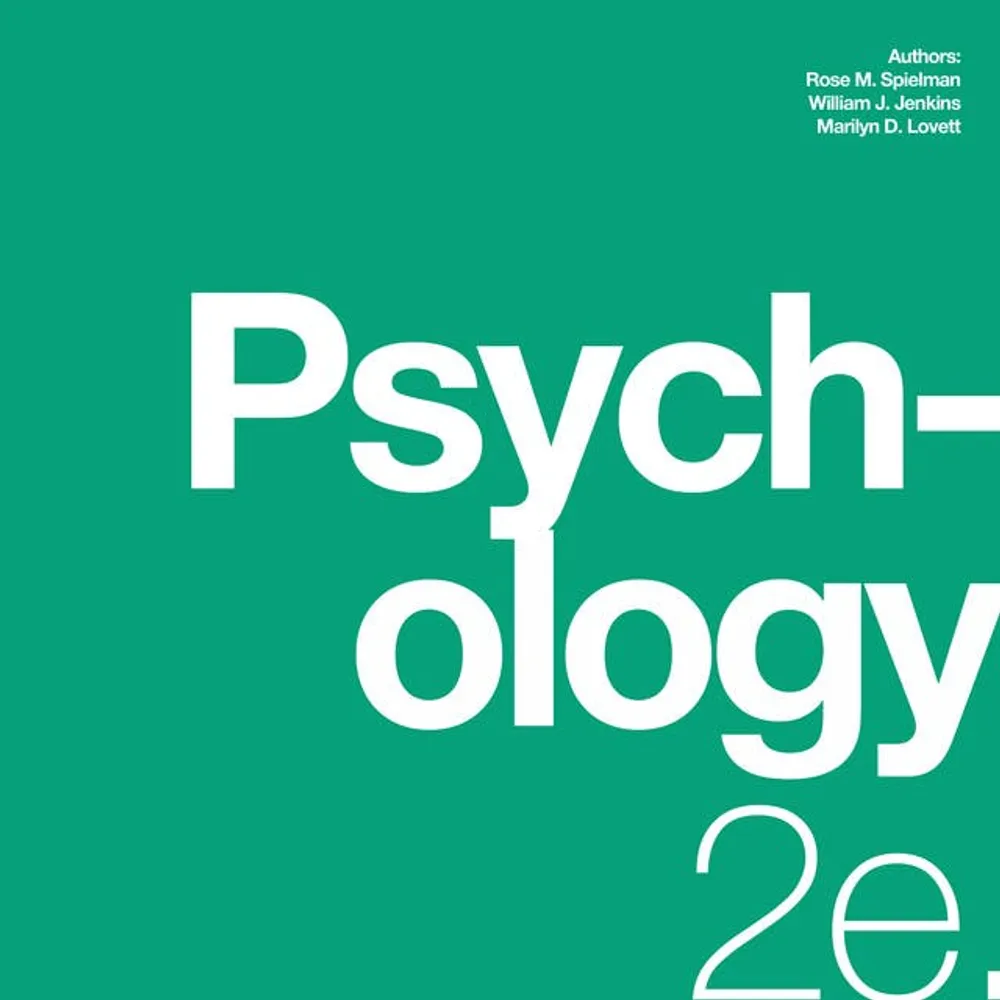
Psychology 2e
Not rated yetRate this bookPsychology 2e introduces the scientific study of behavior and mental processes across sixteen chapters. The OpenStax text by Rose M. Spielman, William J. Jenkins, Marilyn D. Lovett, and contributors connects research and biology with learning, cognition, development, personality, social life, work, stress, and mental health. This guide follows the second edition’s order and emphasizes how claims are supported, where generalizations are limited, and why a textbook example cannot substitute for individual assessment.
Free reading is available at the official source. Opens in a new tab.
 Free
About this book
Psychology 2e introduces the scientific study of behavior and mental processes across sixteen chapters. The OpenStax text by Rose M. Spielman, William J. Jenkins, Marilyn D. Lovett, and contributors connects research and biology with learning, cognition, development, personality, social life, work, stress, and mental health. This guide follows the second edition’s order and emphasizes how claims are supported, where generalizations are limited, and why a textbook example cannot substitute for individual assessment.
Chapter-wise summaries and study tasks
Chapter 1 Introduction to Psychology
The opening chapter defines psychology through questions, evidence, historical approaches, contemporary subfields, and professional activities. Different perspectives investigate biological, cognitive, developmental, or social aspects of the same behavior. Their explanatory levels can complement one another without becoming interchangeable. A familiar everyday explanation may generate a hypothesis but does not establish it.
Ask what a claim means operationally and how it could be tested. Historical influence is not the same as current evidential support. Comparing subfields becomes useful when it clarifies the question and method rather than produces a list of names.
Study task. Describe one behavior through two psychological questions. Identify the evidence each would need and explain why neither perspective alone necessarily supplies the whole account.
Chapter 2 Psychological Research
Research connects hypotheses, operational definitions, designs, samples, measurement, analysis, and ethics. Experiments and observational or correlational studies support different conclusions. Random assignment and random sampling serve different purposes, while bias can arise in recruitment, measurement, and interpretation. Ethical protections continue throughout the process.
Evaluate a study’s actual comparison before accepting a causal statement. A numerical association does not resolve direction or third-variable explanations. Generalization also depends on the people and conditions studied, not merely a large number of observations.
Study task. Design a fictional study with variables, sampling, comparison, and ethical considerations. State its strongest defensible conclusion and one alternative explanation it would leave open.
Chapter 3 Biopsychology
Biopsychology connects cells, signaling, nervous-system organization, endocrine interactions, genes, and behavior. Neural and hormonal communication operate through different arrangements and timescales. Brain regions contribute within networks rather than each containing a complete isolated psychological function. Research tools reveal different aspects of structure or activity.
Separate a biological correlation from a complete causal explanation. Genetic influences do not imply an unchangeable outcome, and a measured brain difference does not independently explain its developmental history. Link cellular mechanisms with systems and the conditions under which behavior is observed.
Study task. Trace a fictional sensory-to-action pathway and compare neural with hormonal communication. Explain what an anatomical or functional measure could reveal and one inference it could not establish alone.
Chapter 4 States of Consciousness
Consciousness is studied through awareness, sleep, biological rhythms, altered states, and substance-related effects. Sleep includes organized patterns rather than one inactive condition, while timing interacts with functioning. Different substances and practices affect processes through different mechanisms, making a single altered-state label incomplete.
Reports and physiological measures provide complementary evidence. Distinguish a temporary experience from a diagnostic conclusion and read source examples in their research context. A classroom account of sleep or drug effects is not a treatment or substance-use recommendation.
Study task. Compare a self-report and physiological measure in a fictional sleep study. Identify what each captures and propose a control needed before attributing a change to one cause.
Chapter 5 Sensation and Perception
Sensation involves detection and transduction; perception organizes and interprets information. Thresholds, adaptation, attention, and context connect physical stimuli with experience. Vision, hearing, and other senses rely on specialized processes, while perceptual organization demonstrates relationships beyond isolated receptor input.
An illusion is an observation requiring explanation, not proof that all perception is arbitrary. Keep stimulus, task, response, and proposed mechanism separate. A perceived difference can arise from changed input, changed context, or changed interpretation, so a useful comparison controls the relevant variables.
Study task. Analyze a perceptual demonstration by separating physical input from reported experience. Change one contextual feature and explain what result would distinguish competing interpretations.
Chapter 6 Learning
Learning includes classical conditioning, operant conditioning, and observational processes. These approaches describe different relationships among stimuli, actions, consequences, and models. Reinforcement increases behavior under the operational definition, while punishment concerns a decrease; positive and negative indicate adding or removing conditions rather than moral value.
A proposed consequence does not count as reinforcement merely because it was intended as a reward. Observe its effect and consider context. Comparing approaches helps explain one pattern without treating every learned behavior as the result of the same sequence.
Study task. Construct one example for each learning process and label the relevant events. Distinguish negative reinforcement from punishment and state what observation would test your classification.
Chapter 7 Thinking and Intelligence
Thinking involves concepts, language, problem solving, decisions, and intelligence-related questions. Algorithms and heuristics offer different strategies, while biases can arise from shortcuts that are useful under some conditions. Intelligence measures sample defined performances and require evidence supporting their interpretation. Language supports communication through structured, learned systems.
Do not infer the cause or permanence of a score difference from the difference alone. Compare task, population, conditions, opportunity, and measurement limits. A named bias is an explanation to test, not a label for every decision someone dislikes.
Study task. Compare two strategies for a fictional problem and identify when each succeeds or fails. Evaluate a testing claim by distinguishing measured performance from an unsupported explanation of its cause.
Chapter 8 Memory
Memory involves encoding, storage, retrieval, and multiple systems with different roles. Forgetting and reconstruction reveal why recollection is not a perfect recording. Cues, organization, interference, and context can influence access and accuracy. Confidence and correctness are not identical measures.
Separate failure to encode from difficulty retrieving and from an altered reconstruction. Study strategies should be judged by later performance rather than immediate familiarity. Experimental tasks illuminate mechanisms while retaining limits on transfer to complex personal memories.
Study task. Compare passive rereading with retrieval practice using delayed checks. Explain how the design distinguishes familiarity from accessible knowledge and identify a confound that would weaken the comparison.
Chapter 9 Lifespan Development
Lifespan development examines physical, cognitive, and psychosocial change from early life onward. Theories emphasize different mechanisms, while study designs distinguish age, time, and cohort effects. Development reflects biological processes and environmental or relational conditions rather than one uniform schedule.
Milestones and stages summarize patterns without fully describing an individual. A cross-sectional difference does not automatically demonstrate how the same person changes. Compare continuity, transition, and variation with attention to the evidence and cultural setting.
Study task. Compare longitudinal and cross-sectional approaches to one developmental question. Identify a cohort explanation and explain why an average milestone should not be used as a complete assessment of one person.
Chapter 10 Emotion and Motivation
Emotion and motivation connect goals, physiological processes, appraisal, expression, and behavior. Competing theories propose different relationships among components. Hunger, sexuality, needs, and other examples show that actions can have multiple interacting influences. A visible expression is not a perfect readout of an internal state.
Specify which component a study measures before evaluating a broad claim. A motive inferred after an action may be plausible without being demonstrated. Compare the prediction of a framework with alternatives and avoid treating a familiar account as universal.
Study task. Analyze a fictional event through two emotion or motivation theories. Identify different predictions and the evidence needed to distinguish them rather than simply assigning both labels.
Chapter 11 Personality
Personality theories describe patterned differences through psychodynamic, humanistic, learning-based, biological, and trait perspectives. Assessment methods sample behavior or reports under specified conditions. Heritability describes variation in a population under a context, not the percentage of one person caused by genes.
A relatively stable trait does not imply identical behavior in every setting. Compare what a theory predicts and how it could be evaluated. A questionnaire category should not become a complete identity or an unsupported explanation of someone’s choices.
Study task. Compare a trait and learning-based account of a fictional pattern. Identify a testable difference and a limitation of inferring a complete personality from one assessment result.
Chapter 12 Social Psychology
Social psychology connects attitudes, attribution, persuasion, group influence, relationships, prejudice, and helping with situational conditions. People interpret behavior through expectations that can overlook context. Groups can facilitate coordination while creating pressures that limit dissent. Research findings need boundaries concerning population and setting.
Link a concept with its proposed mechanism rather than apply a famous label after the outcome. Integrate cognition, learning, and relationships without erasing wider institutions or cultural conditions. A memorable study is not automatic evidence for every modern social setting.
Study task. Analyze a fictional group decision for social influence and attribution. Propose a change that could support dissent and explain how you would evaluate it rather than assume it works universally.
Chapter 13 Industrial-Organizational Psychology
Industrial-organizational psychology applies research to work, personnel decisions, organizations, and human factors. Job analysis, assessment, performance, motivation, leadership, and workplace design address different questions. Evidence must connect a measure or intervention with the actual task and outcome, while fairness and context remain important.
A convenient performance metric can omit important contributions or encourage gaming. Compare individual and organizational influences before assigning responsibility. The chapter provides a framework for evaluation rather than current jurisdiction-specific employment advice.
Study task. Design a fictional job-performance measure with clear criteria and validation needs. Identify a possible bias or unintended incentive and propose an independent check.
Chapter 14 Stress, Lifestyle, and Health
Stress, lifestyle, and health are examined through appraisal, physiological responses, coping, behavior, and social support. A stressor’s meaning and resources available can affect experience. Health relationships involve multiple causes and should not become blame directed at people experiencing illness.
Separate an association from a demonstrated intervention effect. A population trend does not guarantee the same result for one individual. Evaluate measures, duration, comparison groups, and contextual conditions when interpreting a study about well-being or stress.
Study task. Critique a fictional stress-and-health study by identifying its measure, design, and possible confounders. Revise a causal claim that goes beyond the evidence and describe a stronger comparison.
Chapter 15 Psychological Disorders
Psychological disorders are introduced through definitions, classification, explanatory models, and different patterns of experience. Similar symptoms can occur in different circumstances, and a category is not a complete causal theory or description of a person. Duration, impact, context, alternatives, and professional assessment matter.
Read clinical examples as educational cases rather than tools for labeling yourself or someone else. Compare biological, psychological, and social explanations and consider stigma in language. Classification and research develop over time, so real clinical use requires current guidance beyond the textbook.
Study task. Analyze a fictional source case through two explanatory perspectives without assigning a diagnosis. List missing context and revise language that reduces the person to a label.
Chapter 16 Therapy and Treatment
Therapy and treatment connect historical approaches, psychological methods, biological interventions, service delivery, and cultural considerations. Effectiveness requires a defined outcome, population, comparison, and timeframe. An average research result does not by itself determine what is suitable for one person, while access and ethical protections also affect care.
Distinguish a treatment’s proposed mechanism from evidence supporting it. Improvement in an uncontrolled example can have several explanations. The chapter supports research literacy and informed understanding, not a self-treatment protocol or a substitute for professional assessment.
Study task. Evaluate a fictional treatment study for comparison, outcome, follow-up, and bias. Explain what the finding supports and what additional assessment would be required before individual application.
How to study this book
- Use retrieval practice and original examples after reading rather than relying on familiarity with definitions.
- Record each claim, method, alternative explanation, and limit in a research notebook.
- Compare biological, cognitive, developmental, and social levels without assuming they are mutually exclusive.
- Use the source’s cases respectfully and avoid diagnosing real people from chapter descriptions.
- Distinguish the source edition’s classifications and examples from current professional guidance when studying clinical material.
Questions for reflection
- What evidence would make the preferred explanation less plausible?
- Which finding applies to a group and which claim is being made about an individual?
- How does the study’s design limit causal interpretation?
Source edition and coverage
This guide covers all sixteen chapters of OpenStax Psychology 2e, including industrial-organizational psychology. It is distinct from the nineteen-chapter BCcampus adaptation. References, detailed examples, and source assessments remain in the complete text. These are original study explanations and learning tasks. Read the complete book at the official source.
About access & copyright
This page provides book information and study material. Full-text access is provided by the original publisher or authorised source; a listing does not grant permission to republish the book.
Read our Library Access & Copyright policyExplore the contents
Check the chapters covered in this edition.
Visit the official source
See reading, preview or purchase options.
Save for later
Keep this textbook in your saved collection.
Reader ratings & reviews
Share your thoughts
Your review helps other students choose the right resources.
KEEP LEARNING
Your next great read
Business Business
Principles of Macroeconomics 3e
View Principles of Macroeconomics 3e — book Social Sciences
Lifespan Development
View Lifespan Development — book Social Sciences
Introduction to Sociology 3e
View Introduction to Sociology 3e — book Social Sciences
Introduction to Political Science
View Introduction to Political Science — book Social Sciences
Introduction to Anthropology
View Introduction to Anthropology — book Psychology
Introduction to Psychology (University of Minnesota, 2015 Edition)
View Introduction to Psychology (University of Minnesota, 2015 Edition) — book Political Science
American Government and Politics in the Information Age
View American Government and Politics in the Information Age — book Political Science
Social Problems - Continuity and Change
View Social Problems - Continuity and Change — book Cultural & Ethnic Studies



