
 Social Sciences
Textbook
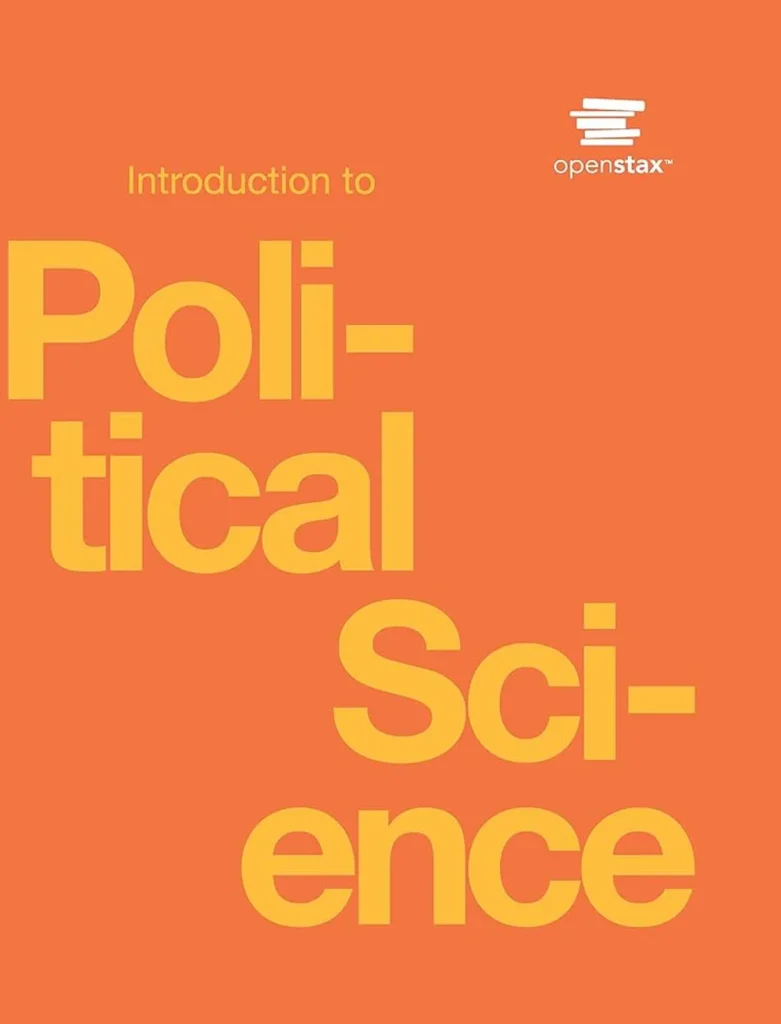
Introduction to Political Science
Not rated yetRate this bookIntroduction to Political Science examines how people make collective decisions, exercise power, organize institutions, and cooperate or compete across borders. This sixteen-chapter guide follows the textbook’s progression from political behavior and rights to government structures and international political economy. Each chapter includes a focused study task that asks readers to compare explanations, assess evidence, and separate descriptive claims from judgments about what ought to happen.
Free reading is available at the official source. Opens in a new tab.
 Free
About this book
Introduction to Political Science examines how people make collective decisions, exercise power, organize institutions, and cooperate or compete across borders. This sixteen-chapter guide follows the textbook’s progression from political behavior and rights to government structures and international political economy. Each chapter includes a focused study task that asks readers to compare explanations, assess evidence, and separate descriptive claims from judgments about what ought to happen.
Chapter-wise summaries and reading tasks
Chapter 1 What Is Politics and What Is Political Science?
Politics concerns the distribution of benefits, burdens, authority, and influence within collective life. This chapter distinguishes political activity from political science, which studies patterns in that activity through systematic questions and evidence. Normative inquiry evaluates what ought to be just or legitimate; empirical inquiry investigates what happens and why. These approaches can inform one another without becoming interchangeable. A public policy may be popular, effective, or fair according to different criteria, and one criterion does not automatically establish another. The chapter also introduces levels of analysis, showing how individuals, groups, institutions, and international relationships can each help explain an outcome. Clear concepts are necessary before competing explanations can be compared.
Study task. Choose a local policy question. Write one empirical question, one normative question, and two plausible explanations operating at different levels of analysis.
Chapter 2 Political Behavior Is Human Behavior
Political behavior grows from human goals, perceptions, identities, and social circumstances. The chapter examines why choices can show recurring patterns even though no simple rule predicts every person’s action. People interpret information through prior commitments and may pursue security, belonging, material benefit, or moral purposes at the same time. Context changes which goals are salient and which choices are available. An explanation based only on individual preference can therefore miss institutional constraints or group influence. Readers should distinguish a tendency observed across many people from a claim about any particular person. Strong analysis considers alternative motivations and identifies what evidence could help distinguish among them.
Study task. Explain one hypothetical participation decision using self-interest, identity, and contextual constraints. State what additional evidence would be needed before favoring one explanation.
Chapter 3 Political Ideology
Political ideologies organize beliefs about authority, freedom, equality, community, and social change. The chapter traces classical origins, social-contract arguments, varieties of liberalism, and major alternatives including nationalism, communism, fascism, and authoritarianism. Later sections examine contemporary positions and movements that present themselves as rejecting ideological thinking. Labels can conceal differences between historical traditions, national contexts, and present-day uses, so readers should compare underlying commitments rather than rely on a left-right placement alone. An ideology’s account of human nature often shapes its preferred institutions and understanding of legitimate power. Studying these traditions analytically requires describing an argument accurately before evaluating its assumptions or consequences.
Study task. Compare two traditions on their understanding of freedom, equality, and legitimate authority. Include one internal variation in each and explain why a single label may oversimplify them.
Chapter 4 Civil Liberties
Civil liberties protect areas of individual freedom against interference, especially by public authority. Constitutional arrangements can recognize those protections, but effective liberty also depends on interpretation, enforcement, and access to remedies. The chapter discusses privacy, self-determination, expression, movement, rights of accused people, and environmental concerns. These freedoms may come into tension with security, public order, or competing rights. A serious analysis identifies the actor restricting freedom, the justification offered, and the process through which the restriction can be challenged. Comparative study reveals that similar rights language can operate differently across systems. Readers should distinguish the existence of a formal guarantee from evidence that people can actually exercise it.
Study task. Analyze a fictional restriction on public expression. Identify the liberty affected, the government’s stated purpose, possible alternatives, and the institutional safeguards needed to assess the restriction.
Chapter 5 Political Participation and Public Opinion
Political participation includes voting as well as contacting officials, organizing, protesting, and other attempts to influence collective decisions. The chapter connects participation to public opinion and the processes through which opinions form and are measured. Unequal resources, registration requirements, time constraints, and social networks can affect whose preferences enter politics. Survey findings also depend on sampling, question wording, timing, and nonresponse. A widely repeated percentage should therefore be examined as a measurement result rather than treated as a direct picture of everyone’s beliefs. Public opinion can influence leaders, but leaders and media can shape which issues people consider. The relationship is interactive rather than a one-way transmission of preferences.
Study task. Design two differently worded survey questions about the same issue. Explain how a representative sample and a participation-barrier analysis would change your interpretation of the results.
Chapter 6 The Fundamentals of Group Political Activity
Group political activity depends on socialization, political culture, and the difficulty of coordinating action. People learn political expectations through families, education, communities, and institutions, while collective identities influence how political commitments are expressed. Shared interests do not guarantee shared action: individuals may benefit from a public good even when they do not contribute to producing it. This creates free-rider and coordination problems. The chapter examines incentives and arrangements that can make cooperation more likely. Readers should distinguish a disagreement over goals from a failure to organize people who broadly agree. Different problems require different solutions, and an incentive that increases participation may also change whose voices carry most weight.
Study task. Use a neighborhood public-good example to distinguish coordination, free riding, and conflicting preferences. Propose a cooperation mechanism and explain one possible unintended effect.
Chapter 7 Civil Rights
Civil rights concern equal standing and protection within political and social institutions. The chapter connects constitutionalism with majority-minority relations, abuses, movements for change, and government responses. A right stated in law may coexist with discriminatory practices or unequal access, making implementation central to the analysis. Social movements can change public understanding, build coalitions, and pressure institutions, while courts and legislatures provide different routes to reform. Political culture affects which claims are recognized and whose experiences are treated as credible. Readers should examine both formal rules and practical outcomes without assuming that every unequal outcome has a single explanation. Historical sequence helps show how legal change and social mobilization interact.
Study task. Construct a hypothetical civil-rights reform timeline linking mobilization, legislation, implementation, and evaluation. Identify evidence needed to judge whether formal change improved access in practice.
Chapter 8 Interest Groups, Political Parties, and Elections
Interest groups, parties, and elections connect citizens to political authority through distinct mechanisms. Groups organize around particular concerns; parties aggregate interests and compete to govern; elections authorize officeholders under defined rules. Each can improve representation while also reproducing inequalities in resources and access. The chapter asks how groups influence policy, how parties operate, and who participates in electoral competition. Electoral rules shape strategic incentives and the translation of votes into political power. Readers should avoid treating the number of participating organizations as a sufficient measure of equal influence. Effective comparison asks whose interests are organized, which choices reach the ballot, and how institutions convert participation into decisions.
Study task. Compare an interest group, a party, and an election as channels of representation. Explain how an electoral rule or resource imbalance could change whose preferences influence the outcome.
Chapter 9 Legislatures
Legislatures make laws, represent constituencies, scrutinize executives, and help authorize public resources. The chapter compares parliamentary and presidential arrangements and distinguishes unicameral from bicameral structures. The existence of a legislature does not by itself establish how much independent influence it exercises. Party discipline, executive powers, committee arrangements, and political conditions can strengthen or limit legislative action. Two chambers may provide additional review while also creating veto points and delays. Readers should trace how a proposal moves through an institution rather than assume that a formal lawmaking power guarantees effective control. The discussion of declining influence invites attention to the changing balance between legislative authority and other centers of power.
Study task. Trace a fictional bill through one-chamber and two-chamber systems. Identify where scrutiny, representation, delay, or executive influence could change its contents.
Chapter 10 Executives, Cabinets, and Bureaucracies
Executives direct government, but their selection, tenure, and relationship with legislatures vary across presidential, parliamentary, and semi-presidential systems. Cabinets coordinate political leadership, while bureaucracies provide administrative capacity and continuity. The chapter compares these arrangements through their advantages, vulnerabilities, and accountability mechanisms. A leader’s formal powers interact with party support, coalition bargaining, expertise, and implementation constraints. Bureaucratic discretion is necessary when general rules must be applied to complex cases, but it also raises questions about oversight. Readers should distinguish political responsibility for a decision from the practical capacity to carry it out. Institutional design affects both, sometimes in conflicting ways.
Study task. Compare how a head of government gains and loses office in two regime types. Then trace how a cabinet decision becomes an administrative action and identify two accountability points.
Chapter 11 Courts and Law
Courts interpret and apply law through procedures that shape which disputes they hear and what remedies they can provide. The chapter compares legal systems, distinguishes criminal from civil law, and examines due process, fairness, judicial review, and executive sovereignty. Judicial independence can protect rights, while mechanisms of selection and review raise questions about accountability. A court’s written decision also depends on whether other actors implement it. Readers should separate a legal rule, the facts established in a case, and the reasoning connecting them. Comparative analysis asks how institutional arrangements affect access, predictability, and constraints on power rather than assuming all courts function in the same way.
Study task. Create a fictional dispute and distinguish its possible civil and criminal dimensions. Explain which procedural protections and enforcement arrangements would affect the fairness of its resolution.
Chapter 12 The Media
Media influence politics by selecting issues, framing events, circulating information, and connecting political actors to audiences. The chapter treats media as an institution and compares changing forms of communication, election coverage, social platforms, and public trust. Different ownership structures and business incentives can affect what receives attention. Digital participation expands opportunities to publish while also making verification and the distribution of misleading material central concerns. Exposure does not guarantee persuasion, and an association between media use and opinion does not by itself establish causal influence. Readers should compare evidence, sourcing, and framing across accounts of the same event. Trust is best evaluated through transparent practices rather than agreement with a preferred conclusion.
Study task. Compare two accounts of one nonpartisan public issue. Record their sources, omitted context, framing choices, and distinction between reporting and commentary before assessing reliability.
Chapter 13 Governing Regimes
Governing regimes differ in how power is obtained, justified, exercised, and constrained. This chapter introduces authority and legitimacy alongside categories used to compare contemporary systems. Elections alone do not reveal whether opposition can compete fairly, rights are protected, or officeholders face meaningful checks. The discussion of illiberal representative regimes highlights the need to evaluate several institutional dimensions together. Regime labels are analytical tools whose usefulness depends on explicit criteria. Readers should examine both formal arrangements and actual practices, including treatment of critics and limits on executive action. A system can change gradually through altered rules and weakened safeguards rather than only through a sudden, visible transfer of power.
Study task. Develop a comparison rubric covering competition, rights, accountability, and constraints on officeholders. Apply it to two fictional regimes and explain any classification uncertainty.
Chapter 14 International Relations
International relations studies interactions among states and other actors in a system without a single overarching government. Power can involve material capabilities, institutions, relationships, and influence over preferences. The chapter introduces sovereignty, anarchy, levels of analysis, and realist, liberal, social, and critical perspectives. These approaches direct attention to different mechanisms: security competition, cooperation, domestic interests, identities, or unequal structures. No single event automatically proves a whole worldview correct. Readers should ask what each explanation predicts, what it leaves out, and which evidence would challenge it. Distinguishing individual, state, and systemic factors helps prevent a complicated international outcome from being attributed to one leader’s personality alone.
Study task. Explain a hypothetical interstate water dispute through two theoretical perspectives and two levels of analysis. Identify one observation that would strengthen each explanation.
Chapter 15 International Law and International Organizations
Global governance involves coordination through international law, intergovernmental organizations, regional bodies, nongovernmental organizations, and other non-state actors. The chapter examines how these institutions operate despite the absence of a world government. Rules can shape expectations and provide procedures for cooperation, but their effectiveness depends on participation, resources, legitimacy, and enforcement mechanisms. Organizations differ in membership, mandates, and decision rules, so they should not be treated as interchangeable. Non-state actors can supply expertise, mobilize attention, or exert economic influence without the same authority as states. Readers should evaluate what a particular arrangement can realistically accomplish and distinguish a commitment on paper from sustained implementation.
Study task. Design a governance arrangement for a cross-border environmental problem. Specify participants, decision rules, monitoring, incentives for compliance, and one accountability weakness.
Chapter 16 International Political Economy
International political economy connects economic relationships with political institutions and distributions of power. The chapter traces the emergence of liberal economic ideas, the Bretton Woods institutions, modernization debates, and later challenges involving poverty, inequality, and environmental pressures. Trade and finance create interdependence, but their benefits and costs can be distributed unevenly across countries and within them. Explanations should distinguish aggregate growth from changes in living conditions for particular groups. Institutions also reflect historical bargaining rather than neutral technical necessity alone. Readers should treat the textbook’s period-specific examples as historical material and examine the assumptions behind competing policy arguments instead of assuming one development path applies everywhere.
Study task. Analyze a fictional trade or development policy by identifying likely beneficiaries, adjustment costs, institutional constraints, and environmental effects. Specify which evidence would be needed to evaluate its results.
How to study this book
- Build a glossary that distinguishes power, authority, legitimacy, liberty, rights, and representation. Attach a concrete example and a counterexample to each term.
- For every causal claim, identify the proposed mechanism, the level of analysis, and an alternative explanation. Use comparative cases carefully rather than selecting only confirming examples.
- Separate the textbook’s historical examples from current conditions. Use primary institutional sources when extending a chapter to contemporary laws, offices, or events.
Questions for reflection
- When can a formally representative institution still exclude important interests?
- How would you distinguish a normative disagreement from an empirical one?
- What makes an international institution effective when it lacks direct coercive power?
Source edition and coverage
This guide covers the sixteen numbered chapters of the OpenStax textbook in their published order. It summarizes the book’s conceptual and comparative framework; dated examples should be read in their source context rather than as statements about current officeholders or law. This original study guide explains the source in new wording and adds learning activities. Read the publisher’s book and complete exercises.
About access & copyright
This page provides book information and study material. Full-text access is provided by the original publisher or authorised source; a listing does not grant permission to republish the book.
Read our Library Access & Copyright policyExplore the contents
Check the chapters covered in this edition.
Visit the official source
See reading, preview or purchase options.
Save for later
Keep this textbook in your saved collection.
Reader ratings & reviews
Share your thoughts
Your review helps other students choose the right resources.
KEEP LEARNING
Your next great read
Social SciencesPrinciples of Microeconomics 3e
Principles of Microeconomics 3e
View Principles of Microeconomics 3e — bookPrinciples of Macroeconomics 3e
Principles of Macroeconomics 3e
View Principles of Macroeconomics 3e — book Social Sciences
Lifespan Development
View Lifespan Development — book Social Sciences
Introduction to Sociology 3e
View Introduction to Sociology 3e — book Social Sciences
Introduction to Anthropology
View Introduction to Anthropology — book Psychology
Introduction to Psychology (University of Minnesota, 2015 Edition)
View Introduction to Psychology (University of Minnesota, 2015 Edition) — book Political Science
American Government and Politics in the Information Age
View American Government and Politics in the Information Age — book Political Science
Social Problems - Continuity and Change
View Social Problems - Continuity and Change — book Cultural & Ethnic Studies



