
 Computer Science
Textbook
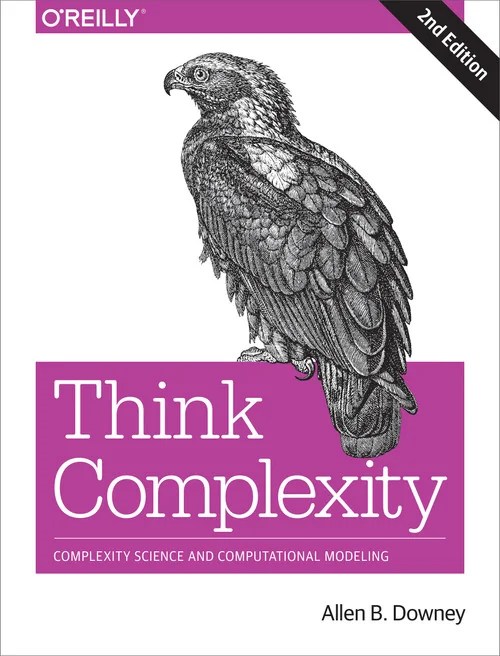
Think Complexity: Exploring Complexity Science with Python
Not rated yetRate this bookThink Complexity explores how many interacting components can generate organized, surprising, or unpredictable behavior. This guide follows the second-edition PDF, version 2.6.4, through twelve chapters and its reading-list appendix. Python…
Free reading is available at the official source. Opens in a new tab.
 Free
About this book
Think Complexity explores how many interacting components can generate organized, surprising, or unpredictable behavior. This guide follows the second-edition PDF, version 2.6.4, through twelve chapters and its reading-list appendix. Python graphs, cellular automata, physical models, and agent simulations provide a common experimental toolkit. The edition contains an explicit correction notice for Chapter 12: a survival/death probability error affected some results and conclusions. That limitation is preserved here, and the author's revised chapter should accompany that part of the reading. An attractive pattern in a simulation is a result to explain and validate, not automatic evidence that the same mechanism governs the world.
AI-assisted book summary
Think Complexity explores how many interacting components can generate organized, surprising, or unpredictable behavior. This guide follows the second-edition PDF, version 2.6.4, through twelve chapters and its reading-list appendix. Python graphs, cellular automata, physical models, and agent simulations provide a common experimental toolkit. The edition contains an explicit correction notice for Chapter 12: a survival/death probability error affected some results and conclusions. That limitation is preserved here, and the author's revised chapter should accompany that part of the reading. An attractive pattern in a simulation is a result to explain and validate, not automatic evidence that the same mechanism governs the world.
Chapter-by-chapter summaries
Chapter 1: Complexity Science
Complexity science shifts attention toward interacting systems and the behavior that emerges from their rules. Downey compares models along several dimensions, including whether they are detailed or abstract and whether they emphasize mathematical deduction or computation. A model's usefulness depends on its purpose; a simplified model can clarify a mechanism without reproducing every observation. The chapter also connects complexity engineering and complexity thinking with questions about scientific explanation. Readers should distinguish an exploratory demonstration, a plausible explanatory mechanism, and an empirically validated account. Those distinctions guide the interpretation of every later simulation.
Study task. Compare two models of one phenomenon and state what each tries to explain, omits, and would need to be tested against.
Chapter 2: Graphs
Vertices and edges represent systems whose relationships matter as much as the properties of individual components. NetworkX provides a computational language for creating graphs, while random graph models let connection probability be varied experimentally. Connectivity becomes a measurable system property rather than a visual impression. Traversal algorithms connect the scientific experiment with data structures and computational cost. A generated graph is one realization of a model, so repeated trials are needed to study a probability of connectivity. Keep model parameters, graph size, and observed outcomes separate when describing a transition.
Study task. Generate repeated random graphs at several edge probabilities and estimate connectivity, reporting variability and the chosen graph size.
Chapter 3: Small World Graphs
Small-world models connect high local clustering with relatively short routes across a network. Starting from a ring lattice and adding rewired connections reveals how a small structural change can sharply reduce path length. The chapter relates the model to social-network questions while distinguishing a stylized mechanism from a complete description of human relationships. Clustering and shortest-path measures capture different properties and must be interpreted together. Breadth-first search and Dijkstra's algorithm add computational methods for examining routes. A successful experiment explains how the graph is constructed and how each reported statistic is defined.
Study task. Vary rewiring while recording clustering and path length, then explain the region in which both small-world characteristics coexist.
Chapter 4: Scale-free networks
Degree distributions expose a limitation of models whose nodes have relatively similar connectivity. Real network data can contain a small number of highly connected nodes and a much longer tail of less connected ones. Preferential attachment in the Barabási-Albert model provides one mechanism for generating that heterogeneity. Cumulative distributions help examine the tail, but a roughly straight log-scale plot does not by itself establish a power law or its cause. Compare model output with observed structure and identify competing explanations. The chapter develops the scientific value of a mechanism while keeping resemblance distinct from confirmation.
Study task. Compare degree distributions from two network models and a dataset, stating which features each model reproduces and misses.
Chapter 5: Cellular Automatons
A cellular automaton evolves a grid through local rules applied repeatedly. Even a simple deterministic rule can produce complicated patterns, challenging the assumption that complex output requires complex instructions. Wolfram's classifications, moving patterns, universality, and questions of falsifiability connect implementation with philosophy of science. A rule table, neighborhood, initial state, and boundary convention fully specify an experiment; omitting one leaves the model ambiguous. NumPy operations and cross-correlation offer compact implementations, but they should be checked against small manual examples. Visual richness is a prompt for analysis rather than proof of unpredictability or real-world relevance.
Study task. Implement one elementary rule, verify its first steps by hand, and test sensitivity to a one-cell change in the initial state.
Chapter 6: Game of Life
Conway's two-dimensional Game of Life creates persistent, oscillating, moving, and growing patterns from a local update rule. The chapter examines these behaviors alongside the distinction between realism and instrumentalism: a model may help explain or investigate an idea without literally describing the entities pictured on the screen. Implementation requires simultaneous updating from a common previous state. Searching for patterns also raises questions about what counts as an emergent entity. Keep the underlying cell rules separate from the larger pattern names used to summarize them, and avoid inferring a physical mechanism solely from a visual analogy.
Study task. Reproduce a still life, oscillator, and moving pattern, then explain how each behavior arises from repeated local transitions.
Chapter 7: Physical modeling
Diffusion, reaction-diffusion, and percolation show how local interactions can model physical processes and produce large-scale structure. Changing a percolation parameter reveals a transition in whether connected paths span a system. Fractal patterns introduce scale-dependent measurements rather than merely irregular-looking shapes. Each model needs a statement of its intended physical interpretation, simplifying assumptions, and boundary conditions. Numerical settings and system size can affect observations near a transition. The chapter extends the earlier abstract experiments into situations where model outputs can be compared with measurable phenomena, while preserving the distinction between qualitative similarity and quantitative validation.
Study task. Estimate a percolation transition at several grid sizes and explain how finite size affects the apparent threshold.
Chapter 8: Self-organized criticality
Sand-pile dynamics illustrate a system that can approach critical-like behavior without an experimenter continually tuning a control parameter to a special value. Local topplings combine into avalanches of very different sizes, motivating heavy tails, fractals, and pink-noise analysis. The chapter connects these observations with reductionism, holism, causation, and prediction. A broad avalanche distribution does not make every event equally likely, and a successful pattern match does not establish that every real crisis is a sand pile. Track the update convention, driving process, and measurement of avalanche size before interpreting a plot.
Study task. Measure avalanche sizes over many additions, compare distribution displays, and test whether changing the update rule alters the conclusion.
Chapter 9: Agent-based models
Schelling's segregation model demonstrates how local preferences can produce a collective arrangement stronger than any one agent explicitly demands. Sugarscape adds agents that move, collect resources, and differ in their requirements, allowing distributions and waves to emerge over time. These examples distinguish assumptions about individual rules from claims about actual people. Observing inequality in a toy world is not enough to explain observed inequality without evidence connecting model and setting. Agent order, replacement rules, and boundary conventions can change outcomes. Replication and sensitivity analysis are therefore part of interpreting the mechanism, not optional decorations added after a striking image.
Study task. Vary one preference or resource parameter across repeated runs and separate the individual rule from the resulting population pattern.
Chapter 10: Herds, Flocks, and Traffic Jams
Agents moving in continuous or road-like spaces produce collective motion through local steering or following rules. Traffic experiments show that a jam can propagate without a fixed obstacle, while boids combine tendencies such as alignment, separation, and cohesion. Arbitration determines how competing local goals are resolved. The chapter's discussion of emergence and free will encourages readers to examine what is gained and lost by describing behavior at different scales. Implementation order and movement constraints remain important. A visually plausible flock needs quantitative observations and sensitivity tests before it supports a strong explanatory claim.
Study task. Perturb a simulated traffic stream or disable one flocking tendency, then explain the resulting change using the local rules.
Chapter 11: Evolution
A population model connects replication, variation, and differential survival with changes in a distribution of traits. Fitness landscapes make the relationship between a trait and reproductive or survival outcomes explicit. Experiments without differentiation provide a comparison needed to identify the effect of selection, while mutation and changing populations introduce further behavior. An evolutionary explanation depends on the precise mechanisms represented, not simply on calling agents successful or fit. Record which quantities are inherited, how new variants arise, and how population size is controlled. The chapter develops model-based evidence while acknowledging that biological evolution contains processes a small simulation may omit.
Study task. Compare runs with and without differential survival, keeping other rules fixed, and define the evidence you would count as selection.
Chapter 12: Evolution of cooperation
Repeated Prisoner's Dilemma interactions provide a model for exploring cooperation, defection, strategy, and evolutionary competition. Payoffs, opponent composition, memory, and population replacement rules determine which strategies do well. Crucially, version 2.6.4 warns that the original code reversed survival and death probabilities, affecting some reported results and conclusions. Study the conceptual setup, but consult the author's corrected chapter and code before reproducing or citing its outcome claims. This is also a valuable lesson in scientific computing: an executable program and persuasive graphs can still implement the opposite of the intended mechanism.
Study task. Audit the survival rule with an extreme test case, then compare corrected results with the edition's explicitly flagged claims.
Appendix A: Reading list
The reading list provides routes beyond the book into complexity science and related modeling questions. Use it to pursue a specific unresolved issue from an experiment, such as empirical validation or competing mechanisms, rather than as a substitute for documenting what the present model actually demonstrates.
Author's Chapter 12 correction
The source explicitly directs readers to the revised cooperation chapter. Keep the correction separate from the original edition's account and identify the code version used in any reproduction.
Study instructions
- For each model, record agents or cells, local rules, update order, boundary conditions, parameters, and measured outcomes.
- Validate tiny cases manually before interpreting a large visualization.
- Use multiple random seeds and parameter ranges, reporting distributions of outcomes rather than a favorite run.
- Separate reproduction of a computational pattern from evidence that its mechanism explains an observed system.
- Read the Chapter 12 correction before using its numerical conclusions and retain a test that catches the reversed probability error.
Questions for reflection
- What makes a model explanatory rather than merely similar-looking?
- How can deterministic local rules create behavior that is difficult to anticipate?
- Which conclusions change when update order or finite system size changes?
Sources and coverage
This original study guide follows the linked source edition and its complete main chapter sequence. It explains the ideas in new wording and adds reading tasks; it does not replace the textbook, reproduce its exercises, or supply an answer key. Publisher and book source; Complete source PDF.
About access & copyright
This page provides book information and study material. Full-text access is provided by the original publisher or authorised source; a listing does not grant permission to republish the book.
Read our Library Access & Copyright policyExplore the contents
Check the chapters covered in this edition.
Visit the official source
See reading, preview or purchase options.
Save for later
Keep this textbook in your saved collection.
Reader ratings & reviews
Share your thoughts
Your review helps other students choose the right resources.
KEEP LEARNING
Your next great read
Computer Science Computer Science
Think Data Structures: Algorithms and Information Retrieval in Java
View Think Data Structures: Algorithms and Information Retrieval in Java — book Computer Science
Think DSP: Digital Signal Processing in Python
View Think DSP: Digital Signal Processing in Python — book Computer Science
Think Stats: Probability and Statistics for Programmers
View Think Stats: Probability and Statistics for Programmers — book Computer Science
The Little Book of Semaphores
View The Little Book of Semaphores — book Computer Science
Think Java: How To Think Like a Computer Scientist
View Think Java: How To Think Like a Computer Scientist — book Computer Science
Building Information - Representation and Management: Principles and Foundations for the Digital Era
View Building Information - Representation and Management: Principles and Foundations for the Digital Era — book Computer Science
Information Systems - A Manager's Guide to Harnessing Technology
View Information Systems - A Manager's Guide to Harnessing Technology — book Computer Science
Programming Languages: Application and Interpretation
View Programming Languages: Application and Interpretation — book Computer Science



